
“One Boss, No Kings” Became Bruce Springsteen’s Perfect 2026 Fan Slogan
Springsteen’s Land of Hope and Dreams American Tour was designed as both a rock show and an argument about American civic identity — creating the exact environment where “One Boss, No Kings” could travel from fan joke to political concert language.
Bruce Springsteen did not hide the premise of his 2026 American tour behind vague symbolism. When Land of Hope and Dreams was announced in February, he described the run as a celebration and defense of American democracy, freedom, the Constitution and what he called the American dream. The official black-and-white tour artwork made the message even more blunt: beneath the oversized title ran the words “NO KINGS.”
By the time the E Street Band crossed the country from Minneapolis to Washington, D.C., a second phrase had emerged around the audience: “One Boss, No Kings.” It worked because it required almost no explanation. “The Boss” has been Springsteen’s nickname for decades; “No Kings” supplied the language of the current political moment.
The result was classic fan culture: an official message became a joke, the joke became a shirt phrase, and the shirt phrase began appearing in reviews, Reddit threads and concert conversations. Nobody needed a marketing department to explain why the words fit together.
“One Boss, No Kings” works because it compresses fifty years of Springsteen mythology and one season of American political language into four words.
The Tour Was Political Before the First Note Was Played
Springsteen has spent much of his career writing about American work, aspiration, war, inequality, community and failed promises, but the 2026 tour was unusually explicit about its civic purpose. In announcing the dates, he said the shows would defend American democratic institutions and criticized the current federal government in direct terms.
Whether listeners agreed with him or not, the framing removed any ambiguity about the tour’s tone. Ticketmaster reviews later reflected that divide: many fans praised the mixture of music and political message, while others said the commentary interfered with the concert experience.
That disagreement is part of the cultural record. A politically charged rock tour does not become meaningful because every person in the room agrees. It becomes meaningful because the audience understands that the stage is functioning as something larger than an entertainment platform.

Why “The Boss” Makes the Phrase Work
“The Boss” is one of rock music’s rare nicknames that escaped fandom and entered common language. Even people who cannot identify every Springsteen album understand the reference.
That familiarity gives “One Boss, No Kings” its double meaning. At one level it is simply a concert joke: there may be no kings, but there is one Boss. At another level, it converts Springsteen’s nickname into an argument about cultural authority versus political authority.
“One Boss, No Kings” should be understood as fan-generated language surrounding the 2026 tour. Springsteen’s official artwork and announcement used “No Kings,” while fans repeatedly paired that phrase with his long-established “Boss” nickname.
Reddit threads from the tour show the phrase appearing naturally in comments, while Ticketmaster reviews used versions such as “No Kings one Boss” as review titles. That matters because it proves the slogan was circulating among concertgoers rather than being retroactively invented around merchandise.
The Design Turns Tour Politics Into Poster Language
The One Boss No Kings Shirt Bruce Springsteen 2026 works best when treated as a document of that specific touring environment. The phrase makes sense because Land of Hope and Dreams already gave the audience the vocabulary.
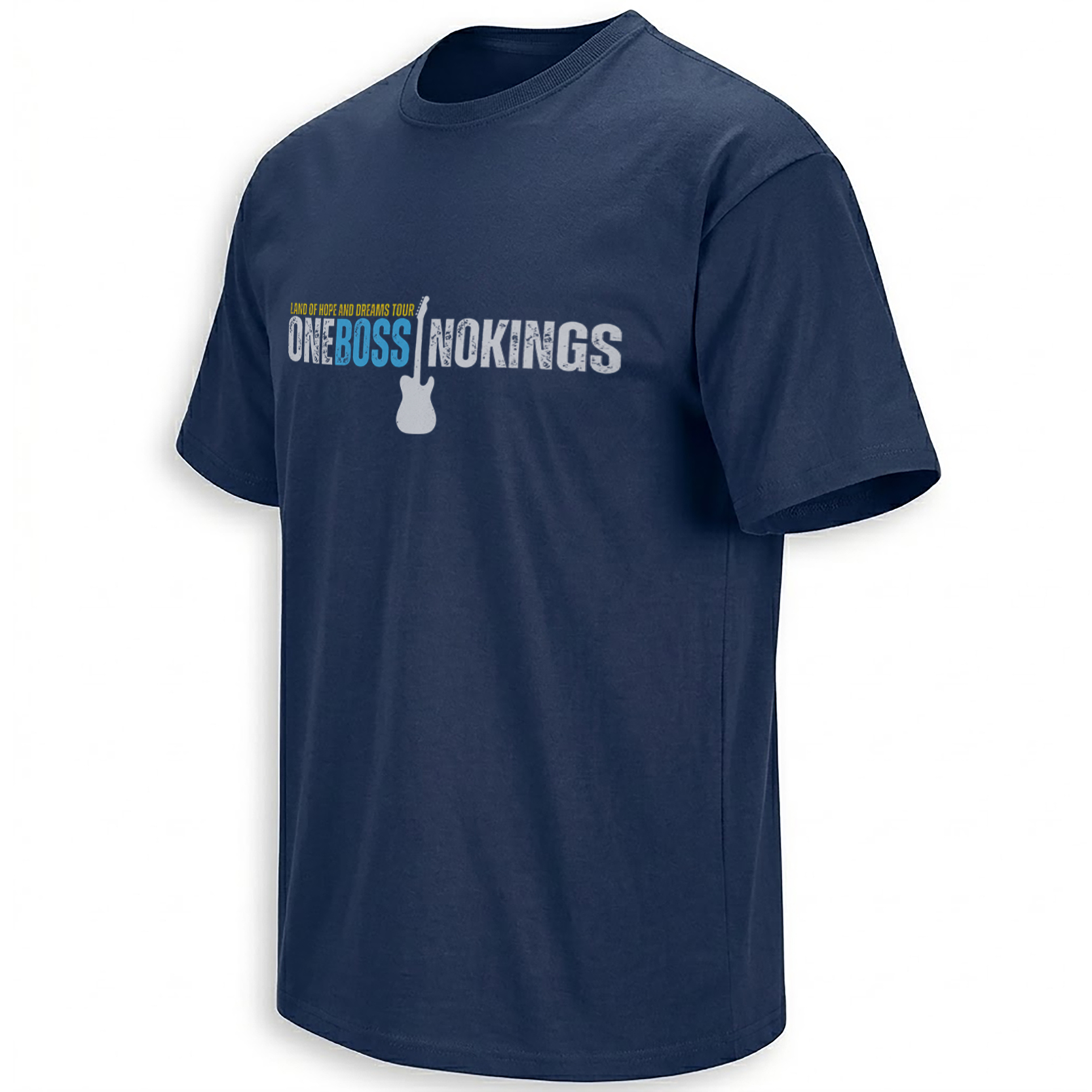
Black, White and Red Make the Message Feel Like Newsprint
The strongest visual decision is restraint. The official tour materials are not dressed like a glossy stadium campaign. Heavy black type, distressed texture and stark white negative space give them the feeling of protest flyers, Xeroxed punk posters and newspaper headlines.
Red works best in small doses because it behaves like a mark made after printing — warning, correction or emphasis. The graphic language feels intentionally civic and rough rather than nostalgic or luxury-driven.
That matches Springsteen’s 2026 stage posture. The tour was not selling an imagined return to the 1980s. It was using songs accumulated across decades as material for talking about the present.
“Land of Hope and Dreams” Was the Right Title for This Argument
The title track has always carried the language of an imagined American community broad enough to hold people with different histories. In 2026, that idea became the tour’s organizing frame.
The show did not separate classic rock memory from contemporary politics. “Born in the U.S.A.,” “Death to My Hometown,” “No Surrender,” “The Promised Land” and newer material appeared inside the same set, allowing old songs to acquire new associations.
That is one reason “No Kings” did not feel pasted onto an unrelated catalog. Springsteen’s writing has always returned to the gap between American ideals and American experience. The 2026 tour simply made that gap more explicit.
The Slogan Became Bigger Than a Single Concert
The most durable fan slogans are flexible. “One Boss, No Kings” can operate as a Springsteen reference first and a civic statement second, or the other way around. That ambiguity helps it travel.
It also explains why the phrase appeared in fan-made signs and clothing around the tour. A concert attendee could signal recognition of both the artist and the political atmosphere without printing an entire speech across a shirt.
Readers looking for more Springsteen-related graphics can use Ellie Shirt’s Bruce Springsteen search archive. Because the phrase also sits naturally inside anti-authoritarian political design, the broader Anti-Trump collection provides the relevant topical pathway without inventing a music collection.
Frequently Asked Questions
What does “One Boss, No Kings” mean in Bruce Springsteen fan culture?
It combines Springsteen’s decades-old nickname “The Boss” with the “No Kings” political language used around his 2026 Land of Hope and Dreams American Tour.
Was “No Kings” actually part of Springsteen’s 2026 tour?
Yes. “NO KINGS” appears directly on official Land of Hope and Dreams American Tour artwork, while Springsteen’s tour announcement explicitly framed the shows around democracy, constitutional government and opposition to what he described as king-like political power.
Is “One Boss, No Kings” an official Bruce Springsteen quote?
It is better understood as fan language. Springsteen officially used the “No Kings” framing, while concertgoers combined it with his famous “Boss” nickname.
When did the 2026 Land of Hope and Dreams American Tour run?
The announced U.S. run opened March 31, 2026 in Minneapolis and concluded May 27 at Nationals Park in Washington, D.C.
Why does the design use a distressed black-and-white style?
The rough typography echoes the official tour’s protest-poster and newsprint visual language, making the slogan feel tied to the civic atmosphere of the 2026 shows.
The One Boss No Kings design preserves the political-rock language surrounding the 2026 Land of Hope and Dreams run, while the Springsteen archive and Anti-Trump collection connect the moment to related graphics.
One Boss No Kings Shirt captures Bruce Springsteen’s 2026 Land of Hope and Dreams tour through fan-made political language, distressed rock-poster styling and the tour’s unmistakable “No Kings” civic message.