
Who Is the Zig-Zag Man? The Face on the Package Is Older Than the Counterculture Around Him
Long before the mustached figure became embedded in record-store, poster and hip-hop visual culture, the Zig-Zag Man began as “Le Zouave” — a stylized image rooted in the distinctive military uniforms of 19th-century French North Africa.
The face is so familiar that it is easy to stop asking who he is. Orange-red head covering. Heavy mustache or beard. Decorated jacket. Side-facing pose. For generations, the figure printed on Zig-Zag packaging has functioned almost like a logo without needing to behave like one.
But the “Zig-Zag Man” did not begin with 1960s counterculture, West Coast rap or vintage streetwear. The visual language reaches back to the Zouaves, military units whose uniforms became some of the most recognizable soldier imagery of the nineteenth century.
That much older history is what makes the image unusually durable. A viewer can read it as French packaging, military illustration, psychedelic-era ephemera, hip-hop visual memory or simply an old printed face whose original context has become almost mysterious.
The Zig-Zag Man became a pop-culture icon because the image was already old enough to feel legendary before modern counterculture adopted it.
Le Zouave Comes From a Real Military Visual Tradition
Zouaves were light-infantry formations associated with the French Army beginning in Algeria during the nineteenth century. Their history is tied to French colonial rule in North Africa, and that context should not be flattened into a romantic costume story.
The earliest units included North African recruits alongside Europeans before the French Zouave regiments later became predominantly European. Their name itself derived from the Zwawa or Zouaoua people of Algeria.
What made the soldiers visually famous was the uniform: short decorated jackets, baggy trousers, broad sashes and distinctive red headwear. The silhouette was so unusual compared with conventional European military dress that Zouave figures became common subjects for painters, illustrators and printed ephemera.

The Famous Battlefield Story Is Better Treated as Brand Legend
Zig-Zag itself tells a colorful origin story for its mascot. According to the company’s account, a Zouave soldier’s clay pipe was broken during battle and he improvised by using paper from a musket cartridge to roll tobacco. The brand says the story inspired its founders to adopt the soldier as a symbol of improvisation.
It is a memorable story, but journalistic caution matters. The company presents the episode as part of its brand heritage; it should not automatically be treated as a separately verified battlefield event with a known individual, exact date and documentary record.
The Zouave military tradition is historical. The specific story of a soldier whose pipe was destroyed and who immediately improvised with cartridge paper is best described as Zig-Zag’s longstanding brand legend unless stronger independent documentation is produced.
That distinction actually makes the graphic history more interesting. Logos often acquire stories that explain why they look the way they do. Over enough decades, the story and image begin reinforcing each other until consumers remember the face even if they have never heard the legend.
Why the Zig-Zag Name Looks Like the Packaging Works
The Braunstein brothers developed an interleaving method in which pulling one sheet brings the next into position. Zig-Zag’s official history explains that the alternating paper arrangement inspired the name itself.
In other words, “Zig-Zag” was not originally a psychedelic phrase or drug-culture invention. It described a mechanical packaging idea. By the time the company trademarked the name in the early twentieth century, the identity already linked engineering, typography and illustration.
The combination proved extremely durable: a short repetitive name, bold lettering and a human face. Even when packaging colors changed, Le Zouave remained the recognition anchor.
The Man Eventually Escaped the Package
By the 1960s and ’70s, Zig-Zag imagery had moved beyond practical packaging into concert posters, counterculture art and underground visual language. That transition is important because once an image is repeatedly borrowed outside its commercial context, it starts behaving like folklore.
The bold portrait-and-border format translated naturally into posters, stickers and hand-drawn parody graphics.
Rolling-paper visibility during the rock era gave the face associations far removed from its nineteenth-century military origin.
Dr. Dre’s The Chronic famously reworked the packaging composition, embedding the format inside another generation’s music imagery.
The Chronic connection is especially powerful. The 1992 album cover did not need to reproduce the original soldier. Its joke depended on viewers already recognizing the framing, lettering and portrait logic. Dr. Dre replaced Le Zouave with himself, proving that the package had become a visual template strong enough to parody.
Why the Vintage Zig-Zag Man Graphic Still Works on Its Own
The Zig Zag Man Shirt Vintage Rolling Papers isolates the most culturally durable part of that history: the face itself. Once removed from an actual booklet, Le Zouave begins to look closer to a nineteenth-century poster character or folk-art portrait.
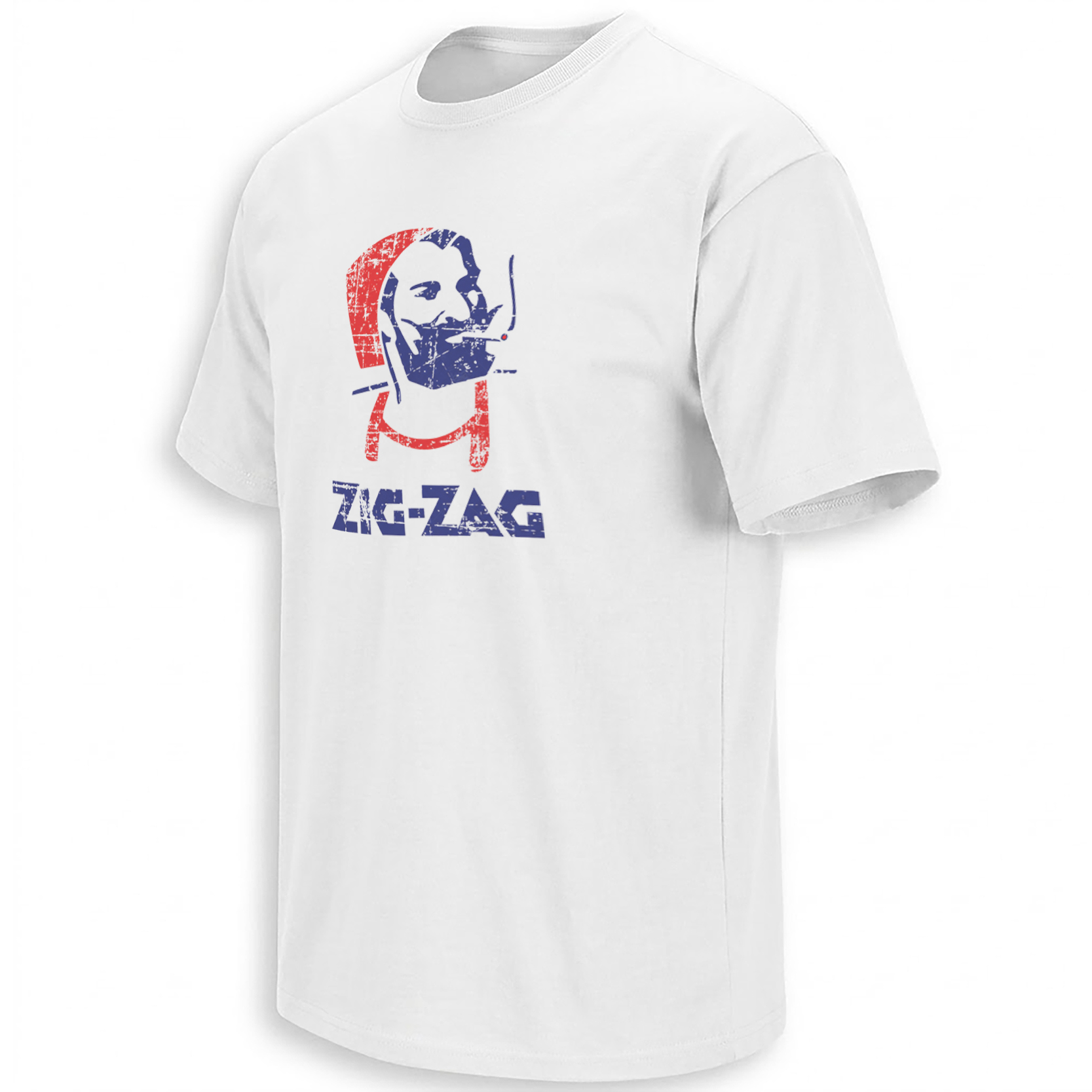
The Color Palette Carries Almost as Much Memory as the Face
Orange, cream, black and muted green sit naturally inside late-nineteenth- and early-twentieth-century commercial printing. Slightly imperfect registration, thick outlines and limited colors made practical sense when packaging had to reproduce cheaply and consistently.
Today those limitations read as style. A modern designer can imitate the faded orange and aged-paper tone precisely because audiences associate them with objects that have passed through decades of use.
The graphic therefore works even for someone who is less interested in the product history than in vintage commercial art. The Zouave face belongs to the same visual family as old tonic labels, tobacco lithographs, circus bills and turn-of-the-century advertisements: human portraits made larger than the objects they were originally meant to identify.
Why the History Should Not Be Reduced to Weed Culture
Modern audiences often encounter Zig-Zag primarily through cannabis references, rap lyrics or rolling culture. That association is real, but it represents only the newest layer of a much longer visual timeline.
The more interesting story stretches from colonial-era French military imagery to industrial paper packaging, print advertising, rock counterculture and hip-hop album design. Each era placed a new meaning onto the same face.
That accumulation is what makes Le Zouave culturally useful. The symbol does not mean only one thing anymore. It behaves like a visual archive.
Readers looking for related graphics can use Ellie Shirt’s Zig-Zag search archive rather than relying on an unconfirmed topical collection URL.
Frequently Asked Questions
Who is the Zig-Zag Man?
The Zig-Zag Man is commonly identified as Le Zouave, a stylized figure inspired by the Zouave soldiers associated with the French Army in nineteenth-century North Africa.
What did Zouave soldiers wear?
Their distinctive uniforms commonly included short decorated jackets, loose trousers, wide sashes and red fez-like or chéchia-style headwear, creating a silhouette widely reproduced in art and illustration.
Is the story about the Zouave soldier’s broken pipe historically proven?
Zig-Zag presents the broken-pipe and cartridge-paper episode as part of its brand history, but it is safest to describe the specific incident as brand legend rather than as an independently verified military event.
Why is the brand called Zig-Zag?
Zig-Zag’s official history connects the name to the company’s interleaving paper system, where sheets alternate so that removing one helps present the next.
How did the Zig-Zag image become connected to hip-hop?
The packaging format was already culturally recognizable before Dr. Dre’s 1992 album The Chronic famously adapted its portrait-and-lettering visual language, strengthening the image’s connection to rap culture.
The Vintage Zig-Zag Man graphic preserves Le Zouave as old print iconography, while the Zig-Zag archive connects the image with related visual interpretations.
Zig Zag Man Shirt turns the historic Le Zouave packaging figure into a vintage graphic rooted in 19th-century military imagery, French print history and the later counterculture and hip-hop life of the iconic face.