The Peanuts Christmas Dance Scene Still Has Better Moves Than Most Holiday TV
After more than six decades, the stage dance from A Charlie Brown Christmas remains one of the rare holiday images that feels instantly musical even with the sound turned off.
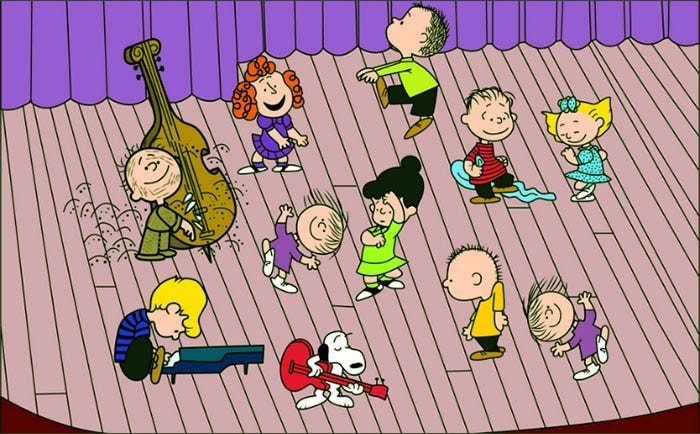
A Charlie Brown Christmas turned sixty in December 2025, yet one of its most replayable moments has almost nothing to do with Charlie Brown’s famously fragile tree. It happens inside the school auditorium, where the Peanuts gang is supposed to be rehearsing a Christmas play and instead begins moving like every child has been assigned a completely different rhythm.
Pig-Pen throws his head and arms into the beat. The twins Three and Four bounce with strange precision. Shermy leans into his own routine. Snoopy becomes Snoopy. Nobody looks professionally choreographed, which is exactly why the sequence survived.
Apple’s own description of the special still identifies the gang’s preference for dancing over acting as part of Charlie Brown’s problem as director. But culturally, the problem became the gift. Those few animated seconds turned into GIFs, reaction clips, looping videos, dance recreations and visual shorthand for the instant a Christmas gathering stops behaving politely.
The scene survives because nobody dances correctly. Every character turns the same jazz groove into a tiny personality test.
The Dance Scene Is Really a Character Roll Call
Most ensemble animation asks background characters to move in roughly the same rhythm. The Peanuts stage scene does the opposite. Each child appears trapped inside a private interpretation of the music.
That is why fans can recognize individual dancers from silhouette alone. Peanuts Worldwide’s own FAQ identifies the famous bouncing girls as sisters Three and Four, characters drawn from Charles Schulz’s 1960s strips. Their numerical names were part of a joke about a culture increasingly reducing people to statistics.
That strange specificity is pure Schulz. Even an apparently throwaway dancing figure has a history. The result is a scene filled with characters who do not behave like anonymous extras. They arrive with oddness already attached.
Vince Guaraldi Is the Invisible Character in the Room
The movement would not matter nearly as much without Vince Guaraldi. Charles Schulz later remembered how unusual the decision was to use Guaraldi’s jazz instead of conventional cartoon scoring. Rather than chasing every physical movement with sound effects, Guaraldi wrote music with enough independence to let the animation breathe.
“Linus and Lucy” became the clearest example. The piano figure is playful without being childish, rhythmic without sounding mechanical and sophisticated without losing warmth. It gives a classroom full of cartoon children the musical atmosphere of a small jazz club.
Guaraldi’s score never tells the viewer exactly how to feel. The music swings, leaves space and repeats with subtle momentum. That openness lets each animated character look as though they are hearing a different part of the same track.
This is one reason A Charlie Brown Christmas escaped the fate of so many seasonal specials. The soundtrack does not merely support Christmas imagery. It created its own December language. For generations of viewers, a few piano notes can activate snow, colored stage curtains, small trees and the Peanuts gang before any picture appears.
Why the Peanuts Dance Graphic Works Better as a Memory Than a Screenshot
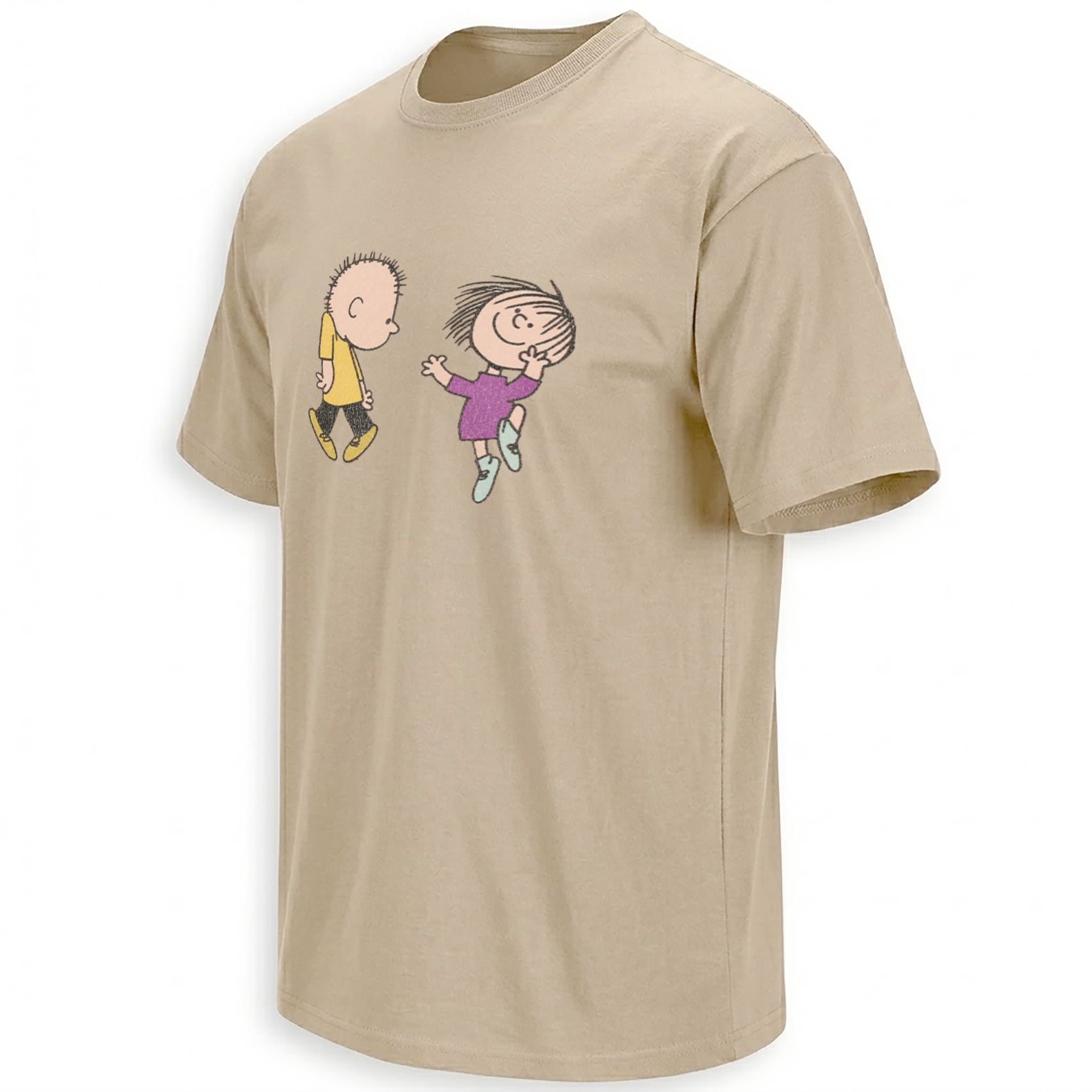
The Peanuts Dance Shirt Charlie Brown Christmas takes the recognizable group movement and compresses it into vintage graphic language. That is important because the appeal is not simply “characters from a television show.” It is the memory of motion.
The Vintage Treatment Fits Because the Special Already Carries Age Beautifully
A modern, hyper-clean rendering would almost fight the cultural memory of the special. A Charlie Brown Christmas belongs to hand-drawn lines, flat colors, sparse sets and backgrounds that never try to overwhelm the characters.
A distressed or faded graphic therefore feels less like artificial aging and more like a natural extension of how audiences encounter Peanuts: through old television memories, paperbacks, holiday decorations, records and images passed between generations.
The design’s real subject is not Christmas merchandise. It is recognition. One pose can remind a viewer of the piano. Another recalls the stage curtain. A Snoopy silhouette can bring back an entire sequence of movement.
Why This Scene Keeps Reappearing Online
Internet culture rewards movements that can be isolated. The Peanuts dance scene is almost perfectly engineered for that without having been designed for social media at all. Each character’s loop works independently, and none needs dialogue or context.
That makes the sequence useful as reaction language. It can mean the party has started, the music is unexpectedly good, somebody is dancing badly with complete confidence, or a quiet room has suddenly become chaotic.
The irony is that Charlie Brown is frustrated by the dancing. The audience eventually sided with everyone ignoring him.
Peanuts Has Become a Multi-Generation Holiday Archive
The longevity matters. Apple extended its Peanuts streaming partnership through 2030 after the franchise’s 75th-anniversary year, keeping the classic holiday specials alongside newer productions. That ensures A Charlie Brown Christmas is not only remembered through nostalgia; new viewers continue meeting the same awkward tree, the same jazz and the same uncontrollable rehearsal.
Readers looking for more character-related pieces can browse Ellie Shirt’s Peanuts product search or the Charlie Brown search archive without relying on an unconfirmed collection URL.
Frequently Asked Questions
What is the famous Peanuts Christmas dance scene?
It is the rehearsal sequence in A Charlie Brown Christmas where the Peanuts gang abandons serious play practice and dances to Vince Guaraldi’s jazz-driven music.
When did A Charlie Brown Christmas originally air?
The special premiered on December 9, 1965 and celebrated its 60th anniversary in 2025.
Why is Vince Guaraldi so important to the dance scene?
Guaraldi’s jazz score gives the scene its loose rhythmic identity, allowing every character’s unusual dance style to feel connected without looking choreographed.
Who are the twin dancing girls in A Charlie Brown Christmas?
Peanuts identifies them as Three and Four, sisters from Charles Schulz’s comic-strip universe whose numerical names formed part of a joke about people being reduced to statistics.
Why does the Peanuts dance scene remain popular online?
Its distinctive individual movements work naturally as GIFs, loops and reaction clips, while the lack of dialogue allows the scene to communicate instantly across generations.
The Peanuts Dance design preserves the visual rhythm of that Christmas rehearsal, while the Peanuts archive connects it with other character memories translated into graphic form.
Peanuts Dance Shirt captures the unforgettable A Charlie Brown Christmas rehearsal through vintage character poses, Vince Guaraldi-era jazz energy and one of holiday animation’s most recognizable dance scenes.