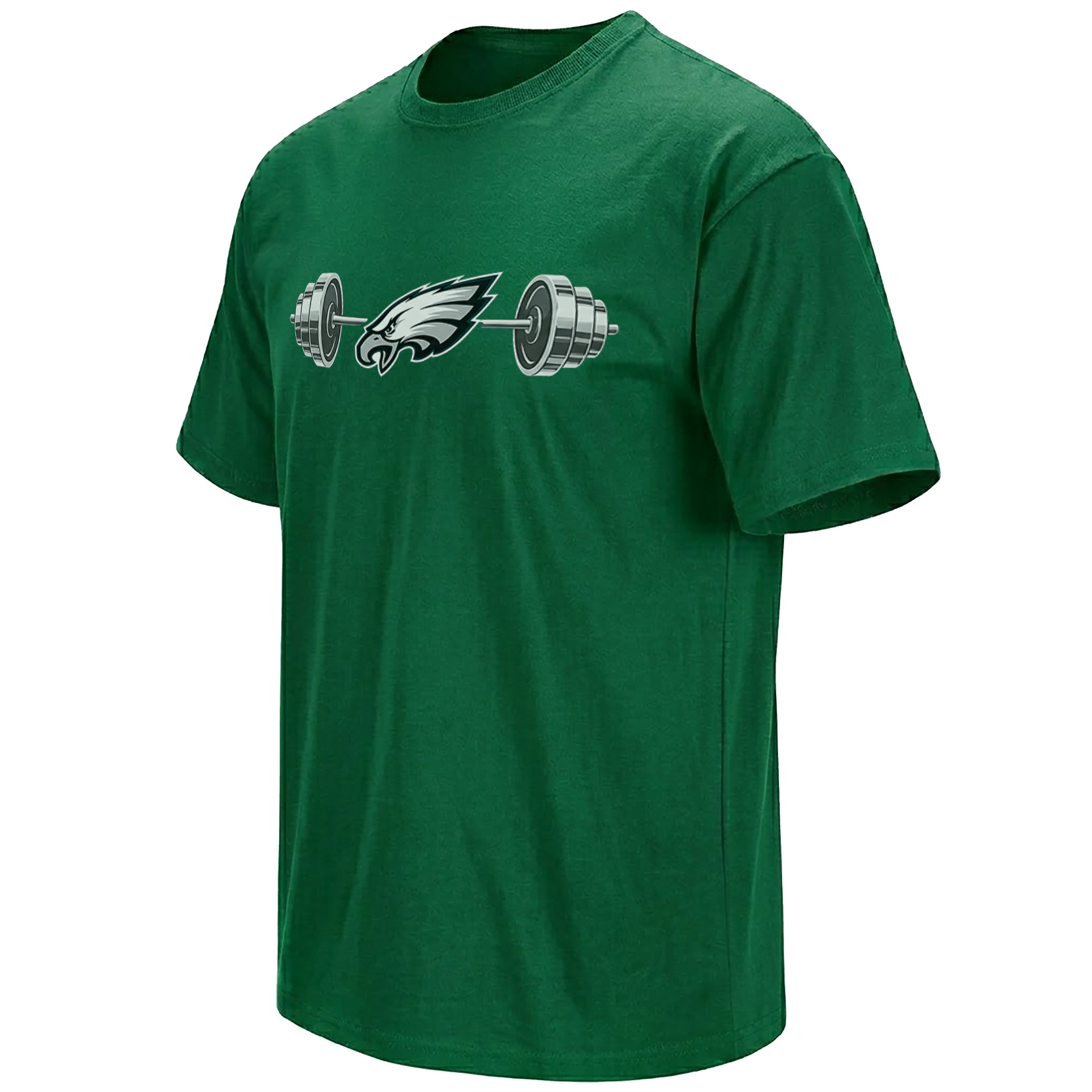
Eagles Barbell: Philadelphia Football Built Under Load
Philadelphia’s first 2026 preseason result was not the headline anyone would use to sell optimism: Baltimore won 24–7. But a Barbell graphic does not need a manufactured victory story. Its real context sits in the weeks before the scoreboard — full pads, line work, inside-zone blocking, defensive pressure and the physical standard Philadelphia expects to carry into the regular season.
Philadelphia has never needed much help turning toughness into football language. The city already understands the emotional vocabulary of collision: protect the line, finish the block, withstand pressure and make the other side feel the effort required to move you.
That makes the barbell particularly effective as an Eagles symbol. A loaded bar is not complicated. It measures whether strength can be controlled. Football asks the same question in motion. Can an offensive lineman anchor against a rush? Can a defensive tackle convert his first step into displacement? Can a running back stay balanced after contact?
Those questions have been visible throughout Eagles camp. Philadelphia worked in full pads before the preseason opener, devoted periods to situational football and watched its offense and defense repeatedly test each other at the line of scrimmage.
Philadelphia strength culture is not about how much weight exists on the bar. It is about what happens when that strength meets another body at the line of scrimmage.
The strongest context came before preseason
Preseason football can distort the story because veteran starters may have limited workloads while younger players are being evaluated under unfamiliar combinations. Philadelphia’s 24–7 loss in Baltimore therefore matters as a real result without needing to become the entire interpretation of the team.
For the Barbell concept, the more relevant evidence came from camp itself. The Eagles held full-pad practices, worked third downs and red-zone periods and created an environment where strength had to translate into football-specific execution.
Jalen Carter and Jalyx Hunt were among the defenders repeatedly showing up in that work. Their role in the design’s cultural context is indirect but obvious: defensive-line power is one of the clearest examples of weight-room strength becoming something visible to fans.
Saquon Barkley and the importance of invisible strength
Running backs receive the highlight when they cross the goal line, but many rushing plays begin with work that television can hide in plain sight. The offensive line creates the initial geometry. Tight ends adjust angles. The running back trusts the opening long enough for the blocks to develop.
That sequence was visible in Philadelphia’s August 8 camp scrimmage. On an inside-zone play near the goal line, Saquon Barkley followed blocks from Tyler Steen and rookie Markel Bell into the end zone.
The play is a useful explanation of Barbell culture because the symbol does not belong exclusively to whoever carries the ball. Strength operates across the structure of the offense. The guard creating movement and the runner finishing through the lane are different expressions of the same preparation.

The offensive line makes Philadelphia different
Every NFL team lifts. That alone cannot make a Barbell series interesting. The identity has to come from how each franchise turns strength into football language.
Philadelphia has an unusually strong connection between its public football identity and offensive-line culture. Jordan Mailata’s path from rugby prospect to elite NFL tackle has itself become part of the team’s storytelling, and the Eagles published a new documentary on that transformation in August.
That makes the loaded-bar motif feel especially credible here. The barbell does not suggest generic fitness. It points toward the mass, footwork and controlled force required in a Philadelphia offensive front where the line often carries almost as much cultural visibility as the players touching the football.
Midnight green gives the graphic its Eagles identity, charcoal provides visual weight and silver acts like bare metal. Rather than using bright gym imagery, the composition works best when it feels like an old football strength program stamped onto training gear.
Jalen Carter brings the other side of the barbell
If offensive-line strength is about sustaining structure, defensive-line strength is often about destroying it. Carter is an ideal example of why those sides belong in the same visual conversation.
Philadelphia’s camp coverage has repeatedly put him in the middle of situational defensive work, including red-zone and third-down periods. The team also entered camp having extended his contract through 2031, reinforcing his place inside Philadelphia’s long-term defensive identity.
For a Barbell graphic, that matters because the design can represent both jobs at once. The same symbolic weight produces the blocker trying to anchor and the defender trying to collapse the anchor.
Why Philadelphia should not look like Detroit, Buffalo or Denver
The wider NFL Barbell series works only if the central concept stays recognizable while each team feels culturally different. Philadelphia should not be Detroit recolored in midnight green.
Detroit naturally lends itself to factory and industrial imagery. Buffalo can feel like cold-weather blue-collar training. Denver can lean toward altitude and orange power. Philadelphia’s strongest direction is harsher and more compact: iron, trenches, concrete, midnight green and a fan culture famous for demanding physical credibility.
That is why this CSS and visual treatment use concrete neutrals, dark iron panels and structured edges rather than simply surrounding the article with green.
A strength-club graphic without a player dependency
One advantage of Eagles Barbell is that its meaning does not disappear when a roster changes. It does not depend on one quarterback, one running back or one defensive star.
That gives the piece a different lifespan from a score-specific or meme-specific graphic. The cultural reference is the team’s relationship with strength itself, which can remain recognizable through new seasons and new players.
Within the wider Philadelphia Eagles collection, that makes the Barbell piece a useful counterpoint to player-specific moments and rivalry graphics. The NFL collection extends the same idea across football cities, allowing the shared barbell structure to become a visual comparison of different team cultures.
Frequently Asked Questions
Why does a barbell fit Philadelphia Eagles culture?
The barbell symbolizes strength under load, preparation and controlled physical force, all of which connect naturally with Philadelphia’s trench-heavy football identity.
Why is Eagles Barbell relevant during the 2026 training camp?
Philadelphia’s current camp has included full-pad work, situational defense, blocking development and physical scrimmage periods, giving the strength concept a direct football context.
Does the design refer specifically to Saquon Barkley or Jalen Carter?
No. Barkley and Carter help illustrate how physical preparation appears on opposite sides of the football, but Eagles Barbell is designed as a team-level strength symbol.
Why is offensive-line culture important to the Philadelphia version?
Philadelphia has a highly visible offensive-line tradition, and players such as Jordan Mailata make strength, blocking and trench play a particularly natural part of the team’s current cultural identity.
How is Eagles Barbell different from the other NFL Barbell designs?
The basic weightlifting framework stays consistent, while Philadelphia’s midnight green palette, iron-and-concrete styling and trench-focused football culture give this version its own identity.
The Eagles Barbell graphic captures the part of football that exists before the highlight — load, repetition, leverage and preparation — while the wider Philadelphia Eagles archive tracks the current roster, slogans and fan moments surrounding the 2026 season.
Eagles Barbell Shirt turns Philadelphia football strength into a midnight-green weightlifting graphic, connecting Eagles culture with full-pad training, offensive-line power, defensive pressure and the physical standard of the 2026 season.