Lions Barbell: Detroit Football Forged Under Pressure
In Detroit’s 2026 training camp, physicality is not hiding behind offseason language. Pads are on, receivers are talking about hitting first, linemen are being judged under contact, and the Lions are again treating blocking as part of the team’s collective personality. That is exactly the environment where a barbell graphic starts to feel like One Pride shorthand.
The visual language of Detroit has always made room for machinery. Steel, assembly lines, repetition and production are built into the city’s mythology, which makes a loaded barbell almost unusually natural as a football symbol. It is another object defined by repeated work: add weight, control it, recover, return and do it again.
That rhythm has been visible at Lions camp this August. Detroit’s first padded practice immediately changed the evaluation. Once helmets and pads went on, the offensive and defensive lines could finally be judged through leverage and contact instead of projection. Training camp stopped looking like installation and began looking like football.
The Lions’ preseason opener against Cincinnati ended in a 16–14 loss, so there is no need to manufacture a victory narrative around the design. The more interesting story is underneath the score. Detroit is still building the physical identity it expects to carry into September, and much of that work is happening in the exact places a Barbell graphic represents: strength, repetition, blocking and the ability to absorb contact.
For Detroit, the barbell works because strength is rarely presented as decoration. It is supposed to become blocking, balance, leverage and the willingness to hit first.
When the pads went on, the idea became real
The first padded practice is one of the most meaningful transitions of every NFL summer. Before that moment, an offensive lineman can move smoothly and a defensive lineman can demonstrate technique, but neither can fully show how his body responds when another NFL-sized athlete is attempting to move him in the opposite direction.
Detroit’s own camp coverage described that shift directly. Physicality increased once the pads arrived, giving the staff its first meaningful look at line play. That matters for the Lions because the offense and defense both depend on players capable of translating gym strength into movement rather than merely carrying impressive weight-room numbers.
Detroit receivers are talking like linemen
One of the most revealing pieces of Detroit’s camp language has come from outside the trenches. Isaac TeSlaa has spoken about playing physically at receiver and about a mentality built around initiating contact rather than receiving it.
That matters culturally because it broadens the meaning of “strength” inside the Lions offense. Blocking is not only the responsibility of the five largest players. Detroit’s receivers have taken pride in contributing to the run game, using body position and willingness to engage defenders as another form of offensive production.
That is the point where a Barbell design becomes more interesting than a literal gym illustration. The weight is symbolic. It represents a teamwide expectation that strength should eventually show up somewhere on film.

Penei Sewell gives the strength concept a football face
Few positions make the connection between strength training and football performance easier to understand than offensive tackle. The job requires the ability to absorb a charging defender, redirect power, generate movement in the run game and repeat those actions while fatigued.
Penei Sewell remains one of the clearest visual reference points for that style of Detroit football. The August 6 Lions gallery placed him directly inside the camp environment alongside the team’s other offensive and defensive players, reinforcing how much of August is ultimately about the body holding up under football-specific stress.
The design does not need to put Sewell’s name on the barbell. In fact, keeping it team-first is part of the appeal. The graphic becomes a Detroit strength-club emblem rather than an individual-player souvenir.
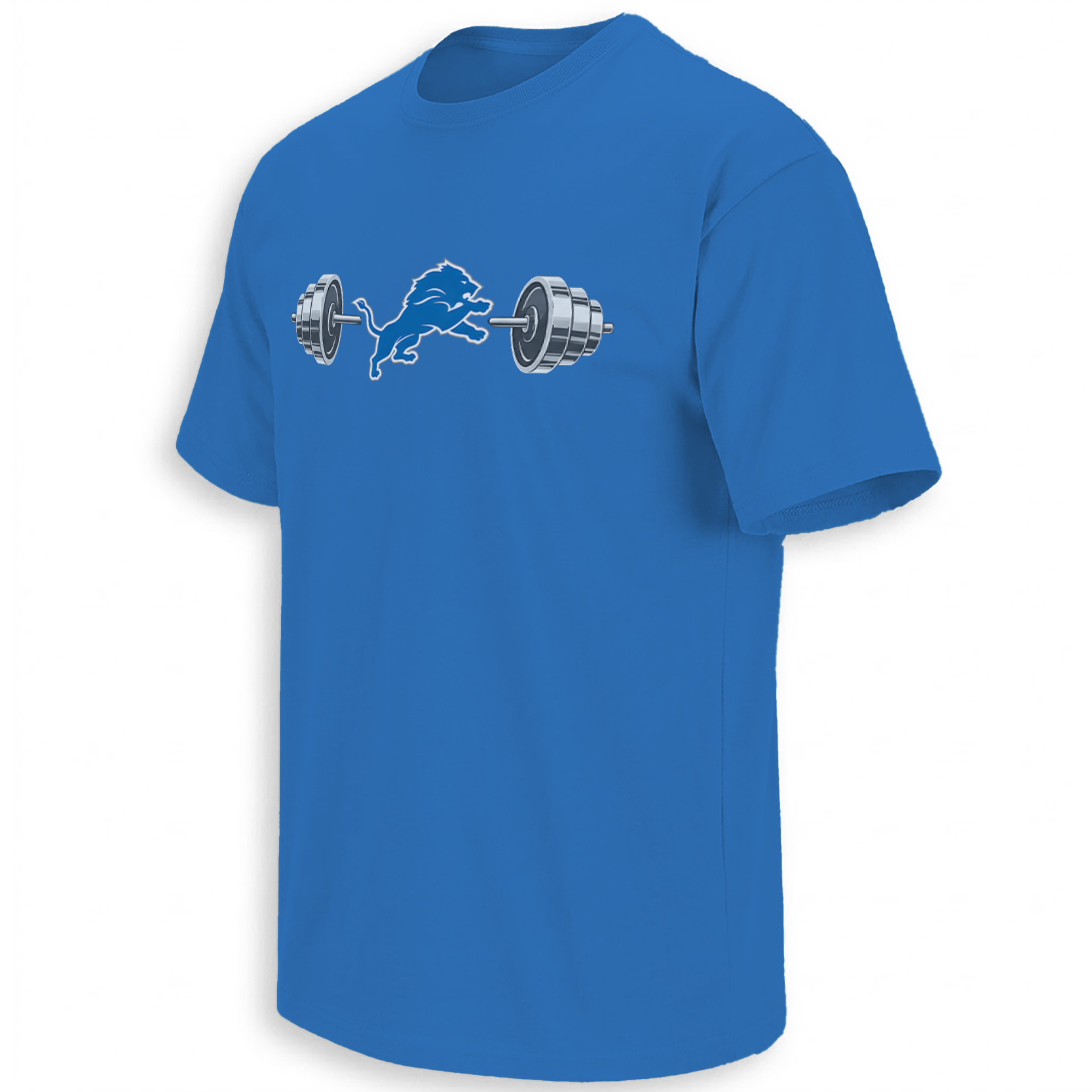
Honolulu blue provides the unmistakable football signal while charcoal and silver create the feeling of machinery, plates and an old industrial gym. The symmetrical barbell gives the composition stability; Detroit’s visual identity supplies the attitude.
Why the Barbell format fits One Pride
“One Pride” is useful because it describes collective identity rather than celebrity. The strongest interpretation of Lions Barbell works the same way. There is no single player carrying the concept. Strength belongs to the roster, the line, the defense, the blockers and, symbolically, the fan culture surrounding them.
That makes the design particularly compatible with Detroit’s recent football personality. Even when the scoreboard does not cooperate, the identity fans recognize is still built around pressure, resilience and the willingness to continue attacking.
The wider Detroit Lions collection works as a running archive of those changing phrases and player moments, while the broader NFL collection shows how the same Barbell concept can take on a different emotional identity when it moves from Detroit to another football city.
From assembly-line imagery to modern gym culture
There is also a visual reason this particular crossover feels coherent. Old strength-club graphics often rely on simple objects, heavy typography and limited colors. Industrial Detroit iconography uses many of the same tools: hard geometry, repetition and objects designed for work rather than decoration.
Put those languages together and the barbell almost becomes a piece of factory machinery. Plates sit evenly on both ends. The center becomes a team identifier. Nothing in the composition needs to move for the graphic to imply effort.
That is why the strongest interpretation is not “Lions plus fitness.” It is Detroit football expressed through the visual vocabulary of physical labor.
Frequently Asked Questions
Why does a barbell fit Detroit Lions culture?
The barbell represents accumulated work, physical preparation and strength under load, themes that naturally connect with Detroit’s industrial identity and the Lions’ emphasis on physical football.
Why is Lions Barbell relevant during the 2026 training camp?
Detroit’s August camp has emphasized padded practices, physical one-on-one work, line play and blocking, giving the strength-club concept a direct connection to what the team is currently building.
Does the Lions Barbell design represent one player?
No. The graphic works as a team-level Detroit football strength emblem rather than a player-specific design.
What does the industrial styling add to the design?
Industrial styling connects the loaded barbell with Detroit’s broader visual language of machinery, repetition, work and production, giving the gym reference a stronger city identity.
How does Lions Barbell fit the wider NFL Barbell concept?
The basic barbell structure can remain consistent across teams, while Detroit’s Honolulu blue palette, One Pride culture and industrial character make the Lions version distinct.
The Lions Barbell design captures the physical side of the current camp without tying the idea to one score or one player. The wider Detroit Lions archive follows the slogans, characters and moments shaping One Pride in 2026.
Lions Barbell Shirt turns Detroit football strength into an industrial-style Honolulu blue weightlifting graphic, connecting One Pride culture with the padded practices, blocking mentality and physical identity of the Lions’ 2026 training camp.