
Broncos Barbell: Denver Is Building Through Power
Denver’s 2026 preseason opener made an old football truth visible again: strength only matters when it transfers to the field. The Broncos beat Atlanta 27–7, rushed for 162 yards, created turnovers and controlled the line of scrimmage — exactly the atmosphere in which a Broncos Barbell graphic starts to feel like football language rather than gym decoration.
There is a specific point every summer when football stops looking like offseason content and starts looking physical again. Players move from shorts to pads. Offensive and defensive linemen meet in one-on-one drills. Running backs begin finishing runs through contact. Coaches talk less about installation and more about execution.
Denver reached that stage quickly in its 2026 camp. Full-pad practices, trench work and situational periods carried the preparation toward the preseason opener in Atlanta. When the Broncos finally played another team on August 14, the statistical shape of the game reflected much of that camp work.
Denver won 27–7. The offense rushed for 162 yards while Atlanta managed only 59. Two first-half takeaways directly created fourteen points, and the Broncos extended what had become the NFL’s longest active preseason winning streak to eight games.
The barbell is useful here because Denver’s best preseason image was not one spectacular throw. It was a team consistently winning physical exchanges.
Why Broncos Barbell works right now
The Broncos Barbell idea begins in the weight room but does not end there. Football strength is visible through movement: driving a defender off the ball, maintaining balance through contact, setting an edge, collapsing a pocket or continuing a run after the first hit.
That distinction matters because the Broncos’ first preseason game was filled with those transferable signs. Sean Payton praised the way Denver blocked the Falcons’ heavier fronts. Rookie Jonah Coleman ran through contact. The defense forced turnovers after weeks of placing additional emphasis on taking the ball away.
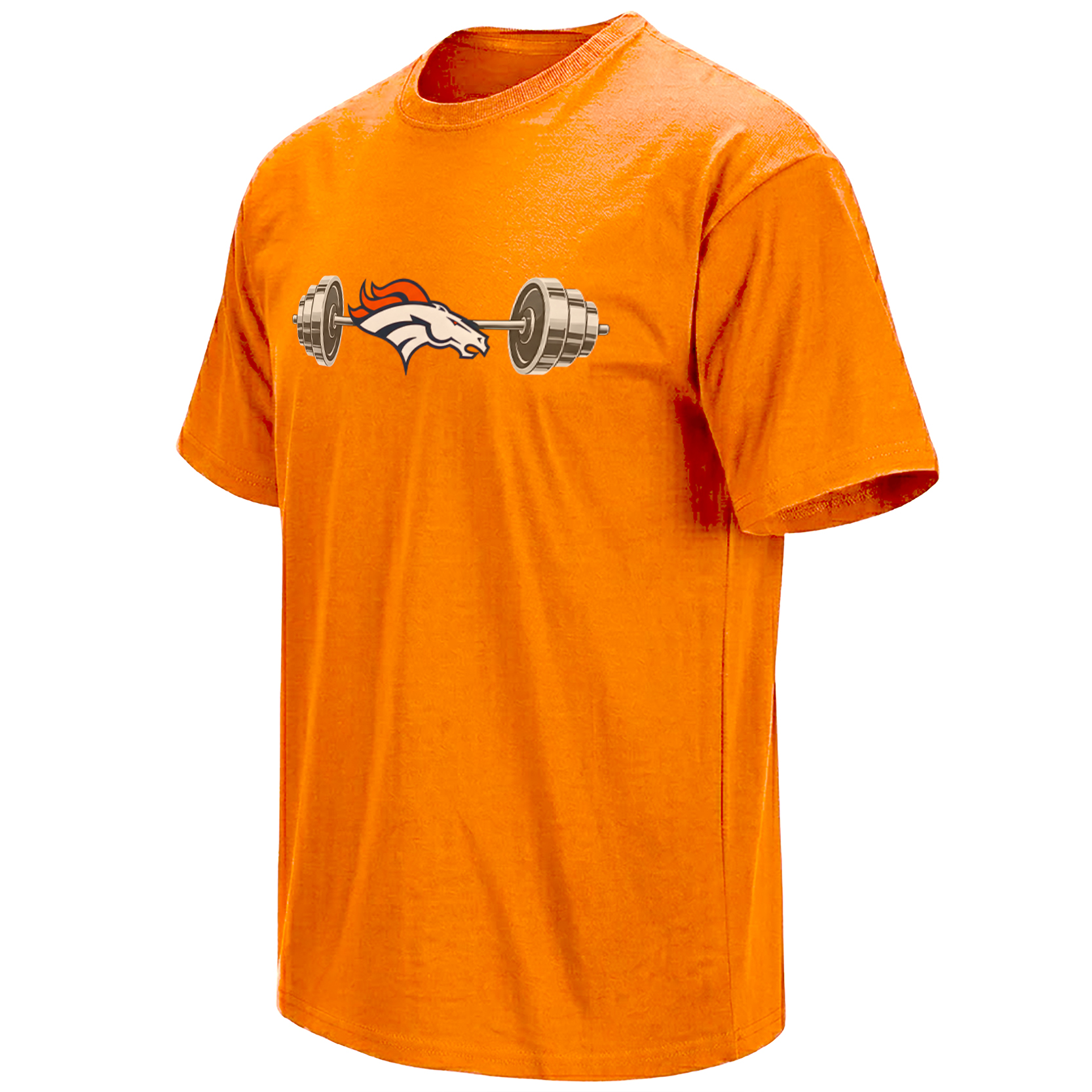
Training camp has made the metaphor literal
Denver’s official training-camp galleries have repeatedly focused on padded practices, one-on-one battles and work in the trenches. Those photographs matter because they reveal what a football weightlifting graphic is actually referencing. The design is not celebrating bodybuilding. It is celebrating football’s relationship with strength.
An offensive lineman’s ability to anchor, a defensive tackle’s first-step power or a running back’s balance after contact all begin with preparation that is invisible to most spectators. The barbell acts as a condensed visual code for that invisible part of the sport.

The Denver visual language is different from Buffalo
The concept may share a barbell framework with other NFL teams, but Denver should not look like a recolored copy. Broncos orange changes the energy immediately. It feels hotter, faster and more explosive, particularly against dark navy.
Buffalo’s version naturally leans toward workmanlike cold-weather toughness. Denver’s version can lean into power at altitude, orange training gear, bright sun and the physicality of the trenches. That distinction is important if Barbell becomes a wider series: the framework stays consistent while each city develops its own training-culture personality.
Orange supplies the impact, navy provides the weight and the symmetrical barbell structure gives the artwork the authority of an old strength-club badge. The result reads like Broncos Country filtered through football-conditioning culture.
Why rushing production strengthens the concept
Nothing translates strength training into football language more directly than a functioning rushing game. Denver’s 162 rushing yards against Atlanta were not a championship statement — this is still preseason — but they offered an immediate visual connection between camp work and field execution.
The Broncos accumulated 45 rushing yards in the opening quarter and 94 by halftime. Coleman averaged six yards per carry in his first preseason appearance, while Denver’s offensive line consistently created room against a heavy Atlanta front.
That is the type of evidence that gives a strength graphic cultural timing. The design is no longer floating next to football. It is arriving during a stretch when Denver’s own reporting is talking about blocking, hard running, pads, trench competition and winning physically.
Broncos Country as a strength-club identity
Football apparel becomes more interesting when it captures how a fan base describes itself. Denver already has one of the NFL’s most recognizable regional identities in “Broncos Country.” Adding barbell language creates another layer: the imagined football club becomes a strength club.
The wider Denver Broncos collection tracks other slogans, player moments and team references, while the NFL collection shows how the same sport produces very different visual identities from city to city.
Frequently Asked Questions
Why does a barbell work as a Denver Broncos football symbol?
The barbell represents the strength, conditioning and physical preparation behind blocking, tackling, rushing and trench play rather than a specific weight-room event.
Why is the Broncos Barbell design timely in August 2026?
Denver opened the preseason with a 27–7 win over Atlanta after a camp filled with padded practices and physical work, including a 162-yard rushing performance in the opener.
What makes the Denver version different from other Barbell designs?
The orange-and-navy palette and Broncos Country context give the design a distinct Denver identity while retaining the larger football strength-club concept.
Does Broncos Barbell refer to one player?
No. The graphic represents a broader Denver football identity built around physical preparation and team strength rather than one individual player.
The Broncos Barbell design turns that idea into a compact visual symbol, while the Broncos Country archive captures the broader team conversation around the 2026 season.
Broncos Barbell Shirt connects Denver football with strength-training culture through a bold orange-and-navy weightlifting graphic, arriving as the Broncos’ physical 2026 camp translates into rushing production and dominant preseason line play.