“Stay Gold, Ponyboy” Never Really Stayed in 1967
S.E. Hinton gave Johnny Cade a few words to say to Ponyboy Curtis nearly six decades ago. In 2026, those words are still moving — from classrooms and Coppola’s film to a Tony-winning Broadway production and a North American tour introducing another generation to what “stay gold” actually means.
On a summer night in 2026, someone in Chicago can walk into the Cadillac Palace Theatre and encounter the same emotional instruction readers first discovered in S.E. Hinton’s 1967 novel: stay gold. At the same time, audiences continue entering the Jacobs Theatre in New York, where The Outsiders is now in its third Broadway year.
That is an unusually long cultural journey for three words spoken between two teenagers. The Broadway adaptation has won four Tony Awards, including Best Musical, and its touring company is crossing North America. Yet the phrase at the center of the story has resisted becoming merely an advertising slogan. It still carries the emotional weight of Johnny Cade asking Ponyboy Curtis not to let violence decide what kind of person he becomes.
That is why “Stay Gold, Ponyboy” continues appearing on posters, tattoos, social captions and vintage-style graphics. It is recognizable as The Outsiders, but it has also become usable outside the story — shorthand for protecting the part of yourself that has not yet become cynical.
“Stay gold” does not ask Ponyboy to remain a child forever. It asks him not to let a hard world convince him that sensitivity is a weakness.
The Phrase Starts With Robert Frost, Not Johnny Cade
The meaning is impossible to understand fully without the poem that comes first. While Ponyboy and Johnny are hiding at the abandoned church, Ponyboy recites Robert Frost’s “Nothing Gold Can Stay.” The poem uses the earliest, most beautiful stage of nature as something precious precisely because it cannot remain unchanged forever.
Johnny remembers it.
Near the end of The Outsiders, his instruction to Ponyboy transforms Frost’s observation into something more defiant. Nature may not be able to remain gold, but perhaps a person can protect some version of that first light: curiosity, empathy, the ability to look at a sunset and still notice that it is beautiful.
“Stay gold” refers back to Robert Frost’s “Nothing Gold Can Stay.” In Hinton’s story, that idea becomes tied to Ponyboy’s innocence and his unusual ability to remain emotionally open despite the violence surrounding the Greasers and Socs.
Why the Sunset Is More Than Retro Decoration
Sunsets are one of the quietest recurring ideas in a story otherwise remembered for fights, class conflict, cars and leather jackets. Ponyboy talks with Cherry Valance about sunsets and realizes that two teenagers separated by the Greaser–Soc divide can still look at the same sky.
That image is essential because it breaks the social categories the novel spends so much time establishing. Wealth does not produce a different sunset. Neither does neighborhood, clothing or reputation.
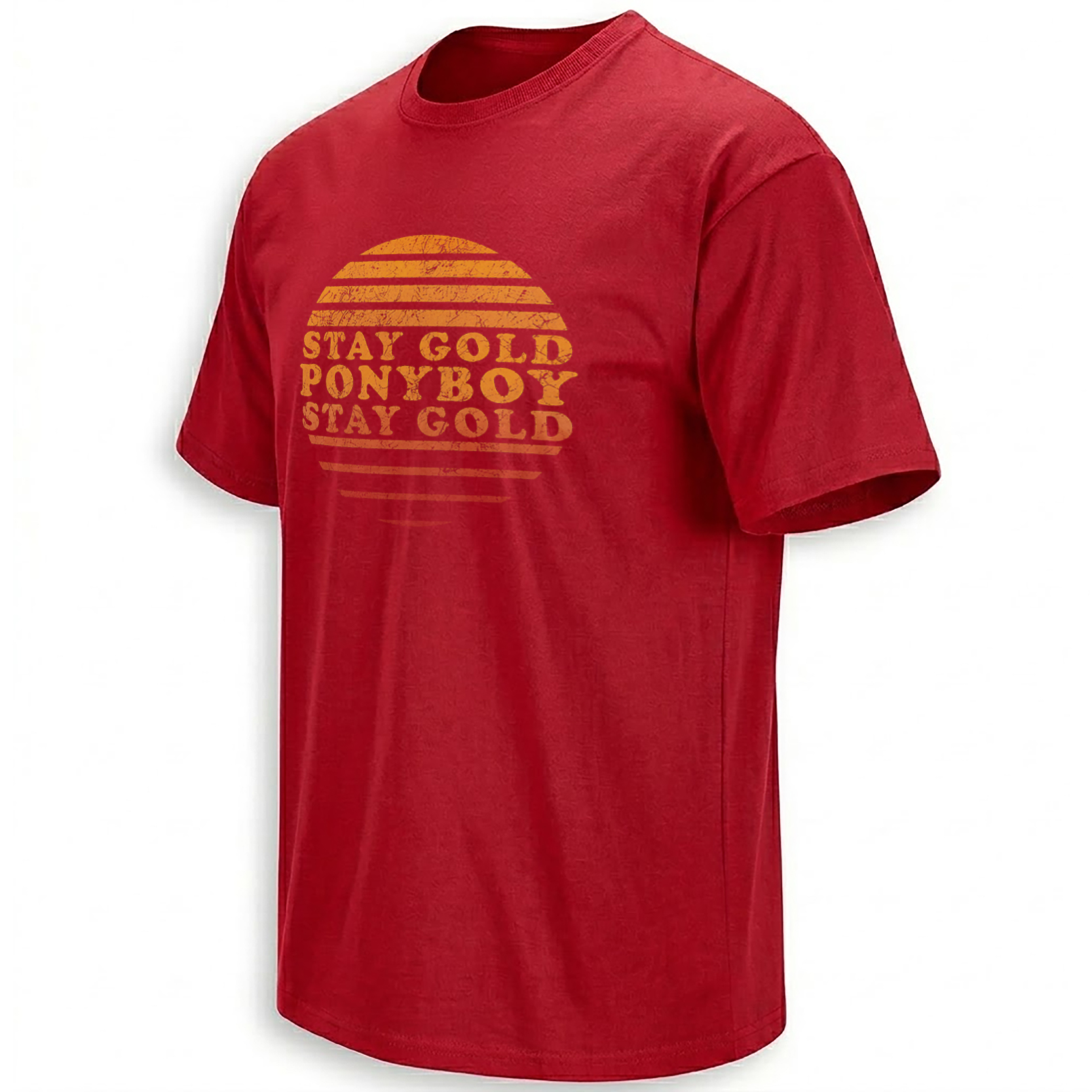
The striped golden sun in the Ellie Shirt design therefore does something more interesting than provide a fashionable 1970s backdrop. It creates a visual bridge between Frost’s “gold,” Ponyboy’s sensitivity and one of the story’s recurring images of shared humanity.
The Film Gave the Words a Face
Francis Ford Coppola’s 1983 adaptation made the line visual for millions of viewers. C. Thomas Howell played Ponyboy, Ralph Macchio played Johnny, and a cast that also included Patrick Swayze, Matt Dillon, Rob Lowe, Emilio Estevez and Tom Cruise helped turn the film into an enduring piece of American youth culture.
The friendship between Ponyboy and Johnny is what keeps “stay gold” from becoming generic inspirational language. The words arrive after audiences have watched both characters encounter fear, violence, hiding, guilt and sacrifice. Johnny knows exactly what the world can take from a teenager when he asks Ponyboy to resist that process.

In 2026, “Stay Gold” Is Live Theater Language Again
The current Broadway and touring life of The Outsiders explains why searches around Ponyboy, Johnny and “Stay Gold” no longer belong only to nostalgia. The musical won the Tony Award for Best Musical and is currently in its third Broadway year, while the North American tour continues moving the story into new cities.
The stage score even contains a song titled “Stay Gold,” turning a literary reference that became a film quote into music performed night after night. A phrase that once passed privately between Johnny and Ponyboy now reaches an entire theater at once.
That continuing stage presence gives the phrase an unusual double audience. Some people encounter it with decades of movie memory already attached. Others hear it first through a contemporary cast and then work backward toward Hinton, Coppola and Frost.
Why the Distressed Graphic Feels Right
The artwork deliberately avoids crisp contemporary branding. Its gold is muted rather than metallic, the horizontal sunset bars are worn away at the edges, and the typography looks like a print that has survived years rather than an image produced yesterday.
That artificial age works because The Outsiders itself has accumulated layers. It belongs simultaneously to 1967 Tulsa, the experience of reading the novel in school, the grain and color of the 1983 film, and the modern Broadway revival.
A polished movie-logo treatment would lock the design to one adaptation. The distressed sunset keeps it closer to memory.
That makes the piece a natural part of Ellie Shirt’s verified movie-inspired collection, where film references can function as cultural shorthand rather than ordinary character merchandise.
Frequently Asked Questions
What does “Stay Gold, Ponyboy” mean?
Johnny is asking Ponyboy to preserve his sensitivity, goodness and ability to see beauty even after the violence and hardship both boys have experienced.
Who says “Stay Gold, Ponyboy” in The Outsiders?
Johnny Cade says the phrase to Ponyboy Curtis near the end of S.E. Hinton’s story.
Is “Stay Gold” connected to Robert Frost?
Yes. The phrase refers back to Robert Frost’s poem “Nothing Gold Can Stay,” which Ponyboy recites while he and Johnny are hiding at the abandoned church.
Why is there a sunset in the Stay Gold Ponyboy design?
Sunsets are meaningful in The Outsiders because Ponyboy uses them to recognize shared beauty across the Greaser and Soc divide, while the golden color also echoes Frost’s poem.
Why is “Stay Gold, Ponyboy” popular again in 2026?
The phrase has never disappeared from The Outsiders fandom, but its visibility is being renewed by the Tony-winning Broadway musical and its North American touring production.
The Stay Gold Ponyboy Shirt translates Johnny’s message into distressed sunset imagery, while Ellie Shirt’s movie-inspired archive follows other lines and images that continued living long after their original scenes ended.
Stay Gold Ponyboy Shirt turns The Outsiders’ defining Johnny-and-Ponyboy message into a distressed golden sunset graphic connecting S.E. Hinton, Robert Frost, the 1983 film and the story’s renewed Broadway life.