The Three Faces of Peter Parker: How Brand New Day Turns Transformation Into Identity
The Three Faces of Peter Parker Shirt captures Tom Holland’s evolution from isolated young man to masked protector and finally to a Spider-Man whose changing body threatens to consume the identity beneath the suit.
Peter Parker has always lived between two faces. One belongs to the ordinary young man who worries, grieves and tries to maintain human relationships. The other belongs to Spider-Man, the mask through which he turns fear into action.
Spider-Man: Brand New Day introduces a third face. As Peter’s heightened senses, organic webbing and arachnid traits become increasingly unstable, the familiar line between human being and superhero begins to fracture. The transformation is not presented as a clean upgrade. It is something Peter fears may erase the person he still hopes to remain.
That tension gives the Three Faces of Peter Parker design its narrative strength. Rather than showing three interchangeable portraits of Tom Holland, the artwork reads from left to right like a psychological progression: Peter Parker, Spider-Man and the emerging creature hidden inside the same body.
The third face is frightening because it is not a villain wearing Peter’s body. It is Peter’s own power continuing to evolve without asking permission.
Peter Parker Is Already Disappearing Before His Body Changes
The film begins with a form of disappearance that is emotional rather than physical. Four years after No Way Home, Peter lives alone in a New York that remembers Spider-Man but has forgotten Peter Parker. MJ and Ned have continued their lives without knowing the person who once stood at the center of them.
Peter responds by becoming Spider-Man almost continuously. Crime-fighting gives his days structure and offers a role that still produces visible results. He can stop a robbery, save a stranger or chase a threat across the city even when he has no personal home to return to.
That choice creates the first transformation represented in the design. Peter’s human face is not simply the “before” image. It is the identity already being pushed to the edge of the frame as the heroic persona takes over more of his life.
The Mask Becomes Safety and Confinement at the Same Time
Spider-Man’s mask traditionally protects Peter’s loved ones. In this chapter, it also protects Peter from the vulnerability of being known. He can function effectively as Spider-Man because the mask requires no explanation of his loneliness, grief or lost relationships.
The central face in the artwork therefore represents more than superhero confidence. It is the identity Peter has used to survive. The red mask provides purpose, but it can also become a place where he avoids rebuilding Peter Parker’s emotional life.
This dual meaning is essential to the film’s character structure. Spider-Man is not false, and Peter Parker is not the only authentic self. Both are real. The danger begins when one identity consumes the space required by the other.

The Third Face Turns Superpowers Into Body Horror
Peter’s physical evolution changes the meaning of his powers. Enhanced senses and organic webbing might sound useful when listed as superhero abilities, but the film frames them through loss of control. His body is moving toward something he did not consciously choose.
This places the transformation close to body horror: the fear that the familiar human form may become unrecognizable from within. The threat is not merely cosmetic. Peter worries that the evolution could destroy his existence or leave him unable to control the instincts emerging alongside the new abilities.
The third portrait in the design communicates this through distortion. Human features remain visible, but they appear overtaken by an increasingly arachnid identity. The image is disturbing because the viewer can still recognize Tom Holland’s Peter inside it.
The three portraits function like stages of one uninterrupted exposure. Instead of separating hero and monster into different characters, the composition shows all three identities occupying the same face.
Why Bruce Banner Matters to Peter’s Transformation
Peter turns to Bruce Banner because Banner understands what it means to share a body with a powerful identity that cannot simply be removed. Bruce has spent years attempting to suppress, control and eventually coexist with the Hulk.
That parallel gives the story a deeper emotional question. Peter initially treats the evolution as a defect requiring an inhibitor. Bruce encourages him to consider whether the change must be completely rejected. The advice does not make the transformation safe, but it forces Peter to ask whether control always means suppression.
In this sense, the third face is not automatically an evil final form. It represents an unresolved possibility. Peter may lose himself to it, master it or discover that accepting part of the evolution is necessary to become whole again.
The Three-Face Layout Reads Like a Transformation Sequence
The design works because the portraits are arranged as progression rather than decoration. The human face establishes emotional familiarity. The masked Spider-Man image provides the iconic middle stage. The final altered face breaks that visual stability.
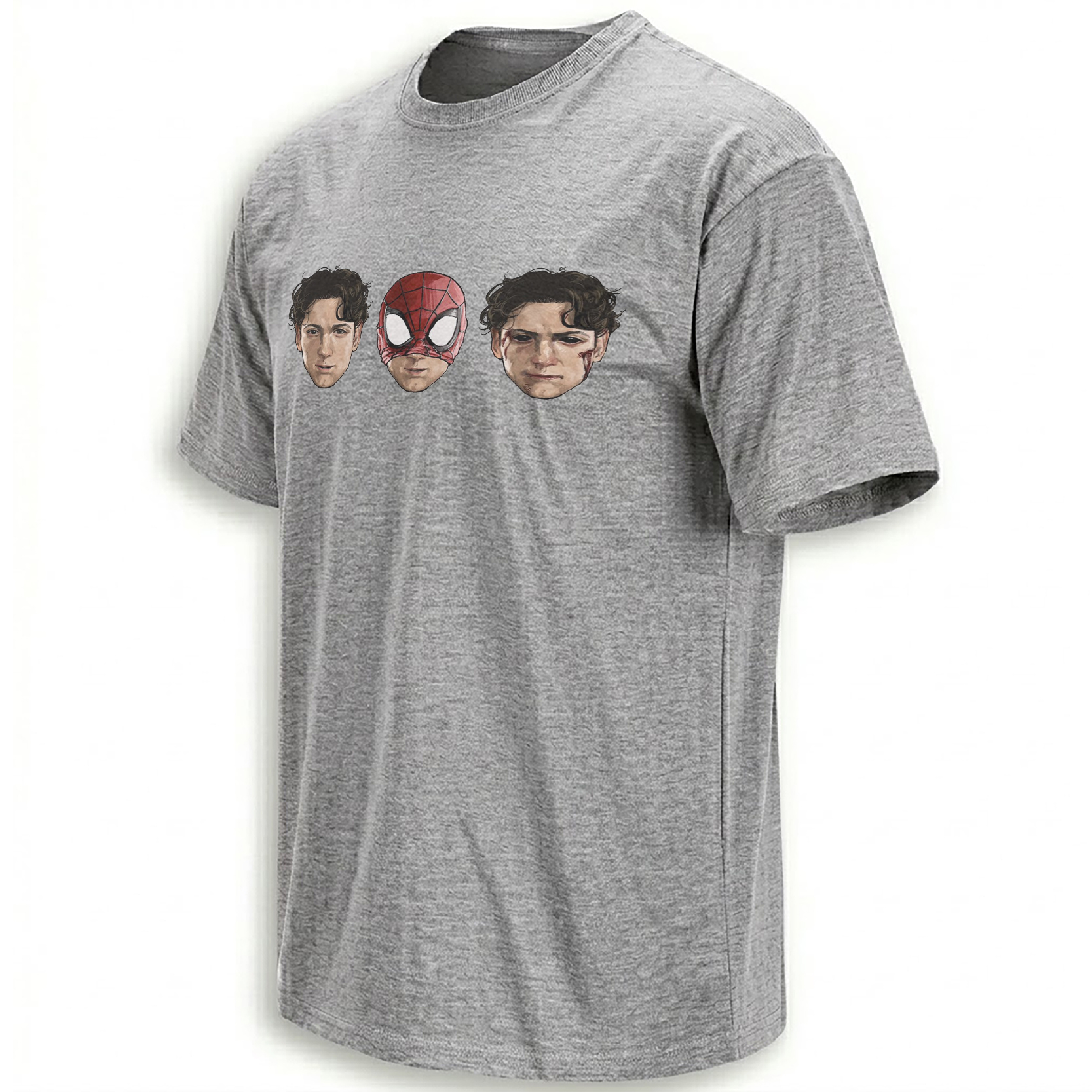
Color reinforces the narrative movement. Natural skin tones keep the first portrait grounded in Peter’s humanity. Red and blue stabilize the central Spider-Man identity through familiar heroic language. Darker shadows and altered facial details pull the final image away from certainty.
The layout resembles classic transformation art, but its real subject is psychological. Each face asks a different question: Who was Peter before the world forgot him? Who did he choose to become? And what remains when his powers begin making that choice for him?
Why the Design Fits the Current Spider-Man Conversation
Fan discussion around the film has repeatedly returned to Peter’s loneliness, his changing powers and the possibility that Spider-Man can no longer be treated as a stable costume he simply puts on. The transformation turns the hero’s body into part of the conflict.
The Three Faces graphic captures that discussion in a format that can be understood before every plot detail is explained. It belongs naturally beside other current film visuals in Ellie Shirt’s Movies Shirts collection, while the Newest collection functions as a running archive of recently released designs tied to current scenes, characters and fan interpretations.
Frequently Asked Questions
What do the three faces of Peter Parker represent?
They represent Peter Parker’s human identity, his established Spider-Man persona and the dangerous physical evolution emerging from his arachnid powers.
Why is Peter Parker physically transforming in Brand New Day?
The pressure surrounding Spider-Man triggers an unstable evolution involving heightened senses, organic webbing and increasingly arachnid physical traits.
Is the third face a separate Spider-Man character?
No. The third face is a transformed version of Tom Holland’s Peter Parker, showing how his own powers may threaten his human identity.
Why does Bruce Banner help Peter Parker?
Banner understands the difficulty of controlling a powerful second nature within the same body and helps Peter think about suppression, adaptation and coexistence.
Why does the three-face design feel darker than a normal Spider-Man portrait?
The progression ends with a visibly altered Peter, turning the familiar superhero transformation into a question about identity, control and loss of humanity.
The Three Faces of Peter Parker Shirt preserves the film’s central transformation as a visual progression from isolated human being to masked hero and evolving arachnid form.
Three Faces of Peter Parker Shirt captures Tom Holland’s Brand New Day transformation through three connected portraits: Peter Parker, the masked Spider-Man and the unstable arachnid identity threatening to emerge.