
One Swing Became The Pose
PCA Bat Drop Pete Crow-Armstrong’s 20-20 summer kept flying
Two home runs, a milestone reached for the second consecutive season and one unmistakably confident finish turned a July night at Camden Yards into another chapter of PCA’s Chicago ascent.
The bat drop lasts only a moment. The hitter finishes the swing, tracks the baseball and lets the bat fall away as if the outcome has already been decided. On July 8, 2026, Pete Crow-Armstrong had every reason to carry that kind of certainty.
Playing against the Baltimore Orioles at Camden Yards, Crow-Armstrong launched two home runs as the Chicago Cubs survived a 9-7 slugfest. The first blast delivered his 20th homer of the season. Combined with the 23 stolen bases he already owned, it completed another 20-homer, 20-steal campaign before the All-Star break.
The second homer gave the Cubs a 4-3 lead in the fifth inning and supplied the visual energy behind the PCA bat-drop moment: a powerful left-handed finish, eyes lifted toward right-center field and the bat released from the story after doing its job.
The The PCA Bat Drop Shirt preserves that attitude. It does not need to reproduce every pitch or line from the box score. The pose carries the larger meaning: PCA was no longer only the spectacular center fielder capable of making impossible catches. He had become one of Chicago’s most dangerous offensive players.
The night the bat drop became a 20-20 statement
Crow-Armstrong homered twice off Orioles starter Dean Kremer, attacking two splitters that finished below or away from the center of the strike zone. His ability to reach those pitches made the performance as technically impressive as it was visually memorable.
Why this was more than another home-run celebration
A bat flip or bat drop becomes culturally significant when the movement completes a story already understood by the audience. The gesture alone is not the achievement. It is punctuation.
In Crow-Armstrong’s case, the punctuation followed one of the most explosive stretches of his young career. He had just been named National League Player of the Month for June after batting .381 with 11 home runs, 20 RBIs, eight stolen bases and a 1.249 OPS across 26 games.
He also hit for the cycle during that run, completing it in reverse order—home run, triple, double and single—and earned selection to his second consecutive All-Star Game. By the time the Cubs reached Baltimore, every long fly ball carried the possibility of another historical footnote.
Reaching a difficult splitter
Kremer started PCA with an 0-2 advantage in the third inning before throwing a splitter that dropped below the strike zone. Crow-Armstrong still reached it and drove it over Camden Yards’ tall right-field wall.
Home runs No. 20 and 21
The first homer completed the 20-20 milestone. The second, also struck against a low splitter, left the bat at 106.7 mph and moved Chicago ahead in the fifth inning.
The bat leaves the frame
Once the baseball is launched, the bat becomes unnecessary. Letting it fall creates the final image: a hitter standing upright and watching his work travel toward the seats.
A bat drop does not create the home run. It tells everyone in the ballpark that the hitter understood the home run before the crowd finished reacting.
Two splitters, two completely different historical rewards
The two home runs belong together, but each served a different purpose in the story of the game.
The milestone swing
PCA reached down for an 0-2 splitter and cleared the high right-field wall. The homer paired with his 23 steals to produce his second consecutive 20-20 season.
The go-ahead swing
Facing another splitter, Crow-Armstrong drove a 106.7 mph shot to right-center field. The solo homer gave Chicago a 4-3 lead and completed his second multi-homer game of 2026.
Kremer’s splitter had been an effective weapon. Before the game, opponents had collected only two singles in 27 at-bats ending with the pitch, and he had not surrendered a splitter home run since August 2025.
Crow-Armstrong changed that record twice in one night. According to MLB, he became only the fourth hitter in the Statcast Era to homer twice against splitters in the same game.
Pete Crow-Armstrong joined Ryne Sandberg and Sammy Sosa as the only Cubs players with 20-homer, 20-steal seasons in consecutive years. PCA’s first such campaign reached the milestone in 73 games in 2025; his second arrived in game 92 of the 2026 season.
PCA’s transformation from defender to complete star
Crow-Armstrong’s first major-league identity was built in center field. His speed, direct routes and willingness to attack the warning track made defense feel like an event. A fly ball into the gap could become a highlight before viewers understood how much ground he had covered.
The 2026 season widened that identity. His defense remained part of the attraction, but opposing pitchers could no longer treat his place in the lineup as secondary to his work in the outfield.
June provided the clearest evidence. Crow-Armstrong combined 40 hits, 11 home runs, five doubles, two triples, 20 RBIs, 17 walks and eight stolen bases. MLB noted that no Cubs hitter had ever previously combined at least 40 hits, 11 home runs, 20 RBIs, 17 walks and eight steals in the same month.
A month that changed the MVP conversation
Crow-Armstrong hit .381 during June and produced the highest OPS among qualified Major League hitters for the month. He collected hits in 14 consecutive games and completed the first reverse-order cycle in Cubs history.
That surge earned him National League Player of the Month, two June Player of the Week honors and a second straight All-Star selection.
Why the bat drop fits Pete Crow-Armstrong
Some baseball celebrations feel disconnected from the player who performs them. PCA’s do not. His entire game is based on visible movement: accelerating into the gap, attacking an extra base, rotating through a low pitch and carrying momentum through the end of a swing.
That makes the bat drop an extension of the same athletic language. It converts a horizontal swing into a vertical image. The baseball rises. The hitter rises out of his stance. The bat drops in the opposite direction.
It is also why the moment translates naturally to apparel. A box score requires context. A silhouette of the completed swing can communicate power, confidence and recognition before the viewer reads the player’s name.
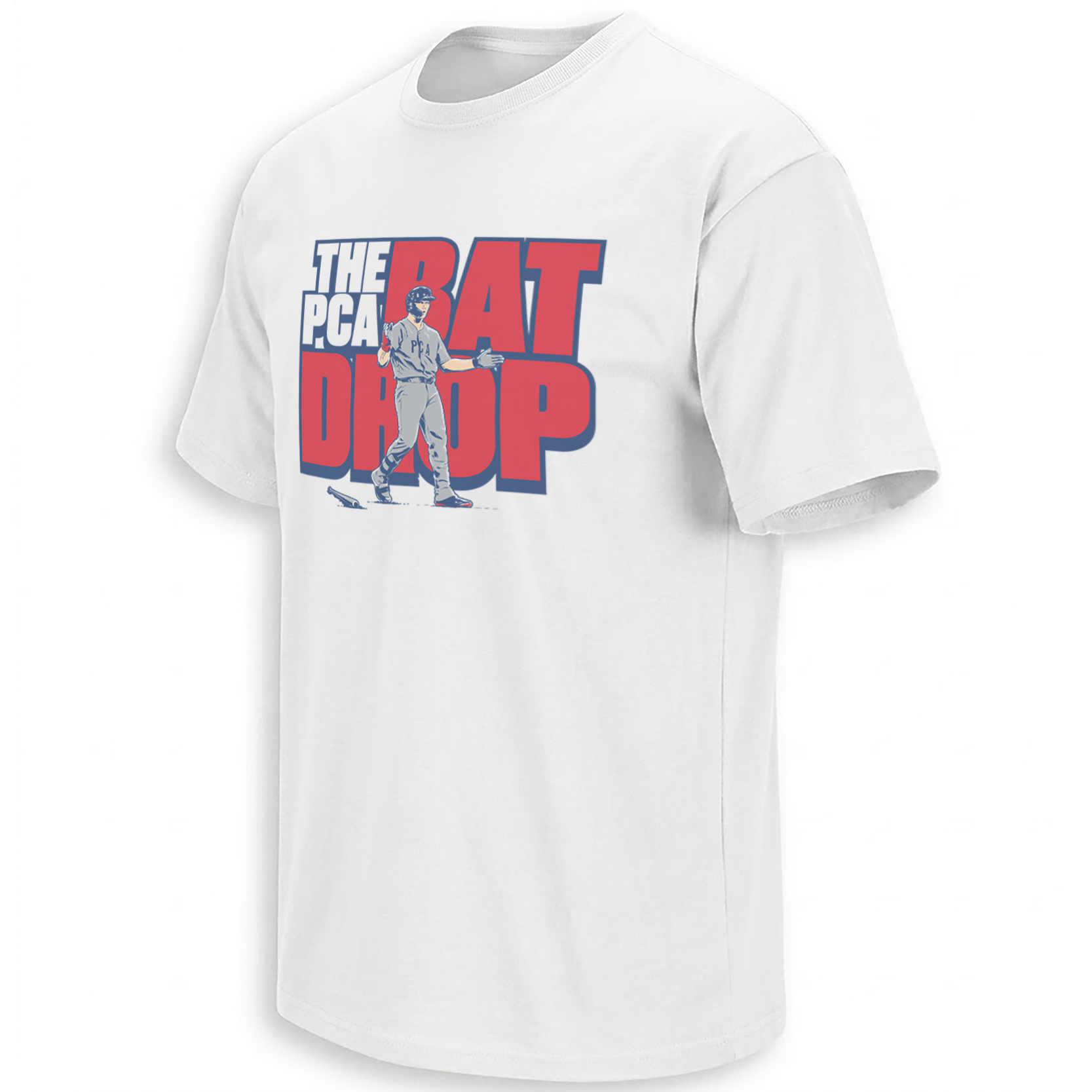
The PCA Bat Drop Shirt
A wearable record of Pete Crow-Armstrong’s powerful left-handed finish and the confidence surrounding his historic 2026 summer with Chicago.
The design focuses on the instant after contact—the ball already traveling, the bat leaving his hand and PCA watching the result unfold.
View The PCA Bat Drop ShirtThe meaning of a modern baseball bat drop
Baseball once treated visible celebration as a challenge to the opponent. Modern players and fans increasingly understand that emotion is part of the entertainment. Home-run reactions become instant visual signatures, circulating through broadcasts, highlight clips, photographs and fan artwork.
The best celebrations still depend on the moment. A routine homer in a decided game carries one meaning. A milestone blast during a historic stretch carries another. PCA’s Baltimore performance combined personal achievement, team offense and the continued rise of a homegrown Chicago fan favorite.
Recognition
The finished left-handed swing is readable even before the viewer reaches the player’s name or number.
Confidence
The falling bat communicates certainty: contact has already created the result the hitter expected.
Memory
The design gives Cubs fans a compact timestamp for PCA’s Player-of-the-Month and 20-20 summer.
That is the real value of the PCA Bat Drop design. It is not only merchandise built around a famous player. It preserves the point at which the conversation around Crow-Armstrong expanded—from elite defender and exciting athlete to complete star capable of altering a game with one swing.
The bat falls out of the picture. PCA remains standing at its center. For Chicago fans watching the summer of 2026 unfold, that composition feels increasingly familiar.
Explore more Chicago baseball designs
Continue through Ellie Shirt’s Chicago Cubs, MLB and newest cultural-moment collections.
Reporting and statistical sources
Frequently asked questions
What moment inspired the PCA Bat Drop Shirt?
The design is tied to Pete Crow-Armstrong’s two-home-run performance against the Baltimore Orioles at Camden Yards on July 8, 2026. The first homer completed his second consecutive 20-homer, 20-steal season.
How many home runs did PCA hit against Baltimore?
Crow-Armstrong hit two home runs in the Cubs’ 9-7 victory. They were his 20th and 21st homers of the 2026 season.
Why was Pete Crow-Armstrong’s 20-20 milestone historic?
He joined Ryne Sandberg and Sammy Sosa as the only players in Chicago Cubs history to record 20-homer, 20-steal seasons in consecutive years.
What pitches did PCA hit for the two home runs?
Both home runs came against splitters from Orioles starter Dean Kremer. The first was an 0-2 pitch below the strike zone, while the second was another low-and-away splitter.
How hard was PCA’s second home run hit?
Statcast measured the second home run at an exit velocity of 106.7 mph. It traveled to right-center field and gave the Cubs a 4-3 lead in the fifth inning.
Was Pete Crow-Armstrong an All-Star in 2026?
Yes. He was selected to his second consecutive All-Star Game after a historic June in which he hit .381 with 11 home runs and a 1.249 OPS.
What number does Pete Crow-Armstrong wear?
Pete Crow-Armstrong wears number 4 for the Chicago Cubs.
Where can I find more Chicago Cubs shirts?
More Chicago baseball designs are available in Ellie Shirt’s Chicago Cubs collection at /collections/mlb/chicago-cubs-shirt/.
The PCA Bat Drop Shirt captures Pete Crow-Armstrong’s confident home-run finish during his historic 2026 Chicago Cubs summer. The design celebrates his two-homer night in Baltimore, second straight 20-20 season and rise as one of baseball’s most electric complete players.