Three Designs · Two Clubhouses · One Rookie Summer
Say Their Names Cole Young, Cooper Pratt and Luis Lara are giving the 2026 rookie class its own soundtrack
One name is repeated until it becomes a punchline. Another is stretched across an entire section of the ballpark. Two more are joined by a dash and a year. Together, the designs capture how young players become part of a fan community’s language.
Baseball fans do not always wait for a formal nickname. Sometimes a player’s identity emerges from a broadcast rhythm, an official social post, a scoreboard introduction or thousands of voices discovering that the same syllable feels good when shouted together.
That is the connection between the Cole “Cole Young” Young Shirt , the Coooooooooop Shirt and the Lara–Pratt ’26 Shirt . They are not built around three unrelated names. Each preserves a different stage in the process through which a promising player becomes recognizable to an entire fan base.
Seattle’s phrase turns Cole Young’s already compact name into a verbal loop. Milwaukee’s “Cooooop” compresses Cooper Pratt into one long, stadium-ready note. “Lara–Pratt ’26” moves beyond the individual and marks the arrival of a partnership the Brewers developed, promoted and publicly committed to for the future.
From lineup card to shared language
A player can arrive with prospect rankings and scouting reports, but fan recognition develops through repetition. The name appears in a lineup, accompanies a decisive hit, circulates through social clips and eventually requires almost no explanation.
Why “Cole Cole Young Young” sounds instantly familiar
Cole Young’s full name already has a built-in symmetry. Both names are short, each carries one syllable and the surname can also function as an adjective. Repeating the sequence creates the cadence of an introduction being echoed back by the crowd: Cole—Cole Young—Young.
The phrase did not have to be reverse-engineered from an unofficial nickname. The Seattle Mariners used the wording themselves in social posts, including a June 1 video captioned, “We’ll say it again: Cole ‘Cole Young’ Young.” That official repetition helped transform a simple name joke into a recognizable piece of Mariners fan language.
Young had already given Seattle supporters meaningful reasons to repeat it. He debuted on May 31, 2025, and became the first player in Mariners history to produce a walk-off plate appearance in his first Major League game. What began as a clever verbal pattern therefore attached itself to a young second baseman whose introduction to Seattle baseball already carried its own dramatic ending.
His 2026 season made the phrase increasingly useful. Young opened the campaign as Seattle’s second baseman of the present rather than merely its future, then delivered his first career multi-homer game against the Angels on June 29.
On July 18, he hit a three-run homer against San Francisco to tie the game in the seventh inning. One day later, he added another two-run homer against the Giants. By July 30, he was still producing hard contact, driving a 104.2 mph triple against the Dodgers.
The player enters the sentence
The opening use works like a traditional crowd call: a first name capable of reaching the player from the stands without requiring another word.
The full name confirms the rhythm
The center of the phrase identifies the player completely while maintaining the compact, one-syllable beat at both ends.
The echo closes the loop
Repeating the surname makes the introduction feel circular, as if another voice in the ballpark has completed the call.
Prospect rankings introduce a player to baseball. A chant introduces him to the people sitting together in the ballpark.
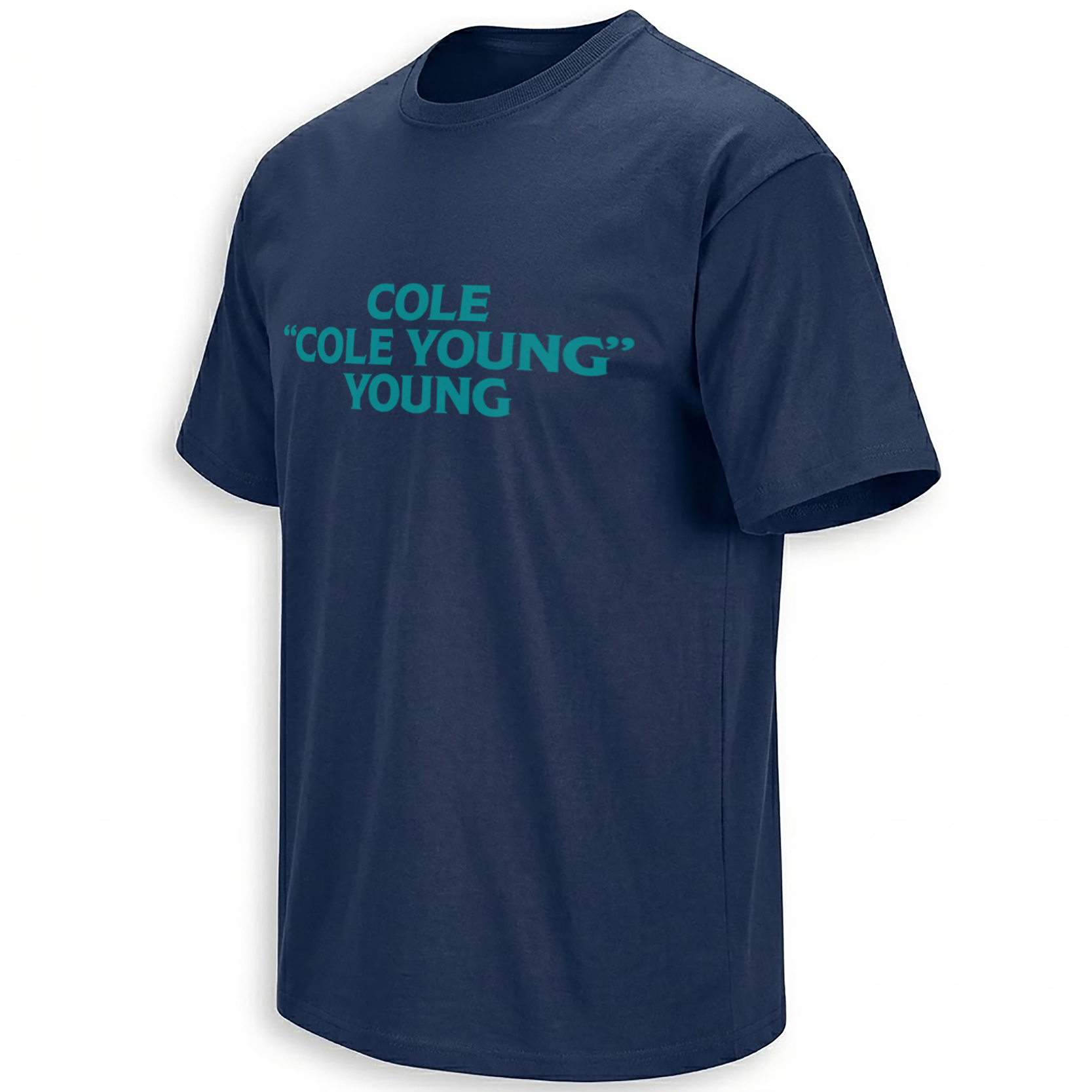
Cole “Cole Young” Young Shirt
A typography-driven record of the playful name pattern Seattle turned into an official social refrain. Its repetition reflects both Young’s memorable name and his growing presence in the Mariners lineup.
View The Cole Young DesignMilwaukee discovers a new reason to shout “Cooooop”
Cooper Pratt’s fan identity works through a different form of repetition. The crowd does not need his full name. It takes the first syllable of Cooper and holds it for as long as the moment permits: “Coooooooooop.”
The sound has historical resonance in Milwaukee. Brewers fans once delivered an extended “Cooooop” for Cecil Cooper, the five-time All-Star first baseman who spent 11 seasons with the club. Reusing the sound for Cooper Pratt does not make the two players equivalent. It gives a familiar piece of Milwaukee baseball language a new, generation-specific subject.
Pratt was promoted on June 16, 2026, after the Brewers had already demonstrated their long-term belief in him with an eight-year contract signed in April. The 21-year-old shortstop collected his first hits, first RBI and first stolen base in Milwaukee’s June 17 victory over Cleveland.
His first Major League homer arrived on July 20 against former Brewers pitcher Freddy Peralta. It began Pratt’s first three-hit game and gave the new chant a home-run highlight to accompany it.
Five days later, the sound became impossible to separate from the atmosphere at American Family Field. Pratt hit a 409-foot homer against Colorado and later delivered a go-ahead RBI single while a crowd of 34,328 sent a loud “Coop!” chant down toward the field.
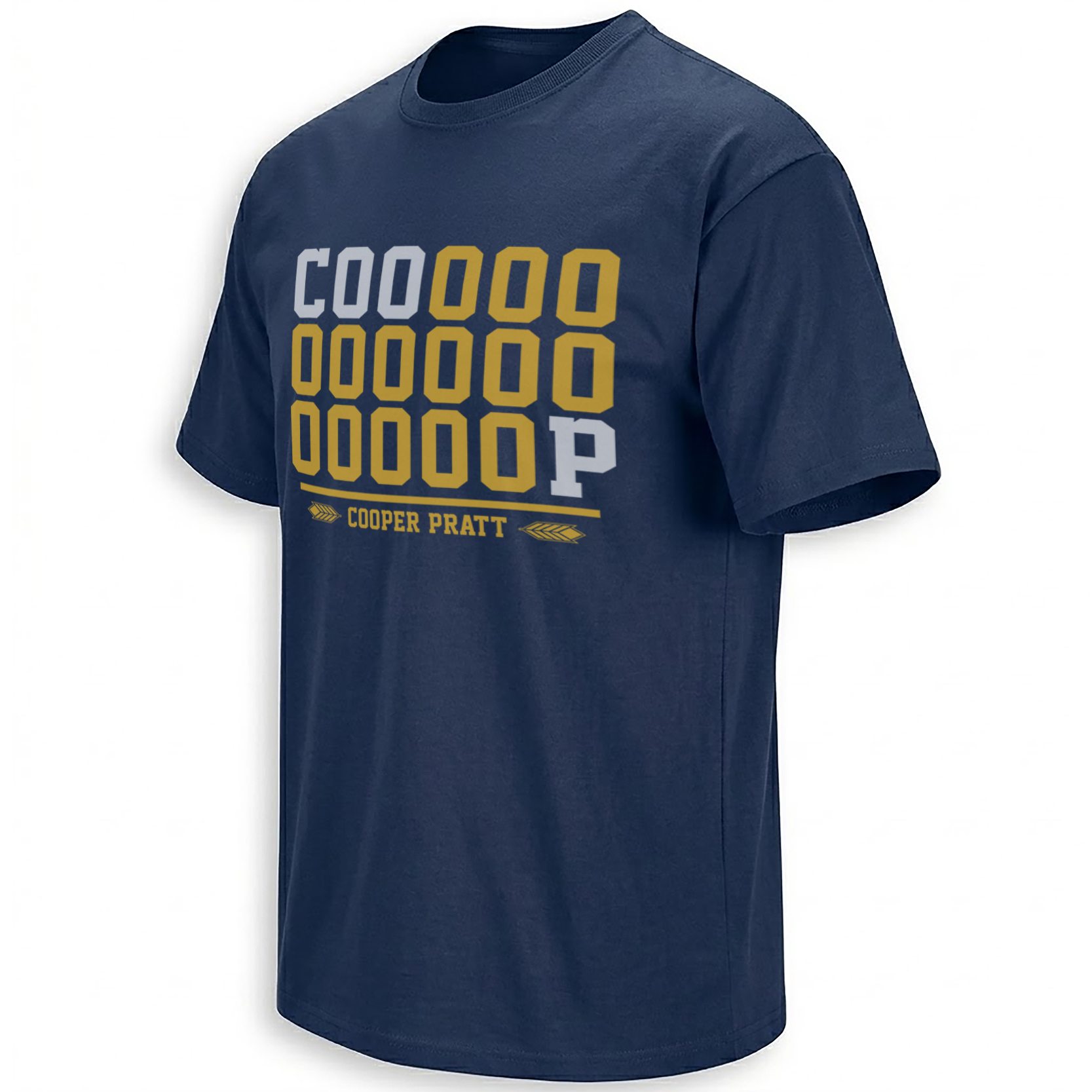
Coooooooooop Shirt
The stretched typography turns Cooper Pratt’s first name into the visual equivalent of a crowd holding one sound together. It captures the instant a rookie’s name becomes stadium participation.
View The Coooooooooop DesignLara–Pratt ’26 records something larger than a nickname
The Lara–Pratt design changes the scale of the story. Luis Lara and Cooper Pratt are not joined only because they happened to reach Milwaukee during the same season. Their paths through the Brewers organization have repeatedly overlapped.
They played together at High-A Wisconsin and later at Triple-A Nashville. Pratt began learning Spanish, Lara worked on his English, and baseball supplied the common language between them. Pratt has described Lara as one of his closest friends in professional baseball.
Milwaukee also made unusually significant commitments to both players before their MLB debuts. Pratt signed an eight-year contract in April. Lara followed with a seven-year deal in June after Pratt helped him understand the process surrounding such a life-changing decision.
Their Major League promotions came only three weeks apart. Pratt arrived on June 16; Lara followed on July 7. By late July, manager Pat Murphy was placing them back-to-back near the bottom of the order and watching the two rookies create offense together.
The Colorado weekend made the partnership visible
During consecutive victories over the Rockies on July 25 and 26, Lara and Pratt combined for nine hits, 10 RBIs and five runs scored. Pratt homered and collected three RBIs on Saturday while Lara reached base three times and drove in three.
On Sunday, Lara added two doubles and two RBIs. Pratt contributed two more hits, including a double, and drove in another two runs. A developmental partnership had become part of Milwaukee’s immediate Major League production.
The pair also created a basketball-themed handshake featuring high-fives, a fake Eurostep and a stepback jumper. They designed it on a Friday and used it the following day after Pratt’s second Major League homer, with Lara waiting for him in the dugout.
That celebration matters because it gives “Lara–Pratt” movement rather than merely punctuation. The dash between the names represents two players advancing through the same system, adapting to the Majors together and developing a shared public identity.
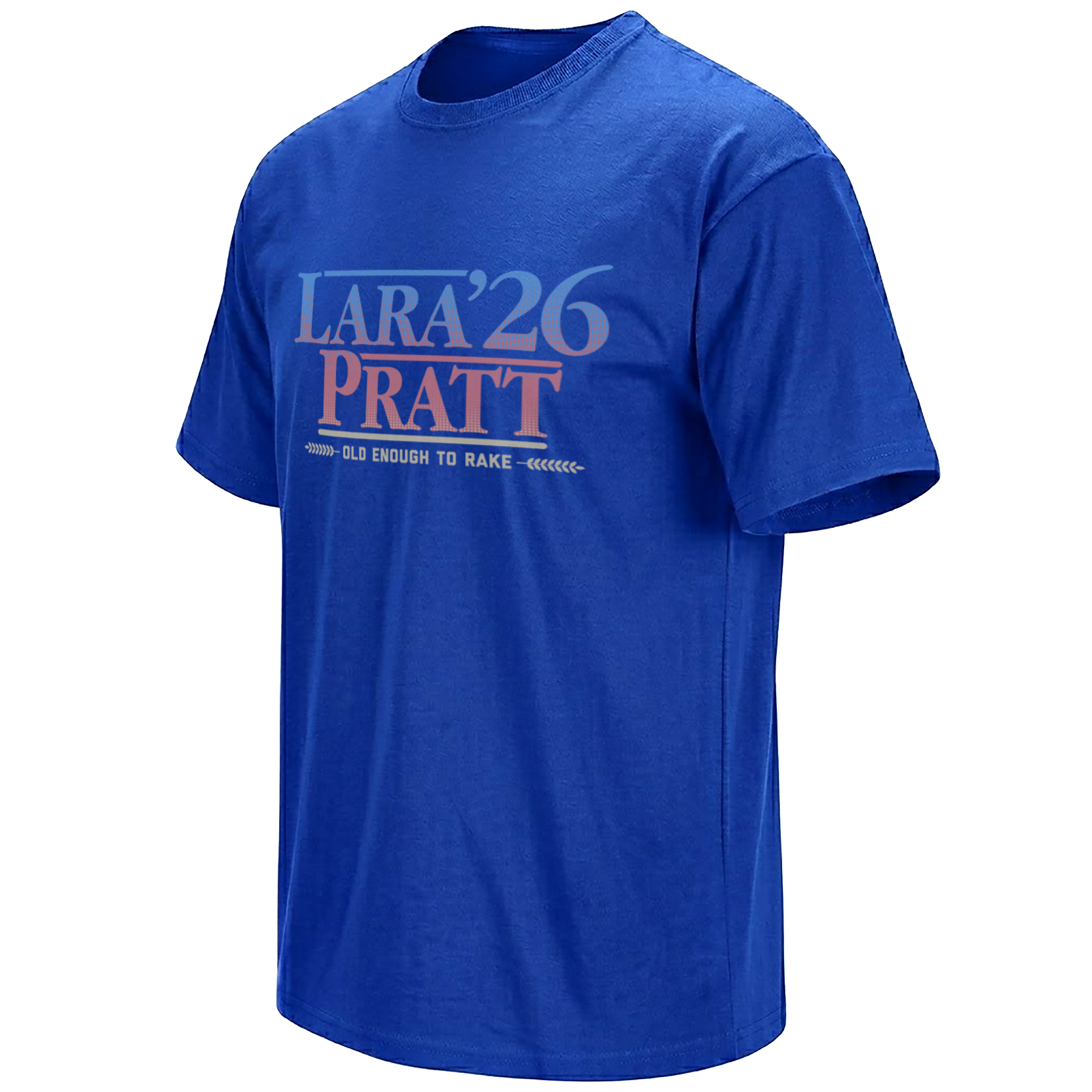
Lara–Pratt ’26 Shirt
A timestamp for the summer when Luis Lara and Cooper Pratt moved from Nashville teammates to productive 21-year-old partners in Milwaukee’s Major League lineup.
View The Lara–Pratt ’26 DesignA timeline of three rookie identities taking shape
Cole Young delivers a walk-off result in his debut
Young becomes the first player in Mariners history with a walk-off plate appearance in his first Major League game.
Seattle repeats “Cole ‘Cole Young’ Young”
The Mariners use the phrase in an official social post, confirming that the name pattern has become part of the club’s public voice.
Cooper Pratt reaches Milwaukee
The Brewers promote their young shortstop and begin giving him regular opportunities at his natural position.
Luis Lara joins Pratt in the Major Leagues
The outfielder’s promotion reunites two former Wisconsin and Nashville teammates in Milwaukee.
Lara and Pratt drive the Brewers together
The rookies combine for nine hits and 10 RBIs in consecutive victories over Colorado, giving the partnership a defining weekend.
Why names become powerful apparel symbols
A traditional player design often depends on a portrait, a uniform number or a detailed action pose. Name-based designs work differently. They rely on the reader already hearing something when the words appear.
“Cole Cole Young Young” produces a beat. “Coooooooooop” asks the reader to extend a vowel. “Lara–Pratt ’26” resembles the title of a partnership or campaign whose meaning is fixed to one season.
This makes each design a compact record of fan participation. The wearer is not simply identifying a favorite player. The typography signals familiarity with the way the player is discussed, welcomed or celebrated within a particular baseball community.
The echo
Cole Young’s repeated name works like a call returned from another part of T-Mobile Park.
The sustained note
“Cooooop” gives Cooper Pratt a sound that can be held until the next pitch or celebration begins.
The partnership
Lara–Pratt ’26 turns two individual development stories into one timestamp for Milwaukee’s future.
None of these phrases guarantees what the players will become. That uncertainty is part of their value. Rookie-season culture records optimism while the story is still being written.
Seattle fans are watching Cole Young establish himself over his first full Major League season. Milwaukee fans are watching Cooper Pratt and Luis Lara learn at premium defensive positions while contributing to a contender. The designs preserve the excitement of recognizing those developments early.
Years from now, the three phrases may recall statistics, postseason appearances or careers still impossible to predict. In July 2026, they mean something simpler: these young players have arrived, and their fan bases have already learned how to say their names.
Explore more 2026 baseball moments
Continue through Ellie Shirt’s verified Seattle Mariners, Milwaukee Brewers, MLB and newest-design collections.
Reporting and cultural sources
- MLB: Cole Young records his first career multi-homer game
- MLB: Young produces a walk-off result in his Mariners debut
- Seattle Mariners: “Cole ‘Cole Young’ Young”
- MLB: Brewers promote Cooper Pratt for his Major League debut
- MLB: Pratt hits his first Major League home run
- MLB: Pratt and Lara combine for six RBIs against Colorado
- MLB: Lara and Pratt’s friendship, handshake and shared rise
- MLB: What the long-term Pratt and Lara contracts mean for Milwaukee
Frequently asked questions
What does “Cole Cole Young Young” mean?
It is a playful repetition of Seattle second baseman Cole Young’s name. The Seattle Mariners used “Cole ‘Cole Young’ Young” in official social content, helping establish the phrase as part of the fan language surrounding him.
When did Cole Young make his MLB debut?
Cole Young debuted for the Seattle Mariners on May 31, 2025. He became the first player in franchise history to record a walk-off plate appearance in his first Major League game.
What inspired the Coooooooooop Shirt?
The design represents the extended “Coop!” chant Milwaukee fans use for rookie shortstop Cooper Pratt. The sound also recalls the historic “Cooooop” once associated with former Brewers star Cecil Cooper.
When did Cooper Pratt hit his first MLB home run?
Pratt hit his first Major League home run on July 20, 2026, against former Brewers pitcher Freddy Peralta during Milwaukee’s 8-3 win over the New York Mets.
Who are Luis Lara and Cooper Pratt?
Luis Lara is a young Brewers outfielder and Cooper Pratt is a young shortstop. Both played together in Milwaukee’s Minor League system, reached the Majors in 2026 and were 21 years old during their breakout July partnership.
What does Lara–Pratt ’26 represent?
Lara–Pratt ’26 marks the season Luis Lara and Cooper Pratt reunited in Milwaukee after developing together at High-A Wisconsin and Triple-A Nashville. It celebrates their friendship, shared promotion timeline and early production as Brewers rookies.
How did Lara and Pratt perform against Colorado?
Across Milwaukee’s consecutive wins on July 25 and 26, 2026, Lara and Pratt combined for nine hits, 10 RBIs and five runs scored.
Are these official MLB or team shirts?
No. These are independent Ellie Shirt designs inspired by baseball fan culture, public game moments and the language supporters use when celebrating the players.
Where can I find more Mariners and Brewers shirts?
More designs are available in Ellie Shirt’s Seattle Mariners collection at /collections/mlb/seattle-mariners/ and Milwaukee Brewers collection at /collections/mlb/milwaukee-brewers/.
The Cole “Cole Young” Young, Coooooooooop and Lara–Pratt ’26 designs capture three ways MLB rookies became part of fan language in 2026: a repeated name, a stadium-length chant and a Milwaukee partnership built through years of shared development.