
Liberals Hate All Kinds of Kings
Working. Thinking. Fact-checking. Three “-king” endings are drafted into one compact piece of conservative provocation.
The slogan’s mechanism is visible before its political message is fully processed. It removes the beginning of three gerunds—working, thinking and fact-checking—and treats their shared ending as three different “kings” that liberals supposedly hate.
That is not a neutral description of millions of people. It is partisan caricature: a deliberately sweeping insult designed to flatter one side and irritate the other. Its effectiveness comes from how efficiently the word construction delivers that conflict.
How a suffix becomes an accusation
The sentence first invites a familiar reading of “kings” as monarchs. The list then reveals that no royalty is involved. The joke is typographic: each word physically contains the letters K-I-N-G, allowing an ordinary grammatical ending to be reframed as a political category.
The three choices are strategic. “Working” implies discipline, “thinking” implies intelligence and “fact-checking” implies truth. Together they assign desirable qualities to the speaker’s presumed side while implying that liberals reject all three.
The design is strongest as evidence of how political apparel works: it does not build an argument step by step; it builds an in-group in three line breaks.Ellie Shirt political culture desk
The fact-checking line contains the real tension
Fact-checking is presented as an uncomplicated virtue, but Americans do not agree on who performs it fairly. Pew Research Center found a large partisan divide in perceptions of fact-checkers: Republicans were far more likely than Democrats to believe that fact-checkers favor one side.
That distrust fits a wider media environment. Pew’s 2025 tracking showed Democrats remained more trusting of national news organizations than Republicans, even as Democratic trust also declined. The Reuters Institute’s 2026 Digital News Report described audiences moving away from traditional news sources amid political instability, social division and pressure toward polarization.
Liberals reject work, thought and verification; conservatives recognize and defend those values.
Trust is fragmented. Political groups disagree not only about facts, but also about which institutions and evaluators deserve authority.
Why political shirts prefer exaggeration
A careful claim needs definitions, exceptions and evidence. A wearable slogan needs immediate recognition. “Liberals hate all kinds of kings” chooses speed over nuance, converting a complicated dispute about work, knowledge and media trust into an identity test.
For supporters, the exaggeration is part of the appeal. It communicates defiance and group membership without requiring a policy position. For critics, the same exaggeration reads as proof that the message is more interested in antagonism than accuracy.
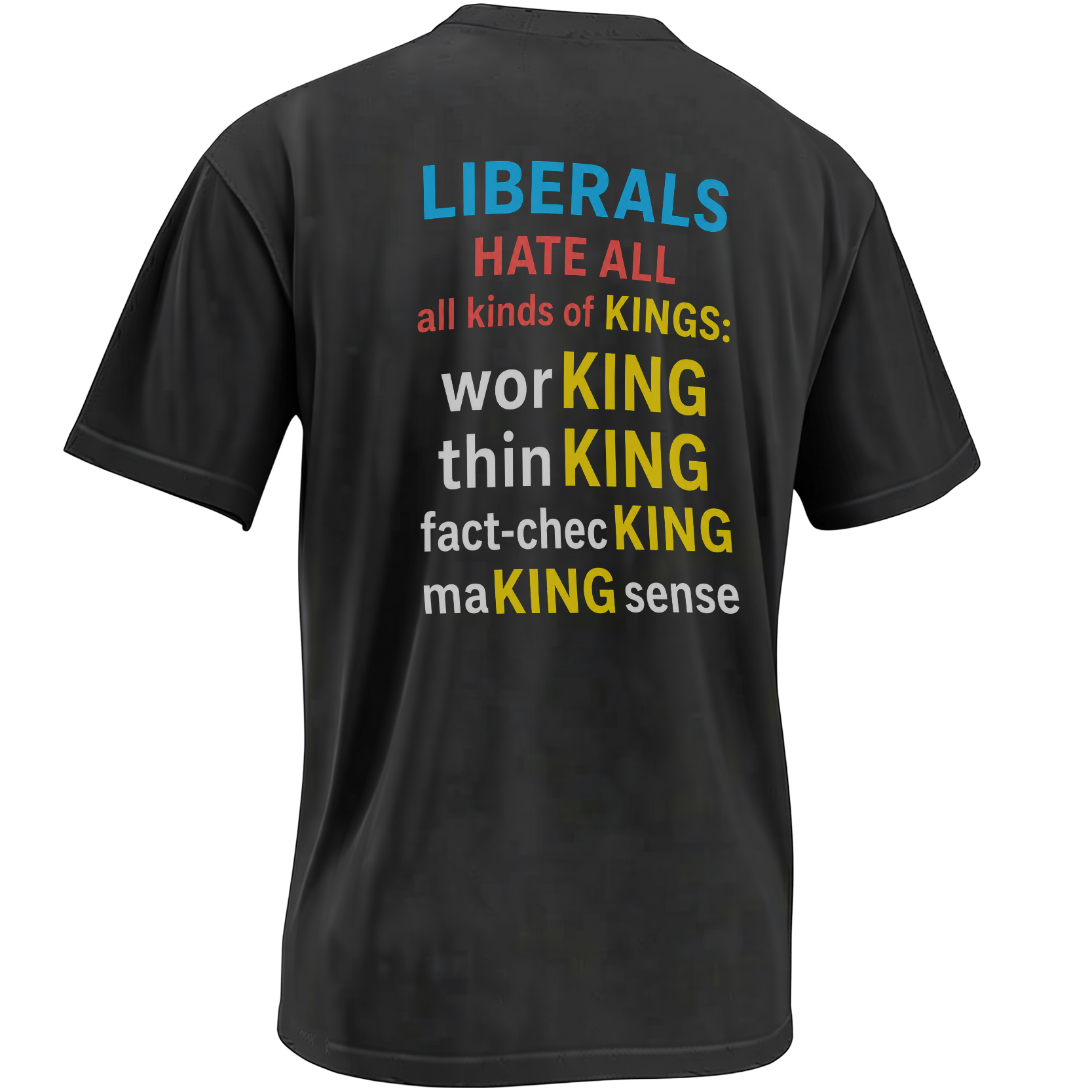
Liberals Hate All Kinds of Kings
The design stacks working, thinking and fact-checking into a blunt conservative slogan whose typography does most of the arguing.
A timestamp from the argument over truth
The shirt matters culturally because “fact-checking” is no longer merely a newsroom procedure. It has become a political signal. Invoking it can communicate seriousness to one audience and suspected institutional bias to another.
By placing fact-checking beside working and thinking, the design claims all three as common-sense virtues. Whether a viewer agrees or objects, the reaction reveals the polarized environment the shirt captures: even the act of verifying a claim has become part of the claim.
Reporting and research
Frequently asked questions
What are the three “kings” in the slogan?
They are the K-I-N-G endings inside working, thinking and fact-checking. The design isolates the shared letters to create the wordplay.
Is “liberals hate working, thinking and fact-checking” a factual claim?
No. It is a broad partisan insult, not a measured description of a diverse political group. The shirt uses exaggeration for provocation and in-group humor.
Why is fact-checking politically controversial?
Americans disagree sharply about whether fact-checkers and news institutions operate fairly. Survey research has repeatedly found major partisan gaps in institutional trust.