I Don’t Need Therapy
The sentence begins like a familiar self-care joke and then chooses fourteen werewolves, public spectacle and complete narrative collapse.
“I don’t need therapy, I just need…” is an established joke structure. The ending is usually coffee, a vacation, a pet or some other manageable substitute. This design refuses every manageable option and replaces it with an explicit encounter involving fourteen werewolves in public.
The result is not persuasive, practical or remotely proportional. That is precisely why it works as absurdist adult humor: each added detail makes the supposed alternative to therapy less believable and more vividly specific.
“I don’t need therapy” prepares the reader for a conventional slogan.
The substitute abruptly leaves wholesome self-care language behind.
Not one supernatural creature, but an exact and excessive pack.
The final qualifier destroys any remaining claim to privacy or normality.
Why exactly fourteen?
Comedy often benefits from specificity. “Several werewolves” would be vague; “a hundred” would sound generically impossible. Fourteen feels counted, planned and bizarrely non-negotiable. The number implies that thirteen would somehow be insufficient and fifteen would violate an unseen rule.
That false precision gives the sentence a miniature fictional world. Somewhere behind the slogan, the reader imagines a person who has compared alternatives and arrived at fourteen as the correct quantity.
The punchline is not merely that the desire is outrageous. It is that the speaker sounds as though fourteen werewolves were selected after careful consideration.Ellie Shirt internet culture desk
Werewolves bring more than shock value
Werewolf stories have long centered on unstable boundaries: human and animal, restraint and appetite, ordinary life and transformation. Modern pop culture has repeatedly recast that threatening folklore as romance, camp, fandom and erotic fantasy.
The shirt exploits all of those meanings at once. Its snarling wolf graphic and distressed type resemble horror merchandise, while the sentence underneath behaves like an unfiltered social post. Gothic imagery supplies drama; internet phrasing punctures it with ridiculous specificity.
The grammar of escalation
Every phrase raises the stakes. “I just need” implies a simple solution. The explicit verb contradicts that simplicity. “In public” adds risk and spectacle. “By fourteen” multiplies the scenario. “Werewolves” finally removes it from reality altogether.
The order matters. If the sentence began with werewolves, the reader would already expect fantasy. By beginning with therapy language, the design holds a familiar doorway open and then runs through it into supernatural chaos.
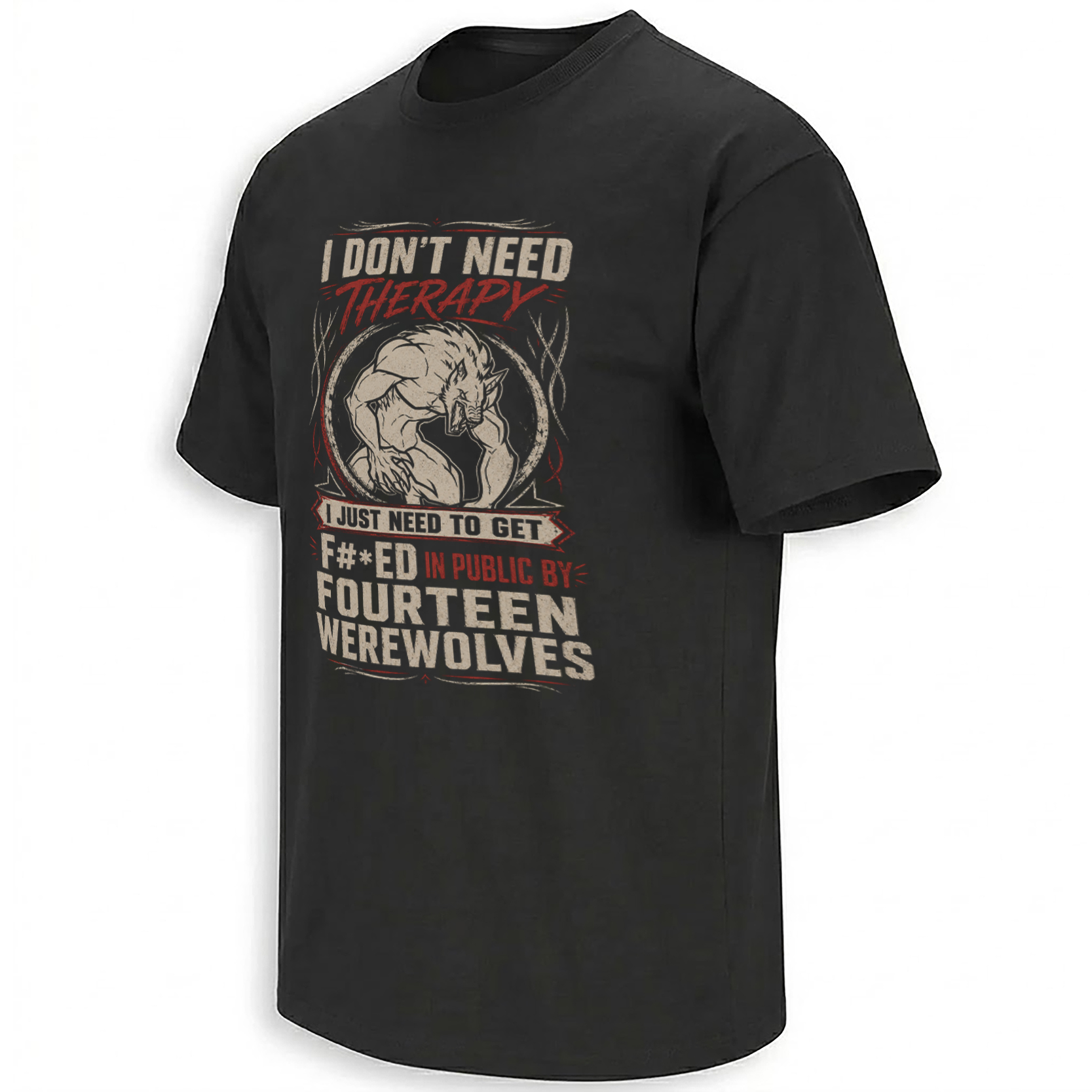
Fourteen Werewolves Shirt
Distressed horror typography and a feral central illustration give the internet’s most excessive therapy substitute the visual weight of a forbidden concert poster.
From slogan to artifact of oversharing
Internet humor frequently treats confession as performance. The funniest version is often not a plausible secret but a statement so excessive that it exposes the mechanics of oversharing itself.
This design preserves that tone in wearable form. It announces a private-sounding desire at maximum public volume, while the horror-poster styling makes the confession look like the title of a cult midnight feature.
The wearer is not asking the audience to believe the scenario. The real invitation is to appreciate how confidently the sentence commits to it.
Cultural context and reference
Frequently asked questions
What does the fourteen werewolves shirt mean?
It is an absurd adult-humor slogan that begins with a familiar therapy joke and escalates into an impossible, explicitly supernatural scenario.
Why does the joke specify fourteen werewolves?
The exact number creates false precision. Fourteen sounds strangely calculated, which is funnier than a vague phrase such as “a pack of werewolves.”
Is the shirt making a real claim about therapy?
No. Therapy is the setup for the joke; the supernatural alternative is deliberately impossible and should not be read as mental-health advice.