Hose. Bee. Lion.
Three innocent pictures sit in a row. The punchline appears only when the viewer stops looking and starts listening.
The Hose Bee Lion design is a tiny decoding game disguised as a graphic tee. A coiled garden hose, a bee and a lion look unrelated on the page. Spoken quickly, however, their names collapse into the slang phrase “hoes be lyin’.”
That delayed recognition is the whole mechanism. The shirt does not print the answer, so the wearer and the viewer briefly become collaborators: one presents the clues, the other supplies the sound.
Why the joke works better as pictures
If the final phrase were printed directly, the design would become a simple slogan. Replacing its sounds with objects creates a rebus: a puzzle in which images, letters or symbols stand in for words or parts of words.
The objects also create deliberate misdirection. A hose belongs in a garden, a bee in a hive and a lion on the savanna. The viewer first searches for a literal relationship that does not exist. Only after saying the labels aloud does the hidden relationship become obvious.
Each icon is familiar enough to name instantly without explanatory text.
Three nouns reproduce the rhythm of an entire slang sentence.
The viewer earns the punchline by completing the sound transformation.
The shirt is funny for the half-second in which “hose, bee, lion” stops being a list of animals and objects and becomes a sentence the pictures never actually show.Ellie Shirt culture desk
A joke made for the scroll
Visual puns travel well online because they can be understood before a caption is opened. The Hose Bee Lion combination has circulated in meme posts for years, often followed by comments from people sounding the words out in real time. Confusion is not a flaw in that format; it is part of the performance.
The image also rewards sharing. Someone who solves it can send it to a friend without explaining the answer, effectively recreating the same tiny test. That cycle—see, hesitate, decode, forward—is a compact version of how participatory internet humor spreads.
The phonetic trick underneath the images
The rebus depends on approximate sound rather than precise spelling. “Hose” loses its final sound as it runs into “bee,” while “lion” is shortened in casual speech toward “lyin’.” Read with a relaxed conversational rhythm, the boundary between the three nouns becomes the rhythm of the hidden phrase.
This is why the design is more successful aloud than silently. Its real typography is pronunciation: pauses, dropped consonants and the expectation that the listener already recognizes the slang construction.
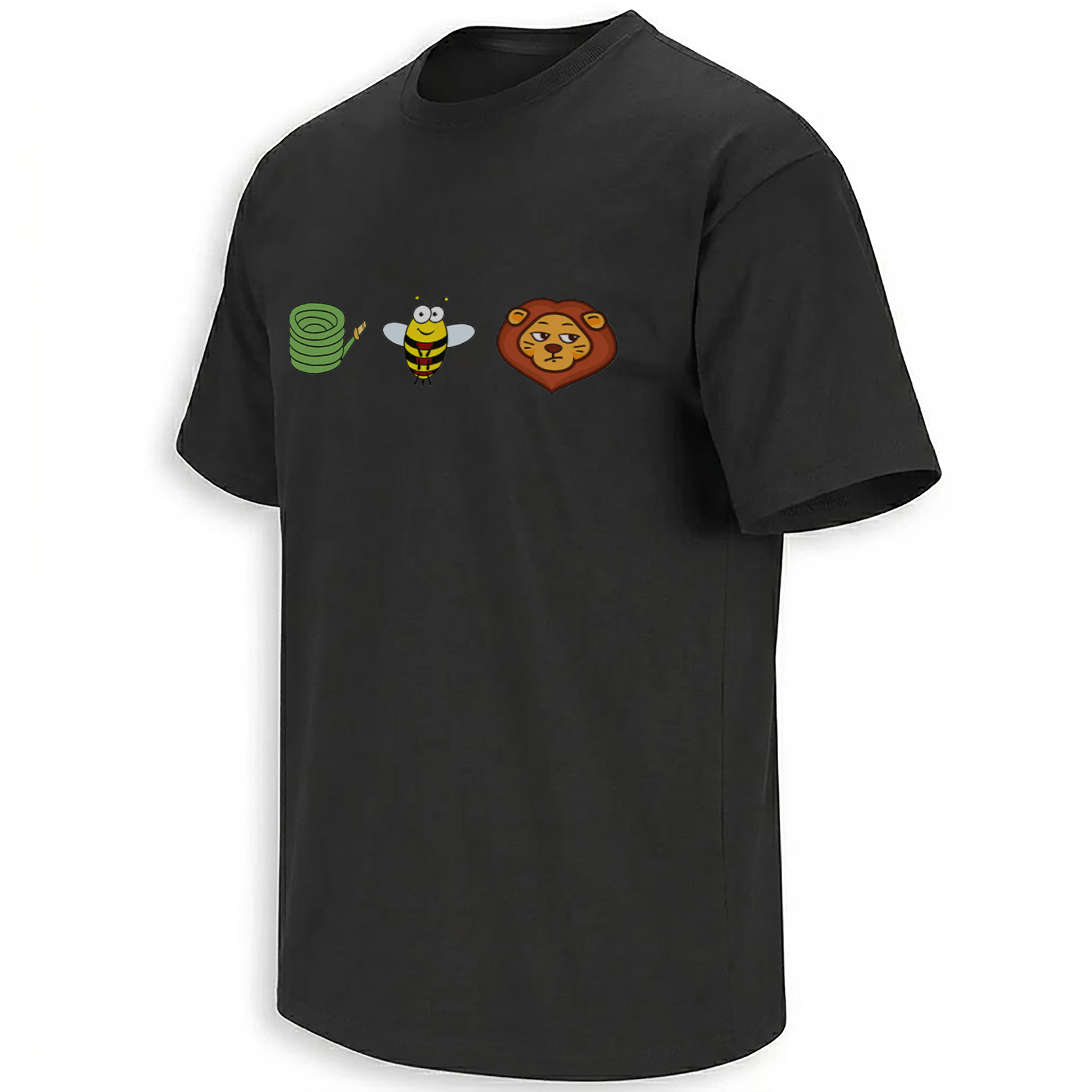
Hose Bee Lion Shirt
A clean sequence of colorful icons turns familiar internet slang into a wearable rebus that reveals itself one sound at a time.
What the design preserves
The shirt belongs to a long tradition of picture riddles, but its vocabulary is unmistakably online. It combines an old puzzle structure with meme-era slang and the visual economy of emoji communication.
Its appeal is therefore not only the answer. It preserves the moment of recognition—the small satisfaction of realizing that three cartoon objects have been saying something else the entire time.
Context and reference
Frequently asked questions
What does Hose Bee Lion mean?
Say the three labels quickly: “hose, bee, lion.” Their combined sound approximates the slang phrase “hoes be lyin’.”
Is Hose Bee Lion a rebus?
Yes. It uses pictures to represent sounds that combine into a different phrase, which is the central principle of a rebus puzzle.
Why is the answer not printed on the shirt?
Leaving the answer unstated makes the viewer participate. The brief attempt to decode the three images creates the joke’s delayed payoff.