
When a Young Boy Went to LEGO City
One of emo’s most recognizable opening lines takes a wrong turn into a frantic toy commercial, sending My Chemical Romance’s Black Parade mythology toward the most famous river emergency in LEGO City.
INTERNET CULTURE FEATURE · UPDATED JULY 27, 2026
In the summer of 2026, the opening piano note of “Welcome to the Black Parade” is once again carrying stadium-sized cultural weight. My Chemical Romance begins the United States leg of its Black Parade 2026 tour at Citi Field on August 9, part of a year that also marks two decades since the band released the album that defined an era of emo culture.
That anniversary atmosphere has returned one famous sentence to everyday circulation: the childhood memory that begins with a young boy being taken into the city by his father. For listeners who grew up with the record, the setup is so familiar that the next words arrive mentally before Gerard Way sings them.
The internet hears that predictability as an invitation. Instead of arriving at a marching band, the boy in this mashup is delivered to LEGO City “to see a man fall in the river”—a collision between theatrical emo memory and the breathless language of a children’s rescue-helicopter commercial.
Two sentences built to be interrupted
The original My Chemical Romance line works like a ceremonial doorway. A father takes his son into the city to see a marching band, establishing the childhood memory that becomes death’s visual form within the wider concept of The Black Parade.
The LEGO City commercial begins from the opposite emotional position. There is no slow recollection or dramatic preparation. A man has already fallen into the river, an emergency is underway and the audience is ordered to start building the rescue helicopter.
The joke works because both sources involve a father, a city and an event important enough to be shown to a child. Grammatically, the pieces almost fit. Emotionally, they could not be further apart.
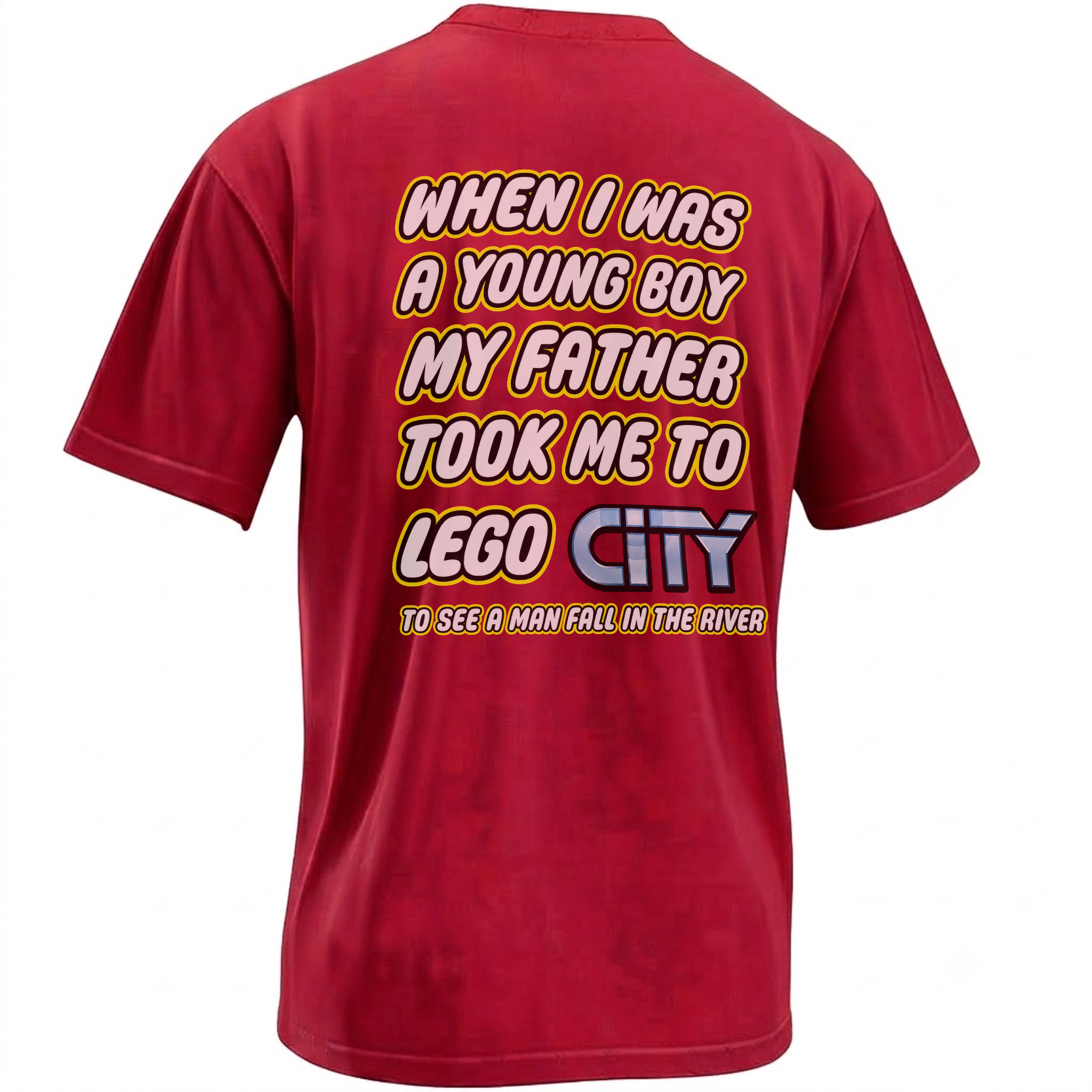
The meme succeeds in the fraction of a second when the reader’s memory supplies “marching band” and the shirt answers with a drowning minifigure.
Why “Welcome to the Black Parade” remains so interruptible
Many famous songs are recognized by their choruses. “Welcome to the Black Parade” is unusual because listeners often recognize it before the first lyric begins. Its opening piano note has become an identification test, an emotional trigger and a reusable internet cue.
The first lines are equally durable. Their deliberate pacing creates empty spaces in which the audience can anticipate each phrase. That predictability has supported countless rewrites: the father can take the young boy almost anywhere, and the marching band can be replaced by any image capable of puncturing the song’s grandeur.
The structure is especially useful for cross-fandom humor. The setup belongs unmistakably to My Chemical Romance, but the final noun or destination can open a door into games, cartoons, films or—as in this case—a building-toy commercial.
How a rescue-helicopter advertisement became meme language
The LEGO City river commercial promoted set 7903, the Rescue Helicopter. Its narration presents the scene as a sequence of commands: acknowledge the emergency, start the helicopter, prepare the lifeline, lower the stretcher and complete the rescue.
The commercial’s intense delivery made the relatively ordinary toy scenario sound like breaking news. The shouted “HEY!” from the stranded minifigure provided another clean fragment that could be repeated, isolated and exaggerated.
The commercial resurfaced as a major online meme around 2019 and 2020, producing remixes, sentence edits and deliberately excessive rescue scenarios. Owners of the original set suddenly found that a familiar childhood advertisement had become recognizable to people who had never assembled the helicopter.
Animation director Tommy Andreasen later shared the commercial and recalled making it with WillFilm in 2004 or 2005, with actor David Bateson providing the narration. The rescue set itself was released in the mid-2000s, years before the advertisement’s second life as internet audio.
2006 is the hidden bridge between both worlds
This shared chronology gives the crossover more emotional accuracy than a random lyric edit. Many people who encountered the LEGO City commercial as children also discovered My Chemical Romance during the same broad era—or absorbed both later through the internet’s archive of mid-2000s culture.
The shirt therefore places two forms of nostalgia on top of each other. One recalls the intensity of hearing an era-defining emo record. The other recalls plastic rescue sets, television advertising and the strangely urgent problems that governed LEGO City.
Why the visual design stays loud instead of gothic
A predictable Black Parade treatment would use military typography, monochrome figures, distressed paper and funeral-procession imagery. This artwork deliberately refuses that direction.
The large rounded lettering has the energy of novelty graphics and animated title cards. Yellow outlines and the metallic blue LEGO City-style wordmark interrupt the emotional seriousness associated with My Chemical Romance’s source line.
The red garment intensifies the toy-commercial side of the crossover. Rather than dressing the meme as an authentic piece of Black Parade-era merchandise, the artwork lets the false destination dominate. The wearer begins with emo language but visually arrives in a bright, synthetic city built from blocks.
The smaller final line is essential. “To see a man fall in the river” behaves like the reveal printed beneath a headline. The size hierarchy controls the reading tempo: recognition first, incorrect destination second, disaster last.
Why the joke lands especially well in 2026
My Chemical Romance is not merely being remembered during the album’s anniversary year. The band is actively carrying The Black Parade back into stadiums. Its official schedule lists the 2026 United States run beginning August 9 at Citi Field, followed by major venues across the country.
That tour gives old lyrics a current social life. Fans are revisiting the album, sharing performance clips, preparing outfits and returning to phrases that have lived in their vocabulary for twenty years.
The meme meets that grand revival with an intentionally ridiculous correction. It respects the recognizability of the song while refusing to leave the lyric untouched. That combination—affection expressed through sabotage—is one of the internet’s most dependable forms of fandom.
A crossover made from involuntary memory
The strongest reference jokes do not require the reader to stop and decode every ingredient. They cause two stored pieces of language to activate at once.
Read “When I was a young boy,” and the MCR melody begins internally. Read “LEGO City,” and the rescue-commercial narrator takes over. The shirt’s humor exists in the mental audio transition between those voices.
That is also why the design can survive beyond one short trend cycle. Both sources have already demonstrated unusual staying power: one as an emo anthem and the other as an endlessly editable commercial premise.
Within Ellie Shirt’s newest design archive, the graphic records a very specific form of 2026 nostalgia—an album anniversary, an upcoming stadium tour and an old LEGO commercial all occupying the same internet memory.
LEGO City Black Parade Meme FAQ
What does the “When I Was a Young Boy My Father Took Me to LEGO City” shirt mean?
It combines the opening setup of My Chemical Romance’s “Welcome to the Black Parade” with the famous LEGO City commercial in which a man falls into the river and requires a rescue helicopter.
What is the original Black Parade reference?
The song begins with a father taking his young son into the city to see a marching band. The meme changes the destination to LEGO City and replaces the band with the river emergency.
Where did the LEGO City river meme come from?
It came from a mid-2000s commercial for LEGO City set 7903, the Rescue Helicopter. The advertisement’s urgent narration and shouted “HEY!” later became widely remixed online.
Why is the meme relevant again in 2026?
The Black Parade reaches its twentieth-anniversary year in 2026, while My Chemical Romance is performing a major international tour built around the album.
Did My Chemical Romance collaborate with LEGO on this phrase?
No. The sentence is an unofficial internet mashup created by combining two independently famous pieces of mid-2000s culture.
Why do the two references fit together so smoothly?
Both contain a young person, a city and a dramatic event. Their sentence structures connect naturally even though one is an emotional rock narrative and the other is a toy-rescue commercial.
The marching band missed its exit
Explore the graphic that reroutes one of emo’s most familiar childhood memories through the endlessly endangered streets of LEGO City.
When I Was a Young Boy My Father Took Me to LEGO City Shirt combines the opening memory of “Welcome to the Black Parade” with the famous man-in-the-river rescue meme, connecting two enduring pieces of mid-2000s nostalgia.