The Bazzmanian Devil Arrived Travis Bazzana Turned a Rookie Season Into Cleveland’s New Cartoon Myth
Travis Bazzana began 2026 in Triple-A, reached Cleveland in April, produced a two-homer breakout in June and entered the All-Star conversation before his rookie season was halfway finished. The nickname graphic translates that acceleration into a spinning baseball character.
Cleveland did not wait long for Travis Bazzana’s rookie season to develop a visual language. By the time he reached the All-Star break, the former No. 1 pick had already supplied the ingredients sports culture loves most: a rapid arrival, one explosive signature game and a nickname built for illustration.
“Bazzmanian Devil” succeeds because fans do not need a long explanation before they understand the joke. Bazzana’s surname naturally bends toward the familiar image of a cartoon whirlwind, but the phrase gained real energy from the way his first Major League months unfolded.
He opened the year outside the Major League roster, debuted for Cleveland on April 28 and quickly moved from highly watched prospect to active part of the Guardians’ season. By early July, he had been selected as a first-time All-Star alongside Parker Messick and Cade Smith — an unusually fast shift from Triple-A uncertainty to baseball’s midsummer stage.
A good player nickname identifies someone. A great one gives fans an entire character they can recognize before the caption appears.
The Moment the Nickname Found Its Highlight
Prospect hype often arrives before a player has produced a Major League image strong enough to support it. Rankings, draft position and scouting grades create expectation, but they remain abstract until a game gives fans something concrete to replay.
For Bazzana, that game came in Houston on June 20. He went 4-for-4, hit the first two home runs of his Major League career and drove in five runs in an 8–1 Cleveland victory.
The box score mattered, but the shape of the performance mattered even more. Multiple hits, multiple home runs and career highs arriving together made the afternoon feel like a release of stored energy. The former top pick was no longer being discussed only through what he might eventually become. He had produced the kind of game that could anchor a rookie-season identity.
“Bazzmanian Devil” sounds especially natural after a performance like that. The phrase suggests repeated motion rather than one isolated swing — a hitter entering the game, circling the bases and returning to the plate before the opponent has fully contained the damage.
How a Draft Story Became a Cleveland Story
Cleveland selected Bazzana first overall in the 2024 MLB Draft, making him the first Australian-born player chosen with the top pick. That history followed him through the minor leagues, where every promotion was measured against the unusual weight attached to his selection.
Yet draft status alone does not create an emotional relationship with a Major League city. That happens through repetition: seeing the player in the lineup, recognizing the batting stance, learning what his best at-bats look like and watching his name enter everyday discussions about winning.
By the summer of 2026, Bazzana had started crossing that boundary. He was no longer only the Guardians’ future arriving from Oregon State and Australia. He was a second baseman contributing to the current Cleveland season, producing runs and appearing in the same conversation as established Major Leaguers.
First overall in 2024, Australian-born and followed through every stage of Cleveland’s development system.
A quick MLB arrival, an explosive two-homer afternoon and a nickname that converted prospect attention into fan culture.
The Artwork Builds a Player, Not Just a Portrait
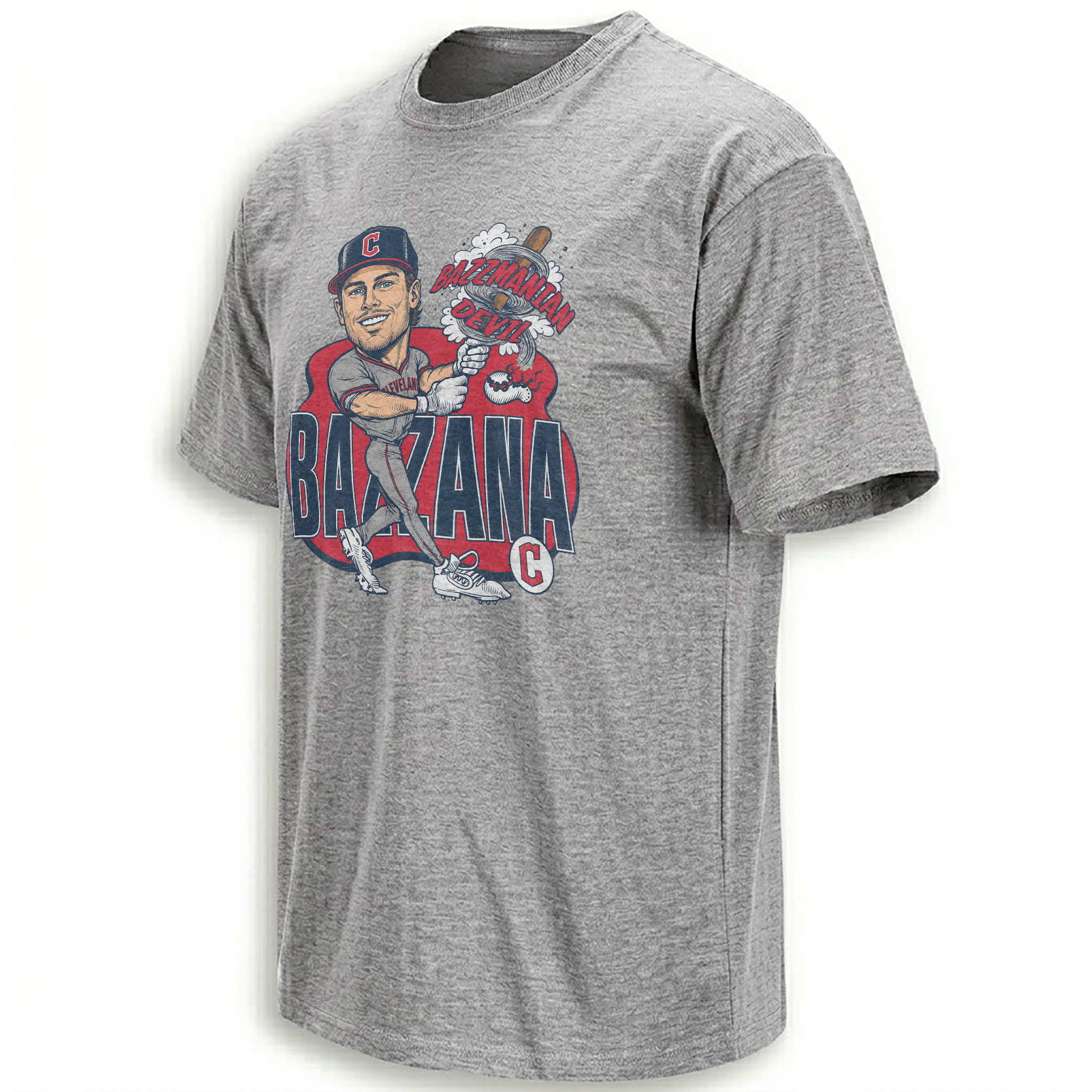
The Bazzmanian Devil Shirt does not attempt to reproduce a realistic baseball photograph. It exaggerates Bazzana into a vintage sports caricature — oversized head, wide smile, compact swinging body and a collection of motion symbols surrounding him.
That choice is important because nickname graphics work best when they create a world around the player. A standard action image would identify Bazzana, but it would not explain the whirlwind idea. The illustration supplies the additional grammar: smoke, rotation, flying equipment and a baseball leaving the scene with a flame trail.
The Tornado Is the Center of the Joke
The twisting cloud above the bat is more than decoration. It converts the nickname from sound into movement. “Bazzmanian Devil” would remain a clever rhyme without it; the tornado gives the phrase physical behavior.
White smoke curls around the red-and-navy nickname lettering, while the bat rises directly into the spinning form. The placement suggests that the swing itself generated the storm.
Nearby, a baseball carries a red flame trail away from the composition. Cartoon baseball art has always used exaggerated fire, speed lines and smoke to visualize force that a still image cannot literally show. Here, those devices turn a batting action into controlled chaos.
The loose helmet near Bazzana’s feet strengthens that reading. The design implies that the movement has become too violent for everything to remain neatly attached. It is a visual joke, but it also supplies rhythm: the eye travels from tornado, to bat, to body, to flying ball and finally down to the equipment displaced by the swing.
Navy and red establish Cleveland immediately; the gray shirt base gives the artwork the faded texture of an older stadium caricature; the circular red backdrop concentrates the action; and the exaggerated smoke, flame and loose equipment transform Bazzana’s name into a complete baseball character.
Why the Oversized Bazzana Lettering Matters
The surname occupies nearly the entire lower half of the graphic. Tall navy letters with red shading create the feeling of a player poster from an era when caricatures and bold names did more work than detailed statistical copy.
This scale is especially appropriate for a rookie. Established stars can be identified by a number, silhouette or familiar pose. Bazzana’s public identity is still being built, so the design makes the name impossible to miss.
The typography also stabilizes the composition. Above it, the artwork spins in several directions. Beneath it, the large surname behaves like a foundation, keeping the tornado and batting figure from feeling visually uncontained.
From Sydney to Baseball’s Midsummer Stage
Bazzana’s Australian background gives his rookie rise another layer of meaning. He grew up in New South Wales, played cricket as a wicketkeeper and opening batter, represented Australia in international baseball and eventually moved through Oregon State to the first overall pick.
That pathway does not fit the most familiar American baseball-development story. It crosses sporting cultures and continents before reaching Cleveland, which is one reason Australian baseball followers have treated his progress as something larger than an individual prospect journey.
His 2026 All-Star selection extended that significance. Bazzana reached the Midsummer Classic during his first Major League season, giving Australian baseball a new reference point and placing his Cleveland rookie story in front of a league-wide audience.
The nickname quietly reflects that background without turning the entire design into a national-symbol collage. “Bazzmanian” echoes a widely understood Australian cartoon association, while the rest of the artwork remains firmly inside Cleveland baseball language.
Why All-Star Selection Changed the Meaning of the Graphic
Before the selection, the design could be read as a playful prospect shirt built around potential. After Bazzana became a rookie All-Star, the same tornado began to look like a visual summary of how quickly his season had moved.
He began 2026 in Triple-A Columbus after being told he would not make Cleveland’s Opening Day roster. Within weeks, he was in the Major Leagues. Within months, players across baseball had voted him into the All-Star Game.
That sequence gives the nickname credibility. The “devil” language is not meant to portray aggression in a literal sense; it describes disruption — the sense that Bazzana entered Cleveland’s season and immediately altered the conversation around the lineup, the future and the franchise’s recent first-round development success.
Internet Baseball Loves a Name It Can Visualize
Player nicknames spread when they are useful. They must fit naturally in captions, sound good during broadcasts and provide fans with a shorthand that feels more expressive than a surname alone.
“Bazzmanian Devil” checks each of those boxes, but its strongest advantage is visual. Fans can immediately imagine rotation, dust, speed and cartoon exaggeration. The phrase arrives with its own motion graphics.
That makes it adaptable across highlight reactions and fan conversation. A multi-hit performance can become “the storm.” A home run can become another ball launched from the whirlwind. A hot streak can be described as the character spinning back into the lineup.
The shirt captures that language before it becomes overly formalized. It feels like a fan-made character emerging during the rookie year rather than a corporate mascot introduced after years of focus-group testing.
A New Character Inside Cleveland’s Baseball Archive
Cleveland baseball has a long relationship with player-specific phrases, caricatures and nicknames. Those devices help fans divide a season into recognizable personalities rather than treating every roster as one interchangeable team identity.
Bazzana adds a particularly flexible character to that tradition. The nickname can follow him beyond a single game because it is tied to his name and style rather than one score or temporary standings position.
The wider Cleveland Guardians collection places the tornado graphic alongside other player stories, team language and season-specific moments, creating a running visual map of how supporters experience the current roster.
Inside the broader MLB collection , the design belongs to baseball’s larger history of turning rookies into characters through newspaper cartoons, scorecard illustrations, nickname shirts and exaggerated action art.
Frequently Asked Questions
Who is Travis Bazzana?
Travis Bazzana is an Australian second baseman whom the Cleveland Guardians selected first overall in the 2024 MLB Draft. He made his Major League debut on April 28, 2026.
Why is Travis Bazzana called the Bazzmanian Devil?
The nickname combines Bazzana’s surname with the familiar Tasmanian Devil idea, creating a playful description of his energetic, disruptive and fast-moving baseball identity.
Was Travis Bazzana selected for the 2026 MLB All-Star Game?
Yes. Bazzana was chosen as a player-elected reserve during his rookie season and represented Cleveland alongside first-time All-Stars Parker Messick and Cade Smith.
What happened during Bazzana’s breakout game against Houston?
On June 20, 2026, Bazzana went 4-for-4 with two home runs and five RBIs as Cleveland defeated Houston 8–1.
What does the tornado represent in the design?
The tornado translates the Bazzmanian Devil nickname into visual movement, making Bazzana’s swing appear to generate smoke, rotation and controlled cartoon chaos.
Why is a flaming baseball included?
The flame trail exaggerates the speed and force of the batted ball in the language of vintage sports cartoons, where fire and motion lines communicate power inside a still image.
How does the artwork reference Cleveland?
Navy, red and gray colors, the red “C” cap, supporting Cleveland symbols and the oversized player lettering connect the nickname character directly to Guardians baseball culture.
The Bazzmanian Devil graphic preserves the speed of Bazzana’s first Major League summer, while the wider Cleveland Guardians archive follows the player moments and fan language shaping the club’s current identity.
Bazzmanian Devil Shirt captures Travis Bazzana’s 2026 Cleveland rookie rise through a vintage cartoon swing, spinning tornado, flaming baseball, oversized Bazzana lettering and Guardians-inspired navy-and-red color.