
Show & Go How Boston Turned Motion Into a Team Identity
A short phrase, a triangle full of names and a roster built around movement turn “Show & Go” into something larger than a slogan: a snapshot of how the 2026 Red Sox want their baseball to feel.
“Show and go” first sounded like the only possible plan after Boston’s travel schedule collapsed between Chicago and New York: arrive, change clothes and play before the body had time to remember everything that had gone wrong.
The phrase survived because the Red Sox did more than survive the trip. They won after the delay, finished a perfect nine-game road run and turned a logistical disaster into clubhouse folklore. What began as improvisation started sounding like an identity.
That is the energy carried by the newer roster-focused Show & Go graphic. The airplane and “See You at 4:15” preserve the original travel joke, but the triangle design expands the phrase. It asks what “show and go” looks like when translated from one chaotic afternoon into the speed, pressure and collective movement of an entire baseball team.
The best clubhouse language does not explain every detail. It gives the entire group a faster way to recognize itself.
From Travel Joke to Baseball Philosophy
The original “Show and Go Airlines” joke worked because it reduced nearly twenty-four hours of uncertainty to one deliberately cheerful promise: the team would eventually appear and the game would still be played.
In baseball terms, “show and go” also carries a second meaning. It suggests reducing hesitation. Reach base and create pressure. Turn a single into extra movement. Force the defense to process the next action before it has finished the previous one.
That interpretation does not require the phrase to become an official tactical doctrine. Its strength comes from emotional accuracy. The words feel compatible with a Boston core associated with athleticism, aggressive baserunning, defensive range and the kind of momentum that makes a lineup appear faster than the stopwatch alone can measure.
The Triangle Turns Individual Names Into One Core
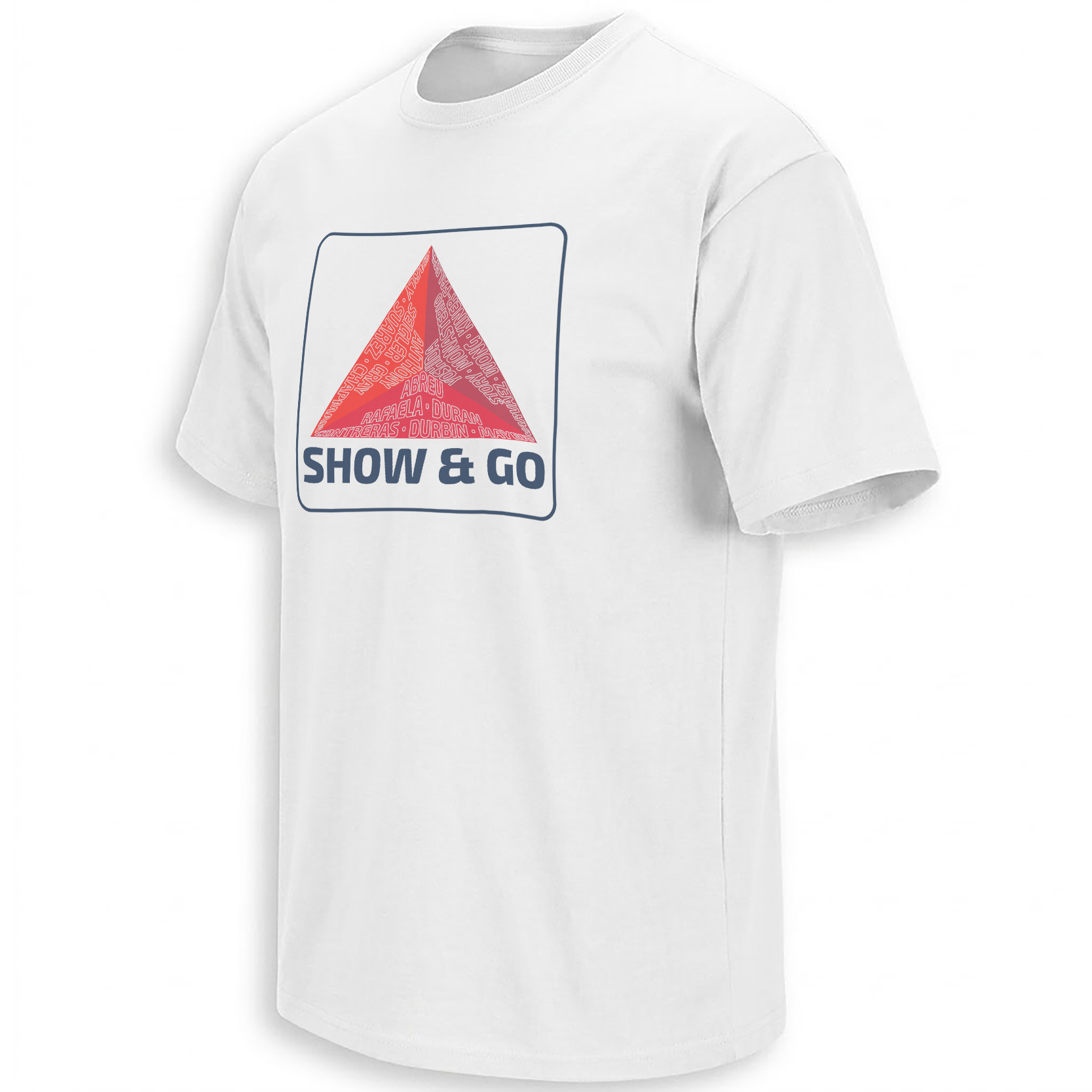
The Show & Go Shirt does not center one player portrait. Instead, names including Abreu, Rafaela, Duran, Contreras, Durbin and Mayer are fitted into a single coral-red triangle.
That visual decision changes the meaning of the design. A normal player shirt asks the viewer to focus on one individual story. The triangle asks the names to function collectively. Each one remains readable, but together they become the texture of the shape.
Why the Geometry Matters
Sports graphics frequently rely on circular seals, horizontal wordmarks or player collages. The triangle creates a different rhythm. Its point directs the eye upward, producing the visual impression of acceleration and forward movement even though the artwork itself remains still.
The rounded navy frame controls that motion. Without it, the triangle and player names could feel like loose word art. Inside the frame, they behave like a compact modern badge — clean at a distance, more detailed when viewed closely.
Coral red softens the harshness of a pure primary red while still reading immediately as Boston baseball color. Navy gives the phrase weight, and the white shirt base leaves enough open space for the shape to remain sharp rather than crowded.
The upward triangle represents movement; the names turn roster identity into texture; the navy frame supplies structure; and the oversized SHOW & GO type converts an internal-feeling phrase into a piece of contemporary Boston streetwear.
Why Roster Shirts Feel Different From Star Shirts
Baseball culture naturally produces player heroes, but a long season also teaches fans to think in combinations. One player reaches base, another moves him, a defender saves a run and a pitcher turns the next inning into an opportunity.
A roster graphic visualizes that dependence. Abreu, Rafaela, Duran, Contreras, Durbin and Mayer do not appear as isolated advertisements. Their names are arranged inside the same geometric system, creating the impression of a core whose identities overlap.
That makes the shirt read like a snapshot rather than a permanent historical roster. It belongs to a specific version of Boston baseball — one shaped by the names fans are currently watching, debating and connecting to the team’s changing competitive identity.
The Internet Understands Short Clubhouse Language
Long explanations rarely become fan language. Short phrases do. They fit into captions, signs, broadcasts, group chats and the compressed emotional vocabulary of a winning streak.
“Show and go” works because it can carry several memories at once. For fans who followed the travel episode, it recalls the late arrival and the victory at Citi Field. For others, it sounds like a philosophy of movement. Inside the triangle design, it becomes a label for the roster itself.
The phrase therefore gains meaning through repetition rather than official definition. Every Boston win, extra-base advance or chaotic sequence gives supporters another reason to use it, even when they are no longer discussing the delayed flight that started the joke.
Boston’s Running Visual Archive
The wider Boston Red Sox collection captures both sides of that developing language. The airline graphic records the exact travel disaster, while the speed-core triangle turns “Show & Go” into a broader roster statement.
Inside the broader MLB collection , the design joins baseball’s long tradition of clubhouse phrases, improvised jokes and roster graphics that become meaningful because fans remember the stretch of the season in which they appeared.
That is why the two Show & Go visuals should not be treated as duplicates. One is a documentary punchline. The other is an identity system. Together they show how a moment moves from event, to joke, to shared team language.
Frequently Asked Questions
What does “Show & Go” mean in Red Sox culture?
The phrase grew from Boston’s chaotic 2026 trip from Chicago to New York, when the team arrived with little normal preparation, played anyway and turned the experience into clubhouse humor.
How is this design different from the Show and Go Airlines shirt?
The airline design preserves the delayed-flight story and “See You at 4:15” joke, while the triangle graphic expands the phrase into a roster and speed-oriented Boston baseball identity.
Which player names appear inside the triangle?
Visible names include Abreu, Rafaela, Duran, Contreras, Durbin and Mayer, arranged as word art inside the coral-red triangle.
Why is the design built around a triangle?
The upward-pointing triangle creates a visual sense of speed, direction and collective movement while allowing multiple roster names to form one recognizable shape.
Why did the phrase become memorable after the road trip?
Boston won despite the travel disruption and completed a perfect 9–0 road trip, changing the phrase from a joke about inconvenience into a symbol of adaptability and momentum.
The Show & Go Speed Core graphic turns Boston’s current names into one moving shape, while the wider Red Sox culture archive follows the clubhouse stories, player moments and visual language surrounding the team.
Show & Go Shirt captures Boston’s 2026 speed-core identity through a coral-red triangle filled with Red Sox player names, a bold navy wordmark and the clubhouse language born from an unforgettable road trip.