
Giannis Antetokounmpo Is a Miami Heat Player and No. 7 Has Become the Symbol of a New Era
After thirteen seasons, two MVP awards and a championship in Milwaukee, Giannis Antetokounmpo has arrived in Miami with a new uniform, a new number and another franchise prepared to organize its championship ambitions around him.
Miami had spent years waiting for the next superstar transaction to become real. Rumors came and disappeared, trade frameworks were debated, cap sheets were studied and nearly every major name eventually found some connection to the Heat’s search for another championship centerpiece.
On July 6, the waiting ended. Giannis Antetokounmpo and Bobby Portis arrived from Milwaukee in a blockbuster trade that sent Tyler Herro, Jaime Jaquez Jr., Kel’el Ware, Kasparas Jakučionis and a major package of draft assets to the Bucks.
The scale of the move was immediately clear. Miami did not trade for a star who might someday become the face of the team. It acquired a two-time MVP, a Finals MVP, an NBA champion and one of the defining interior forces of his generation.
One day later, the visual break from the past became even sharper. Giannis would not bring No. 34 with him to Miami. The next chapter would begin with No. 7.
The trade moved Giannis from Milwaukee to Miami. The number change made the move feel like a genuine second career rather than the continuation of the first.
Miami Finally Landed the Kind of Star It Had Been Chasing
The Heat’s history is partly a history of transforming major acquisitions into franchise eras. Shaquille O’Neal arrived in 2004 and helped build the path to the 2006 championship. LeBron James and Chris Bosh joined Dwyane Wade in 2010, producing four consecutive NBA Finals appearances and two titles.
Those moves shaped the expectations surrounding every Miami offseason afterward. The organization was not satisfied with merely improving around the edges. Its preferred strategy remained the pursuit of a player large enough to alter the structure of the conference.
Giannis fits that tradition more clearly than almost any player Miami could have acquired. He brings championship experience, global recognition, elite transition force and the ability to reshape both offensive spacing and defensive responsibilities.
The cost reflects the ambition. Miami surrendered young players, an All-Star scorer in Herro and significant draft capital. The Heat did not preserve two timelines. They chose the present.
Miami spent multiple seasons searching for a superstar capable of restoring the team’s championship ceiling after the previous Finals-era core changed.
The Heat acquired Giannis and Portis through a massive package built from players, a 2026 lottery selection and future draft control.
Giannis moved away from the No. 34 identity attached to his Milwaukee career and selected No. 7 for the beginning of his Miami chapter.
Why the End of the Milwaukee Chapter Feels So Significant
Giannis did not leave Milwaukee as a temporary star or a player whose identity had become disconnected from the franchise. He left as the central figure in modern Bucks history.
Milwaukee drafted him in 2013, watched him develop from an unusually long and raw prospect into a global superstar, and built its greatest recent basketball memory around his rise. His 2021 championship, Finals MVP performance and 50-point closeout game became permanent parts of the city’s identity.
That history makes the Miami arrival emotionally complicated. The Heat are not simply receiving another elite forward. They are receiving a player whose previous team, number and city had become inseparable from how basketball culture understood him.
The farewell matters because the new imagery cannot erase the old chapter. Giannis No. 7 in Miami will always be read against Giannis No. 34 in Milwaukee. The contrast is part of the cultural power.
No. 7 Makes the Arrival Feel Like a True Reinvention
Jersey numbers often function as visual shorthand. No. 34 immediately recalls Giannis attacking the rim in a Bucks uniform, lifting the championship trophy and building thirteen seasons of Milwaukee history.
By selecting No. 7, Giannis created separation. Every future Miami photograph will carry a number that did not appear in the defining images of his first career chapter.
That separation is especially important in sportswear and fan culture. A color change alone can feel like a familiar player placed into another team’s template. A number change signals that the player has accepted a new visual identity.
No. 7 therefore operates as a timestamp. It identifies the exact moment when the Milwaukee icon became the centerpiece of Miami’s next championship attempt.
Three Graphics, Three Ways to Record the Arrival
The three Giannis Miami designs do not repeat the same idea. Each records a different stage of how a blockbuster transaction becomes fan memory.
The arrival graphic treats the trade as an event. The signature graphic treats Giannis as a new Miami icon. The No. 7 new-era design treats the number itself as the central symbol of transformation.
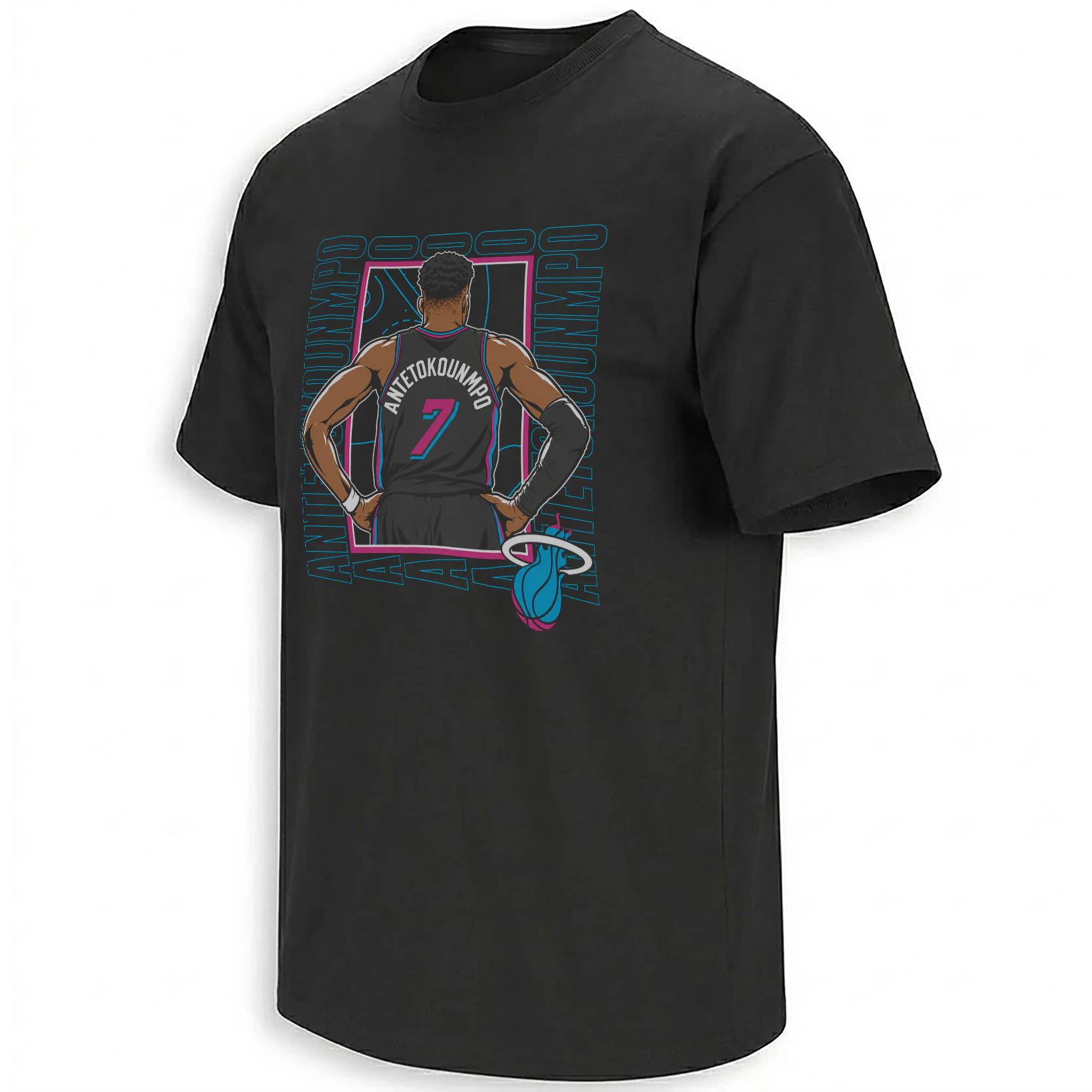
An event-style composition centered on the first visual shock of the trade: Giannis wearing Miami colors and a number never associated with his Milwaukee era.
View the arrival piece →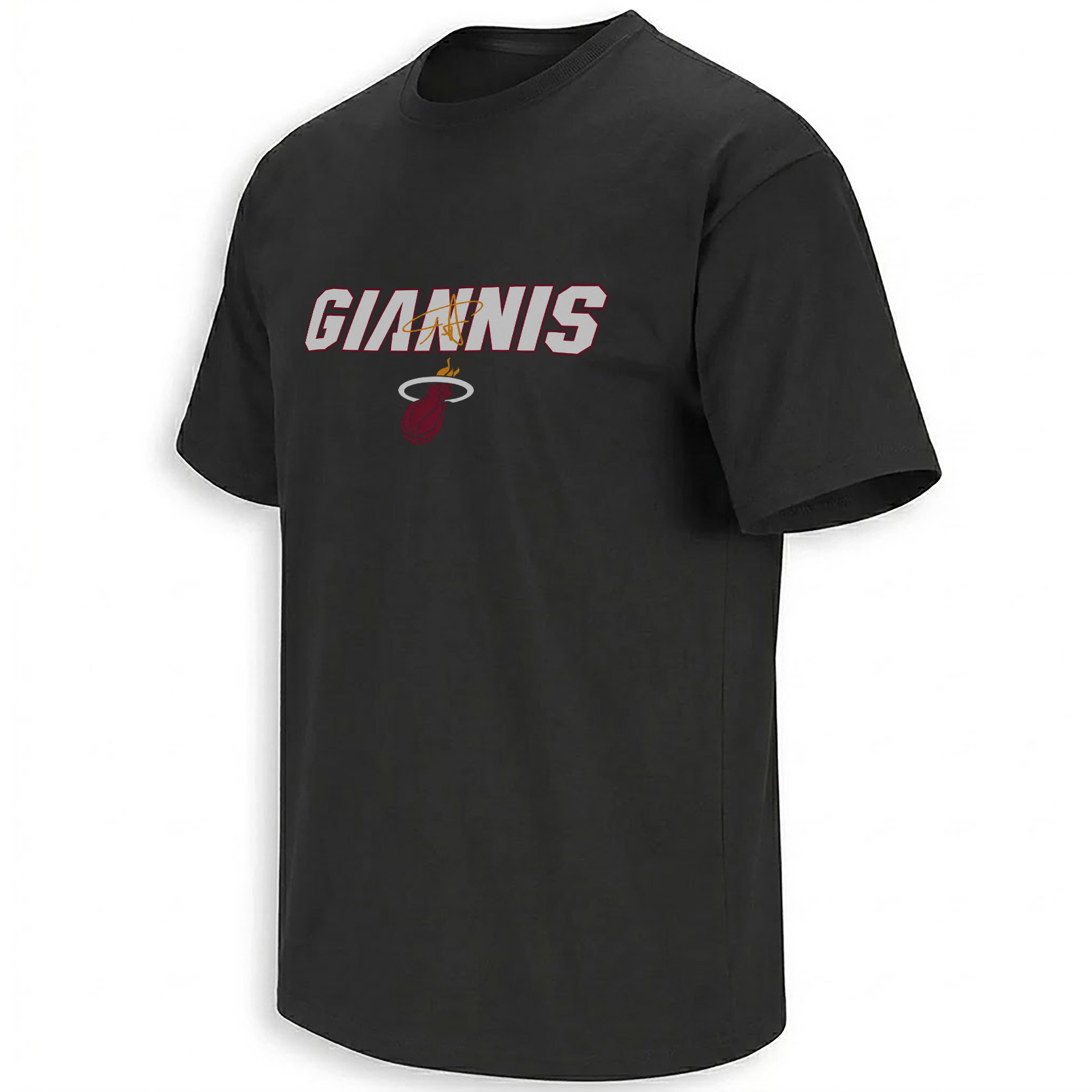
A cleaner, emblem-like interpretation that combines personal signature language with Miami identity and treats the acquisition as the birth of a new franchise symbol.
Open the signature design →
The number becomes the headline, transforming Giannis’ change from 34 to 7 into the most concise visual marker of his South Beach chapter.
Explore the No. 7 piece →The Arrival Graphic Captures the Shock of the Transaction
The first design operates like a breaking-news poster. Giannis is presented through the visual information fans needed immediately after the trade: Miami colors, Heat identity and No. 7.
That directness matters because blockbuster transactions first exist as disbelief. Fans refresh the announcement, imagine the uniform and attempt to reconcile the player they know with a setting that still looks unfamiliar.
An arrival graphic freezes that brief period before the new image becomes normal. Months later, Giannis in Miami may feel established. At the moment of the trade, it looked almost impossible.
The Signature Graphic Turns Giannis Into a Miami Emblem
Signature-based graphics create a different kind of authority. Rather than emphasizing the transaction, they emphasize ownership of the new identity.
A signature suggests that the player has placed his personal mark onto the franchise. It moves the visual language from “Giannis has arrived” to “this is now part of Giannis’ world.”
That distinction fits Miami’s history of superstar branding. The city has repeatedly transformed individual players into eras with their own logos, color systems, catchphrases and visual signatures.
The No. 7 Graphic Records the Cleanest Symbol of the New Era
The third design removes much of the surrounding explanation and allows No. 7 to carry the meaning. That number contains the trade, the uniform change and the decision to separate the Miami story from the Milwaukee one.
Numbers are especially powerful in basketball culture because they become part of how fans refer to players. A new number begins empty. Each major performance then adds meaning.
No. 7 currently represents arrival. If Miami reaches the Finals, wins a major playoff series or creates another championship run, the number will absorb those images.
The deep red palette gives the graphics immediate Miami recognition while also communicating the intensity of a franchise making an all-in championship move.
Controlled pink and blue references connect the designs to South Beach culture without overwhelming the stronger black-and-red basketball foundation.
The new number visually separates Giannis’ Miami identity from every major image produced during his thirteen seasons wearing No. 34 in Milwaukee.
Large names, numbers and arrival language reproduce the feeling of a city announcement rather than an ordinary player portrait.
Why Giannis and Heat Culture Appear Built for Each Other
Miami’s public identity is organized around conditioning, physical preparation, defensive responsibility and the expectation that star players participate in the same demanding culture as everyone else.
Giannis has built his career through many of the same ideas. His game depends on force, repetition, physical discipline and the willingness to attack the most crowded part of the floor.
The fit is not only stylistic. It is symbolic. Heat Culture often presents itself as the structure capable of maximizing players who are willing to work inside it. Giannis arrives as one of the league’s clearest embodiments of relentless physical commitment.
Miami is therefore not asking fans to believe that the franchise will change Giannis’ personality. It is asking them to imagine what happens when two established identities reinforce each other.
The Giannis-to-Miami story is not simply whether an MVP can produce elite statistics in another uniform. It is whether Heat structure, Giannis’ physical dominance and Bam Adebayo’s defensive intelligence can create another championship architecture.
The Bam Adebayo Partnership Changes Miami’s Defensive Ceiling
Bam Adebayo was the player Miami clearly protected during the trade process. That decision reveals the intended shape of the next era.
Giannis and Bam give the Heat two large, mobile defenders capable of switching, protecting the paint and changing assignments within the same possession. Their combined athletic range could allow Miami to create defensive lineups that are both physically overwhelming and tactically flexible.
Offensively, the fit will create more questions. Miami must provide enough shooting and half-court organization to prevent opposing teams from crowding the lane. But the pressure Giannis places on the rim should also create opportunities for Bam as a passer, cutter and short-roll decision-maker.
The pairing gives Miami something it has not possessed in years: a superstar whose physical presence can bend an opponent before the Heat need to rely on difficult late-clock shot creation.
The Trade Also Redefines Miami’s Relationship With the Future
Before the deal, Miami could still imagine several possible versions of its next roster. Young players might develop. Draft picks might become future trade assets. Another star might eventually become available.
The Giannis trade collapsed those possibilities into one decision. The future assets left. The superstar arrived.
This creates urgency around every remaining roster move. Shooting, guard play, health management and depth are no longer abstract development questions. They are championship variables attached to the later stage of Giannis’ prime.
No. 7 therefore represents a countdown as much as a beginning. Miami has chosen the era it wants. The responsibility now is to build quickly enough around it.
Why the Internet Reaction Focused So Quickly on the Uniform
Blockbuster trades immediately create visual speculation. Fans do not wait for training camp to imagine the new player in team colors. Edits, jersey swaps, lineup graphics and number debates appear within minutes.
Giannis intensified that response because No. 34 had been part of his identity for so long. The switch to No. 7 gave fans a second visual event after the trade itself.
Across basketball spaces, the discussion moved between the enormous trade package, Miami’s championship ceiling, the fit beside Bam and the strange new appearance of “Antetokounmpo 7” on the back of a Heat uniform.
That unfamiliarity is exactly why the designs matter now. They document the brief cultural stage when the new image still feels surprising.
Miami Has Entered Another Superstar Era
The Heat’s championship history is organized around names large enough to define periods: Wade, Shaq, LeBron, Bosh, Butler and now Giannis.
Each era had a different emotional shape. Wade and Shaq represented the franchise’s first title. The Big Three represented overwhelming expectation and global attention. Jimmy Butler’s years represented defiance, difficult playoff roads and a culture capable of repeatedly exceeding regular-season assumptions.
The Giannis era begins with different pressure. Miami has acquired an established champion who is openly connected to the pursuit of additional titles. The franchise has sacrificed flexibility to give that pursuit a new home.
Whether the era ultimately reaches the Finals cannot yet be known. What can already be identified is its visual beginning: red and black, South Beach, Antetokounmpo across the back and the number 7 beneath it.
The Wider Miami and NBA Visual Archive
The broader Miami Heat collection now functions as a visual timeline connecting Heat Culture, older championship eras, current player identity and the first graphics of the Giannis No. 7 chapter.
The wider NBA collection places the transaction inside the larger culture of superstar movement, number changes, new partnerships and the moments when one trade reorganizes how an entire league imagines the next season.
Frequently Asked Questions
Is Giannis Antetokounmpo officially a Miami Heat player?
Yes. Miami officially acquired Giannis Antetokounmpo and Bobby Portis from the Milwaukee Bucks in a blockbuster trade announced on July 6, 2026.
What number will Giannis wear for the Miami Heat?
Giannis will wear No. 7 in Miami after wearing No. 34 throughout his thirteen-season career with Milwaukee.
Who did Miami trade for Giannis Antetokounmpo?
Miami sent Tyler Herro, Jaime Jaquez Jr., Kel’el Ware, Kasparas Jakučionis and a major package of draft selections and future pick control to Milwaukee.
Why is the No. 7 change culturally important?
The new number visually separates Giannis’ Miami chapter from the No. 34 identity attached to his MVP seasons, championship and thirteen years in Milwaukee.
How do the three Giannis Miami graphics differ?
The arrival graphic records the shock of the trade, the signature design presents Giannis as a new Miami icon and the No. 7 graphic treats the number change as the central symbol of the new era.
Why could Giannis and Bam Adebayo become a major defensive pairing?
Both players combine size, mobility, interior protection and the ability to defend multiple positions, giving Miami unusual flexibility in switching and help-defense structures.
What does the trade mean for Miami’s championship timeline?
Miami exchanged young talent and significant future assets for an established superstar, making the immediate pursuit of another NBA championship the clear priority.
The Giannis arrival graphic , signature design and No. 7 new-era piece preserve three different layers of the blockbuster moment, while the Miami Heat visual archive follows the championship expectations, player language and South Beach identity surrounding the beginning of the Giannis era.
Giannis Antetokounmpo Miami Heat graphics capture his blockbuster 2026 arrival through No. 7, signature branding and South Beach color language, preserving the moment Miami transformed a two-time MVP into the centerpiece of its next championship era.