Bryce Harper’s Swing: The silhouette that still defines modern Philadelphia baseball
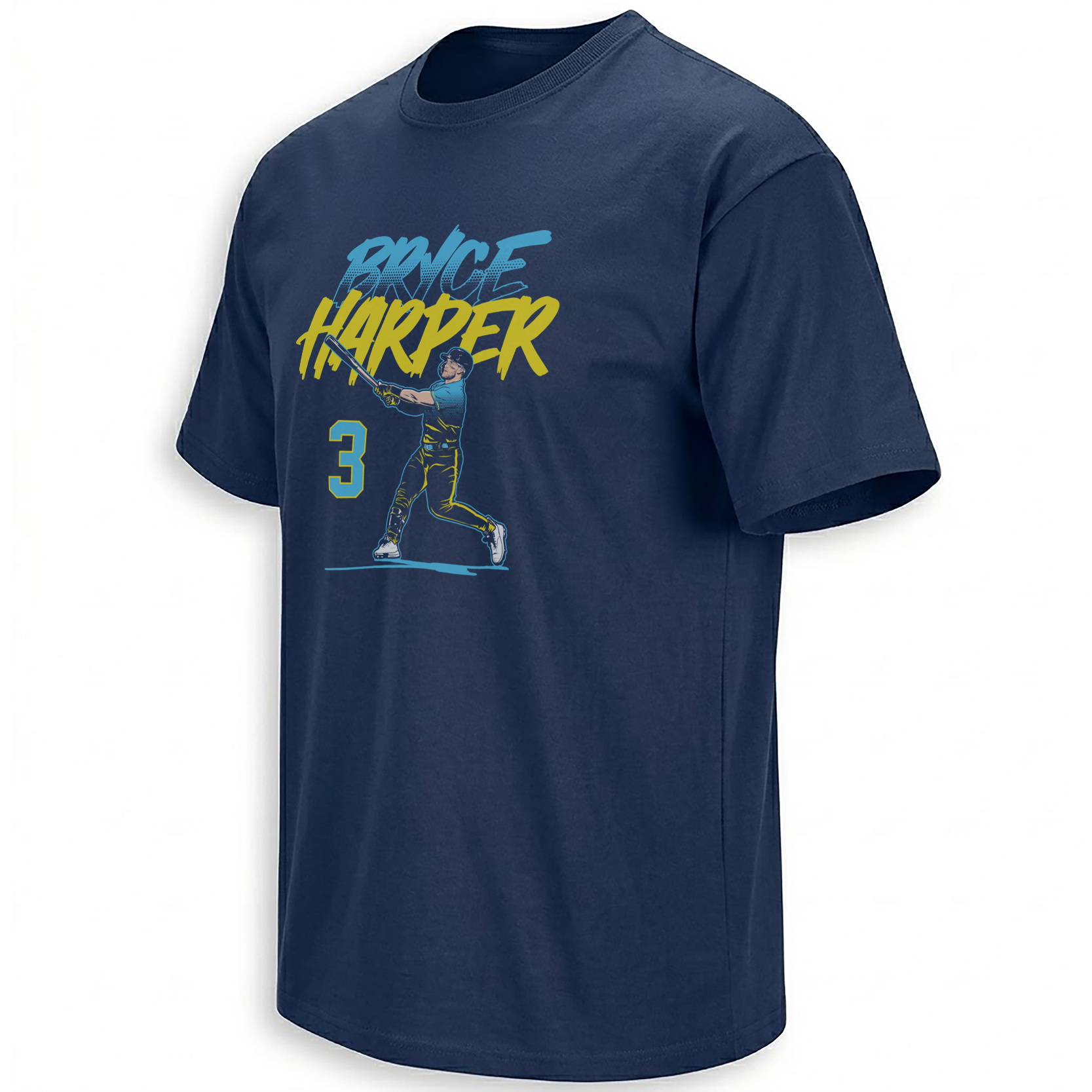
The leg lift, violent rotation and No. 3 crossing the center of the frame have become their own Phillies language—recognizable even before the ball appears.
Bryce Harper reached Philadelphia’s 2026 All-Star summer with another season already dense enough to feel like a highlight reel. He had twenty home runs before the break, earned an eighth career All-Star selection and completed the first cycle of his major-league career against the Mets on June 20.
The All-Star Game and Home Run Derby arriving at Citizens Bank Park placed him inside an unusually local spotlight. Harper was no longer simply representing Philadelphia on a national stage. The national stage had moved into the ballpark where his swing had produced some of the franchise’s defining modern images.
That timing gives the No. 3 slugger graphic its meaning. It does not commemorate only one home run. It isolates the physical signature that connects an MVP era, postseason memory, the 2026 cycle and a hometown All-Star week.
The swing is recognizable because Philadelphia has watched it produce too many important memories to mistake it for anyone else.
A batting silhouette that works like a logo
Most baseball players are identified by their face, number or uniform. Harper can also be identified by the geometry of his swing.
The front leg rises, the hands stay loaded, and the torso releases into a rotation that looks both controlled and violent. The follow-through often finishes with enough extension to make the body appear temporarily pulled toward right field.
That motion has become a form of visual shorthand. A clean outline of the pose can carry the same recognition as a portrait.
The cycle completed a missing line in his career
Harper had already won MVP awards, reached the World Series, delivered postseason home runs and won a Home Run Derby. Yet a cycle remained absent until the June game against New York.
He completed it with a two-run triple, the hit least associated with a veteran first baseman known primarily for left-handed power. That made the achievement feel less like statistical housekeeping and more like another example of Harper finding drama inside an ordinary regular-season date.
Kyle Schwarber’s three-home-run game during the same Phillies victory made the afternoon even more excessive. Philadelphia did not merely beat a division rival. It produced an entire archive of offensive images in one game.
The raised front leg creates tension before the forward move and makes the silhouette immediately recognizable.
Harper’s hips and shoulders release through the zone with the force that defines his pull-side power.
The extended follow-through creates the photograph fans remember after the baseball has disappeared into the seats.
No. 3 has become part of Phillies identity
Numbers gain meaning through repetition. Harper’s No. 3 has appeared in postseason bat flips, curtain calls, home-run celebrations and the daily visual rhythm of Citizens Bank Park.
The design makes the number large enough to behave like architecture. Harper’s swing moves across it rather than sitting beside it, linking athlete and number into one mark.
Red, blue and white keep the composition unmistakably Philadelphia, while the limited palette avoids the clutter of a full game scene.
Harper’s value to Philadelphia is not limited to production. His number, hair, eye black, swing and emotional relationship with the crowd have created a complete visual vocabulary around one player.
A hometown All-Star stage changed the context
Harper had represented the National League many times before, but Philadelphia hosting the game in 2026 placed his All-Star identity inside his adopted baseball home.
The Derby brought another layer. Harper had won the event in Washington in 2018, and returning to the competition at Citizens Bank Park made the swing itself the subject of the night.
Even without winning, the image of No. 3 taking repeated cuts beneath the Philadelphia lights belonged to the larger story of how fully he had become identified with the city.
Why the graphic avoids one specific game
A design tied to a single home run can preserve one timestamp. A swing graphic can absorb many of them.
The pose can point toward the cycle, a playoff blast, the Derby or an ordinary regular-season home run that shook the right-field seats. The meaning changes according to the memory the viewer brings.
The Bryce Harper No. 3 swing design operates as that broader player artifact. The Philadelphia Phillies collection follows the wider city archive, while the MLB collection places Harper’s imagery inside the league’s larger culture of stars, records and recognizable mechanics.
Frequently Asked Questions
What number does Bryce Harper wear for the Phillies?
Harper wears No. 3, a number that has become closely connected to his Philadelphia identity.
Did Bryce Harper hit for the cycle in 2026?
Yes. Harper completed the first cycle of his career on June 20, 2026, during a 15–3 Phillies victory over the Mets.
Why is Bryce Harper’s swing so recognizable?
His high leg lift, explosive hip rotation and extended left-handed follow-through create a distinctive silhouette visible even without a detailed portrait.
Was Bryce Harper an All-Star in 2026?
Yes. The Philadelphia event marked the eighth All-Star selection of Harper’s major-league career.
What does the No. 3 design represent?
It combines Harper’s jersey number with his batting silhouette, creating a visual summary of his modern Phillies era rather than one isolated game.
The Bryce Harper No. 3 graphic preserves that signature movement, while the Phillies visual archive follows the player moments and city memories surrounding his era.
Bryce Harper Shirt captures the Phillies slugger’s unmistakable left-handed swing through bold No. 3 imagery, Philadelphia red and blue, and the visual language of his cycle and 2026 hometown All-Star summer.