
Brohearn: Ryan O’Hearn’s 10-RBI night became instant Pittsburgh folklore
Three home runs, one grand slam and a franchise-record 10 RBIs transformed Ryan O’Hearn’s No. 29 into the center of one of the loudest offensive nights in Pirates history.
Ryan O’Hearn’s first home run gave Pittsburgh the lead. His second turned the night into a performance. By the third, the scoreboard had become a historical document.
O’Hearn drove in 10 runs against Atlanta at PNC Park, setting a Pirates single-game franchise record and becoming only the seventeenth player in the modern era to reach double-digit RBIs in one game.
The final line—three home runs, a grand slam and 10 RBIs—looked almost too complete to belong to an ordinary regular-season night. Pittsburgh won 12–4, and O’Hearn personally accounted for nearly the entire offensive margin.
Pittsburgh did not need a nickname for the performance. “Brohearn” arrived because the box score had already turned O’Hearn into everyone’s favorite teammate.
The grand slam changed the night immediately
O’Hearn’s first home run came with the bases loaded in the opening inning. A grand slam does more than produce four runs. It resets the emotional shape of the game before the opponent has time to settle.
The swing gave Pittsburgh a 4–1 lead and established that O’Hearn was seeing the ball differently. By the third inning, he had added a three-run home run to center, pushing the score to 7–2 and moving the performance from excellent toward historic.
The third home run completed the spectacle. Ten RBIs placed him above every previous Pirate in a single game, a remarkable claim for a franchise whose history stretches across generations of great hitters.
Why 10 RBIs feels almost impossible
RBI totals depend on more than the hitter. Teammates must reach base. The lineup must turn over. The game must remain alive long enough to create repeated opportunities.
Even a three-home-run game does not guarantee 10 RBIs. Solo shots can produce an extraordinary power night without approaching a franchise run-production record.
O’Hearn combined individual power with ideal traffic on the bases. The grand slam delivered four, the second homer added three more and the remaining opportunities pushed him into a category reached by very few modern hitters.
A grand slam that turned a one-run deficit into an immediate Pittsburgh lead.
A three-run drive to center that made the performance feel larger than one swing.
The final blast that completed the three-homer night and locked the record into place.
How “Brohearn” captures the emotional tone
The nickname works because it is affectionate rather than formal. “Brohearn” sounds like the name a clubhouse or fan section creates when a player suddenly becomes responsible for everyone’s good mood.
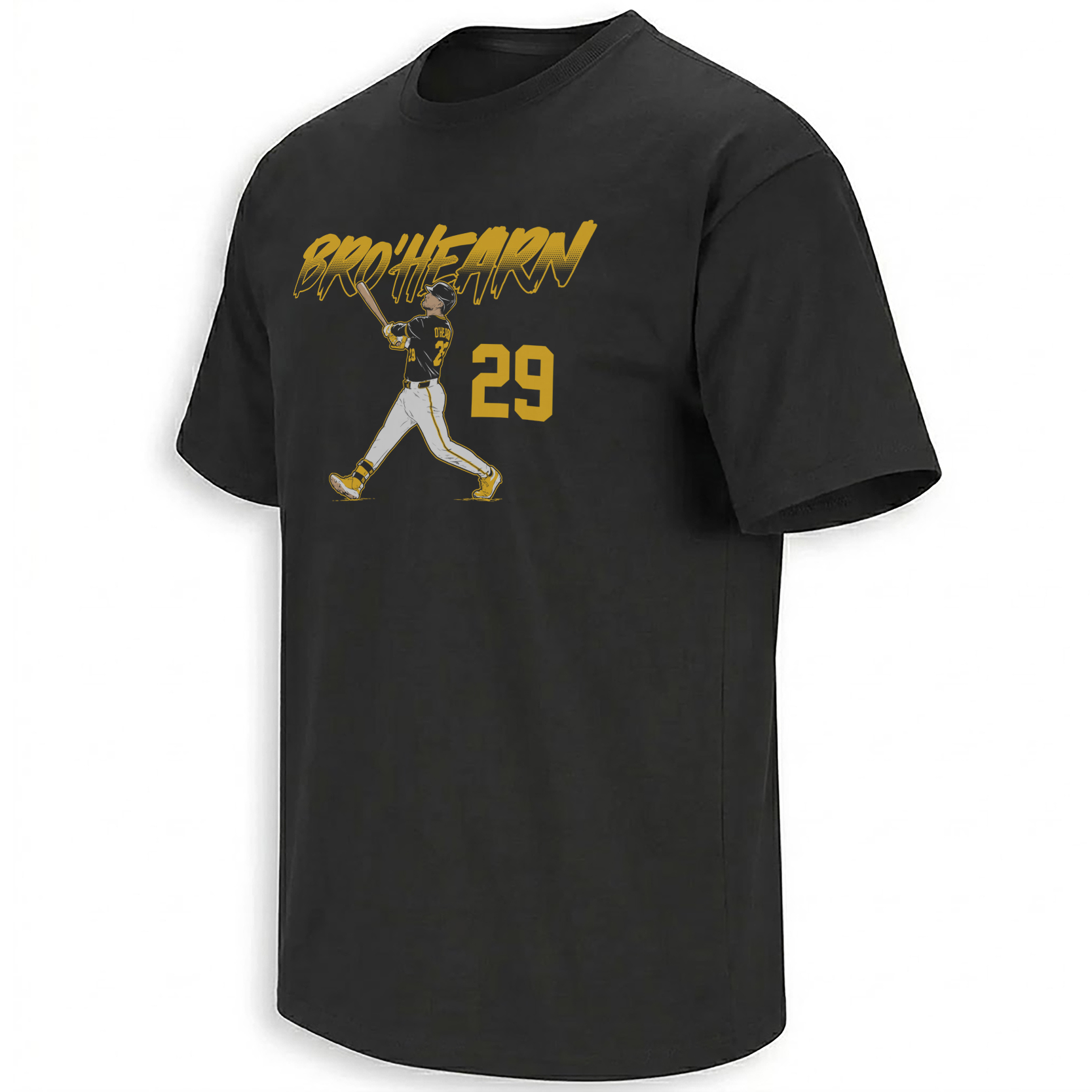
It also fits the visual structure of the design. The player’s identity is not presented as distant superstar mythology. The No. 29, bold Pirates coloring and casual wordplay make the graphic feel like something created inside the celebration.
That tone matters for a player who arrived in Pittsburgh as an important lineup addition rather than a lifelong franchise icon. One performance can rapidly change the relationship between a player and a fan base. Ten RBIs made that change visible.
O’Hearn’s 10 RBIs surpassed every previous single-game total in Pirates history and placed his name inside a rare modern-era MLB group.
No. 29 became the center of PNC Park
Baseball uniforms make numbers part of memory. Fans may forget the precise inning of a swing but remember which number turned toward the dugout after crossing home plate.
In this design, No. 29 acts as both identification and scoreboard shorthand. It points toward O’Hearn while carrying the scale of the night around it.
Black and gold give the piece immediate Pittsburgh identity. The palette does not need to explain the city because it belongs to a larger visual culture shared across its teams.
The night also belonged to a changing Pirates lineup
O’Hearn’s performance mattered beyond the record because Pittsburgh had added him to strengthen the middle of the order. A historic game offered the most dramatic possible proof of what that presence could mean.
His 10 RBIs gave Paul Skenes unusually generous run support and allowed the night to feel like a complete team release rather than an isolated personal achievement.
The crowd did not merely watch a hitter collect statistics. It watched a lineup repeatedly create chances and one player convert almost every important one.
Why the graphic works as a Pittsburgh artifact
The strongest player-moment designs preserve the emotional shorthand rather than every detail. “Brohearn,” No. 29 and Pirates black-and-gold provide everything needed to return to the night.
The Brohearn Ryan O’Hearn design functions like an instant clubhouse poster created after the final out.
The wider Pittsburgh Pirates collection places it alongside player moments, PNC Park memories and black-and-gold baseball culture, while the broader MLB collection connects the record to the league’s larger archive of historic single-game performances.
Frequently Asked Questions
What did Ryan O’Hearn do in his historic game against Atlanta?
He hit three home runs, including a grand slam, and drove in 10 runs during Pittsburgh’s 12–4 victory.
What Pirates record did Ryan O’Hearn set?
His 10 RBIs became the most by any Pirates player in a single game.
How rare is a 10-RBI game?
O’Hearn became only the seventeenth player in the modern era to record at least 10 RBIs in one MLB game.
What does “Brohearn” mean?
It is a fan-style nickname blending “bro” with O’Hearn, capturing the affectionate reaction to his historic performance.
Why is No. 29 important in the artwork?
No. 29 identifies O’Hearn and acts as the central visual marker connecting the design to his Pirates identity.
The Brohearn No. 29 graphic preserves O’Hearn’s record night, while the Pirates visual archive follows the black-and-gold moments, player stories and PNC Park language surrounding the season.
Brohearn Shirt captures Ryan O’Hearn’s historic three-home-run, 10-RBI performance through Pittsburgh black and gold, bold No. 29 imagery and the fan nickname born from one unforgettable night at PNC Park.