
Ring the Bell: Philadelphia’s Signal to the Baseball World
The 2026 MLB All-Star Game brought baseball’s national spotlight to Citizens Bank Park, but Philadelphia answered with a symbol that already belonged to the city: the bell that marks home runs, history and the particular noise of summer in South Philadelphia.
Philadelphia entered July 14 as the center of the baseball world, but the city had been ringing in the occasion for days. All-Star Week had moved through the Convention Center, Independence Mall and Citizens Bank Park, placing league stars inside a summer already shaped by America’s 250th anniversary and Philadelphia’s role in the country’s founding story.
The 2026 game carried a thirty-year return. Philadelphia had not hosted the Midsummer Classic since 1996, and Citizens Bank Park had never held one. That distance gave the event the feeling of an arrival rather than another stop on the MLB calendar.
Yet the strongest visual language did not come from novelty alone. It came from a symbol fans already associate with Phillies baseball. At Citizens Bank Park, the illuminated bell swings after home runs. Across the city, the Liberty Bell carries centuries of national meaning. “Ring the Bell” connects those two identities in three words.
Philadelphia did not simply host baseball’s stars. It gave the week a sound, a symbol and a phrase the city already understood.
Why “Ring the Bell” Belongs to Philadelphia Baseball
Few host cities can connect an All-Star event to one image as naturally as Philadelphia can connect baseball to a bell. The symbol moves between national history and ballpark ritual without requiring explanation.
The Liberty Bell identifies the city beyond sports. Its crack, age and historical weight prevent it from becoming a generic patriotic icon. It carries the texture of an object that survived long enough to become larger than its original function.
Inside Phillies culture, the bell acquires a different energy. The giant neon version at Citizens Bank Park flashes and swings after home runs, transforming a historical form into a celebration signal. The same outline can mean independence in one setting and a baseball leaving the yard in another.
“Ring the Bell” compresses both meanings. It sounds ceremonial enough for America’s 250th-anniversary summer, but it also sounds like an instruction shouted after Philadelphia puts another run on the board.
One Phrase, Two Visual Versions
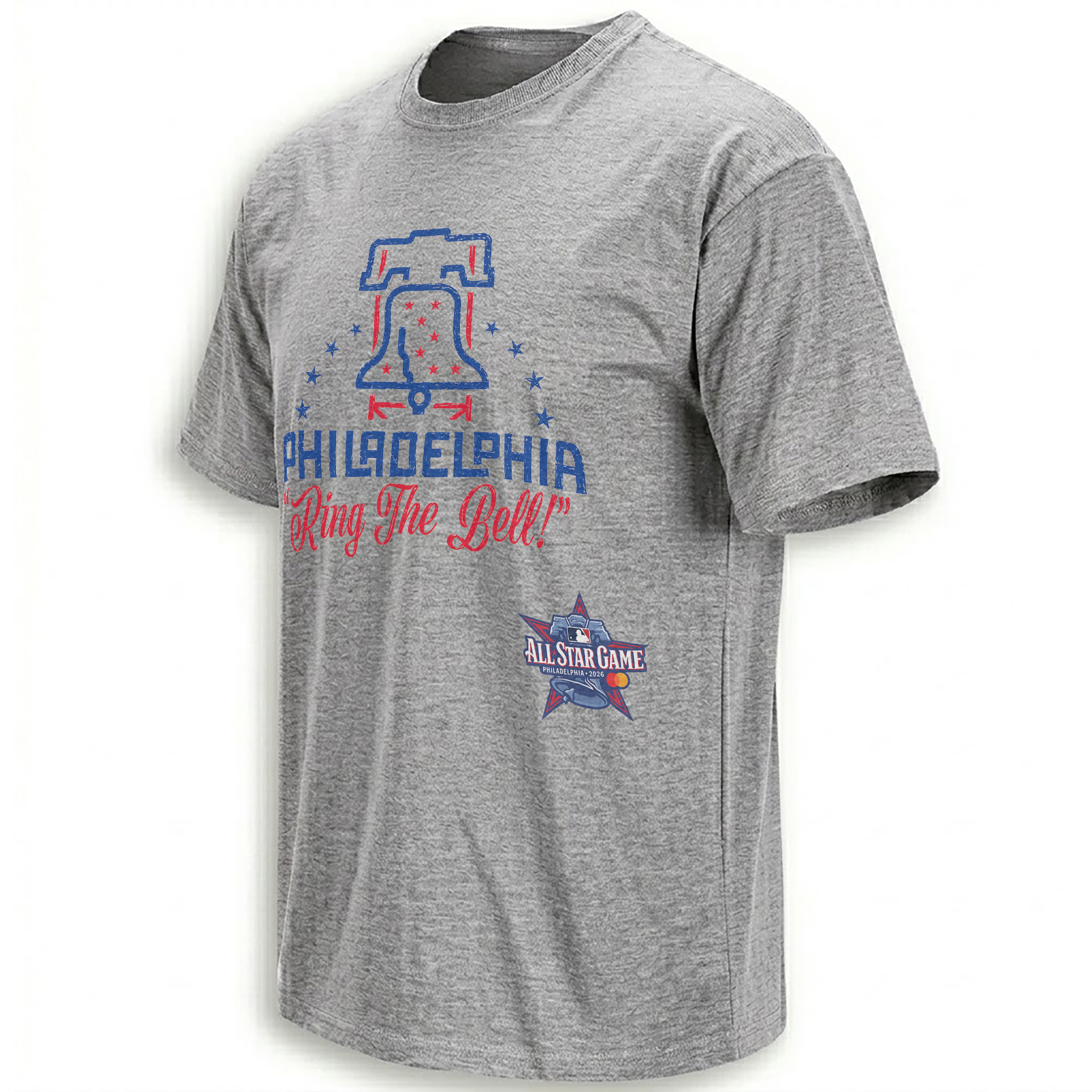
The two “Ring the Bell” designs preserve the same cultural moment but approach it from different visual directions. The first version behaves like an event poster. It gathers the bell, stars, baseball references and 2026 language into a dense commemorative composition.
The blue edition is cleaner and more direct. Its cooler field gives the white and red elements sharper separation, allowing the phrase and central emblem to operate with the immediate clarity of a ballpark sign or broadcast graphic.
Neither version needs to reproduce the complete official event identity. Their strength comes from translating the mood into fan language. The first records the scale of the occasion. The second emphasizes Philadelphia’s unmistakable blue-red baseball palette.
A layered event-poster composition built around the Liberty Bell, patriotic stars and Philadelphia’s role as the center of the 2026 baseball summer.
View the commemorative layout →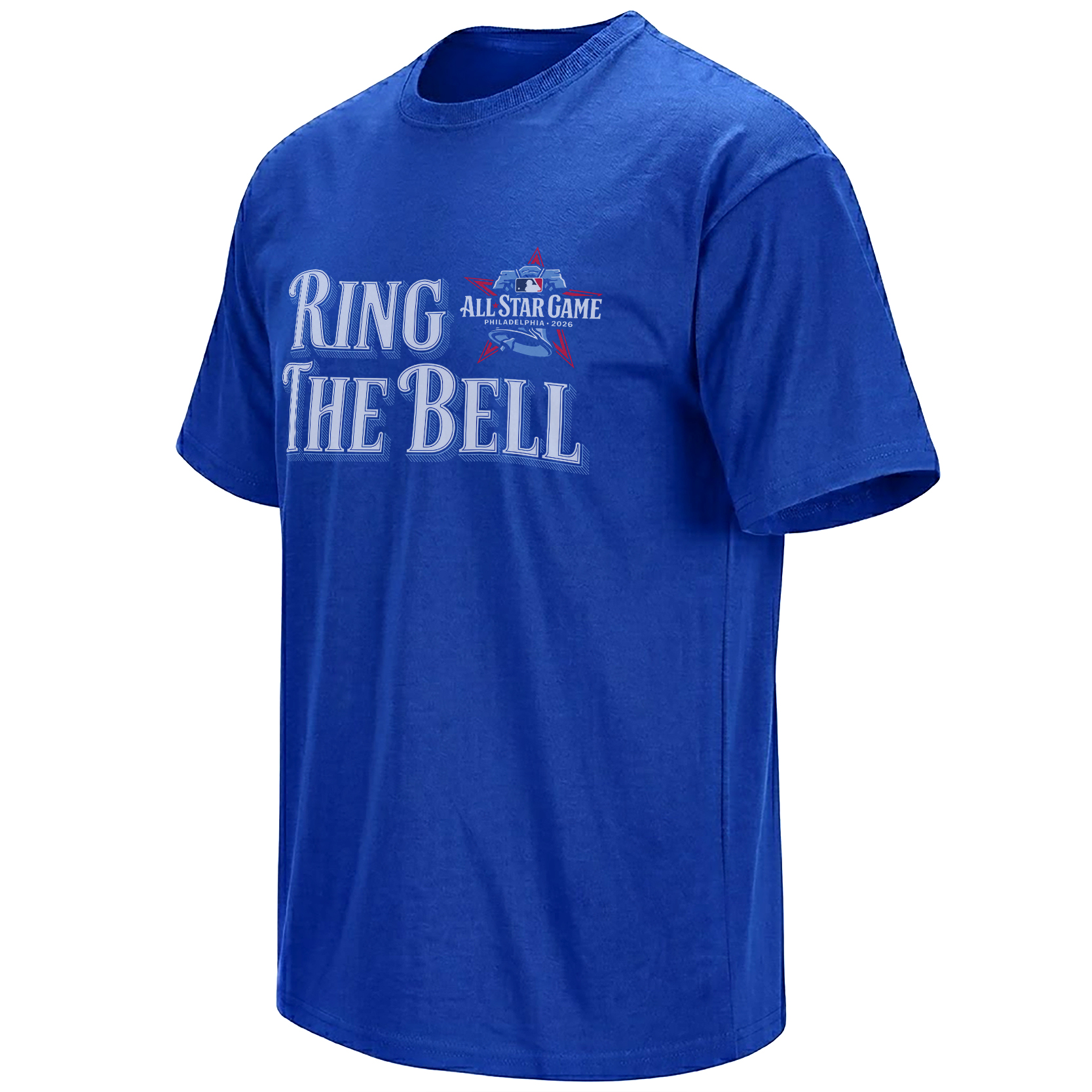
A cooler, cleaner Philadelphia treatment that lets the white-red event lettering and central bell image land like a stadium signal.
Explore the blue version →The Primary Design Feels Like an All-Star Week Poster
The first graphic uses density as part of its storytelling. Multiple stars, layered type and the large bell create a composition that feels designed for an event larger than one game.
That visual fullness reflects the structure of All-Star Week itself. The Futures Game, Draft, Home Run Derby, red carpet and main event all placed different forms of baseball spectacle around Philadelphia. The design does not isolate one player because the city is the subject.
Its patriotic palette also carries more than ordinary team color. Phillies red and blue naturally overlap with the colors of the American flag, allowing the graphic to reference America’s anniversary year without leaving Philadelphia baseball identity.
The bell acts as the visual anchor, locating the event in Philadelphia before the viewer processes the smaller All-Star details.
Repeated stars connect the All-Star label to patriotic iconography while adding the scale of an arena banner or event poster.
The year converts the graphic from general Philadelphia baseball imagery into a timestamp tied to one specific midsummer gathering.
The Blue Edition Turns the Message Into a Stadium Signal
The second design creates a different emotional rhythm. The blue field immediately recalls evening baseball, illuminated signage and the cool glow of a stadium concourse before the first pitch.
White lettering produces the strongest contrast, while red accents preserve Philadelphia’s sharper edge. The composition feels less like a historical program and more like a graphic that could flash on a scoreboard after the phrase is shouted.
That distinction gives the two editions separate identities. The primary version is archival and ceremonial. The blue version is immediate, louder and closer to the live atmosphere of Citizens Bank Park.
One design records the full symbolism of the 2026 host city. The other isolates Philadelphia’s blue-red baseball energy. Together they show how a single All-Star moment can be remembered as both civic history and ballpark noise.
America’s 250th Anniversary Changed the Meaning of the Game
A normal All-Star Game celebrates the league’s best players and the host ballpark. Philadelphia’s 2026 edition carried an additional historical frame because the country’s 250th anniversary placed the city at the center of national attention.
MLB leaned into that connection with red-white-and-blue presentation, Independence Mall red-carpet imagery and Liberty Bell references across the event environment. Baseball’s midsummer showcase became part of a wider Philadelphia summer built around the country’s founding narrative.
That context made the bell more than local branding. It became a bridge between America’s pastime and America’s birthplace, giving the event a visual identity that would have felt impossible to reproduce in another city.
Why Citizens Bank Park Matters to the Memory
Philadelphia’s previous All-Star Game was played at Veterans Stadium in 1996. The 2026 edition therefore marked more than a return to the city. It introduced the event to the ballpark that defines the modern Phillies era.
Citizens Bank Park carries its own archive: the 2008 championship, postseason home runs, October towels, the Phanatic’s chaos and the roar that turns ordinary fly balls into moments of collective anticipation.
The ballpark’s bell is central to that identity. When it lights up after a Phillies home run, history becomes animation. The symbol does not sit silently behind glass. It moves, glows and tells the crowd what just happened.
Bringing the All-Star Game into that setting allowed the larger baseball world to enter a ritual Philadelphia fans already understood.
A Host-City Graphic Can Outlast the Final Score
All-Star Games produce a winner, but their cultural memory is rarely limited to the scoreboard. Fans remember uniforms, caps, Home Run Derby swings, red-carpet arrivals, ballpark transformations and the visual identity that covered the city during the week.
The “Ring the Bell” graphics belong to that second category. They preserve the way Philadelphia looked and sounded while hosting the game rather than attempting to summarize every inning.
That makes them closer to old event programs, city posters and saved ticket stubs than ordinary team graphics. Their purpose is to answer a future question: what symbol represented Philadelphia when baseball’s stars gathered there in 2026?
Philadelphia Baseball as a Running Visual Archive
The two designs sit naturally inside the wider Philadelphia Phillies collection, where player moments, postseason slogans, city references and historic graphics form a running archive of how Philadelphia experiences baseball.
The broader MLB collection places the All-Star pieces beside league-wide events, rivalry graphics and individual performances, showing how baseball culture moves between local identity and national spectacle.
Within that larger visual map, “Ring the Bell” remains unmistakably local. It does not merely state that an All-Star Game occurred. It records the sound Philadelphia attached to it.
Frequently Asked Questions
When and where was the 2026 MLB All-Star Game held?
The 2026 MLB All-Star Game was scheduled for July 14 at Citizens Bank Park in Philadelphia, concluding the city’s All-Star Week events.
Why is “Ring the Bell” connected to Philadelphia baseball?
The phrase connects Philadelphia’s historic Liberty Bell with the illuminated bell at Citizens Bank Park that swings and flashes after Phillies home runs.
Why was the 2026 All-Star Game especially significant for Philadelphia?
It was the city’s first MLB All-Star Game since 1996, the first held at Citizens Bank Park and part of Philadelphia’s major role in America’s 250th-anniversary celebrations.
What is the difference between the two Ring the Bell designs?
The primary edition uses a layered commemorative-poster composition, while the blue edition offers a cleaner stadium-style treatment built around cooler color, sharp white lettering and red accents.
Why does the Liberty Bell work so well in an MLB All-Star design?
The symbol identifies Philadelphia immediately, connects the game to America’s anniversary year and also reflects the Phillies’ long-established bell imagery at Citizens Bank Park.
Why can an All-Star Game graphic become a cultural artifact?
Host-city graphics preserve the location, visual identity and atmosphere surrounding the event, allowing fans to remember how the city experienced the week beyond the final score.
The commemorative Ring the Bell design and the blue stadium edition preserve two sides of the same 2026 moment, while the wider Philadelphia Phillies archive follows the city’s player stories, postseason memories and baseball language across the season.
Ring the Bell Philadelphia All-Star Game designs capture the 2026 Midsummer Classic through Liberty Bell symbolism, red-white-and-blue baseball typography and two visual treatments inspired by Philadelphia history and Citizens Bank Park energy.