
Ryan Blaney Owned the Night: 171 Laps, Overtime and One Atlanta Finish
Ryan Blaney’s 2026 EchoPark victory was not a late-race theft. It was a night-long No. 12 performance that survived weather, drafting pressure, an overtime restart and one final push to the checkered flag.
By the time Ryan Blaney crossed the line at EchoPark Speedway, the race had already stretched from Sunday night into Monday morning. Weather had stopped the action, the final laps had become an overtime drafting fight, and multiple cars were still capable of changing the result in the final corners.
Yet the chaos should not obscure the clearest fact of the night: the No. 12 had controlled the race. Blaney led 171 of 263 laps, won both opening stages and repeatedly returned to the front after the field reorganized around cautions, pit cycles and changing alliances.
The final margin made the finish feel like a photo, but the complete race read like dominance. Christopher Bell was ultimately scored second, 0.068 seconds behind, after Bubba Wallace received a penalty connected to the yellow-line rule during the final-lap battle. Blaney’s name remained above all of it.
Overtime produced the final image, but 171 laps explained why the No. 12 belonged in Victory Lane.
The Difference Between Surviving a Drafting Race and Owning One
Drafting races can make control feel temporary. A driver may lead one lap and disappear the next as lanes organize, pushes arrive and alliances dissolve. That volatility makes Blaney’s 171 laps at the front especially striking.
He began from the pole and swept Stage 1 by leading all sixty laps. He returned to the front before the weather interruption and continued carrying the race after the delay. NASCAR noted that his total was the highest number of laps led in a drafting race since Richard Petty led 184 laps in the 1964 Daytona 500.
That historical comparison gives the number scale. Blaney was not merely present near the lead at the correct time. He spent the majority of the event shaping the race’s pace, lane movement and strategic decisions.
Weather Turned the Race Into a Test of Repetition
The weather delay divided the event into separate emotional phases. Before the stoppage, Blaney had already established the No. 12 as the reference car. After the track returned to green, he had to rebuild that position under a new set of conditions.
Long delays can dissolve momentum. Track temperature changes, drivers sit outside the competitive rhythm and teams must restart the strategic conversation after hours of uncertainty. The race resumed late enough that the victory eventually belonged to Monday morning rather than Sunday night.
Blaney’s ability to remain central on both sides of that interruption strengthened the meaning of the win. It was not a single uninterrupted run built around ideal conditions. It was dominance that had to be reassembled.
Blaney led every lap of the opening stage, establishing control before the race developed into its later weather and drafting drama.
The No. 12 remained a central force when the field returned to green after the extended interruption near midnight.
One final drafting sequence and push placed Blaney ahead at the exact moment the checkered flag converted control into victory.
The Final Lap Was a Moving Argument About Space
Overtime compressed the entire race into one unstable formation. Carson Hocevar led as the white flag arrived, with Tyler Reddick helping the outside line. Blaney and Bubba Wallace reconnected on the frontstretch, creating the momentum required to challenge.
Blaney moved around Hocevar, while Wallace’s movement below the yellow line became the central officiating issue after the finish. Christopher Bell supplied one final push to the No. 12, and the cars reached the line separated by less than a tenth of a second.
The post-race penalty changed the order behind Blaney, dropping Wallace and moving Bell into second. It did not change the winner. Blaney passed inspection, and the official result preserved a finish that had been built from far more than the final drafting move.
The finish was chaotic enough to dominate immediate discussion, but the deeper story remained Blaney’s 171 laps led, two stage victories and repeated ability to place the No. 12 back at the front.
Why the Winner Graphic Uses Poster Energy
Racing graphics are strongest when they communicate motion before the viewer reads every word. Angled type, hard contrast and oversized car-number language can make a static composition feel as though it is moving through the frame.
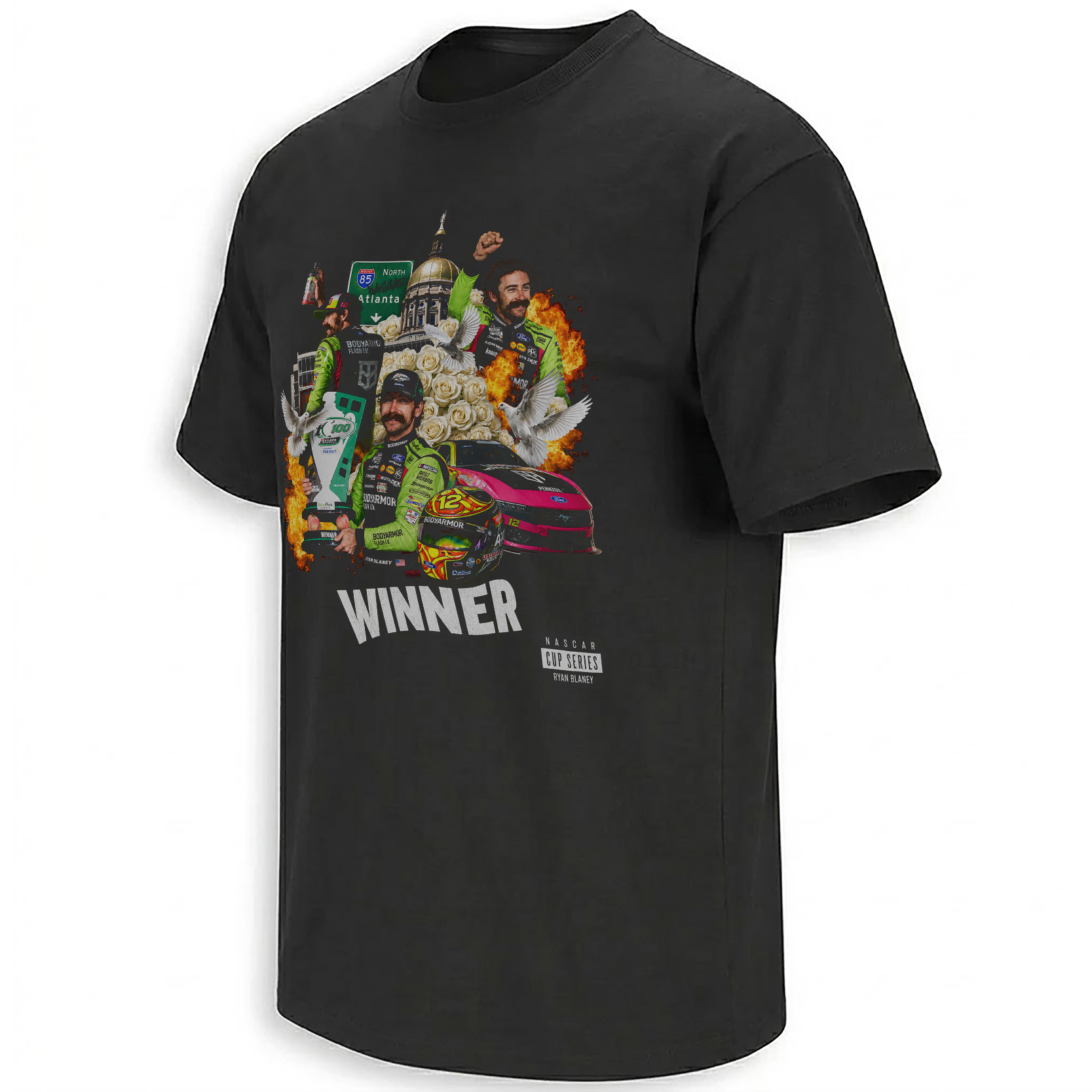
The Ryan Blaney winner artwork follows that logic. The No. 12 identity functions as the dominant visual anchor, while the driver, car and event language build the context around it. Red, yellow and black provide an immediate racing hierarchy with enough contrast to remain legible from a distance.
Rather than attempting to illustrate every final-lap position, the graphic concentrates on the result: Blaney, Atlanta-area EchoPark, 2026 and the visual authority of a winner’s poster. That compression is what allows the design to operate as a timestamp rather than a race report.
The No. 12 Has Its Own Drafting-Race Reputation
Blaney’s career has repeatedly placed him inside the most precise form of NASCAR chaos. His major drafting-track victories and narrow finishes have built an identity around timing, lane awareness and the ability to accept help without surrendering control of the final move.
EchoPark added a different variation. The winning instinct remained important, but it arrived after hours of visible superiority. The victory therefore joined two versions of Blaney’s reputation: the driver capable of surviving the final chess match and the driver capable of dominating the entire race that creates it.
That balance explains why the win immediately felt larger than another entry in a season list. It became his second victory of 2026 and first since Phoenix in March, but its real distinction came from how much of the night belonged to him.
From Race Result to Collectible Memory
NASCAR victories are remembered through a specific sequence of images: the car taking the flag, the driver reaching Victory Lane, the number framed by confetti and the winner graphic circulating before the engines fully cool.
Apparel built around that sequence functions like an old race program or event poster. Years later, the graphic can point back toward the weather delay, the Sunday-to-Monday timeline, the 171 laps and the overtime finish without requiring every detail to appear in the artwork.
The Ryan Blaney EchoPark winner design preserves that exact race-night identity. For readers exploring a wider field of speed, driver and circuit culture, the broader racing collection extends the visual conversation across motorsport-inspired graphics and track-specific moments.
Frequently Asked Questions
What race did Ryan Blaney win at EchoPark in 2026?
Blaney won the 2026 Quaker State 400 NASCAR Cup Series race at EchoPark Speedway in Hampton, Georgia.
How many laps did Ryan Blaney lead?
He led 171 of the race’s 263 laps and also won both of the opening stages.
Why did the race finish after midnight?
A lengthy weather interruption delayed the event, and the race resumed late Sunday night before ending in the early hours of Monday morning.
Who officially finished second behind Ryan Blaney?
Christopher Bell was officially scored second, 0.068 seconds behind Blaney, after Bubba Wallace received a post-race yellow-line penalty.
Why does the EchoPark winner design work as a cultural artifact?
It preserves the No. 12 identity, event location, victory year and winner imagery from a race remembered for Blaney’s dominance, the weather delay and the overtime finish.
The Ryan Blaney EchoPark winner graphic records the No. 12’s Atlanta-area victory as a race-poster artifact from one of the most controlling performances of the 2026 Cup Series season.
Ryan Blaney Winner Shirt captures his 2026 EchoPark victory through No. 12 racing imagery, bold winner typography and the memory of a weather-delayed overtime race in which he led 171 of 263 laps.