“God Forbid I Commit a Little Tax Fraud” Turns Internet Chaos Into a Protest Placard
The viral phrase works by defending an obviously questionable act with an even more outrageous comparison, compressing anti-establishment frustration, conspiracy parody and deliberately reckless meme language into seven impossible-to-ignore lines.
By July 2026, the sentence “God forbid I commit a little tax fraud while the elites eat children” had already escaped the boundaries of a single post. It appeared across meme products, stickers, repost culture and apparel searches, where its appeal came less from any coherent political claim than from the sheer force of its tonal escalation.
The line begins with mock innocence. “God forbid” is the language of someone pretending to have been unfairly judged. “A little tax fraud” then minimizes an actual offense with the vocabulary normally reserved for eating one extra cookie or arriving slightly late.
The final clause detonates that fake reasonableness. It introduces an intentionally grotesque conspiracy-style accusation so disproportionate that the sentence stops behaving like an argument and becomes a performance of internet derangement.
The sentence is funny because it begins like a complaint, accelerates like a conspiracy post and ends like the speaker has completely lost control of the microphone.
This Is Satire, Not a Serious Defense of Tax Fraud
The first requirement for understanding the phrase is recognizing its deliberate unreliability. The speaker is not presented as a trustworthy moral commentator. The joke depends on the speaker admitting to wrongdoing, dismissing it as minor and then attempting to escape accountability through a wildly exaggerated comparison.
That structure belongs to a broad category of online humor in which users imitate the language of grievance while making the grievance increasingly indefensible. The persona may be anti-government, anti-corporate, conspiracy-minded or simply chaotic. What matters is that the performance keeps escalating after ordinary reason has left the room.
The “elites eat children” clause should therefore be read as conspiracy parody and grotesque hyperbole, not as a verified statement about any identifiable group. Its function is to represent the most extreme possible leap from ordinary resentment into unhinged internet rhetoric.
The artwork reproduces a viral satirical phrase. It does not establish that its final accusation is factual, and it should not be interpreted as evidence against any real person or organization. The cultural subject is the language of conspiracy-style memes, not the truth of the allegation.
Why the Joke Feels Native to the Current Internet
Modern meme language often works through disproportion. A small inconvenience becomes a constitutional crisis. A harmless preference becomes a moral emergency. An obviously bad decision is defended by pointing toward something incomparably worse.
This phrase uses that pattern with unusual efficiency. The tax-fraud admission gives the speaker just enough guilt to be ridiculous. The word “little” makes the denial more suspicious. The anti-elite ending then borrows the emotional temperature of political outrage while abandoning any attempt at responsible evidence.
The result can move between several online communities without belonging completely to any of them. It can read as libertarian mockery, anti-rich resentment, conspiracy satire, ironic criminality or pure shitposting. Each audience recognizes a different layer, which helps the sentence survive beyond one original context.
The line mocks the perceived double standard between ordinary people punished for relatively small violations and powerful figures imagined as escaping consequences.
The extreme final claim imitates the language of sensational posts, transforming political suspicion into intentionally grotesque absurdity.
The Shirt Makes the Sentence Impossible to Scroll Past
On a screen, the phrase can disappear with one swipe. On the God Forbid I Commit a Little Tax Fraud Shirt, it becomes physical, oversized and socially unavoidable.
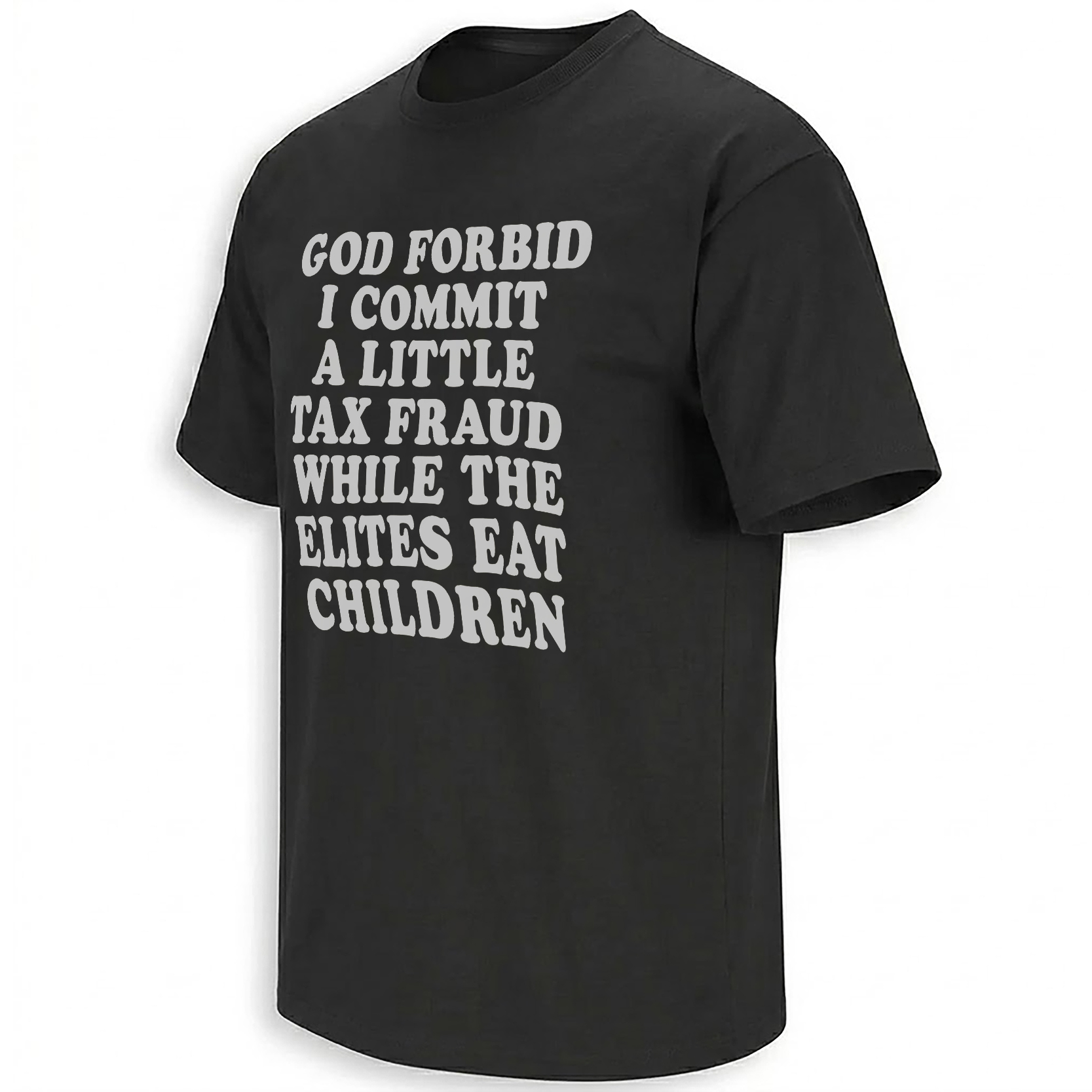
The design removes every visual distraction. There are no portraits, political symbols, cartoon characters or supporting illustrations. The black garment operates like an empty protest board, while seven stacked lines of off-white type carry the entire confrontation.
That decision changes the wearer’s role. They are not merely displaying a joke. They are forcing everyone nearby to read the joke in sequence, line by line, before the final escalation becomes visible.
Seven Lines Create the Timing of the Joke
The line breaks are not incidental. They control the rhythm in the same way an edited video controls a reveal. Each phrase receives its own beat, allowing the sentence to grow more reckless as the reader moves downward.
“God Forbid” establishes the theatrical complaint. “I Commit” introduces the confession. “A Little” attempts to soften it. “Tax Fraud” delivers the first punchline. The final three lines then redirect the reader into a far darker and more absurd accusation.
Because the last word stands alone, “Children” receives the strongest visual emphasis without becoming larger than the surrounding text. The design allows placement to create impact rather than relying on decorative effects.
The Rounded Typography Makes the Message Stranger
The letterforms are heavy, rounded and slightly retro. They resemble the friendly typography of an old novelty shirt, a 1970s slogan graphic or an upbeat community poster rather than the severe type normally associated with political anger.
That softness creates a useful contradiction. The visual tone appears casual and approachable, while the language becomes progressively more alarming. A rigid military stencil or distressed protest font would make the piece feel predictably aggressive. The rounded letters make the statement feel cheerfully inappropriate.
Off-white rather than pure white also matters. It lowers the digital sharpness and gives the design a slightly aged, screen-printed appearance. The graphic feels less like a freshly typed social post and more like a slogan that has somehow circulated for decades.
Why Text-Only Meme Shirts Often Create Stronger Reactions
An illustration gives viewers an immediate emotional instruction. A smiling character signals comedy. A politician signals partisanship. A skull signals darkness. Text-only clothing withholds that assistance.
The reader must process the sentence before deciding how to react. That delay can produce laughter, discomfort, recognition or disagreement, sometimes in rapid succession. The graphic becomes a small public test of context.
It also mirrors how many viral phrases are first encountered online. They appear as screenshots, captions or blocks of text with little visual explanation. Preserving that plainness allows the garment to retain the raw energy of the original format.
In this case, adding imagery would weaken the effect. The sentence is already crowded with implication: guilt, hypocrisy, class resentment, conspiracy rhetoric and mock victimhood. The absence of illustration gives those ideas room to collide.
The Meme Channels Anger Without Becoming a Policy Argument
Anti-elite humor often begins with a recognizable frustration: the belief that rules are enforced differently depending on wealth, power or access. That emotional foundation helps explain why a phrase this exaggerated can still feel immediately legible.
Yet the shirt does not develop that frustration into a factual case. It abandons evidence for spectacle. The final accusation is so extreme that it exposes the speaker’s performance rather than proving the speaker’s point.
This distinction is important. The graphic belongs to internet satire, where absurdity can express distrust without offering a coherent political program. It captures the emotional atmosphere of suspicion and double-standard discourse while simultaneously making that atmosphere look ridiculous.
The humor therefore cuts in several directions. It mocks powerful people, mocks the person confessing to fraud and mocks the kind of online argument that believes maximum outrage is a substitute for credibility.
From Screenshot Language to Wearable Internet Memory
Meme apparel becomes culturally useful when it preserves not only a sentence but a specific mode of communication. This design records an era when users routinely blend irony, political anger, criminal confession jokes and conspiracy language until no single interpretation feels stable.
The wider Newest collection functions as a running archive of those rapidly changing phrases. Some designs emerge from sports celebrations or entertainment releases; others come from one sentence that spreads because it captures exactly how strange online communication has become.
“God forbid I commit a little tax fraud” belongs to the second category. Its durability does not depend on anyone believing the speaker. It depends on recognizing the rhythm: fake innocence, reckless confession, class resentment and one final leap into complete absurdity.
Frequently Asked Questions
What does the God Forbid I Commit a Little Tax Fraud meme mean?
It is an absurdist joke in which the speaker minimizes an illegal act and then attempts to justify it by making a dramatically more extreme accusation about powerful elites.
Is the phrase meant as a literal confession?
No. Its common use is satirical and performative, borrowing the language of mock innocence, anti-establishment resentment and exaggerated internet outrage.
Does the design claim that elites literally eat children?
The phrase uses that wording as grotesque conspiracy parody and hyperbole. The shirt does not provide evidence for the allegation, and the statement should not be treated as a verified factual claim.
Why is the shirt designed with text only?
Removing illustrations allows the sentence to control the entire experience. Readers must follow the seven stacked lines before reaching the final escalation.
Why does the typography look retro?
The rounded off-white lettering resembles vintage novelty and protest graphics, creating a playful visual contrast with the confrontational and deliberately inappropriate wording.
The God Forbid I Commit a Little Tax Fraud design preserves an unhinged anti-elite meme as a seven-line visual performance, while the latest Ellie Shirt archive follows the phrases and cultural fragments currently moving from online discourse into physical graphics.
God Forbid I Commit a Little Tax Fraud Shirt turns an absurdist anti-elite meme into a seven-line off-white statement on black, combining mock innocence, conspiracy parody and confrontational internet humor.