
The Knicks’ 2026 Poster Turns Sixteen Playoff Wins Into a Season Map
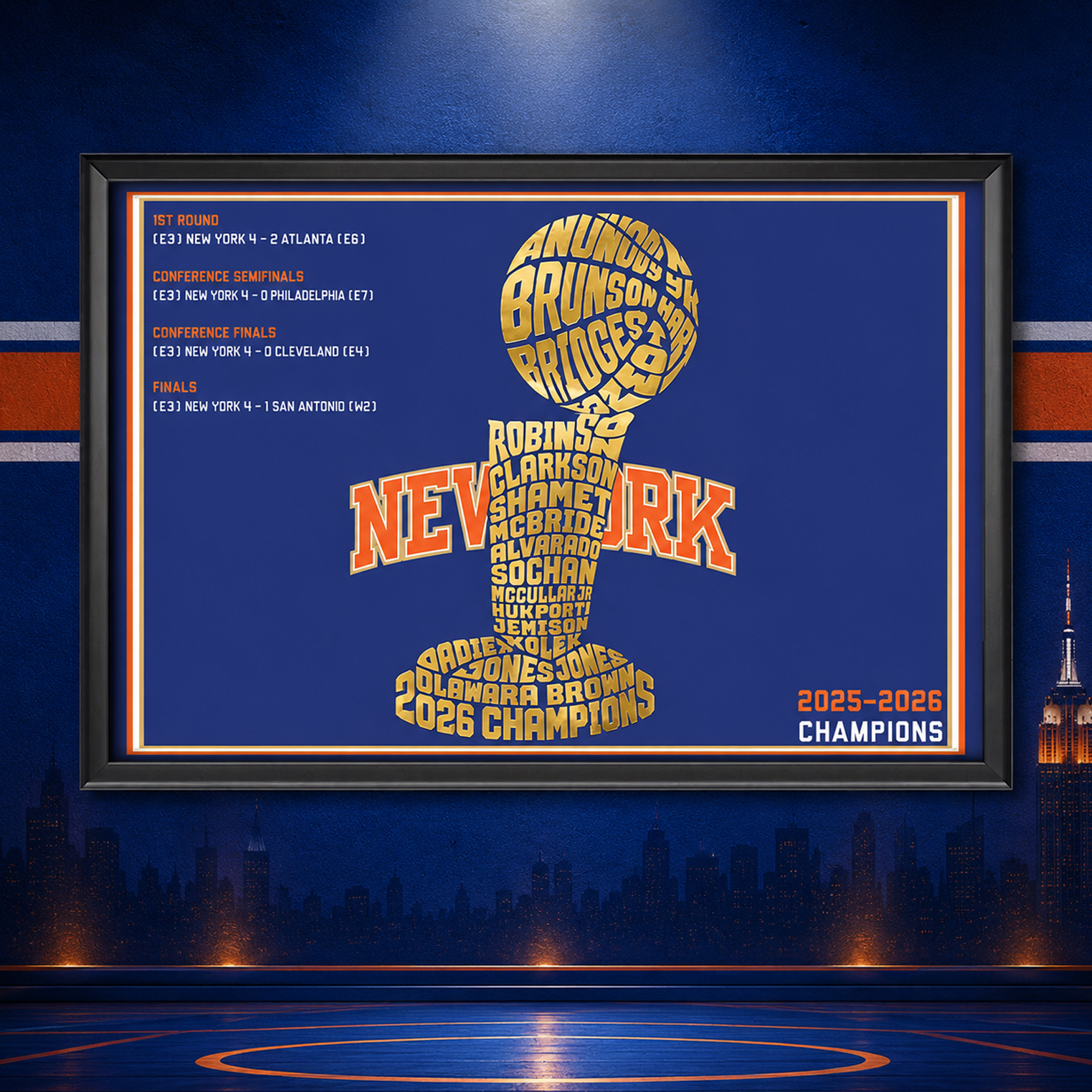
Atlanta, Philadelphia, Cleveland and San Antonio appear not merely as opponents, but as coordinates on New York’s road to the title. A roster-built trophy stands at the center while the complete playoff path becomes the frame around it.
In July 2026, the Knicks’ title run is already being compressed into a few permanent images: Jalen Brunson holding the Finals MVP trophy, OG Anunoby’s Game 4 tip-in, the parade through Lower Manhattan and the scoreboard showing New York as champion for the first time since 1973.
The full postseason journey was more complicated. New York opened against Atlanta, fell behind 2–1, then stopped losing for nearly a month. The Knicks won the final three games of the first round, swept Philadelphia, swept Cleveland and carried a 13-game winning streak into the Finals.
The Knicks Roster Trophy Poster preserves that longer route. It treats the championship not as one isolated finish but as a sequence of opponents, series results, players and cities arranged around the gold object they collectively produced.
The trophy records the destination. The playoff path explains how New York reached it.
A Championship Poster Can Record Time, Not Just Victory
Most championship graphics prioritize the final state. They show a trophy, the season year, a title declaration and perhaps the principal stars.
A playoff-path poster performs a different cultural function. It preserves progression. Each opponent represents a separate version of the team, a separate pressure test and a different stage in the transformation from contender to champion.
Atlanta represents the last moment New York’s run appeared unstable. Philadelphia represents acceleration. Cleveland represents total control of the Eastern Conference. San Antonio represents the final resistance and the one-point games that forced the Knicks to prove their composure.
Read vertically, the poster is a trophy. Read around its edges, it becomes a map: four opponents, four series results and sixteen wins ordered into the geography of one championship spring.
Round One: Atlanta Forced New York to Find Its Identity
The Knicks entered the postseason as the East’s third seed, but their first-round series did not begin like the foundation of a dominant title run.
Atlanta pushed New York into a six-game series and held a 2–1 lead after three games. At that stage, the Knicks were closer to another complicated postseason disappointment than to league history.
New York answered by winning the next three games. That recovery mattered beyond survival. It established the emotional rule that would define the remaining postseason: the Knicks could absorb an ugly position without allowing it to become the final shape of the series.
The Four-Round Path Became Four Different Tests
The Knicks recovered from a 2–1 deficit, won three consecutive elimination-building games and discovered the rhythm that would carry into the rest of the postseason.
The offense and defense accelerated together. New York completed a historic sweep and extended its franchise-record postseason winning streak.
The Knicks won all four games, including a 37-point closeout, becoming the first team since the 2017 Warriors to sweep both the conference semifinals and conference finals.
Four comeback wins, a record 29-point Game 4 rally and Brunson’s 45-point closeout completed the franchise’s first championship in 53 years.
The Poster Places the Roster Inside the Trophy
The Knicks Roster Trophy Poster carries forward the typographic concept of building the championship object from player surnames.
Brunson, Towns, Bridges, Anunoby and Hart form the basketball at the top. The wider rotation creates the stem and base, transforming the roster from supporting information into the physical architecture of the award.
In poster form, however, the trophy receives a larger environment. Series results, opponent identities and postseason progression surround the roster, allowing the artwork to explain both who built the championship and which route they traveled.
Poster Scale Changes How the Typography Is Read
On apparel, the roster-built trophy must work quickly. From several feet away, the viewer first sees New York, gold and a familiar basketball-trophy silhouette.
Wall art allows a slower encounter. The names can be examined individually. Series results can be followed in order. The viewer can move from the championship at the center toward the opponents around it and then back into the roster.
That reading process resembles studying a bracket after the season has ended. The outcome is already known, but attention moves backward through the decisions, games and turning points that created it.
Gold typography, a trophy silhouette and the New York wordmark establish the championship immediately.
Player names, opponent markers and series scores reveal the complete roster and route hidden inside the central image.
The 13-Game Winning Streak Gives the Path Its Unusual Shape
New York’s route was not simply four ordinary series victories. After falling behind Atlanta 2–1, the Knicks won 13 consecutive playoff games.
That streak carried them through the end of the first round, complete sweeps of Philadelphia and Cleveland, and the first two games of the NBA Finals. It became the second-longest winning streak in NBA postseason history.
The streak explains why the middle of the poster feels almost uninterrupted. The opponent names change, but the result remains the same. New York moves through the bracket without requiring a loss to reset its urgency.
San Antonio finally ended the streak in Game 3 of the Finals. The interruption did not change the larger direction. New York responded with the historic Game 4 comeback and closed the series in Game 5.
Philadelphia Represents the Moment the Run Became Ruthless
A sweep can hide how quickly a series loses competitive balance. Against Philadelphia, New York repeatedly established control early and prevented the Sixers from developing the kind of extended counterattack that could change the matchup.
The series also showed that the Knicks were no longer surviving primarily through late-game resilience. They could overwhelm an opponent from the opening quarter, create large margins and close the round without allowing the series to become emotionally complicated.
On the poster, Philadelphia therefore represents acceleration. Atlanta forced New York to locate its postseason identity. The next round showed what happened once that identity became stable.
Cleveland Turned the Eastern Conference Title Into a Statement
The Eastern Conference Finals were expected to provide the largest obstacle before the Finals. Instead, New York won four straight.
The 130–93 closeout transformed the sweep from a narrow achievement into a declaration. The Knicks did not merely reach the Finals; they left the East with an eleven-game winning streak and three road closeouts already completed.
Cleveland’s position on the playoff map therefore carries symbolic weight. It is the final Eastern checkpoint, the opponent standing between New York and its first Finals appearance of the era.
Once that section of the route was completed, the championship object at the center of the poster no longer appeared theoretical.
San Antonio Made the Final Line More Difficult Than 4–1 Suggests
A five-game Finals can look comfortable in historical summaries. The individual games tell another story.
New York won Game 2 by one point, Game 4 by one point and Game 5 by four. The Knicks trailed by double digits in all four of their victories and had to repeatedly reconstruct games San Antonio appeared positioned to control.
Game 4 provided the defining reversal. The Knicks erased a 29-point deficit and won 107–106 on Anunoby’s tip-in with 1.2 seconds remaining.
The Finals path therefore completes the poster with tension rather than ceremony. The trophy may stand still at the center, but the route leading toward it was built from unstable scores, narrow margins and repeated recoveries.
Why the Opponent Logos Belong Around the Trophy
An opponent is usually removed from championship merchandise. Once a team wins, visual attention moves entirely toward the champion.
A playoff-path poster keeps the defeated teams visible because they establish scale. Atlanta, Philadelphia, Cleveland and San Antonio are not decorative references. They are the four barriers that define what New York’s sixteen wins required.
Their placement around the trophy creates a visual bracket without reproducing a conventional tournament chart. The route remains readable, but the champion occupies the center rather than the end of a horizontal line.
The Poster Works Like a Subway Map of the Postseason
New York is a city accustomed to understanding movement through mapped sequences. A subway line is remembered through stops, transfers and the final station rather than only the destination.
The playoff poster carries a similar logic. Atlanta is the difficult beginning. Philadelphia and Cleveland are rapid consecutive stops. San Antonio is the final transfer from conference champion to NBA champion.
The metaphor fits because supporters experienced the postseason as movement across geography: Madison Square Garden, Atlanta, Philadelphia, Cleveland and San Antonio linked through broadcasts, road games and the changing pressure of each round.
The trophy at the center functions like the point where every line converges.
From Roster List to Historical Architecture
The names inside the trophy are not equal in size because the players were not equal in public visibility or role.
Brunson, Towns, Anunoby, Bridges and Hart create the recognizable basketball. Mitchell Robinson, Miles McBride and the wider rotation form the connecting structure below.
That hierarchy mirrors a basketball team without reducing the supporting names to footnotes. The stars define the outer silhouette; the full roster allows the silhouette to stand.
In a wall-art format, the relationship becomes easier to study. Each name occupies a physical location inside the championship object, turning roster construction into literal architecture.
The Poster Records a Closed 2025–26 Roster
The distinction between championship roster and current roster becomes more important once the offseason begins.
Trades, free agency and new additions may reshape the next Knicks team, but they cannot change the names connected to the completed 2025–26 run.
The poster should therefore be read as a historical document rather than an active depth chart. It records the people attached to one postseason and the series through which that group moved.
That fixed quality is one reason wall art can become more meaningful with age. A schedule expires. A completed playoff path becomes an archive.
The Design Turns Statistics Into Visual Memory
Four series scores can appear dry when written as 4–2, 4–0, 4–0 and 4–1. The poster gives those numbers different emotional weights.
The first score represents recovery. The second and third represent dominance. The fourth represents the final test and the title.
Together, the results form a narrative rhythm: struggle, acceleration, control and completion.
That structure helps the design avoid becoming a list of facts. The statistics are not presented as detached data. They become chapters positioned around the trophy they produced.
Why a Season Map Complements Player and Game Art
Knicks championship graphics often focus on one emotional doorway. A Brunson image preserves leadership. An Anunoby design preserves the tip-in. A Game 4 graphic preserves the 29-point comeback. A roster collage preserves personalities.
The playoff-path poster preserves sequence. It allows individual moments to remain inside a larger structure rather than replacing one another.
That makes it a natural part of the New York Knicks Shirts and championship archive , where the 2026 title can be approached through players, city identity, Finals moments and complete postseason history.
Within the broader NBA Shirts collection , the poster also reflects a long basketball tradition: converting playoff brackets, rosters and trophy imagery into visual records that outlive the season itself.
The Wall-Art Format Makes the Championship Feel Permanent
Apparel moves through public space. A poster stays in one location and gradually becomes part of the room around it.
That difference changes the relationship with the design. The playoff path can be revisited without requiring a specific occasion. Names become familiar through repetition. Opponents retain their place in the sequence even as future seasons add new results.
The artwork therefore behaves less like immediate celebration and more like a season plaque. It announces the title, but it also invites the viewer to reconstruct the route whenever attention returns to the wall.
A Map of the Moment the Knicks Rewrote Their Timeline
Before the 2026 playoffs, the franchise’s championship timeline jumped from 1973 into uncertainty.
After the Finals, the gap had an ending. Atlanta, Philadelphia, Cleveland and San Antonio became the four postseason coordinates linking the modern roster to the franchise’s third championship.
The poster preserves that transition. The roster names explain who carried the season. The series results explain where the team traveled. The trophy explains what the journey changed.
Seen together, they form a map of the spring when New York stopped referring to its last title as something that happened more than half a century ago.
Frequently Asked Questions
What playoff path appears on the Knicks 2026 champions poster?
The poster records New York’s series victories over the Atlanta Hawks, Philadelphia 76ers, Cleveland Cavaliers and San Antonio Spurs.
What were the Knicks’ 2026 playoff series results?
New York defeated Atlanta 4–2, swept Philadelphia 4–0, swept Cleveland 4–0 and defeated San Antonio 4–1 in the NBA Finals.
How long was the Knicks’ postseason winning streak?
After falling behind Atlanta 2–1, the Knicks won 13 consecutive playoff games, the second-longest postseason winning streak in NBA history.
Which players form the trophy in the poster?
The names of Jalen Brunson, Karl-Anthony Towns, Mikal Bridges, OG Anunoby and Josh Hart form the basketball, while additional roster names create the trophy stem and base.
Why are the opponents included in the artwork?
Atlanta, Philadelphia, Cleveland and San Antonio define the four stages of the championship journey and turn the poster into a complete playoff map rather than a simple trophy graphic.
What happened in the 2026 NBA Finals?
The Knicks defeated the Spurs 4–1, winning four games after trailing by double digits and completing their first championship since 1973.
Is the roster on the poster a current 2026–27 depth chart?
No. It is a commemorative record of the completed 2025–26 championship group and its playoff path.
What makes the design different from the roster trophy shirt?
The poster expands the roster-built trophy into a full wall-art archive by adding the four playoff opponents, series results and broader championship journey around the central typography.
The Knicks Roster Trophy Poster preserves New York’s complete playoff path, while the wider Knicks championship archive follows the players, comeback nights and city symbols created along the way.
Knicks Roster Trophy Poster turns New York’s 2026 championship into a complete season map, combining a gold trophy built from player names with the playoff path through Atlanta, Philadelphia, Cleveland and San Antonio.