
The Curse Worked: Widow’s Bay Became a 2026 Emmy Breakout
Two days after earning 19 Emmy nominations, Apple TV’s cursed-island horror comedy no longer looks like television’s strangest hidden discovery. It looks like one of the defining ensemble shows of 2026.
On July 8, 2026, the residents of Widow’s Bay received the kind of national attention Mayor Tom Loftis had spent an entire season trying to manufacture. The difference was that the visitors were not tourists arriving by ferry. They were Emmy voters, and they brought 19 nominations with them.
The recognition arrived less than three months after the series premiered on Apple TV and only weeks after its first-season finale. In television time, that is a remarkably fast transformation: from an eccentric genre experiment built around an isolated New England island to a major comedy contender discussed alongside the year’s most established prestige series.
That shift matters because Widow’s Bay was never an obvious awards-season machine. Its world contains unreliable folklore, failed civic promotion, sea-bound dread and townspeople who treat supernatural catastrophe as a recurring municipal inconvenience. The show succeeded by refusing to choose between genuine horror and character comedy—and by trusting its cast to make both tones feel equally real.
Widow’s Bay became a breakout because its monsters were strange, but its people reacted with the exhausted logic of a community that had survived strange things before.
From Word-of-Mouth Curiosity to Awards-Season Event
When the series debuted on April 29, its immediate hook was tonal. Creator Katie Dippold and director-executive producer Hiro Murai built a show in which the supernatural threat was allowed to remain threatening, even while the human response became increasingly funny.
That balance gave the series unusual momentum. Horror audiences could engage with its folklore, creatures and shifting genre references, while comedy viewers found an ensemble of public officials, believers, skeptics and long-suffering residents who behaved as if a curse were simply another item on the town agenda.
Through spring and early summer, the show grew through recommendation rather than one isolated viral stunt. Viewers described it through combinations because no single label seemed sufficient: folk horror and workplace comedy, coastal mystery and civic farce, supernatural anthology and character-driven small-town television.
By July, Widow’s Bay was no longer being discussed only as a cult discovery. Its Emmy performance placed the entire ensemble, its visual world and its difficult horror-comedy balance inside the center of the 2026 television season.
The Mayor Who Refused to Believe the Town
Matthew Rhys anchors the series as Tom Loftis, a mayor desperate to revive an economically struggling island community. Widow’s Bay has poor connectivity, deep-rooted superstition and a local population that believes the island is cursed. Loftis sees these beliefs as an obstacle to tourism and modernization.
That premise gives the season its central comic mechanism. Tom wants respect, visitors and a coherent civic plan. The island keeps producing evidence that the most inconvenient residents may be correct. Each new supernatural event weakens his public certainty while increasing the audience’s understanding of why this community has survived through caution, ritual and collective memory.
Rhys plays the contradiction without turning Loftis into a simple fool. The mayor is vain, frightened and frequently overwhelmed, but his effort to create a future for his teenage son gives the character an emotional center. The fear works because he believes in the practical stakes even when he rejects the supernatural ones.
An Ensemble Built Like a Town Directory
The series depends on its community feeling populated rather than decorated. Kate O’Flynn, Stephen Root, Kevin Carroll, Dale Dickey and Kingston Rumi Southwick do not merely orbit Rhys. Their characters create competing systems of belief around the island.
The skeptical mayor who attempts to convert a cursed island into a viable tourist destination while losing control of both the narrative and the danger.
An outspoken believer in the island’s supernatural history whose certainty often sounds absurd until events begin proving him right.
Loftis’ assistant and one of the essential personalities connecting municipal dysfunction, local knowledge and the show’s dry comic timing.
Bechir, Rosemary and Evan expand the story beyond the mayor’s office, giving the island its law, memory, family pressure and generational perspective.
Ensemble recognition feels especially appropriate for a show whose real protagonist is the island itself. Widow’s Bay behaves like a town where every resident possesses one incomplete part of the survival manual and no one trusts the person holding the next page.
The Cast Collage as a Map of the Island
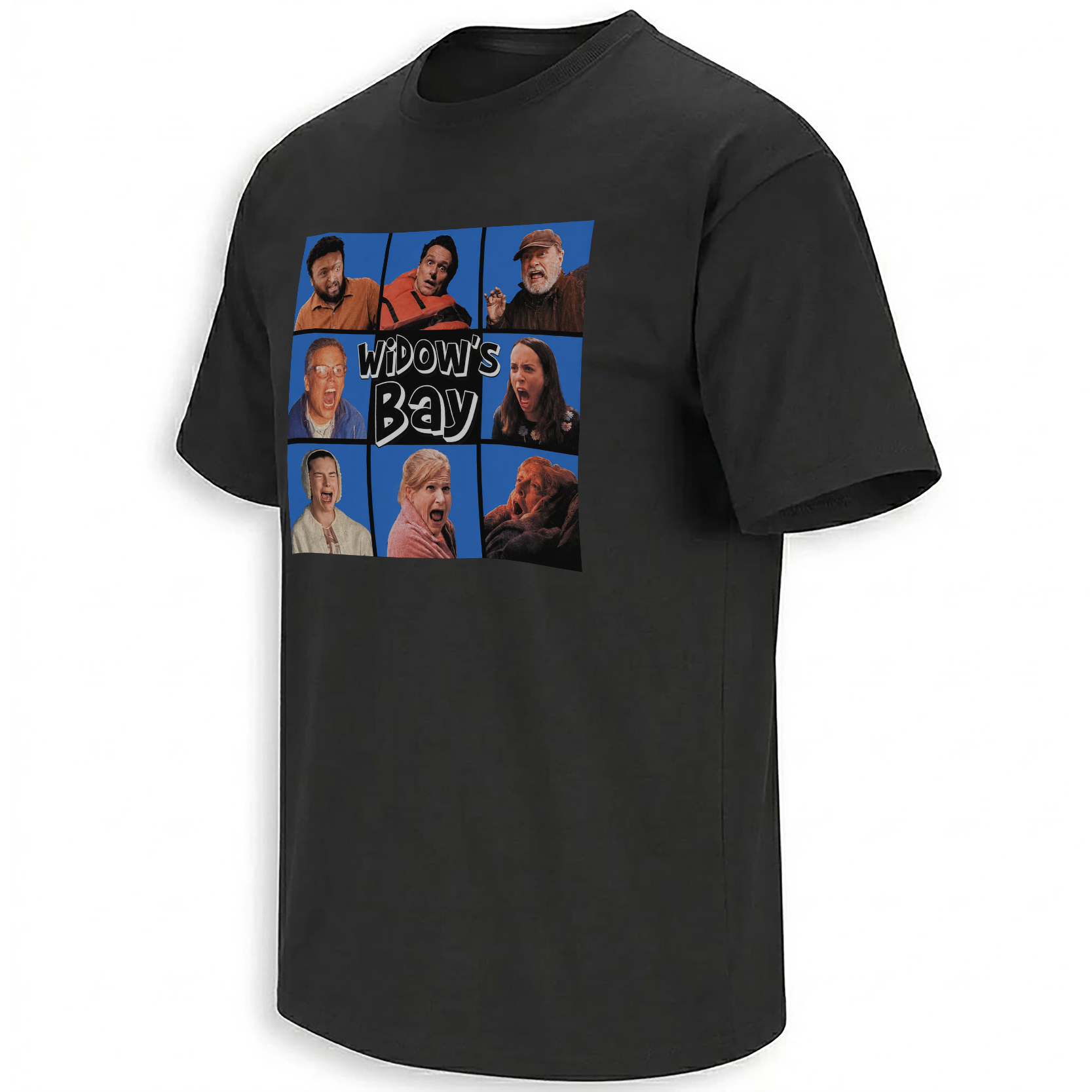
The Widow’s Bay cast collage design translates that ensemble structure into a single visual field. Rather than isolating one star, the composition assembles the characters like evidence pinned together in a local archive.
That choice suits the show’s cultural moment. The Emmy conversation is not only about one performance or one frightening image. It is about how the cast collectively established the tone of an island where bureaucratic frustration, community folklore and supernatural panic occupy the same frame.
Why the Collage Format Fits the Series
Cast-collage graphics have long belonged to the language of cult television, horror posters and bootleg fan apparel. Their strength comes from accumulation. Instead of explaining the plot, they create a social map: who matters, who may know more than they admit and who appears likely to survive the image.
In the Widow’s Bay artwork, the layered portrait treatment reflects the series’ ensemble construction. Faces are not arranged as a clean corporate cast photo. They appear embedded within the same ominous environment, suggesting that every character is part of the island’s history rather than an outsider simply passing through it.
The coastal horror palette reinforces that feeling. Dark marine tones, weathered highlights and cinematic contrast evoke fog, old tourism posters, corroded signage and the visual unease of a place whose scenic surface has never been the whole story.
The design works like an unofficial visitor file assembled after the tourist campaign has already gone wrong. Its portraits advertise the people of Widow’s Bay while the composition quietly warns that none of them can be separated from the curse surrounding the island.
Horror That Refuses to Become a Punchline
Many horror comedies create distance from fear by mocking the genre. Widow’s Bay takes a more difficult route. Its characters can be funny, the civic situation can become absurd and local behavior can produce deadpan comedy, but the supernatural events are still permitted to carry consequences.
That seriousness gives the comedy something solid to push against. When residents respond to an impossible event with practical frustration, the humor does not tell viewers that the danger is fake. It tells them that this town has developed social habits around surviving it.
The structure also allowed the season to move among different horror traditions. Haunted spaces, maritime folklore, uncanny rituals and community paranoia could enter the story without flattening the series into one repeating monster formula.
Why Viewers Kept Recommending the Show by Comparison
Breakout television often becomes legible online through comparison. Viewers explain an unfamiliar series by placing it between familiar ones. With Widow’s Bay, those comparisons repeatedly emphasized the combination of small-town character comedy, prestige mystery and genuine genre danger.
The comparisons helped people enter the show, but they did not fully contain it. Widow’s Bay has its own comic rhythm: less interested in rapid jokes than in watching stubborn people maintain social roles while reality becomes increasingly impossible.
That is why the series generated durable word of mouth. Viewers were not recommending one twist. They were recommending a place, an ensemble and a tone difficult to reproduce in a short clip.
The Emmy Nominations Made the Hidden Island Visible
Awards recognition can change how a first season is remembered. Before July 8, Widow’s Bay could be framed as an unusually successful genre discovery—one of those shows viewers felt compelled to introduce to friends before the wider audience arrived.
Nineteen nominations altered that identity almost overnight. The series entered Emmy season as an institutional success without losing the strangeness that made it attractive. Its curse, municipal incompetence and coastal folklore had become prestige television rather than obstacles to it.
That tension now defines the show’s cultural position. It remains a cult object in tone, but no longer in scale. The island is still difficult to reach. The series is not.
A Television Artifact From the Moment the Secret Broke Open
Fan graphics often become most meaningful at the exact point when a show crosses from discovery into shared recognition. The audience that found the series early still remembers recommending it as an overlooked oddity, while the Emmy nominations mark the moment that private enthusiasm became public consensus.
The cast collage belongs to that transition. It captures the ensemble before future seasons, awards ceremonies or larger franchise expectations reshape how viewers remember the first year. In visual terms, it preserves the original attraction: a strange group of people standing together inside an island that should never have become a tourist destination.
Ellie Shirt does not currently have a confirmed dedicated Widow’s Bay, Apple TV or television collection URL. Rather than inventing a category, the most accurate broader internal path is the newest cultural graphics archive , where newly released entertainment, fandom and internet-culture designs appear together.
Frequently Asked Questions
How many 2026 Emmy nominations did Widow’s Bay receive?
Widow’s Bay received 19 nominations when the 2026 Emmy nominations were announced on July 8, establishing the Apple TV series as one of the year’s most recognized new shows.
What is Widow’s Bay about?
The series follows Mayor Tom Loftis as he tries to revive an isolated New England island through tourism, despite residents warning that the town is cursed and its old supernatural stories are beginning to return.
Who stars in Widow’s Bay?
The principal ensemble includes Matthew Rhys, Kate O’Flynn, Stephen Root, Kevin Carroll, Dale Dickey and Kingston Rumi Southwick.
Why is Widow’s Bay described as a horror comedy?
The show combines genuine supernatural danger with character-driven humor, allowing the horror to remain serious while comedy emerges from the residents’ personalities, civic conflicts and practical reactions.
Why does the cast-collage artwork fit the series?
The collage reflects the show’s ensemble structure by presenting the characters as one interconnected community, while its dark coastal palette evokes the folklore, isolation and haunted atmosphere of the island.
The Widow’s Bay cast collage preserves the ensemble at the exact moment Apple TV’s cursed coastal comedy moved from word-of-mouth discovery to a 19-nomination Emmy phenomenon.
Widow’s Bay Shirt captures Apple TV’s Emmy-nominated horror comedy through a cinematic cast collage, cursed-island atmosphere and the eccentric ensemble that turned the 2026 series into a major television breakout.