
McCartney II Shirt Turns Paul McCartney’s Experimental Pop Era Into a Collage Artifact
McCartney II has never behaved like a safe legacy record. Released in 1980 after being built from home-recording experiments, synth textures and one-man studio curiosity, it now feels less like a detour and more like one of Paul McCartney’s strangest bridges into the future.
The story of McCartney II begins away from the expected machinery of rock prestige. Paul McCartney recorded the project at home on his farm in Scotland in the summer of 1979, during a period when Wings’ future was uncertain, and the official album notes describe a record built from electronic style, domestic origins and McCartney’s habit of playing with equipment until the experiment became the song.
That is why the album still feels unusually alive in fan culture. McCartney II is not simply a 1980 release date or a post-Beatles catalog entry. It is the sound of a giant pop figure going back into a private room and letting odd machines, drum patterns, filtered vocals and synth lines loosen the idea of what a Paul McCartney record could be.
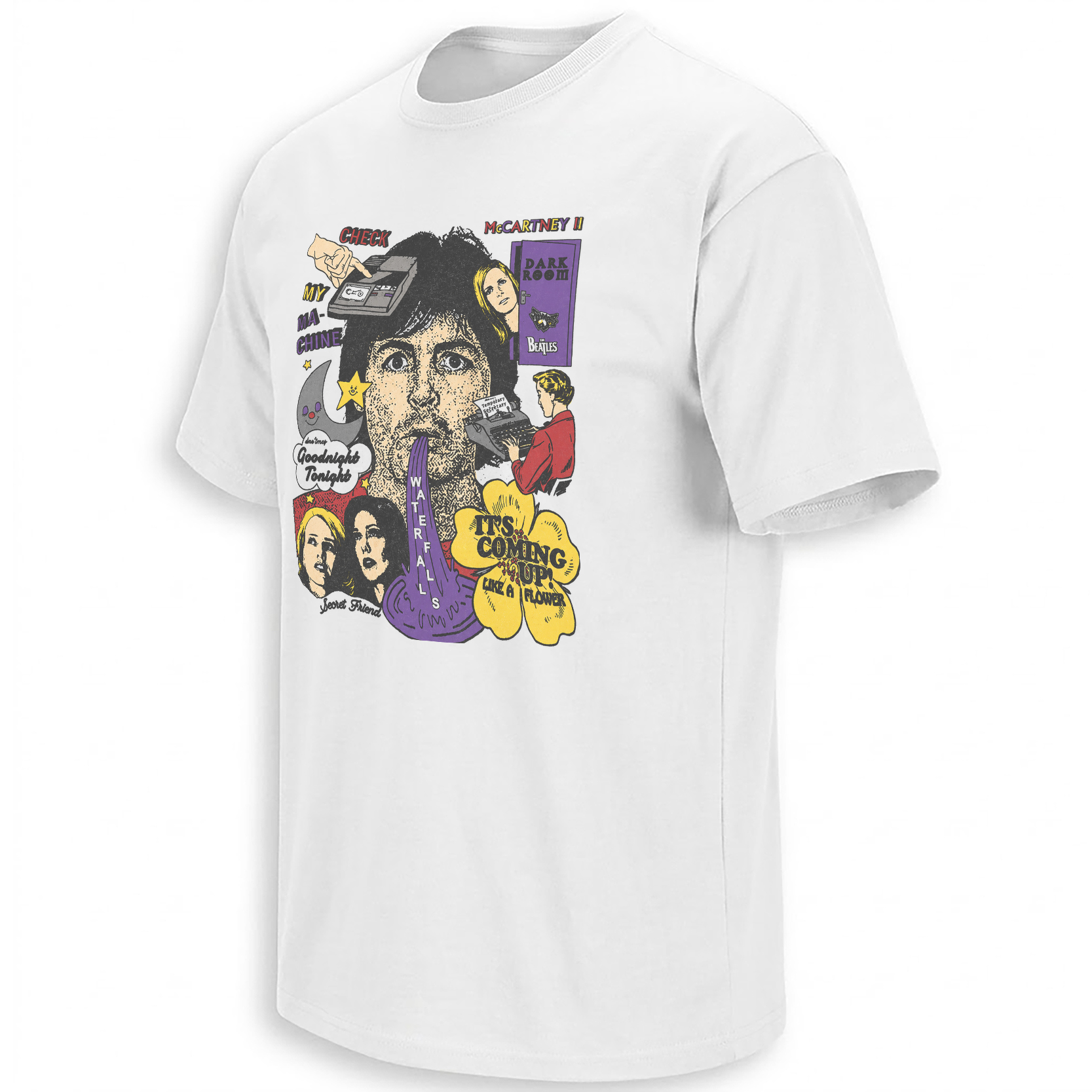
The collage shirt works because it understands that memory. It does not frame McCartney only as a polished stadium legend. It frames him as the restless studio figure behind Coming Up, Temporary Secretary, Waterfalls and the strange little electronic corners that made McCartney II feel jarring then and weirdly current later.
McCartney II matters because it sounds like a pop master briefly refusing to act museum-safe.
Why McCartney II Still Feels Strange in the Best Way
McCartney’s career is often narrated through melody, craft and historical weight. That framing is deserved, but it can make the weirder records seem like side rooms. McCartney II pushes against that. It is charming, uneven, playful, synthetic, domestic and eccentric in ways that do not always match the public idea of McCartney as the effortless writer of universal hooks.
That tension is the album’s cultural value. The record contains recognizable McCartney warmth, but it also lets machines interrupt the room. Drum machines click. Synths wobble. Vocals bend into odd characters. Songs that might have been polished into conventional pop are left with sharper, stranger edges.
Over time, that oddness has become the point. The album’s early electronic leanings, home-studio feel and off-center pop instincts have made it especially interesting to listeners who hear bedroom pop, lo-fi synth work and one-person production as part of modern music language rather than a novelty.
The Collage Format Fits the Album’s Construction
A straight portrait would not carry the same meaning here. McCartney II was not a straight-line record. It came from private experimentation, new equipment, leftover curiosity and a willingness to let songs exist in unusual shapes. A collage is therefore the right visual language because it suggests assembly, interruption and fragments being turned into personality.
The artwork uses multiple McCartney images rather than one static icon. That choice gives the design motion. It implies different versions of the same artist: the Beatles survivor, the Wings leader, the solo home-recording tinkerer, the melodic craftsman and the electronic oddball all occupying one graphic field.
The red, yellow and blue accents help keep the piece out of plain nostalgia. They feel closer to pop print, old magazine cutouts and record-store wall collage than a reverent black-and-white tribute. That matters because McCartney II is not best remembered as a solemn legacy object. It is remembered as playful, strange and adventurous.
The layered portrait arrangement, warm paper mood, bright pop color accents and “II” era framing make the design feel like an analog fan collage for an album built from home-recording curiosity, synthesizer experiments and off-kilter studio play.
From Farmhouse Experiment to Cult Pop Reference
The official McCartney notes describe the album as conceived at home on his Scottish farm, with the first recorded track tied to experiments with new equipment. That origin story matters because it places McCartney II closer to a personal laboratory than a normal superstar production cycle.
The record arrived before Wings fully dissolved, which gives it another layer of in-between energy. It is not quite a band album, not quite a conventional solo statement, and not merely an archival curiosity. It sits at a hinge point: McCartney stepping away from the group frame and letting the home studio become its own band.
That is why modern listeners often find the album easier to understand than some 1980 audiences did. The idea of one artist building a whole sonic world from private equipment now feels natural. McCartney II anticipated that mindset from inside an older pop era.
Why “Temporary Secretary” Changed the Album’s Afterlife
For many listeners, Temporary Secretary became the gateway into McCartney II’s strangeness. The song’s robotic vocal shape, frantic synth programming and almost comic insistence made it a perfect example of the album’s refusal to behave like respectable heritage rock.
Its afterlife helped reframe the album. What once might have sounded abrasive or unserious could later sound internet-ready, club-adjacent, meme-friendly or simply ahead of the taste cycle. The track made it easier for younger listeners to approach McCartney not only as a melody figure, but as someone willing to make something genuinely odd.
The collage shirt benefits from that same reappraisal. It reads McCartney II through the lens of rediscovery rather than release-day confusion. The design is not asking fans to treat the album as a flawless masterpiece. It is asking them to recognize the charm of a pop legend letting the machines misbehave.
McCartney II fits today’s fan culture because it rewards rediscovery: odd clips, deep-cut debates, synth-pop reappraisal, home-recording mythology and the pleasure of finding the weird room inside a famous catalog.
The Shirt Works Because It Avoids Safe Legend Worship
Many McCartney graphics lean toward the obvious: Beatles memory, clean portrait reverence, classic-rock prestige or familiar greatest-hits language. This design takes a more interesting route. It focuses on the part of McCartney’s story where the legend becomes a maker again — alone, curious and willing to sound strange.
That makes the collage feel less like a poster of fame and more like a visual argument. It says the experimental McCartney matters too. The artist behind polished pop standards is also the artist who made odd synth-pop sketches, home-studio experiments and songs that did not always explain themselves neatly.
In that sense, the design belongs in a modern music-fandom lane where listeners do not only celebrate the hits. They celebrate the detours, the misunderstood albums, the strange B-sides, the home demos and the moments when an artist’s catalog becomes more interesting because it refused to stay tidy.
Why Album-Memory Graphics Matter
Music shirts often work as portable record shelves. They tell other listeners which era, sound or obsession someone is carrying with them. A McCartney II collage is especially specific because it does not simply say “Paul McCartney.” It names an album era with a particular sonic temperature.
That specificity matters for fan culture. McCartney II signals the listener who knows Coming Up, understands why Temporary Secretary still sparks reactions, and appreciates the homemade electronic weirdness that sits beside McCartney’s more polished catalog landmarks.
Since a music-specific Ellie Shirt collection URL is not confirmed here, the safest broader path is the Newest collection, where current pop-culture, music-adjacent, meme and fandom graphics sit together as a running archive of visual references.
The Shirt as a Studio-Era Timestamp
The McCartney II Shirt captures a record that feels like a private studio door left slightly open. The collage form suggests the clutter of ideas: portraits, fragments, color, era markers and the feeling of an artist assembling a self-contained world from whatever was close enough to plug in.
That is why the design feels strongest as a timestamp of experimentation. It does not reduce McCartney to biography or celebrity. It points to a particular creative mode: home-recorded, synth-curious, slightly eccentric and newly resonant in a culture that now understands bedroom production as a serious artistic language.
The result is a graphic for the fans who hear McCartney II not as a footnote, but as a strange, charming and stubbornly modern album-era artifact.
Frequently Asked Questions
What is the McCartney II Shirt about?
It is a Paul McCartney music-culture shirt built around the experimental 1980 album McCartney II, using collage artwork to reflect the record’s home-recorded, synth-heavy personality.
Why is McCartney II considered experimental?
The album moved into electronic textures, eccentric synth-pop, filtered vocals and home-studio experimentation, making it feel very different from many conventional McCartney or Wings-era records.
Why does the design use a collage style?
Collage fits the album because McCartney II itself feels assembled from private experiments, machine play, pop fragments and different versions of McCartney’s musical identity.
What does McCartney II represent in Paul McCartney’s catalog?
It represents a transitional, self-produced solo moment where McCartney stepped away from the band frame and let home recording, synthesizers and odd pop ideas shape the record.
Why does McCartney II still connect with modern listeners?
Its homemade electronic sound, strange synth-pop moments and one-person studio approach now feel closer to modern bedroom-pop and experimental production culture than many listeners may have expected in 1980.
The McCartney II Shirt turns Paul McCartney’s 1980 experimental pop era into a layered collage piece, while the Newest archive follows the music-adjacent, pop-culture and fandom graphics that turn specific cultural references into wearable memory.
McCartney II Shirt captures Paul McCartney’s 1980 experimental pop era through layered collage artwork, synth-pop memory, home-recorded album mythology and the strange charm of a cult favorite solo record.