Logan Webb’s Historic June Turned “Webby-Man” Into San Francisco’s Perfect Pitching Hero
Five starts, a Major League-best 0.71 ERA and another one-hit performance at Oracle Park transformed Logan Webb’s June from a return-to-form story into one of the strongest pitching months in recent Giants history.
The nickname had existed long before the numbers became historic. San Francisco already called Logan Webb “Webby,” a familiar shortening that matched his place inside the clubhouse and the rotation. By the end of June 2026, the name carried a different charge.
Webb completed five June starts with a 0.71 ERA, a 0.61 WHIP and at least seven innings in every appearance. Three consecutive outings reached eight innings, restoring the version of the Giants ace built around endurance, movement and the expectation that the bullpen could remain seated deep into the night.
The final start of the month supplied the cleanest image. Webb held Atlanta to one hit across seven scoreless innings at Oracle Park, retired 16 consecutive hitters and lowered his season ERA to 3.09. The “Webby-Man” joke suddenly felt less like a nickname parody and more like a comic-book explanation for what hitters had experienced all month.
Webb did not overpower June with one spectacular night. He built a web across five starts and made every opposing lineup spend the month trying to escape it.
The Month San Francisco’s Workhorse Returned
Webb’s season had not followed a straight line. A right-knee issue interrupted the spring, while his ERA climbed above five before his return from the injured list at the end of May.
The response was not built through a dramatic velocity jump or a completely new repertoire. It came through the qualities that have defined Webb’s best years: throwing strikes, reading swings, creating ground balls and trusting that movement could produce softer contact than pure speed.
His one-hit start in Milwaukee on June 3 set the tone. A no-hit bid survived into the seventh inning, and San Francisco needed only one run to win. That performance was followed by a sequence of long starts in which Webb repeatedly placed the Giants in a position to control the final innings.
Why “Webby-Man” Works Beyond the Name Joke
The visual pun begins with the surname. “Webb” naturally becomes “Webby,” and “Webby” naturally opens the door to a spider-web superhero concept.
Yet the design works because it also describes Webb’s pitching style. His sinker, changeup, cutter and breaking pitches do not travel through one predictable lane. They move across different levels of the strike zone, producing a network of possible paths that hitters must identify before the ball reaches the plate.
A traditional superhero graphic might depend on explosive strength. Webb’s baseball power is based on control. He wins by placing the hitter inside a sequence, changing the speed of the next pitch and making the expected result disappear.
The Artwork Turns Pitch Movement Into Comic Movement
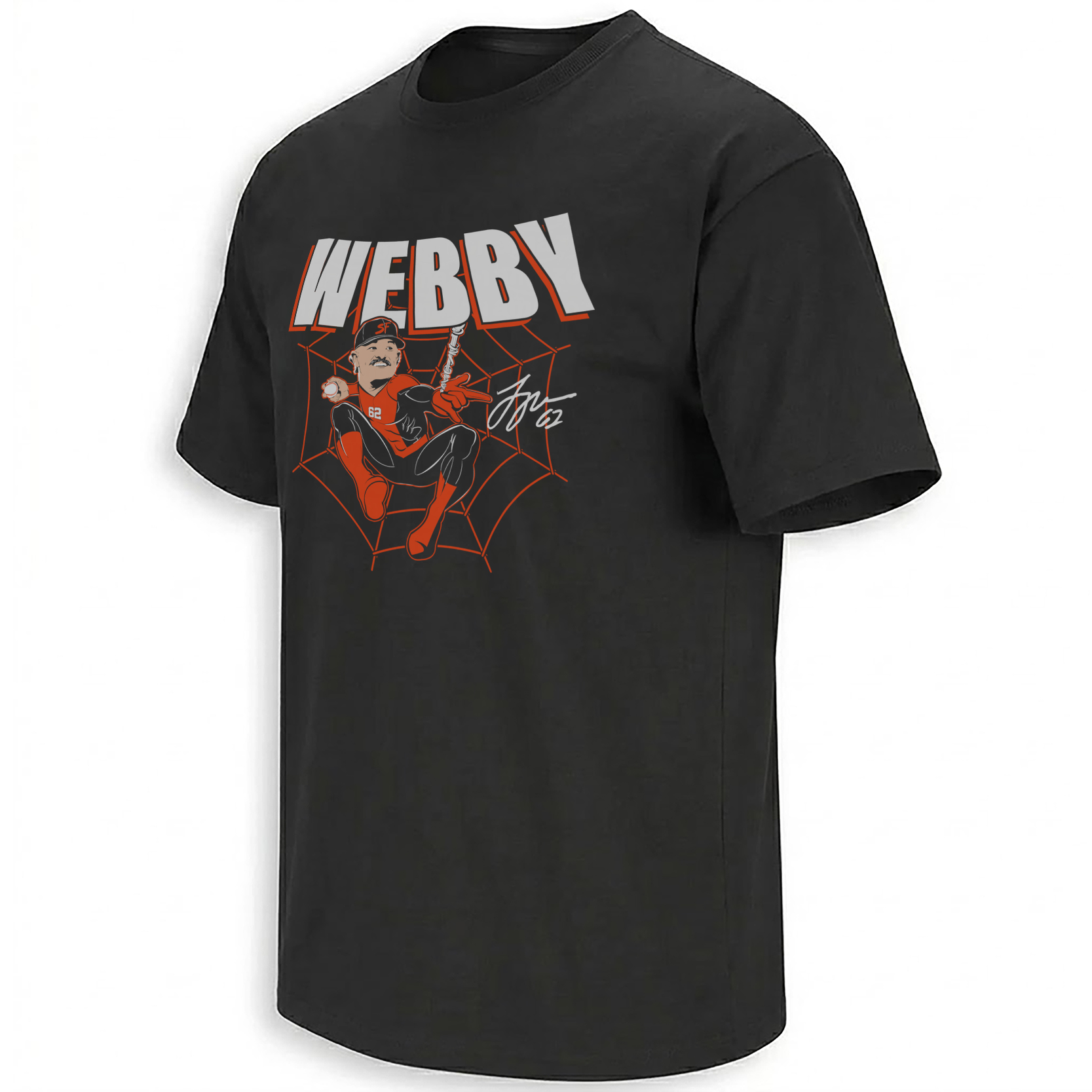
The central pose is not a standard pitching delivery. Webb appears in a compact superhero crouch, one arm holding the baseball near his body while the other extends forward and releases a strand of webbing.
That choice moves the design away from photographic realism and toward comic-book exaggeration. The web line replaces the conventional speed trail, suggesting that control and movement are the actual powers behind the scene.
Oversized “WEBBY” lettering sits above the composition like a title masthead. White block type, black shading and an orange offset create the visual depth of a printed comic cover, while the signature detail gives the lower section the feeling of a collectible player card.
Dimensional lettering, a crouched airborne pose and radiating spider-web lines turn the artwork into a baseball superhero cover rather than a normal pitching portrait.
The web functions as a metaphor for Webb’s movement-heavy arsenal, in which sinkers, changeups and breaking pitches force hitters to navigate several possible paths.
Black and Orange Keep the Joke Inside Giants Culture
The black base creates the atmosphere of an evening game and gives the spider web enough negative space to remain readable without covering the entire composition.
Orange carries the Giants identity while also behaving like classic comic-book energy. It appears around the web, typography shadow, uniform details and cleats, creating movement without turning the graphic into a multicolor superhero costume.
White and gray preserve the player’s face, uniform and baseball, allowing Webb’s mustache and No. 62 to remain recognizable inside the parody structure.
The design is strongest when read as a record of Webb’s established San Francisco identity rather than a reference to one score. “Webby,” No. 62, the movement-heavy arsenal and the orange web can remain recognizable long after the June stat line changes.
Calling His Own Pitches Changed the Rhythm
Webb’s June dominance also reflected a change in how he controlled the game. With PitchCom allowing pitchers to call their own selections, Webb took greater responsibility for sequencing and tempo.
That autonomy fits his identity. Webb has spent enough time studying hitters, reading swings and understanding his own movement to work like the central operator of the inning rather than simply following instructions from behind the plate.
The result was a month in which rhythm became part of the pressure. Hitters had less time to reset, Webb remained connected to the logic of the next pitch and San Francisco repeatedly reached the late innings without losing control.
Why Oracle Park Still Feels Like Webb’s Stage
Webb’s best starts at Oracle Park carry a specific atmosphere. The marine air, deep outfield and evening shadows naturally reward pitchers who can keep the ball low and trust the defense.
His style fits that environment. Ground balls become part of the architecture, long innings feel sustainable and one early Giants run can remain meaningful deep into the game.
The wider San Francisco Giants collection records that Bay Area baseball identity through current players, Oracle Park references, local humor and black-and-orange visual language.
Inside the broader MLB Shirts collection, the Webby-Man piece belongs to a larger tradition of converting player nicknames, pitching styles and current performances into visual fan folklore.
Frequently Asked Questions
Why is Logan Webb called “Webby”?
“Webby” is a familiar nickname formed from Webb’s surname and is commonly used by Giants teammates, fans and local media.
How dominant was Logan Webb in June 2026?
Webb recorded a 0.71 ERA and 0.61 WHIP across 38 innings, completed at least seven innings in all five starts and earned National League Pitcher of the Month.
What happened in Webb’s June 27 start against Atlanta?
He threw seven scoreless innings, allowed only one hit, struck out six and retired 16 consecutive hitters during San Francisco’s 5–0 victory.
Why does the design use a spider web?
The web creates a visual pun on Webb’s surname while also representing the movement and sequencing of his sinker, changeup and breaking pitches.
What number does Logan Webb wear?
Webb wears No. 62 for San Francisco, and the number appears clearly on the superhero-style player illustration.
The Webby-Man design turns Logan Webb’s nickname, No. 62 and movement-heavy arsenal into an orange-and-black comic concept, while the Giants visual archive follows the larger Bay Area baseball story surrounding him.
Webby Man Shirt transforms Logan Webb’s Giants nickname into a spider-web baseball hero through No. 62, oversized comic lettering, an orange web and the movement-driven pitching identity behind his historic June 2026.