
No Fly Zone
Kamari Lassiter’s second NFL season turned a familiar defensive slogan into measurable reality: four interceptions, 17 passes defended, a Pro Bowl selection and another reason Houston’s secondary feels built for the next stage.
“No Fly Zone” is one of football’s simplest warnings. It tells a quarterback that one part of the field is no longer neutral space. A receiver may line up there, run a route there and ask for the ball there—but throwing into that area carries consequences.
Kamari Lassiter gave the phrase real weight during his second season with Houston. The Texans cornerback finished 2025 with four interceptions, 17 passes defended and 86 total tackles across 16 regular-season games. By January, he had been selected for the 2026 Pro Bowl alongside Houston safety Calen Bullock.
The numbers describe production. The visual identity tells the rest of the story: Lassiter rising above the field with the football secured, one finger pointed toward the sky and a Texas-shaped warning behind him. The entire composition reads like restricted-airspace signage built for a defensive back.
Lassiter doubled down on his ball-production reputation during his second NFL season.
His breakup total placed him among the league’s most productive coverage defenders.
Lassiter contributed as a physical run defender as well as an outside cover corner.
His second-year leap earned recognition alongside teammate Calen Bullock.
Why “No Fly Zone” Fits Kamari Lassiter
The phrase has been used for dominant secondaries for decades, but it is especially effective when attached to a cornerback whose game is built on more than waiting for mistakes.
Lassiter plays with the physical confidence to challenge receivers early in the route. He is comfortable closing space, contesting the catch point and attacking underneath throws before they can become easy completions.
That style changes the quarterback’s decision before the ball is released. A true coverage warning is not created only by interceptions. It is created when the passer looks toward one side, recognizes the risk and moves to another option.
The best no-fly zones operate psychologically. They narrow the offense’s usable field and make every target toward the boundary feel more expensive.
The Shirt Captures the Moment After Possession Changes
The featured artwork does not show Lassiter waiting in a backpedal or standing in a conventional player portrait. It places him in midair with the football held in his left hand and his right arm extended upward.
His legs stretch across the lower half of the composition, creating the impression that he has just taken the ball away and is moving immediately into the return. The pose sits between interception, celebration and forward motion.
Behind him, the words “NO FLY ZONE” fill almost the entire printable area in tall condensed lettering. Some sections are fully shaded while others remain outlined, allowing the text to feel large without overwhelming the player illustration.
A pale Texas silhouette occupies the middle layer. It places the defensive warning inside Houston territory without requiring a skyline, stadium or conventional team crest.
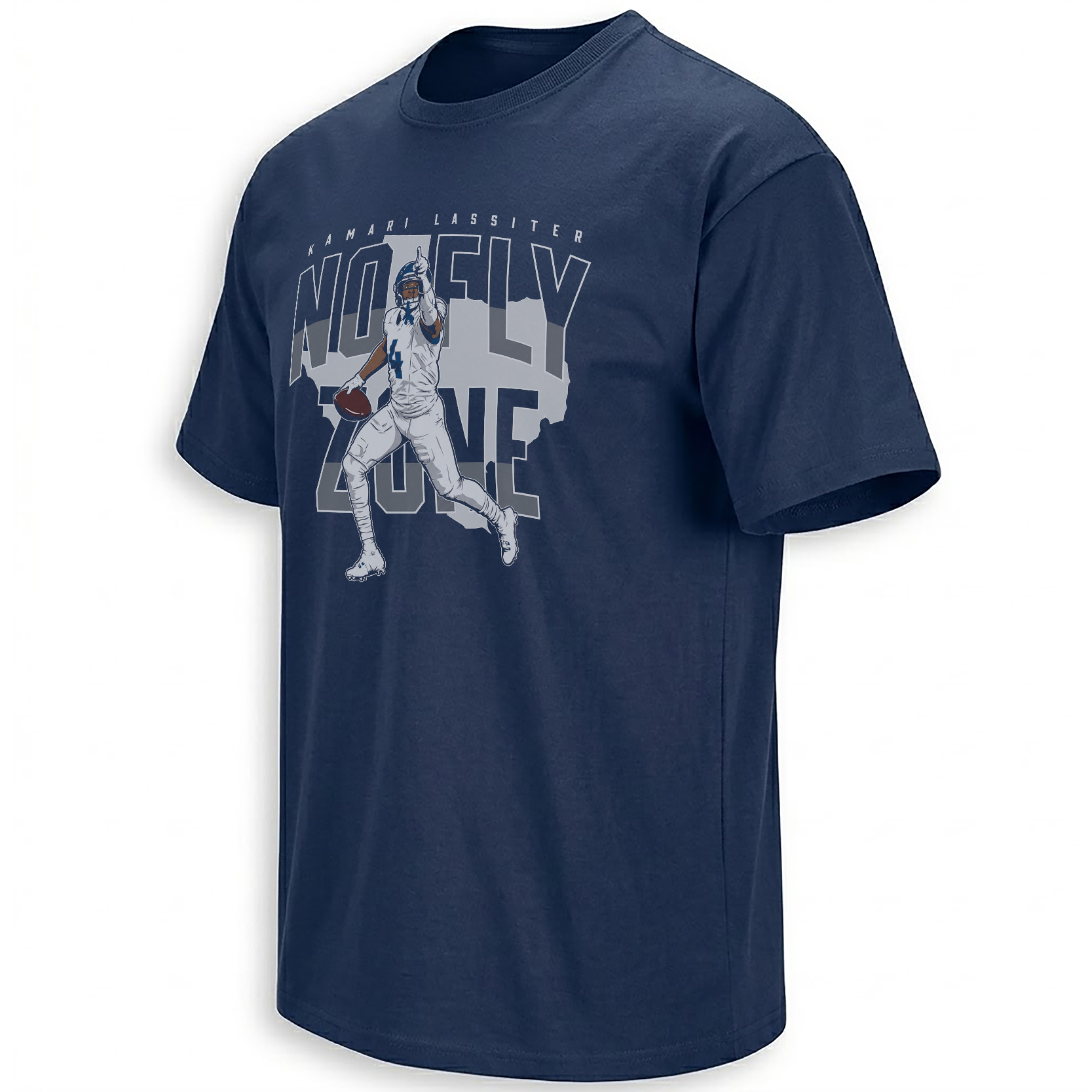
No Fly Zone Shirt
A dark-navy defensive graphic featuring Kamari Lassiter securing the football in midair, raising one finger and crossing oversized “No Fly Zone” lettering placed over a pale Texas silhouette.
The Design Works Because the Player Breaks Through the Typography
The most effective visual decision is the contrast between the rigid lettering and Lassiter’s diagonal body position.
“No Fly Zone” is arranged like an official boundary marker. The letters are tall, square and fixed in place. Lassiter cuts across them with one leg extended behind him and the other bent forward, creating the sense that he has physically entered and taken control of the airspace.
His white uniform separates cleanly from the navy shirt base. Blue and dark-red details remain restrained, while the brown football provides the composition’s only warm focal point.
The result resembles a modern defensive campaign poster rather than a traditional player photograph. It is designed to communicate the position first: cornerback, interception, territory denied.
Three Interceptions as a Rookie, Four More in Year Two
Lassiter recorded three interceptions and 10 passes defended during his rookie season after arriving as a second-round draft pick.
He increased those totals to four interceptions and 17 defended passes while playing a larger role in Houston’s defense.
Through his first 30 regular-season games, Lassiter accumulated seven interceptions and 27 passes defended.
Interceptions can fluctuate from season to season because they depend partly on opportunity. A cornerback cannot intercept a pass that the quarterback refuses to throw.
Pass breakups therefore help complete the picture. Lassiter’s jump from 10 defended passes as a rookie to 17 in his second year showed that the ball continued finding him—and that he continued disrupting it even when the play did not end with possession changing hands.
That combination is what gives the “No Fly Zone” concept credibility. It is not attached to one isolated highlight. It represents a two-season pattern of contested catches, broken-up throws and intercepted passes.
The Interceptions Were Not All the Same
Lassiter’s 2025 takeaways revealed different parts of his coverage skill. Some required staying on top of a vertical route. Others demanded patience near the goal line, where a cornerback has less space to defend and cannot afford to lose leverage.
Against San Francisco, he rose above Jauan Jennings and turned a potential touchdown catch into an interception. The play reflected the exact visual language used by the shirt: the defender in the air, the receiver denied and the football leaving the offense’s possession.
Against Kansas City, Lassiter tracked a deep Patrick Mahomes throw and completed another takeaway downfield. Against Arizona, he intercepted Jacoby Brissett in the end zone and prevented the Cardinals from converting a scoring opportunity.
Each play reinforced a different meaning of “No Fly Zone.” One denied the catch point. One controlled the deep ball. One closed the end zone.
Lassiter’s value comes from route recognition, physical positioning, timing at the catch point and the confidence to play the football rather than merely reacting to the receiver.
Houston’s Secondary Is Larger Than One Corner
A true restricted-airspace defense cannot be built by one player. Quarterbacks will simply redirect the ball toward a weaker matchup unless the entire secondary closes options together.
Houston’s defensive structure has become difficult to attack because Lassiter operates beside other young defenders capable of changing a possession.
A premier outside corner whose range, ball skills and ability to travel with top receivers give Houston an elite presence on the opposite boundary.
A center-field playmaker whose interception range extends the secondary’s control beyond the individual cornerback matchup.
A physical and versatile defensive back who can influence coverage, pressure and run support from multiple alignments.
Lassiter and Bullock receiving Pro Bowl recognition together was especially meaningful because both entered the league in 2024. Their development gave Houston something franchises spend years trying to create: a young secondary core capable of growing without waiting for one another.
Stingley’s presence adds another level. An offense cannot automatically avoid Lassiter by throwing toward the other sideline. Houston can place high-level coverage talent across the formation and force the quarterback to hold the ball longer.
That additional hesitation benefits the pass rush. Coverage and pressure are not separate defensive stories. They create one another.
From Georgia’s Defensive Culture to Houston
Lassiter arrived in the NFL after playing inside one of college football’s most demanding defensive environments at Georgia.
His college reputation was not built around workout mythology or one spectacular testing number. It was built around preparation, competitive discipline, physical coverage and the ability to remain connected to polished route runners.
Daily practice battles against future NFL receivers helped shape that approach. At Georgia, Lassiter learned to treat each repetition as information. When a receiver won, the response was not simply frustration. It was analysis: what release created the separation, what technique failed and how could the next rep be played differently?
That mindset translated naturally to cornerback life in the NFL. The position guarantees occasional losses. The challenge is preventing one lost route from becoming a lost series.
The “Locksmith” Identity Came Before the No-Fly Zone
During Lassiter’s first Houston training camp, the nickname “Locksmith” began following him. It described the same basic concept through a different metaphor: receivers enter the matchup, and access becomes difficult.
“Locksmith” focuses on the individual duel. “No Fly Zone” expands the idea across a section of the field.
Together, the phrases describe the reputation Lassiter has been building since the Texans selected him with the 42nd overall pick in the 2024 NFL Draft. He is not framed as a defender waiting behind the play. He is framed as someone controlling entry.
That is why the shirt avoids generic action imagery. The raised finger and secured football suggest authority. The Texas silhouette defines the territory. The text establishes the restriction.
The Number on the Artwork Preserves a Specific Stage
Jersey-number changes can create an unexpected timeline inside sports artwork. A design made around one season may preserve the number connected to the highlight, even after the player enters the next year with a new numeral.
In this case, No. 4 belongs to the run of interceptions, defended passes and Pro Bowl recognition that gave the “No Fly Zone” wording its meaning. The artwork therefore operates like a season-specific poster.
Why the Texas Silhouette Matters
The state outline behind Lassiter is more than an empty background shape. It changes the slogan from a general football phrase into a territorial statement.
Restricted airspace requires a location. The pale-gray Texas silhouette supplies one immediately. It implies that the warning applies inside Houston’s defensive boundaries, particularly when the Texans are playing beneath the roof at NRG Stadium.
The state shape also balances the narrow player figure. Its broad horizontal form keeps the composition from becoming too tall and creates separation between the outlined upper letters and darker lower typography.
Because the silhouette remains muted, it reinforces location without competing with Lassiter or the football.
Why the Navy Shirt Base Is Essential
The dark navy background allows the design to behave like a night-operation graphic. White and silver elements resemble reflective markings, while the deeper blue details connect the artwork naturally to Houston football.
The limited palette also gives the shirt a more serious defensive tone. There is no explosive rainbow treatment, oversized flame effect or crowded stadium scene. The visual message remains controlled and direct.
Navy works especially well with denim, gray athletic shorts, neutral outerwear and red accessories. Because the central artwork uses white and cool gray, it remains legible without requiring additional bright color around it.
The Phrase Can Outlive a Single Game
Some sports designs depend entirely on one score or one opponent. Their emotional power can be intense but narrow.
“No Fly Zone” has more staying power because it describes a position and a style of play. It can remain relevant through interceptions, pass breakups, playoff games and future matchups against elite receivers.
Every target into Lassiter’s coverage becomes another opportunity for the phrase to renew itself. When the pass is broken up, the warning survives. When the ball is intercepted, the warning becomes a highlight.
The design therefore functions as both a record of his 2025 breakout and a statement entering 2026.
Explore more Houston football artwork: Browse player, defense and game-day graphics in the Houston Texans collection, or visit the broader NFL shirts and apparel collection.
What Comes Next for Lassiter and Houston’s Airspace
The next challenge is consistency. Once a cornerback develops a reputation, opponents adjust. They use motion to create different releases, bunch formations to prevent clean contact and route combinations designed to force defenders into difficult communication decisions.
Lassiter will also face the paradox shared by every respected corner: improved coverage can reduce interception opportunities because quarterbacks become less willing to test him.
His progress therefore cannot be judged only by whether four interceptions become five. It will appear in completion percentage, contested targets, explosive plays prevented, run support and the amount of freedom Houston’s coaches have to call aggressive coverages.
The visual expectation remains simple. The ball enters the air. Lassiter rises toward it. One side of the field becomes unavailable.
No flight clearance granted.
Frequently Asked Questions
What does “No Fly Zone” mean in football?
“No Fly Zone” describes a secondary or defensive back who makes passing into a particular part of the field unusually difficult or dangerous for the quarterback.
Who is Kamari Lassiter?
Kamari Lassiter is a Houston cornerback selected in the second round of the 2024 NFL Draft after playing college football at Georgia.
How many interceptions did Kamari Lassiter record in 2025?
Lassiter recorded four interceptions during the 2025 regular season.
How many passes did Lassiter defend in 2025?
He finished the regular season with 17 passes defended, increasing his career total to 27 through his first two NFL seasons.
Was Kamari Lassiter selected to the Pro Bowl?
Yes. Lassiter was selected for the 2026 Pro Bowl Games alongside Texans safety Calen Bullock.
What does the No Fly Zone Shirt artwork show?
The design shows Lassiter in an airborne interception pose with the football in one hand and one finger raised over large “No Fly Zone” lettering and a Texas-shaped background.
Why does the artwork show number 4?
The graphic preserves the number associated with the breakout period represented by the design. Houston’s current 2026 roster lists Lassiter as number 3.
Which other players form Houston’s secondary core?
Houston’s defensive backfield also features standout players including Derek Stingley Jr., Calen Bullock and Jalen Pitre.
Why is there a Texas silhouette in the design?
The state outline defines the restricted territory as Houston and gives the defensive slogan a clear Texas football identity.