Hey Chicago, Whaddya Seiya?
Seiya Suzuki sent Wrigley Field home with a two-out walk-off, then returned two days later to launch the 100th home run of his Major League career. Chicago suddenly had both a hero and the perfect phrase for the moment.
On Monday night, Seiya Suzuki stood between the Chicago Cubs and another stranded opportunity. The score was tied, two outs had already disappeared in the bottom of the ninth, and San Diego had summoned Mason Miller with the bases loaded.
Suzuki drove Miller’s slider toward deep left field. Padres outfielder Jase Bowen retreated to the ivy, leaped at the wall and briefly appeared capable of ending the inning. The ball escaped his glove, Pete Crow-Armstrong crossed home plate and the Cubs walked off with a 3–2 victory on June 29.
Less than 48 hours later, Suzuki produced another headline. His first-inning, three-run blast in Chicago’s 23–3 rout of the Padres became the 100th Major League home run of his career. By the time the series ended, the man at the center of the “Hey Chicago, Whaddya Seiya?” design had supplied both its dramatic image and its historical context.
Suzuki’s ninth-inning drive sent Crow-Armstrong home with the winning run.
The victory gave Chicago a Major League-leading tenth walk-off win of 2026.
Suzuki reached the milestone with a three-run shot against Walker Buehler.
Chicago tied a franchise record with eight home runs in the July 1 victory.
A Walk-Off Built From Pressure, Patience and One Last Swing
The final play looked simple in the box score, but the inning had already passed through several emotional stages. Dansby Swanson opened the rally with an infield single. Pete Crow-Armstrong followed with another hit, and Alex Bregman loaded the bases.
Michael Busch then lifted a shallow fly to left. Bowen caught it and threw Swanson out at home, turning what could have been the winning sacrifice fly into a double play. Wrigley had moved from expectation to frustration in a matter of seconds.
That left Suzuki facing one of baseball’s hardest late-inning matchups. Miller’s velocity and slider give hitters little time to make a decision, but Suzuki stayed through the pitch and sent it far enough that the left fielder had to collide with the most famous outfield wall in baseball.
The hit was officially scored as a single, though it traveled like something much larger. Suzuki had already rounded first before realizing the game was over. His arms lifted, his teammates poured out of the dugout and Wrigley transformed from tension to celebration.
Why “Whaddya Seiya?” Sounds So Naturally Chicago
The phrase works because it feels like something that could be shouted from a bleacher seat, written across a neighborhood bar sign or spoken during a postgame conversation on the train home.
“Whaddya say?” is already an informal invitation to react. Replacing the final word with Suzuki’s first name turns the expression into a player slogan without making it feel artificially constructed. It has the rhythm of a Chicago call-and-response:
Hey Chicago—what do you say?
Hey Chicago—Whaddya Seiya?
The timing made the wordplay even stronger. Suzuki did not merely contribute to the win. He supplied the final image: number 27 with both arms raised while his teammates and the crowd recognized that the game had ended.
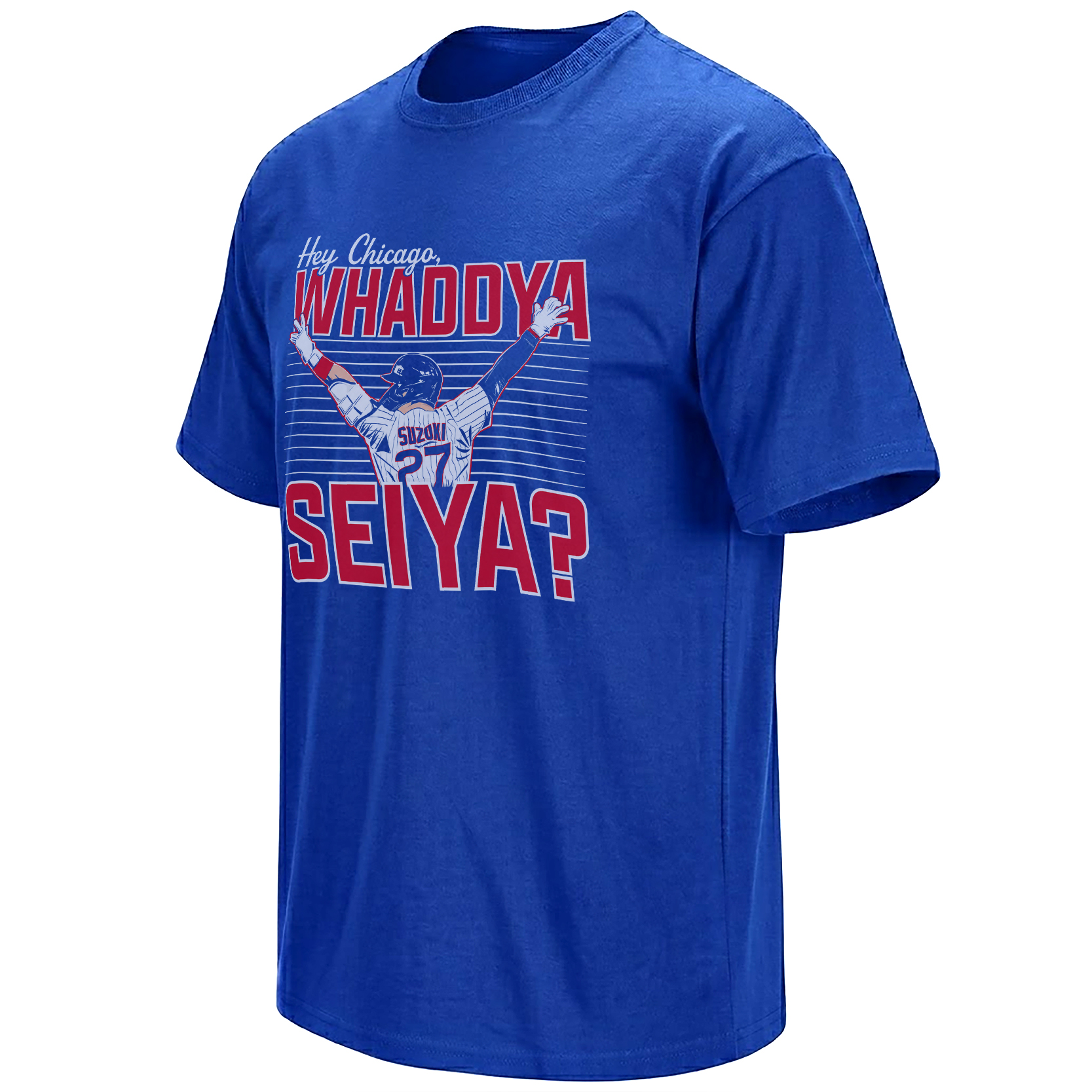
Hey Chicago, Whaddya Seiya? Shirt
A royal-blue Chicago baseball graphic centered on Suzuki’s arms-raised celebration, with his number 27 jersey, red-and-white block lettering and horizontal lines that give the artwork a retro scoreboard-poster feel.
The Artwork Captures the Celebration, Not the Contact
Many baseball graphics focus on the swing. This design chooses the second after the swing—the moment when the outcome has become clear.
Suzuki is illustrated from behind with “SUZUKI” and the number 27 visible across the pinstriped uniform. Both arms stretch above his shoulders, creating a wide V-shape that communicates victory even before the text is read.
His pose also reflects the uncertainty of the actual play. Suzuki initially watched Bowen approach the wall without knowing whether the ball had been caught. Once the winning run scored, the raised arms became a release of everything held inside the at-bat.
The large red “WHADDYA” and “SEIYA?” lettering surrounds the player, while the smaller handwritten “Hey Chicago” adds the tone of a personal greeting. Thin horizontal lines behind Suzuki suggest an old broadcast screen, ballpark scoreboard or 1980s sports poster.
On the royal-blue shirt base, the red typography and white pinstripes remain highly visible. The limited palette prevents the composition from becoming complicated and lets the wordplay remain the first thing a viewer understands.
One At-Bat, Three Runs Created
Suzuki doubled and later scored Chicago’s first run on Michael Conforto’s two-out single.
His sacrifice fly brought Dansby Swanson home and tied the game at 2–2.
Suzuki’s deep two-out drive allowed Crow-Armstrong to score the winning run.
The walk-off did not emerge from an otherwise quiet game. Suzuki was involved in all three Chicago runs. He doubled and scored in the fourth, delivered the tying sacrifice fly in the fifth and finished the game in the ninth.
That complete offensive line helps explain why the shirt’s visual focus belongs entirely to him. The final hit became the memorable clip, but his influence had been building throughout the night.
Wrigley Field Made the Ending More Dramatic
The same ball hit in another stadium might have produced a cleaner outcome. At Wrigley Field, the play had to interact with the ivy, the brick and the unusual dimensions that have shaped more than a century of Chicago baseball.
Bowen reached the warning track and jumped into the wall. For a brief instant, Suzuki and the crowd had to wait. The uncertainty gave the celebration an extra beat—the kind of pause that makes a stadium collectively hold its breath.
Suzuki’s drive carried to the left-field wall, where Bowen could not complete the catch. The image connected a modern Chicago star with Wrigley Field’s most recognizable physical feature.
That setting gives the walk-off a specifically Chicago identity. It was not merely a late hit at a generic park. It was a ball driven toward an ivy-covered wall while more than a century of baseball architecture framed the result.
Then Came Home Run Number 100
The walk-off could have carried the entire week by itself. Suzuki added another milestone in the series finale.
Facing Walker Buehler in the first inning on July 1, Suzuki launched a three-run homer approximately 426 feet to center field. It opened the scoring in a game that quickly became one of the largest offensive explosions in Cubs history.
Chicago eventually won 23–3 and hit eight home runs, tying the franchise’s single-game record. Dansby Swanson hit three, Michael Conforto hit two, and Pete Crow-Armstrong and Michael Busch joined Suzuki in the home-run parade.
For Suzuki, the first-inning blast carried an additional meaning: it was the 100th homer of his Major League career. He became the fourth Japanese-born player to reach that mark, joining Shohei Ohtani, Hideki Matsui and Ichiro Suzuki.
Why the Milestone Matters in Suzuki’s Chicago Story
Suzuki arrived from Japan with expectations shaped by his power, plate discipline and years of success with the Hiroshima Toyo Carp. His transition to Major League Baseball required adjustments to velocity, travel, pitching patterns and a longer season.
Reaching 100 home runs gives his Cubs career a durable numerical landmark. It also places him inside a small group of Japanese hitters whose power translated across leagues and cultures.
The milestone does not erase the quieter parts of his value. Suzuki can work deep counts, drive the ball to multiple fields and influence a game without hitting a home run, as the walk-off night demonstrated. But round numbers create historical clarity, and 100 makes the body of work easier to see.
Chicago’s Walk-Off Identity Has Become a 2026 Theme
Suzuki’s winner was already the Cubs’ tenth walk-off victory of the season, the highest total in Major League Baseball at the time. It was also another example of a team repeatedly extending games until one final plate appearance changed the result.
Walk-off wins create a different emotional relationship with a team than comfortable victories. The crowd cannot relax early. Every pitch remains important, and the celebration arrives without a gradual transition. One second the game is unresolved; the next, everyone is moving toward home plate.
That suddenness is captured in Suzuki’s pose. The artwork does not show a carefully arranged portrait. It shows a player reacting while the outcome is still becoming real.
From a Tight 3–2 Game to a 23–3 Avalanche
The Padres series contained two completely different versions of winning. The opener required one last swing after Chicago and San Diego combined to leave 20 runners on base. The finale was effectively decided early as the Cubs produced a franchise-record-tying home-run barrage.
Suzuki connected the two performances. In the close game, he supplied precision under late pressure. In the blowout, he supplied immediate power. Together, the games demonstrated why one player can be remembered through more than a single statistical identity.
By completing the sweep, Chicago earned its fifth consecutive win and its fifteenth victory in nineteen games. The series did more than improve the standings. It gave the season a cluster of images: the ivy walk-off, Suzuki’s raised arms, Swanson’s three-homer game and the scoreboard displaying 23 runs.
A Phrase That Works Beyond One Night
“Hey Chicago, Whaddya Seiya?” is rooted in the walk-off, but it is not limited to that play. It can follow every meaningful Suzuki at-bat because the slogan operates as a question waiting for an answer.
What do you say after a game-winning hit? What do you say after 100 career home runs? What do you say when a player from Hiroshima becomes part of the everyday language of Wrigley Field?
The answer is embedded in the name.
How the Design Fits Chicago Baseball Style
The royal-blue base makes the shirt immediately compatible with Chicago game-day colors. It pairs naturally with light denim, gray shorts, white sneakers or a red cap without requiring additional graphics.
Because the design uses an illustrated back view rather than a detailed portrait, the celebration remains the visual priority. The number 27 and surname identify the player, while the raised arms make the emotion understandable from a distance.
The shirt works particularly well as a Wrigley Field piece because it resembles the kind of fan-made phrase that can grow from one game and continue through the rest of a season.
Explore more Chicago baseball artwork: Browse the Chicago Cubs collection for more player and Wrigley-inspired designs, or visit the wider MLB shirts and apparel collection.
What the Moment Will Look Like in Memory
Box scores will preserve the official details: a single, two outs, bottom of the ninth, Crow-Armstrong scoring and Chicago winning 3–2.
Memory will preserve something less orderly. It will remember Bowen disappearing into the ivy, Suzuki running beyond first without knowing the outcome and a stadium erupting once the ball fell free.
It will also remember what happened next: a 426-foot home run, career number 100 and one of the loudest offensive afternoons the old ballpark has seen.
For one summer week, Suzuki supplied Chicago with a walk-off, a milestone and a phrase built to be repeated.
Hey Chicago—Whaddya Seiya?
Frequently Asked Questions
What does “Hey Chicago, Whaddya Seiya?” mean?
The phrase is a Chicago-style play on “What do you say?” using Seiya Suzuki’s first name. It became especially fitting after his dramatic walk-off hit against San Diego.
When did Seiya Suzuki hit the walk-off against the Padres?
Suzuki delivered the walk-off on June 29, 2026, at Wrigley Field, giving the Cubs a 3–2 victory over San Diego.
What happened on Seiya Suzuki’s walk-off hit?
With two outs and the bases loaded in the ninth inning, Suzuki drove Mason Miller’s slider toward the left-field wall. Jase Bowen could not complete the catch at the ivy, allowing Pete Crow-Armstrong to score.
Was the play scored as a home run?
No. It was officially scored as a walk-off RBI single, even though the ball traveled to the warning track and nearly left the park.
When did Seiya Suzuki hit his 100th MLB home run?
Suzuki hit career home run number 100 on July 1, 2026, with a three-run shot during Chicago’s 23–3 victory over the Padres.
What does the shirt artwork show?
The design shows Suzuki from behind in number 27 with both arms raised, surrounded by large red-and-white “Hey Chicago, Whaddya Seiya?” lettering on a royal-blue shirt.
How many walk-off wins did the Cubs have after Suzuki’s hit?
Suzuki’s game-winning hit gave Chicago its tenth walk-off victory of the 2026 season, the most in Major League Baseball at that point.