Sophie Cunningham Pointed for 22 Seconds. The Internet Supplied the Rest of the Story.
A heated Fever–Mercury game produced technical fouls, arguments and another debate about Caitlin Clark. Yet the image that escaped the arena was almost silent: Sophie Cunningham standing still, maintaining eye contact and pointing at DeWanna Bonner long enough for confrontation to become comedy.
By the time Indiana completed its 86–77 victory over Phoenix on June 22, the scoreboard had become only one part of the night. The game also produced five technical fouls, another emotionally charged sequence involving Caitlin Clark and a Sophie Cunningham gesture that looked as though it had been created specifically for the reaction-image economy.
The confrontation began after Clark and former Fever teammate DeWanna Bonner became involved in a fourth-quarter exchange. Cunningham moved into the scene, and she and Bonner began pointing at one another. Bonner was eventually guided away. Cunningham did not stop.
For roughly 22 seconds, she held the pose, adjusted the angle and continued pointing with the patience of someone who had discovered that repetition was making the other person more irritated. Both players received technical fouls. Online, the gesture immediately began separating from the original argument and entering a much larger world of captions, GIFs and visual punchlines.
The moment became funny because Cunningham refused to let it end at the socially appropriate time.
A Confrontation Became Comedy Through Duration
Pointing is not an unusual basketball gesture. Players point toward assignments, referees, benches and the direction of possession throughout every game. Cunningham’s version became memorable because it stopped functioning like communication.
After the first few seconds, the message had already been delivered. After ten seconds, the gesture became stubborn. By the time the sequence approached 22 seconds, it had acquired the rhythm of a sketch.
Cunningham was not shouting continuously or charging toward Bonner. She remained relatively composed, extending one arm while maintaining the same accusatory focus. The contrast between the surrounding chaos and her almost mechanical repetition made the clip unusually easy to replay.
On her podcast, Cunningham later acknowledged that the gesture was silly but explained that she continued because it was clearly annoying Bonner. That explanation confirmed what viewers had already read into the footage: the point was no longer only part of the argument. It had become deliberate trolling.
Why the Image Escaped WNBA Context So Quickly
The strongest reaction images remain readable after the names and original conflict disappear. Cunningham’s pose met that standard almost immediately.
A viewer did not need to know the Fever roster, the Mercury rivalry or the officiating sequence. One person was pointing with extreme commitment. Another person was reacting. The basic social relationship was visible without explanation.
That allowed the frame to attach itself to everyday situations: identifying the friend responsible for a bad decision, selecting someone for an unwanted task, calling out the person who touched the thermostat or silently assigning blame inside a group chat.
The gesture also worked because it could represent opposite emotions. Depending on the caption, Cunningham could appear accusatory, supportive, sarcastic, impressed or absurdly certain. A single still image contained enough directional clarity to be repurposed without losing its visual force.
The extended arm tells the viewer exactly where to look, allowing the image to function like a built-in caption arrow.
Cunningham’s expression suggests complete certainty even when the surrounding caption makes the situation ridiculous.
The point can identify a person, object, opinion or punchline without requiring the original basketball context.
The Internet Did Not Need Another Fight Clip
Women’s basketball already generates constant debate around physicality, officiating and player treatment. Another pushing sequence could easily have disappeared into the familiar argument cycle.
Cunningham’s prolonged point offered something different. It preserved the tension while converting it into an image people could enjoy without reenacting every dispute about the foul call.
That tonal shift mattered. Instead of circulating only through WNBA accounts, the clip travelled into general sports pages, entertainment feeds and meme communities. People who did not regularly follow the league began asking why the woman in the Indiana jersey had been pointing for so long.
The answer was less important than the visual. The longer the sequence circulated, the more the point became detached from Bonner and attached to Cunningham’s broader internet persona: confrontational, loyal, expressive and fully willing to lean into the joke.
A short argument clip has a beginning and an ending. Cunningham’s repeated point feels as though it could continue forever, making it ideal for GIFs, reaction edits and captions built around relentless commitment.
The Meme Fits Sophie Cunningham’s Fever Role
The point did not arrive without prior context. Cunningham had already become closely associated with defending teammates and refusing to remain outside confrontations involving Clark.
During a 2025 game against Connecticut, she was ejected after a hard foul on Jacy Sheldon following an earlier incident in which Sheldon made contact near Clark’s eye. That sequence helped establish Cunningham as a player willing to answer physical treatment with unmistakable force.
The Bonner point represented a different version of the same role. There was no chase-down foul and no attempt to overpower the confrontation physically. Cunningham used stillness, eye contact and an almost childish gesture to communicate the same message: she had entered the situation and was not planning to disappear quietly.
That history changes the meaning of the meme inside Fever fandom. To a neutral viewer, the image is simply funny. To Indiana supporters, it also belongs to an ongoing protector narrative surrounding the roster.
Four Frames Explain the Entire Sophie Cunningham Persona
Cunningham’s straight arm creates the clean central silhouette that made the June moment instantly recognizable.
Her face remains serious enough to preserve the confrontation while the duration turns it into comedy.
Smaller frames connect the point to Cunningham’s established reputation for entering disputes involving Fever teammates.
What began as a viral gesture becomes a compact archive of loyalty, provocation and competitive theatre.
Why the Point Was Stronger Than a Quote
Viral sports moments often rely on a line delivered in a press conference. Those phrases need audio, transcription and enough context for the audience to understand why they matter.
Cunningham’s point crossed language barriers without assistance. The gesture was already complete before anyone added text. Captions could change its application, but they did not need to explain the emotion.
This gave the image a longer internet life than a conventional trash-talk exchange. Spoken words remain attached to the people involved. A pointing pose can be cut out, rearranged and placed beside almost anything.
The meme therefore worked like a visual tool rather than a single joke. Cunningham supplied the body language; the internet decided what she was identifying.
How the Artwork Preserves the Meme Without Losing the Basketball
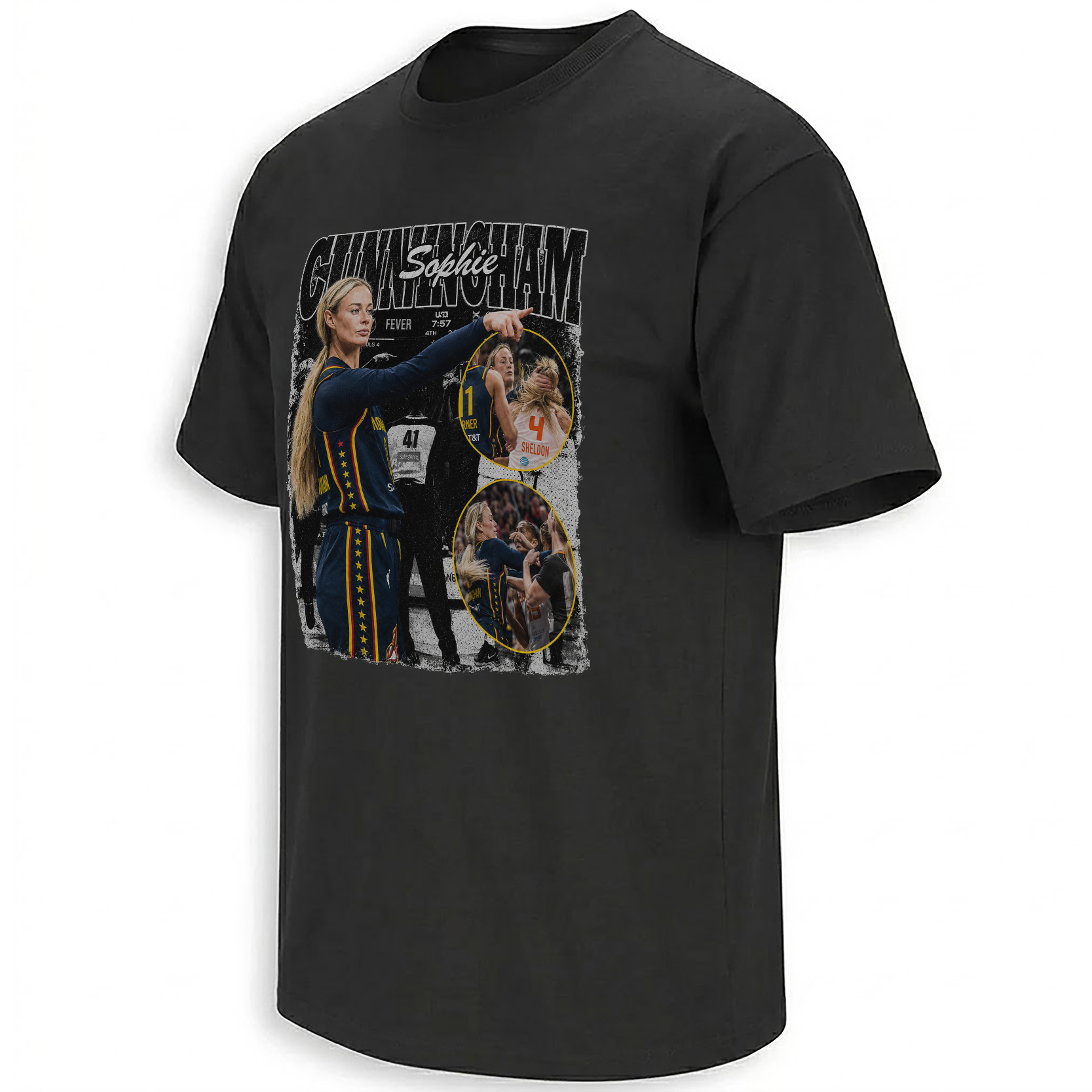
The Sophie Cunningham Point design uses the main pointing image as the visual anchor, allowing her extended arm to travel across the upper half of the composition. That direction gives the artwork movement even though the central pose is static.
Her navy Indiana uniform supplies the dominant color field. Yellow and red trim create thin lines of energy against the distressed black-and-grey background, preserving the Fever identity without turning the composition into a conventional team-logo graphic.
The oversized Cunningham lettering behaves like a magazine masthead or bootleg-player poster. A handwritten Sophie treatment softens the harder block typography and introduces the feeling of an individual signature layered over public spectacle.
Two circular inset images preserve the confrontational context. They do not merely repeat the pointing pose. They show Cunningham inside the larger physical theatre that shaped how fans interpret her role.
The yellow circles resemble editorial annotations placed around important moments in a contact sheet. This gives the design the feeling of a visual investigation: the main frame provides the meme, while the smaller frames explain why this particular player produced it.
The Black Colorway Makes the Clip Feel Like Internet Evidence
The black garment supports the collage’s screenshot-and-archive mood. Grey crowd imagery fades into the fabric, while the Indiana navy, yellow circles and Fever trim remain visible as selected pieces of evidence.
That contrast makes the design resemble a late-night sports edit assembled from paused broadcasts and social screenshots. It feels closer to a fan-created documentary poster than a clean official player portrait.
The weathered texture also acknowledges how quickly a current sports moment becomes internet history. The point was only days old when it began appearing in visual remixes, yet the distressed treatment makes it look as though fans have already been saving the frame for years.
From Gainbridge Fieldhouse to the Wider Meme Economy
The original incident belonged to a specific rivalry. Indiana and Phoenix were navigating a physical, emotionally charged game involving former teammates, technical fouls and another debate about how officials manage Clark’s intensity.
The meme no longer belongs only to that sequence. It has appeared in conversations unrelated to basketball and inspired comparisons to famous sports trolls whose gestures became more memorable than their words.
That expansion matters for the WNBA. Viral visibility is often discussed only through scoring records and star performances, but personality moments can carry the league into feeds that would never surface a normal game recap.
Cunningham did not create the moment as a marketing exercise. Its power came from the opposite quality: she appeared genuinely committed to irritating the person standing across from her. The internet recognized the authenticity and converted it into entertainment.
The Fever’s Visual Archive Has a New Arrow
Indiana’s recent cultural identity has been shaped by far more than box scores. The team generates debate, physical confrontations, celebrity attention, referee discourse and images that spread beyond regular basketball audiences.
The Indiana Fever collection follows that evolving language through player moments, team slogans, viral reactions and graphics tied to how supporters experience each new chapter.
The broader WNBA collection places Cunningham’s point inside a league-wide visual culture where rivalry, personality and internet-ready emotion increasingly travel alongside the basketball itself.
Within that archive, the point occupies a rare position. It began as an argument, became a joke and ended as an image capable of saying almost anything.
Frequently Asked Questions
Why did Sophie Cunningham point at DeWanna Bonner?
Cunningham entered a fourth-quarter confrontation involving Bonner and Caitlin Clark during Indiana’s June 22 game against Phoenix. She and Bonner pointed at each other before Cunningham continued the gesture after Bonner was moved away.
How long did Sophie Cunningham keep pointing?
The widely circulated sequence lasted approximately 22 seconds, long enough for an ordinary confrontation gesture to become intentionally comic.
Did Sophie Cunningham receive a technical foul?
Yes. Cunningham and Bonner were both assessed technical fouls during the confrontation in Indiana’s 86–77 victory over Phoenix.
Why did the pointing clip become a meme?
The extended arm, serious expression and unusually long duration made the moment understandable without basketball context. The image could be reused to identify, accuse or sarcastically select almost anyone.
How did Cunningham explain the gesture?
Cunningham later said the pointing was silly but that she continued because it was visibly annoying Bonner, confirming the deliberately provocative humor viewers saw in the clip.
What does the Sophie Cunningham Point design represent?
The graphic combines the viral 22-second point with images of Cunningham entering earlier Fever confrontations, presenting the meme as part of her larger reputation for loyalty, physicality and competitive trolling.
The Sophie Cunningham Point design preserves the viral frame and the protector narrative surrounding it, while the wider Indiana Fever visual archive follows the rivalries, personalities and reactions shaping one of basketball’s most closely watched teams.
Sophie Cunningham Point Shirt captures the Indiana Fever guard’s viral 22-second pointing standoff through a distressed player collage, bold directional pose and confrontation imagery tied to her protector-and-provocateur persona.