Why Not Us?
The United States has won its group, reached the knockout stage on home soil and arrived at the moment when cautious hope can become something far more dangerous: belief.
On July 1, the United States Men’s National Team will walk into the San Francisco Bay Area Stadium to face Bosnia and Herzegovina in the Round of 32 of the 2026 World Cup. The group stage is over. The safety net is gone. From here, one victory can push an entire country deeper into belief, while one mistake can end the tournament.
The USMNT enters that match as the winner of Group D, carrying six points from victories over Paraguay and Australia. Even after a 3–2 defeat against Türkiye in the final group match, the Americans remained at the top of the table and secured a home-soil knockout game.
They have already accomplished the first requirement of this World Cup: survive the group.
Now comes the question printed across a navy-and-white eagle graphic, repeated by supporters who can see the bracket opening in front of them and felt in every stadium where the host nation has taken the field.
Why not us?
The Group D winners meet Bosnia and Herzegovina in Santa Clara, California, with a place in the Round of 16 at stake.
Belief Has Finally Reached the Knockout Stage
For years, nearly every conversation about the 2026 World Cup was framed in the future tense.
What would it feel like when the tournament arrived? Could the United States take advantage of playing at home? Would the generation led by Christian Pulisic, Weston McKennie and Tyler Adams finally turn its talent into a historic run?
Those questions are no longer theoretical.
The tournament is here. The streets outside the stadiums are filled with national-team shirts. American goals are being celebrated in packed public spaces. A young supporter watching this World Cup may remember these weeks as the moment soccer stopped feeling like a visiting event and became part of the country’s own sporting language.
Winning Group D made that emotion more concrete. It gave the United States a route into the elimination rounds and placed the team one victory away from accomplishing something no USMNT side has managed at a World Cup since 2002: winning a knockout match.
“Why Not Us?” is not a prediction that the United States will win the World Cup. It is a refusal to decide in advance that such a dream belongs only to somebody else.
The Road Through Group D
The American group-stage performance was not flawless, but it offered enough evidence to make ambition feel reasonable.
The opening match against Paraguay delivered the statement the host nation needed. The United States won 4–1, scoring more goals than any previous USMNT side had managed in a single World Cup game.
Folarin Balogun scored twice, Gio Reyna found the net and the Americans transformed opening-night anxiety into a demonstration of attacking possibility.
The second match brought a different requirement. Against Australia in Seattle, the USMNT produced a controlled 2–0 victory. Alex Freeman scored his first World Cup goal, the defense preserved a clean sheet and the United States collected the points that ultimately secured first place.
Türkiye then supplied a warning. With several regular starters rested, the Americans took an early lead but lost 3–2. The defeat exposed mistakes and stopped the group stage from ending in uninterrupted celebration.
It did not change the table.
Why Bosnia Cannot Be Treated Like a Formality
Finishing first creates opportunity. It does not create immunity.
Bosnia and Herzegovina reached the Round of 32 after navigating Group B and enters the matchup with a disciplined defensive identity. The Bosnians are comfortable allowing opponents to hold the ball, closing central spaces and looking for moments to counterattack.
Veteran striker Edin Džeko still provides experience, positioning and a dangerous presence around the penalty area. Ermedin Demirović offers another physical attacking option, while young wide players can create problems when the shape of a match begins to stretch.
The most emotionally complicated figure may be Esmir Bajraktarević. Born in Wisconsin, developed within the American soccer system and previously capped by the United States, he later chose to represent Bosnia and Herzegovina.
He now has the opportunity to face former teammates in the biggest match of his international career.
Bosnia’s path to the tournament also included eliminating four-time world champion Italy during qualifying. That result alone should prevent the Americans from treating the Round of 32 as an automatic step.
Knockout soccer does not care which team possesses more marketing power, a larger home crowd or the more favorable position in pre-match predictions. It rewards the team that solves the game in front of it.
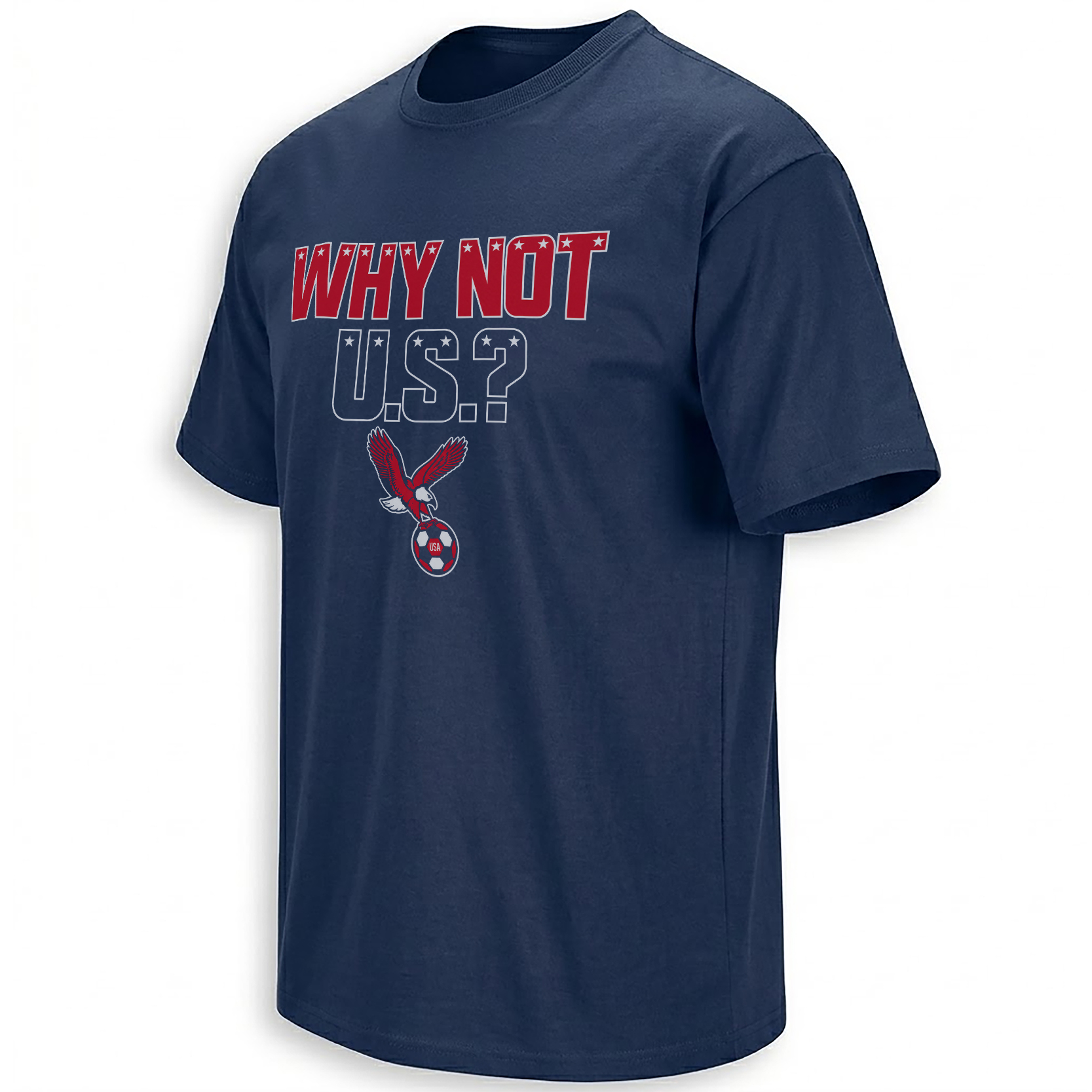
Why Not Us Shirt
The design turns the question surrounding the USMNT’s home World Cup run into a bold national-team graphic featuring a determined eagle, tournament symbolism and red, white and blue details.
Available on navy and white, the artwork captures the emotional space between hope and conviction—the point when supporting the host nation begins to feel like participating in something larger.
The Eagle Is More Than a National Symbol
The eagle at the center of the artwork does not appear calm or ceremonial. Its eyes are narrowed, its beak is open and its feathers spread outward with the visual force of a crest designed for competition.
That expression matters.
The design is not presenting the United States as a passive host welcoming the world to North America. It presents the host nation as a participant with its own ambition.
The eagle becomes a visual version of the shirt’s question. It looks forward rather than backward. It carries no guarantee, but it does carry intent.
On the navy version, white and red elements emerge sharply from the dark garment, giving the design the feeling of a night match beneath stadium lights. On white, the same artwork becomes brighter and more immediately patriotic, with the navy and red details carrying the composition.
Both versions preserve the same idea: the United States did not wait eight years to host this tournament merely to appear in it.
What “Why Not Us?” Really Means
The phrase appears constantly in sports because it occupies the perfect distance between arrogance and insecurity.
“We will win” demands certainty that no honest supporter can possess. “We cannot win” removes the reason to watch.
“Why not us?” opens a third possibility.
It acknowledges the traditional powers. Brazil, Argentina, France, Spain, England, Portugal and other established contenders entered the tournament carrying deeper World Cup histories. Several possess more complete squads and more players accustomed to the final stages of elite competitions.
But World Cups are not won through historical reputation alone. They are shaped by matchups, confidence, health, crowd energy, penalties, moments of individual brilliance and the pressure that begins to alter even experienced teams.
The question does not deny the difficulty. It asks why difficulty should eliminate belief before the match begins.
The Pressure Is Different Now
Group-stage pressure is complicated by mathematics. A draw may be useful. Goal difference can matter. One defeat can be repaired by the result of another match.
The knockout stage removes those calculations.
Against Bosnia and Herzegovina, the United States must solve a single opponent within one evening. The game may require patience against a compact defensive block. It may demand creativity from Reyna, direct running from Pulisic, movement from Balogun or a set-piece contribution from a defender.
It may also reach extra time or penalties.
Captain Tim Ream has emphasized the need to prepare for surprises because the previous group opponents did not always behave as expected. Paraguay and Australia altered their approaches. Bosnia can do the same.
The USMNT cannot simply possess the ball and assume opportunity will arrive. It must recognize when to accelerate, when to remain patient and when the emotional energy of the home crowd threatens to become anxiety.
The United States has not won a men’s World Cup knockout match since defeating Mexico in the Round of 16 in 2002. Victory over Bosnia and Herzegovina would end that wait and move the 2026 team one step closer to establishing itself as the most significant USMNT generation of the modern era.
Pulisic and the Generation Built for This Summer
Christian Pulisic has carried the label of American soccer’s leading figure for most of his adult life. He experienced a World Cup as a young supporter, missed the 2018 tournament when the United States failed to qualify and scored on the international stage in Qatar four years later.
The 2026 tournament is different.
He is no longer merely the gifted young player expected to change the ceiling of American soccer. He is one of the experienced leaders expected to deliver when the country hosts the largest World Cup in history.
Around him is a generation that has accumulated experience across Europe’s major leagues and international competitions. McKennie brings physical presence and late runs from midfield. Adams provides control and defensive intelligence. Reyna offers the type of creativity required when an opponent refuses to leave space.
Balogun’s two goals against Paraguay showed why a natural center forward can alter the American attack. Freeman’s emergence demonstrated that the story is not limited to the names supporters already knew before the tournament began.
This is the balance every home nation hopes to discover: established stars carrying expectation and young players arriving without fear.
A Shirt for the Moment Before the Answer
Championship apparel is created after certainty arrives. It records a result that cannot be taken away.
The Why Not Us Shirt belongs to a different emotional moment.
It exists before the answer.
The United States has reached the knockout stage, but its final destination remains unknown. The shirt captures supporters while they are still imagining the possibilities—before the Round of 32, before the potential Round of 16 and before anyone knows whether the dream will last another night or another three weeks.
That timing gives the artwork its cultural value.
It does not claim a trophy. It documents belief at the point when belief still requires courage.
Some shirts celebrate what already happened. “Why Not Us?” remembers the moment supporters were brave enough to believe before they knew the ending.
From Soccer Nation Debate to Soccer Nation Moment
American soccer has spent decades arguing about when the sport will finally arrive.
The question has often been measured through television ratings, youth participation, league attendance and whether the country’s best athletes choose soccer over other sports.
A home World Cup changes the scale of that discussion.
Arrival is no longer an abstract projection. It looks like children wearing national-team shirts in cities hosting matches. It sounds like full stadiums singing before kickoff. It appears in supporters learning the knockout bracket and imagining where the United States might play next.
The country does not need to abandon football, basketball or baseball for soccer to matter. It only needs moments powerful enough to enter the broader sporting memory.
A first knockout victory in 24 years would become one of those moments.
A deeper run could become something much larger.
The Possibility Beyond Bosnia
Tournament brackets encourage supporters to look ahead even when players and coaches cannot afford to do so.
The United States knows that winning the Round of 32 would place it in the final 16 teams. From there, the scale of each match would grow, the national audience would expand and every remaining opponent would carry its own danger.
Yet the most important feature of the path is not the identity of a hypothetical future rival. It is the simple fact that the path exists.
The Americans won their group. They are playing at home. They possess attacking players capable of deciding matches. They have entered the part of the tournament where one week can permanently change how a generation is remembered.
None of those facts guarantee success.
Together, they make the question legitimate.
Explore More USA and World Cup Culture
The Why Not Us design belongs to the wider culture surrounding the 2026 tournament: host-city energy, national-team belief, knockout-stage tension and the visual symbols supporters use to identify themselves inside a global event.
Explore more soccer-driven graphics, supporter designs and tournament moments through the collections below.
The answer may arrive against Bosnia and Herzegovina. It may be postponed into another round. It may become joyful, painful or historic.
That uncertainty is the reason the match matters.
The United States has reached the knockout stage of a World Cup played in its own stadiums. The crowd is ready. The opportunity is real. The next chapter will be decided rather than imagined.
Until then, the most honest expression of American belief remains the simplest one.
Why not us?
Why Not Us USMNT FAQ
Who will the USMNT play in the 2026 World Cup Round of 32?
The United States will face Bosnia and Herzegovina in the Round of 32 on July 1, 2026, at the San Francisco Bay Area Stadium in Santa Clara, California.
Did the United States win its 2026 World Cup group?
Yes. The USMNT finished first in Group D with six points after defeating Paraguay and Australia before losing its final group match against Türkiye.
What were the USMNT’s Group D results?
The United States defeated Paraguay 4–1, beat Australia 2–0 and lost 3–2 to Türkiye. Those results were enough to secure first place in Group D.
What does “Why Not Us?” mean for USMNT fans?
“Why Not Us?” expresses belief that the United States can use home support, a talented generation and its position in the knockout bracket to make a historic 2026 World Cup run.
When did the USMNT last win a World Cup knockout match?
The United States last won a men’s World Cup knockout match in 2002, when it defeated Mexico 2–0 in the Round of 16.
What is featured on the Why Not Us Shirt?
The artwork features the phrase “Why Not Us?” with a fierce American eagle, red, white and blue visual details and references to the USMNT’s 2026 home World Cup campaign.
What colors are available for the Why Not Us Shirt?
The featured design is presented on both navy and white garments, offering a darker stadium-inspired version and a brighter patriotic version.
Is the Why Not Us Shirt only connected to one match?
No. While the design is especially relevant as the USMNT enters the knockout stage, it represents the wider belief surrounding the United States throughout its 2026 World Cup campaign.