Let’s Tuching Go: How Alex Tuch’s Washington Arrival Became an Arena-Ready Rally Cry
Washington’s acquisition of Alex Tuch was already large enough to reshape the Capitals’ forward group. “Let’s Tuching Go” gives that roster move something statistics cannot provide: a phrase built to be shouted, repeated and attached to the first No. 89 moment that makes Capital One Arena rise.
Alex Tuch became a Washington Capital on June 24, 2026, after Buffalo signed him to an eight-year, $84 million contract and traded him for David Kampf and a 2027 third-round draft pick. The scale of the commitment ensured that this would not feel like an ordinary offseason depth move.
Tuch arrived after scoring 33 goals and 66 points in 79 regular-season games for Buffalo, giving Washington a proven finisher whose 6-foot-4 frame, reach and direct attacking style fit the physical identity the Capitals have cultivated for years.
The move also came one day after Washington acquired Jordan Kyrou, creating the sense that the organization was changing the forward group in public and at speed. Before Tuch had taken a shift in Capitals colors, the city already had the contract, No. 89, a crown graphic, an 8-bit character and a phrase ready for the arena: “Let’s Tuching Go.”
A trade becomes part of fan culture when the new player no longer sounds like a transaction. He sounds like something the building can yell.
The Phrase Begins Where Hockey Language Usually Begins
“Let’s go” may be the most adaptable phrase in sports. It can begin as encouragement, become celebration and finish as pure noise. Its meaning depends less on grammar than timing.
A fan can shout it before the opening faceoff, after a clean hit, during a late penalty kill or when the puck crosses the line. It belongs to no single player because it is designed to move through an entire building.
“Let’s Tuching Go” inserts Tuch’s surname into that familiar rhythm. The wording is deliberately unruly. Its purpose is not formal sentence structure. Its purpose is instant recognition, repetition and the physical pleasure of yelling a name that already sounds like movement.
The phrase therefore operates like the strongest arena slogans: short enough to read across a concourse, loud enough to survive crowd noise and flexible enough to attach itself to moments that have not happened yet.
Why Tuch’s Name Invites Fan Language
Some player names resist wordplay. Tuch’s almost demands it. The surname is one syllable, visually compact and close enough to several familiar expressions that fans can reshape it without losing recognition.
“King Tuch” turns the arrival into a coronation. “Tuch Around and Find Out” converts his physical game into a warning. “Let’s Tuching Go” places the surname inside a chant.
The crown reflects the scale of the eight-year contract and treats Washington’s major addition like a capital-city arrival.
The warning phrase translates size, forechecking and No. 89 into the vocabulary of physical consequence.
The rally phrase belongs to the crowd, turning one player’s name into something supporters can repeat together.
Together, the phrases show how quickly a player can become culturally legible. Fans do not need to wait for a complete statistical season to understand the basic character Washington believes it has acquired.
Tuch is large, fast for his size, capable of scoring more than 30 goals and willing to play through difficult ice. The wordplay converts those traits into forms supporters can carry into the arena.
The Graphic Looks Like a Rally Towel Became a Poster
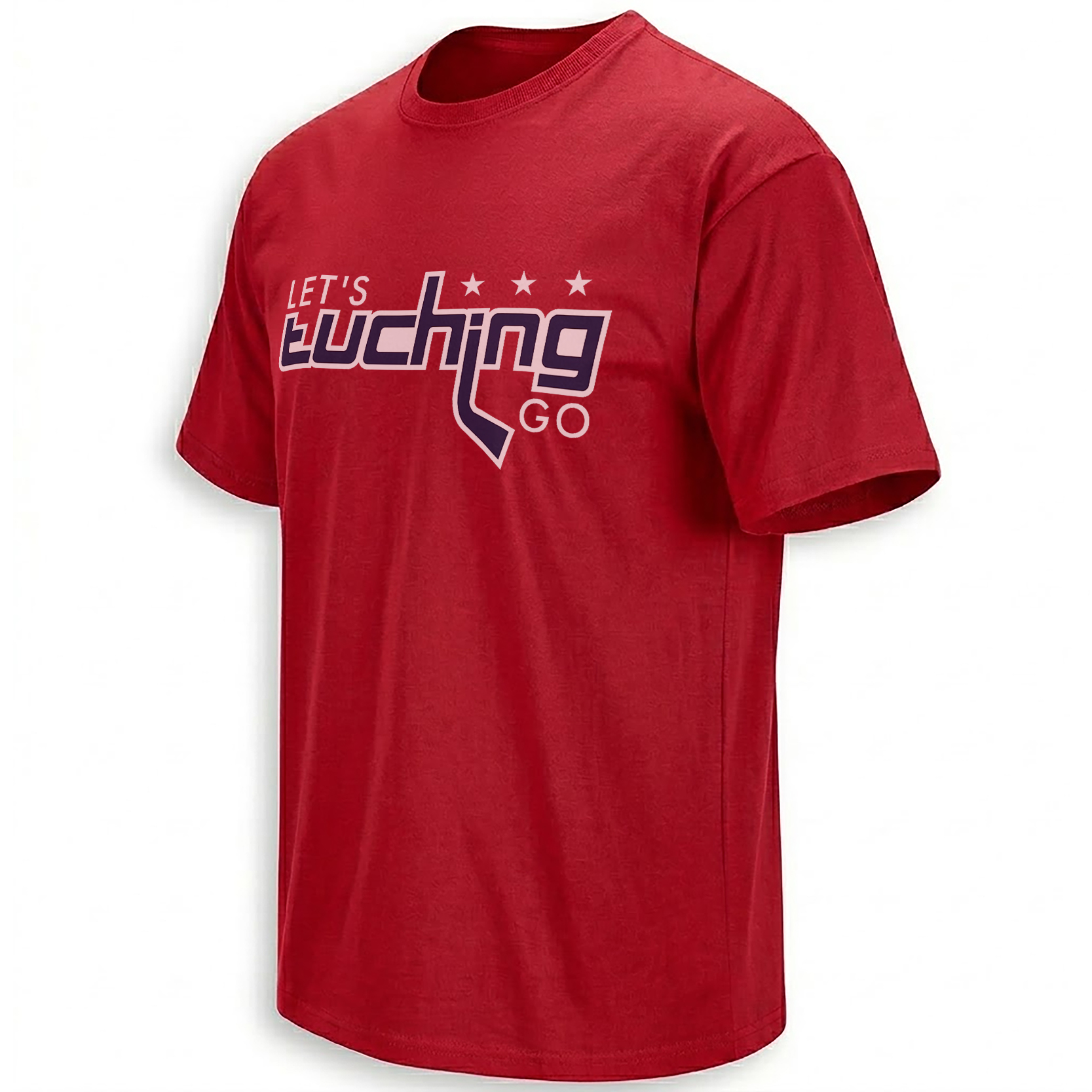
The Let’s Tuching Go design does not treat the phrase like a quiet caption. The language is the event. Oversized lettering fills the composition, while Tuch appears as the figure around whom the words gather.
That hierarchy gives the artwork the feeling of a rally towel, concourse poster or scoreboard prompt. The viewer should understand the emotional instruction before studying every smaller visual detail.
Capitals red and navy create immediate team recognition. White provides the sharp contrast required for distance reading. The roughened athletic texture prevents the lettering from feeling like polished corporate branding.
Bold type converts the phrase into crowd direction. Rather than asking the image to describe Tuch’s entire career, the artwork preserves the first emotion surrounding his Washington chapter: excitement moving faster than the opening-night schedule.
The Chant Exists Before the First Goal
Most player slogans form after a defining moment. A postseason goal produces a phrase. A celebration becomes a meme. A quote escapes the locker room and enters the stands.
Offseason rally language reverses that process. It creates the vocabulary first and waits for the game to supply the memory.
Tuch has not yet scored a Capitals goal. He has not yet entered a Washington home opener, collided with a Metropolitan Division rival or stood in front of the net while the crowd begins to understand how his game feels in person.
“Let’s Tuching Go” is built for those future events. The phrase is a container awaiting content.
The first time No. 89 finishes from the slot, protects a puck through contact or turns a forecheck into sustained pressure, the slogan will gain a specific image. Until then, it preserves anticipation.
Washington Is Betting on More Than a Goal Total
Thirty-three goals establish the offensive reason for the contract, but Washington’s official explanation of the move emphasized a broader profile. Tuch brings size, versatility, net-front presence, defensive responsibility and leadership experience.
Those qualities matter because rally cries work best when fans can use them during more than scoring plays. A crowd may react to a goal most loudly, but physical hockey creates dozens of smaller ignition points.
A heavy retrieval can extend a shift. A blocked shot can protect a lead. A penalty-kill rush can force an opponent backward. A controlled entry by a large winger can change the emotional shape of a possession.
Tuch’s game offers enough visible action for the phrase to remain useful throughout a night. “Let’s Tuching Go” does not have to wait exclusively for the red light.
The Contract Makes the Chant Long-Term Language
Short-term acquisitions often generate cautious fan response. Supporters may enjoy the arrival while understanding that the player could disappear before the broader identity fully forms.
An eight-year agreement changes that emotional calculation. Washington has positioned Tuch as a player whose name should remain part of the franchise vocabulary deep into the next decade.
The contract carries an average annual value of $10.5 million and runs through 2033–34. That term places expectation on every part of the transition. The Capitals are not asking Tuch to provide one productive spring. They are asking him to become a durable feature of the organization.
Rally language reflects that commitment. A phrase attached to a long-term player can evolve with the relationship: first-goal excitement, regular-season familiarity, playoff tension and eventually nostalgia.
The artwork is not celebrating a temporary rental. It captures the opening week of a relationship Washington expects to last eight seasons, giving the phrase room to accumulate real memories.
No. 89 Gives the Rally Cry a Visible Address
A phrase identifies the emotion. A number identifies where to look.
Tuch’s No. 89 provides continuity from his earlier NHL chapters while immediately becoming new when placed inside Washington’s red, white and blue. The number helps supporters imagine the silhouette before they have watched him through a full Capitals season.
Eighty-nine is also visually distinctive. It does not blend into the cluster of traditional hockey numbers commonly associated with star forwards. Its size and asymmetry make it easy to anchor within graphics.
The slogan and number therefore perform different jobs. “Let’s Tuching Go” belongs to the voice. No. 89 belongs to the eye.
Tuch’s Arrival Fits Washington’s Existing Physical Vocabulary
Capitals fans already understand the appeal of large forwards whose effect extends beyond scoring. Tom Wilson has spent years making physicality, net pressure and emotional confrontation part of Washington’s modern identity.
Aliaksei Protas adds another large frame capable of creating offense. Pierre-Luc Dubois brings additional size through the middle. Tuch does not arrive as Washington’s only physical presence; he enters an environment where that style is already readable.
That familiarity should make his transition easier for the crowd to interpret. Fans will not have to learn why a protected puck, hard forecheck or net-front battle matters. They already respond to those actions.
The new question is how Tuch’s version of that game will interact with Washington’s existing forwards. His skating and reach provide a different geometry, allowing him to create speed without surrendering mass.
The Kyrou Trade Makes the Phrase Part of a Larger Reset
Washington’s acquisition of Jordan Kyrou one day before the Tuch deal changed how both moves were interpreted. One transaction could have been viewed as a targeted adjustment. Two major additions in consecutive days looked like a strategic shift.
Kyrou brings transition speed, puck carrying and open-ice creativity. Tuch brings a more direct route through defenders and toward the net. The Capitals added two established scorers without asking them to solve the same problem in the same way.
“Let’s Tuching Go” belongs specifically to Tuch, but its urgency also reflects the wider offseason mood. Washington was not waiting quietly for the next era to arrive. It was actively selecting pieces for it.
The Ovechkin Question Makes Every New Phrase More Significant
At the time Tuch arrived, Alex Ovechkin had not publicly finalized whether he would return for another NHL season. That uncertainty placed every major Capitals acquisition inside the shadow of a potential historical transition.
Washington cannot replace Ovechkin through a pun, trade or single contract. His relationship with the franchise is unique. The more realistic task is to develop a new collection of recognizable players whose games and identities can support the club after its defining superstar has played his final shift.
This is where fan language matters. A franchise’s next era becomes emotionally real only when supporters acquire new names to shout, numbers to recognize and moments to claim.
“Let’s Tuching Go” is a small but revealing sign of that process. Washington fans are already testing how No. 89 sounds inside the culture.
The 2018 Stanley Cup Final Gives Tuch a Hidden Washington History
Tuch’s connection to the Capitals began long before the trade. As a Vegas Golden Knights rookie in the 2018 Stanley Cup Final, he was the forward denied by Braden Holtby’s paddle save late in Game 2.
The play became “The Save,” one of the most replayed images in Washington sports history. It preserved a 3–2 victory, shifted the emotional direction of the series and helped carry the Capitals toward their first Stanley Cup.
Tuch was positioned on the opposite side of that memory—the player one quick movement away from tying the game. Eight years later, he enters Washington with the same unfinished desire to win the Cup.
The circularity makes the new rally phrase more interesting. The player once silenced by Washington’s defining save is now being given language designed to make Washington louder.
Leaving Buffalo Gives the Celebration Emotional Weight
Tuch’s move was not a simple departure from a city he never embraced. He grew up supporting the Sabres, became an alternate captain and helped Buffalo return to the Stanley Cup Playoffs after a fourteen-year absence.
He described the decision to leave as deeply difficult, while also explaining that the Washington opportunity and contract were too significant to pass up.
That distinction matters because the most compelling sports arrivals often contain two emotions at once. Washington can celebrate the new player without pretending his previous chapter was meaningless.
“Let’s Tuching Go” focuses on forward movement. It does not erase Buffalo. It records the moment Tuch chose the next phase of his career and Washington began imagining how that phase might sound.
From Internet Wordplay to Arena Language
Not every online phrase survives contact with a real crowd. Some jokes work only as captions. Others are too long, too specific or too dependent on context to move beyond a screen.
The strongest rally phrases contain a built-in rhythm. They can be divided into beats, printed in oversized type and understood without an explanatory paragraph.
“Let’s Tuching Go” has that quality because its structure remains close to the most familiar sports chant. Even someone seeing it for the first time can hear the intended delivery.
Whether the exact phrase ever becomes an organized arena chant is less important than the cultural function it already serves. It converts a player transaction into crowd language and gives supporters a way to express excitement before the schedule supplies the first shared moment.
The Graphic Is a Timestamp of Maximum Possibility
Every offseason contains a brief period when a new acquisition exists almost entirely through projection. There are no disappointing shifts, no line-combination debates and no cold scoring stretches.
The player is represented by recent statistics, imagined chemistry and the best-case version of fit.
The Let’s Tuching Go graphic belongs to that period. It records Washington’s initial optimism: a large winger arriving after another 33-goal season, signed for eight years and placed inside a forward group receiving significant new talent.
Later moments may add complexity to the phrase. The first goal will give it a highlight. A major hit may give it confrontation. A playoff game could give it permanence.
For now, the design preserves the clean emotional beginning—the moment Washington had every reason to yell before the puck had even dropped.
A New Piece in the Washington Hockey Archive
The broader NHL Shirts archive follows the way trades, jersey numbers, playoff memories and player phrases become visual records of hockey culture.
The Let’s Tuching Go graphic preserves the rally side of Tuch’s arrival. It complements the ceremonial language of King Tuch, the physical warning of Tuch Around and Find Out and the retro anticipation of the Tuch Washington 8-bit design.
Together, those pieces form a multi-angle archive of one transaction: crown, warning, player-select screen and crowd chant.
Why This Phrase Can Grow With the Season
The most durable player slogans are not complete when they first appear. They gather evidence.
A phrase begins as design language, then attaches itself to a goal, a rivalry, a playoff series or one image that fans keep replaying. The original artwork becomes more meaningful because the season eventually gives it a story.
Tuch’s Washington chapter begins with unusually clear expectations. The contract is long. The salary establishes status. The recent scoring supplies credibility. The physical profile fits the organization.
“Let’s Tuching Go” is therefore less a prediction than an invitation. The phrase asks the next season to provide moments worthy of being shouted back at it.
Frequently Asked Questions
When did Alex Tuch join the Washington Capitals?
Washington acquired Alex Tuch from the Buffalo Sabres on June 24, 2026, after Buffalo signed him to an eight-year contract extension.
What contract did Alex Tuch sign?
Tuch signed an eight-year, $84 million contract carrying an average annual value of $10.5 million before being traded to Washington.
How did Alex Tuch perform during the 2025–26 season?
Tuch recorded 33 goals and 33 assists for 66 points in 79 regular-season games with Buffalo.
What does “Let’s Tuching Go” mean?
The phrase places Tuch’s surname inside the familiar rhythm of “Let’s go,” turning his Capitals arrival into playful, repeatable rally language.
Why does the phrase fit Alex Tuch’s playing style?
Tuch’s size, skating, net-front play and physical forechecking create visible moments that can energize a crowd even when he is not scoring.
How does this design differ from other Alex Tuch Capitals graphics?
King Tuch emphasizes the scale of his arrival, Tuch Around and Find Out emphasizes physical confrontation, the 8-bit piece emphasizes a newly unlocked player and Let’s Tuching Go emphasizes collective crowd energy.
The Let’s Tuching Go piece captures the crowd-facing side of Alex Tuch’s arrival, while the wider hockey archive follows the trades, player identities and fan language shaping the NHL’s next chapter.
Let’s Tuching Go Shirt turns Alex Tuch’s 2026 Washington Capitals arrival into an arena-ready rally graphic, combining No. 89 energy, bold red-and-navy typography and the excitement surrounding his eight-year contract and 33-goal season.