Mickey Checks Into the Twilight Zone: Why the Tower of Terror Still Feels Like Disney’s Perfect Nightmare
The Twilight Zone Tower of Terror did more than attach a drop ride to a famous television series. It created a complete lost-Hollywood mythology—one where the lobby is frozen in 1939, the service elevator ignores physical reality and even Mickey Mouse can feel like an artifact left behind by vanished guests.
The first sign that the Hollywood Tower Hotel is different from other abandoned buildings is that it does not appear entirely abandoned. Music still drifts through dusty rooms. Luggage remains where somebody once placed it. A card game appears to have been interrupted rather than completed.
The hotel is not presented as a ruin. It is presented as a place where time stopped waiting for the guests to return.
Since opening at Disney-MGM Studios on July 22, 1994, The Twilight Zone Tower of Terror has used that distinction to become one of Disney’s most atmospheric attractions. The physical drop creates the headline thrill, but the deeper memory begins much earlier—during the long approach toward a hotel that seems to have been preserved by whatever force destroyed it.
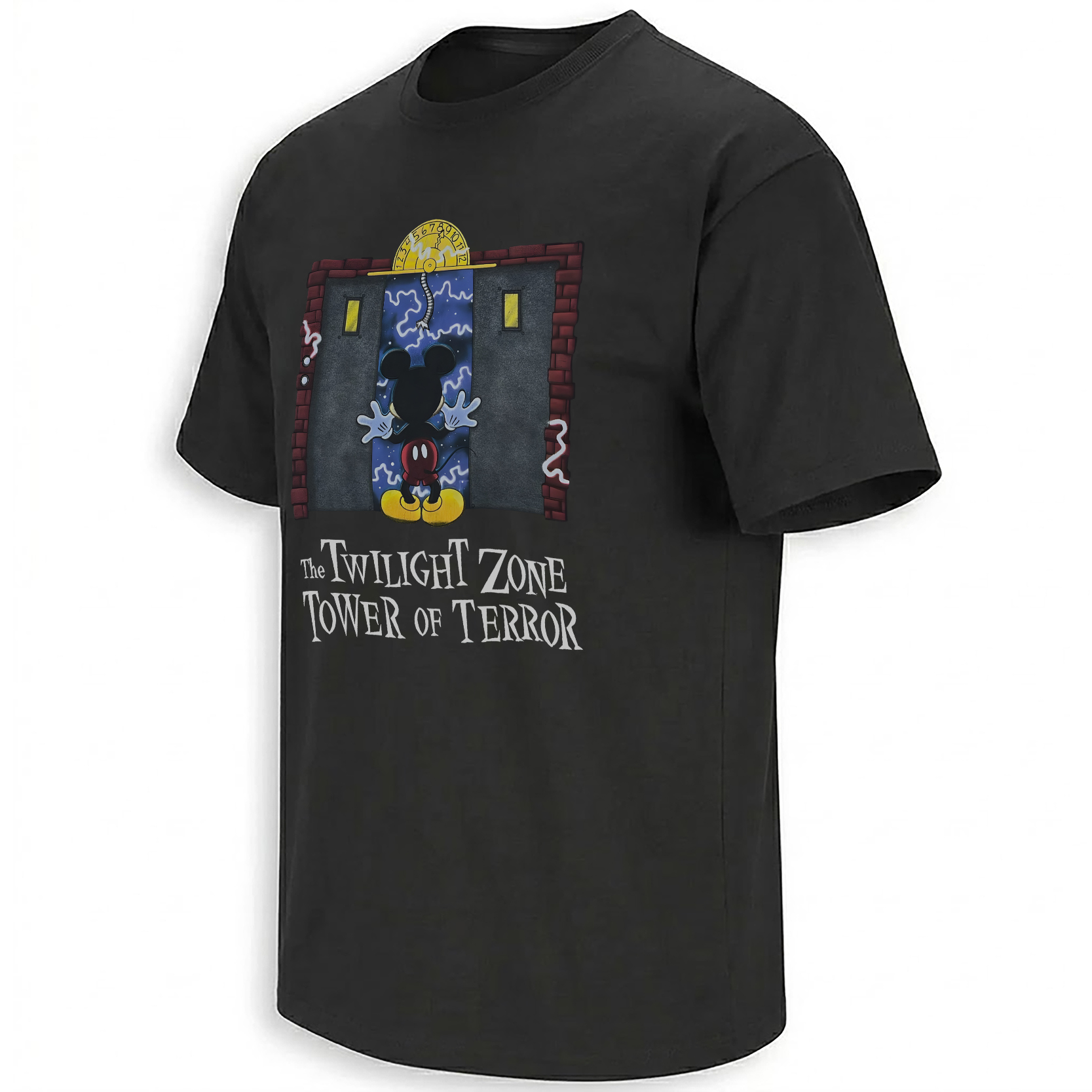
The Tower of Terror graphic featuring Mickey inside a retro elevator frame draws from that same contradiction. Disney’s most familiar character is placed inside one of the company’s darkest environments, converting cheerful recognition into eerie nostalgia.
The elevator drop frightens the body. The abandoned hotel frightens the imagination long before the doors close.
The lasting architecture of Tower of TerrorThe Hollywood Tower Hotel Is the Attraction’s Real Star
The Tower of Terror works because it does not begin as a ride system. It begins as a building with a history.
Guests approach through the grounds of the fictional Hollywood Tower Hotel, once presented as a glamorous destination for movie stars and wealthy travelers. Its architecture suggests early twentieth-century California revival styles, drawing visual authority from real luxury hotels while exaggerating their scale into something theatrical.
The structure appears damaged but not destroyed. Dark openings expose parts of the upper floors. Weathered surfaces imply decades without maintenance. At night, lighting turns the façade into an enormous warning sign visible across the park.
This visual preparation is essential. A generic tower could deliver the same physical motion, but it could not produce the same emotional anticipation. The Hollywood Tower Hotel creates the belief that riders are entering a place where something already happened.
The attraction’s story then gives that belief a date: October 31, 1939. Lightning struck the hotel as five passengers traveled in an elevator toward the Tip Top Club. The group disappeared, and part of the building vanished with them.
Guests do not simply board another elevator. They enter the same unresolved event.
Art Deco details, expensive luggage and old Hollywood music establish the hotel as a place that once expected famous guests.
Dust-covered objects and abandoned rooms suggest that the hotel did not close normally—its story simply stopped moving forward.
Every rider repeats the vanished passengers’ elevator route, turning a historical mystery into a personal experience.
Why The Twilight Zone Was the Perfect Story Engine
The Twilight Zone television series did not rely on one monster, one location or one continuous mythology. Its defining structure was transformation: an ordinary person entered an ordinary situation and gradually discovered that reality operated according to different rules.
That format made the series ideal for an attraction. Guests do not need to know a specific episode before entering. The recognizable narration, black-and-white imagery and concept of the Fifth Dimension establish a larger language of uncertainty.
The elevator is especially effective because it begins as one of modern life’s most ordinary machines. People enter, select a floor and trust that the system will move vertically according to predictable limits.
Tower of Terror breaks that agreement.
The car moves into darkness, enters a dimension beyond the hotel’s ordinary architecture and then begins a drop sequence the passenger cannot control or fully predict.
The Twilight Zone identity therefore contributes more than branding. It transforms mechanical failure into supernatural logic. The elevator is not merely malfunctioning. It has crossed into a place where up, down, distance and time are no longer reliable.
The ride vehicle begins as believable hotel machinery, leaves the familiar shaft and enters the Fifth Dimension. That transition turns vertical motion into storytelling: guests are not only falling, but traveling through the supernatural interruption that consumed the hotel in 1939.
Mickey’s Presence Is Stranger Than It First Appears
Mickey Mouse represents reassurance inside Disney culture. His silhouette, gloves and rounded features immediately signal familiarity, optimism and the emotional promise of the larger resort.
The Tower of Terror changes that meaning through context.
Mickey appears as an Easter egg within the attraction’s historical environment, most famously as a doll associated with the child star among the vanished elevator passengers. Sheet music and other details also reference him inside the hotel’s abandoned world.
These appearances do not turn the attraction into a Mickey story. They make the fictional hotel feel connected to Disney history while preserving the illusion that its rooms have remained untouched since the 1930s.
A Mickey doll inside a haunted hotel is emotionally different from Mickey appearing in a parade. The object looks like something once loved by a child who never returned to collect it.
That is the darker possibility behind the graphic. Mickey remains recognizable, but recognition no longer guarantees safety. He has entered the elevator, and the floor indicator is moving toward a destination beyond the normal hotel directory.
The Artwork Works Because It Combines Opposing Disney Moods
The design’s main tension comes from placing playful character energy inside a visual system associated with danger.
Mickey’s familiar form introduces warmth and accessibility. The elevator frame, distressed surfaces and Tower of Terror language introduce suspense. Neither side completely defeats the other.
If the artwork were entirely frightening, it would lose the specific theme-park nostalgia that makes the attraction emotionally distinct. If it were entirely cheerful, it would fail to communicate the mystery of the Hollywood Tower Hotel.
The most effective Tower of Terror memorabilia occupies the space between those poles. It remembers being frightened and delighted at the same time.
Vintage texture strengthens that duality. The faded surface makes the image appear as though it came from the hotel’s original operating years rather than from a contemporary souvenir shop.
The result resembles a recovered elevator advertisement from a building that should no longer be accepting guests.
Burgundy, black and tarnished brass evoke an old luxury hotel, while distressed printing makes the character scene feel like a surviving artifact from 1939. The elevator structure provides order; the Twilight Zone story promises that the order will not last.
Why the Queue Is More Important Than the Drop
Thrill attractions are often evaluated through speed, height or intensity. Tower of Terror’s strongest achievement is that guests are already participating in the story while moving through the queue.
The gardens allow the hotel to emerge gradually. Cracked signs and overgrown landscaping suggest abandonment before guests reach the main entrance.
Inside the lobby, the story becomes more specific. Dust covers furniture. Old newspapers and luggage remain in place. The atmosphere suggests that employees and guests vanished without completing even the smallest tasks.
The library then changes the experience from architectural mystery into a Twilight Zone episode. Rod Serling’s presentation gives the hotel’s disappearance a supernatural framework and directly addresses the guests preparing to board.
By the time the boiler-room doors open, the physical ride has become the final act of a story already in progress.
This is why many fans remember the lobby music, bellhop costumes and pre-show as intensely as the drop itself. The attraction does not ask riders to imagine a haunted hotel after being restrained inside a vehicle. It convinces them before they reach the elevator.
The Bellhops Keep the Hotel Fiction Alive
Tower of Terror cast members do not behave like ordinary attraction attendants. Their bellhop costumes and restrained delivery position them as employees of a hotel that has somehow continued operating after its disappearance.
The humor is usually dry rather than loud. Instructions about seatbelts and personal belongings can be delivered with the calm professionalism of staff members who have seen countless guests enter the service elevator and understand exactly what waits above.
That performance style matters because conventional theme-park enthusiasm would break the atmosphere. The attraction requires hospitality without reassurance.
Bellhops welcome guests, but their behavior suggests that checking in may have been a serious mistake.
The cast therefore occupies the same emotional space as the artwork: recognizable Disney service translated through dark comedy and supernatural implication.
The Drop Sequence Is Frightening Because It Refuses a Simple Rhythm
A predictable drop can still be physically intense, but the body begins preparing once it understands the pattern.
Tower of Terror developed through several generations of ride programming before introducing randomized sequences. The uncertainty means riders cannot rely on a single remembered version.
The elevator may rise before dropping, pause unexpectedly or reveal the park outside before moving again. The body responds not only to acceleration but to the inability to determine when the motion is finished.
This unpredictability extends the Twilight Zone premise into the ride system. Reality does not simply break once. It remains unstable until the elevator finally returns to the hotel.
The floor indicator, elevator doors and service-shaft language become powerful visual symbols because they represent false information. Numbers imply order, but the attraction uses them to measure movement toward disorder.
The Number 13 Became a Theme-Park Design Shortcut
Floor 13 carries a long architectural and superstitious history. Many real hotels omit the number from elevator panels, moving directly from twelve to fourteen to avoid alarming guests.
Tower of Terror uses that cultural knowledge immediately. Thirteen becomes the level associated with the hotel’s supernatural zone, a destination that ordinary elevators are not supposed to acknowledge.
The number is effective in graphic design because it communicates danger before any full sentence is read. Placed inside an elevator indicator, it suggests that the machine has entered forbidden territory.
In the retro Mickey artwork, floor 13 functions as more than decoration. It provides the visual bridge between the friendly character and the attraction’s darker mythology.
Mickey may look calm. The elevator panel explains why the viewer should not be.
Old Hollywood Makes the Horror Feel Elegant
Tower of Terror is frightening without becoming visually ugly. Its horror is framed through faded luxury rather than industrial brutality.
The hotel once belonged to an imagined version of Hollywood filled with movie premieres, glamorous guests and expensive evening clothes. That lost sophistication makes the abandonment more emotionally effective.
A plain building can be empty. A luxury hotel can feel abandoned by an entire social world.
Art Deco and revival details supply symmetry, ornament and confidence. Dust, cracks and darkness then interrupt those qualities without completely erasing them.
The attraction’s visual identity depends on this preserved elegance. The hotel still remembers what it believed it was supposed to become.
The graphic carries that mood through aged lettering, structured framing and colors associated with old theaters, hotel carpeting and tarnished brass fixtures.
Why Tower of Terror Memorabilia Feels Like Evidence
The best attraction merchandise does not simply print a ride name on clothing. It behaves like an object that could exist inside the story.
Tower of Terror is especially suited to this approach because the hotel already contains fictional documents, signage, luggage tags, room numbers and service language.
A shirt can resemble a hotel uniform graphic, lost travel advertisement or elevator warning. The wearer is not merely displaying the attraction logo; the wearer appears to have brought something back from the hotel.
The Twilight Zone Tower of Terror Mickey design follows that artifact logic. It frames Mickey as part of the elevator mythology rather than adding him as an unrelated decorative character.
The design’s age, framing and distressed finish suggest that the image survived the same event that left the Hollywood Tower Hotel frozen in time.
The Attraction Exists Between Television and Theme-Park Memory
Tower of Terror does not reproduce one specific Twilight Zone episode. Instead, it creates an original experience using the series’ narrative grammar.
That choice allowed Disney Imagineers to build a story suited to physical movement while remaining recognizable to viewers familiar with Rod Serling’s world.
Guests become the episode’s central characters. The library pre-show introduces the premise. The service elevator becomes the impossible object. The drop sequence delivers the twist.
For many younger visitors, the attraction may even precede direct knowledge of the television series. They encounter The Twilight Zone first as music, narration, black-and-white imagery and the feeling of an elevator moving where it should not.
The ride therefore functions as both adaptation and cultural gateway. It preserves the emotional structure of an older television phenomenon inside a modern theme-park ritual.
Mickey Connects the Dark Ride to the Larger Disney World
Tower of Terror is unusually self-contained. Its fictional hotel, television license and horror tone allow it to feel separated from the brighter character-driven areas of Disney parks.
Mickey Easter eggs create a quiet connection without disrupting that independence.
They remind attentive guests that the hotel belongs inside Disney storytelling, even when the attraction avoids castles, songs and visible fairy-tale optimism.
This relationship explains why Mickey-centered Tower of Terror artwork feels culturally natural. The character is not being inserted into an entirely unrelated environment. He already exists around the edges of the attraction’s history.
The graphic simply moves that hidden connection into the foreground.
The California Version Made Loss Part of the Nostalgia
Tower of Terror nostalgia also carries the memory of versions that no longer exist in their original form.
The Disney California Adventure attraction opened in 2004 and closed in January 2017 before being transformed into Guardians of the Galaxy – Mission: Breakout!
That change created two simultaneous fan experiences. Mission: Breakout developed its own audience, while the former Tower of Terror became an object of West Coast theme-park memory.
Photographs, shirts and vintage-style graphics gained additional meaning because they could preserve a version of the building that guests could no longer enter.
The attraction therefore demonstrates how theme-park experiences become historical. Rides may appear permanent while operating, but rethemes and closures can rapidly turn ordinary souvenirs into evidence of a lost environment.
The Artwork Captures the Attraction Before the Doors Open
The most effective moment in the design is not the fall itself. It is the suspended second inside the elevator.
Mickey is visible. The doors and frame establish the location. Tower of Terror language supplies the warning. The viewer understands that motion is about to begin but cannot see the outcome.
That anticipation is more reusable than a literal illustration of riders screaming during a drop. It allows the image to preserve suspense rather than only reaction.
Theme-park memories often work this way. The strongest emotion returns through the small moments before the attraction begins: the sound of the doors, the bellhop’s expression or the light above the elevator.
The graphic turns that threshold into the cultural artifact.
Why the Design Appeals Beyond Halloween
Tower of Terror naturally fits Halloween because its story includes disappearance, lightning, ghosts and a hotel frozen since October 31, 1939.
Yet the attraction’s identity is broader than seasonal horror. Its old Hollywood style, television history and theme-park status make the imagery wearable throughout the year.
Mickey also softens the darkness enough to prevent the design from becoming purely macabre. The result can appeal to character fans, ride collectors and visitors who associate Tower of Terror with a specific vacation memory.
The graphic belongs to horror-adjacent culture rather than graphic horror. Its tension comes from atmosphere, implication and nostalgia.
That distinction is central to Disney’s darker attractions. They create fear while preserving enough theatrical warmth for guests to want to return.
A Theme-Park Archive Built From Attractions, Not Just Characters
Disney visual culture is often organized around characters and films. Theme-park attractions create another category of memory.
A ride can develop its own architecture, music, costume language, fictional history and fan vocabulary. Tower of Terror is one of the clearest examples because the Hollywood Tower Hotel feels like a complete property inside the larger resort.
The broader movie and entertainment-inspired archive follows cultural objects that sit between screen stories, fandom and wearable nostalgia.
Tower of Terror occupies a special position within that archive. It began with a television language, became a physical attraction and then generated its own independent mythology.
The Mickey elevator design records the point where those layers meet: television unease, Disney character history and the memory of standing in front of a service-elevator door.
Why the Hollywood Tower Hotel Still Accepts New Guests
Attractions survive culturally when their technology and story remain connected. A thrilling ride system can become dated if the surrounding fiction stops feeling convincing.
Tower of Terror continues to work because its central idea does not depend on contemporary technology being visible. Old elevators, abandoned hotels and ghost stories are designed to feel from another time.
Aging can even improve the illusion. Weathered surfaces and older visual effects belong naturally inside a hotel frozen in 1939.
New generations enter with different relationships to The Twilight Zone, Mickey Mouse and old Hollywood, but the emotional sequence remains understandable.
The building looks wrong. The lobby feels interrupted. The elevator doors close.
Then the floor indicator begins moving toward a number the hotel was never supposed to have.
Frequently Asked Questions
When did The Twilight Zone Tower of Terror open?
The original attraction opened at Disney-MGM Studios, now Disney’s Hollywood Studios, on July 22, 1994.
What is the story of the Hollywood Tower Hotel?
The fictional story says lightning struck the hotel on October 31, 1939, causing five elevator passengers and part of the building to disappear into The Twilight Zone.
Is Tower of Terror based on a specific Twilight Zone episode?
No. The attraction creates an original story using the narration, themes, visual language and supernatural logic associated with the classic television series.
Does Mickey Mouse appear inside Tower of Terror?
Mickey appears through hidden references and Easter eggs, including a Mickey doll associated with the child star shown among the hotel’s vanished elevator passengers.
Why is the number 13 important to Tower of Terror?
Thirteen draws on hotel and elevator superstition and represents the forbidden floor connected to the attraction’s supernatural Fifth Dimension imagery.
What does the retro Tower of Terror Mickey artwork represent?
The design combines Mickey’s familiar character imagery with a haunted service elevator, aged hotel-poster texture and Tower of Terror’s 1930s supernatural mythology.
The Twilight Zone Tower of Terror Mickey design preserves the attraction’s haunted Art Deco atmosphere through retro elevator framing, character nostalgia and the floor-13 imagery that continues to define Disney’s darkest hotel.
Twilight Zone Tower of Terror Shirt combines Mickey Mouse nostalgia with a haunted retro elevator, distressed Hollywood hotel styling and the mysterious floor-13 atmosphere of Disney’s legendary drop attraction.