Hello, Schlitty: Cam Schlittler Has Become a Yankees Language
After a career-high 13-strikeout performance in the Bronx, Cam Schlittler is no longer being discussed only as a promising young starter. “Schlitty” has become shorthand for overpowering fastballs, calm swagger and the feeling that a new Yankees pitching identity is arriving in real time.
Yankee Stadium understood the pattern quickly on June 19. Cam Schlittler kept reaching back for velocity, Cincinnati hitters kept arriving late, and every rising fastball seemed to turn the night into another entry in the young right-hander’s rapidly expanding Bronx file.
By the time Schlittler left the mound, the numbers looked like the kind that make an ordinary June game feel historically loud: six scoreless innings, four hits, no walks and a career-high 13 strikeouts in a 5–0 Yankees victory. It was the club’s eighth shutout of the season and another reminder that his starts have begun to carry their own atmosphere.
The performance also pushed the conversation beyond prospect excitement. At 25 years and 134 days, Schlittler became the youngest pitcher in Yankees history to record at least 13 strikeouts without issuing a walk. His 1.71 ERA through 16 starts was the lowest by a Yankee at that stage of a season since Whitey Ford posted a 1.47 mark in 1964.
Those are serious statistics. The language surrounding them, however, has become wonderfully unserious. “Schlitty” now works as greeting, compliment, nickname and verdict. Hello, Schlitty. Schlitty good. The Greatest Schlitty in the World. A complicated surname has become one of the easiest words in the Yankees fan vocabulary.
“Schlitty” is what happens when a pitcher becomes recognizable enough that fans no longer need his full name to explain the feeling.
Bronx vocabulary, summer 2026The Night “Schlitty” Became Bigger Than a Nickname
Baseball nicknames usually need repetition before they acquire meaning. At first, they are simply shortened names, clubhouse habits or broadcast-friendly labels. Then a performance arrives that gives the nickname a specific emotional temperature.
Schlittler’s June 19 outing did exactly that. His first pitch brushed Cincinnati leadoff hitter Blake Dunn, but the early imperfection did not create instability. It became the brief preface to a night controlled by fastballs that appeared similar out of the hand and then moved through different parts of the strike zone.
Schlittler generated 18 swings and misses on 49 swings while relying primarily on a sinker, four-seamer and cutter. That mixture is central to why the performance looked so uncomfortable from the hitter’s perspective. The velocity supplied the headline, but the inability to identify which version of the fastball was coming supplied the helpless swings underneath it.
Yankees teammates described the pitches as appearing almost unfair from behind the play. Jazz Chisholm Jr. noted how far hitters seemed to be underneath the ball. Ben Rice emphasized how little time they had to distinguish one fastball shape from another. The reactions matched what the crowd could already see: Cincinnati was not merely missing. It was repeatedly late to the same problem in several disguises.
From October Pressure to a 2026 Ace Conversation
Schlittler did not enter 2026 as a blank slate. His reputation changed dramatically during the deciding game of the 2025 American League Wild Card Series against Boston, when he struck out 12, walked none and worked eight scoreless innings in a 4–0 Yankees victory.
The opponent made the performance more personal. Schlittler grew up in Massachusetts, within the cultural reach of Fenway Park, before becoming the young Yankees pitcher responsible for ending Boston’s season. The rivalry instantly supplied tension that an ordinary rookie breakthrough could not have manufactured.
That October appearance established something more valuable than velocity. It established a pressure identity. Yankees fans had seen that Schlittler could take the ball in an elimination game, attack rather than retreat and remain emotionally controlled while one of baseball’s oldest rivalries tightened around him.
His second major-league season has expanded that identity. He opened 2026 with eight strikeouts over 5 1/3 scoreless innings against San Francisco, later matched up with Jacob deGrom, handled another Subway Series spotlight and continued to deliver the kind of outings that have made “Cam Day” feel like a legitimate event on the Yankees calendar.
After the 13-strikeout performance, Aaron Boone acknowledged that Schlittler had a case as the best pitcher in the American League at that moment. Jazz Chisholm Jr. argued that he should start the All-Star Game. Across New York sports culture, Knicks guard Josh Hart pushed the conversation even further by declaring “Schlitty” his Cy Young choice.
Schlittler’s own response remained restrained. He emphasized consistency, health and winning games rather than accepting the larger label. That contrast has become part of the appeal: the fan conversation is getting louder while the pitcher at the center of it continues to speak like someone reviewing his next adjustment.
The dominant image was not only the strikeout total. It was the repeated visual of hitters swinging beneath fastballs that appeared to rise through the top of the zone, then trying to adjust to sinkers and cutters arriving from nearly the same release point.
Why Yankees Fans Are So Ready for a Homegrown Power Arm
The Yankees have never lacked famous pitchers. Their history includes hired aces, October specialists, veteran stars and major free-agent arrivals. A homegrown power starter carries a different emotional charge because fans can trace the journey from development to the Stadium mound.
Schlittler was selected in the seventh round of the 2022 MLB Draft after pitching at Northeastern. He then moved through the Yankees’ system rather than arriving as a completed star. That development path makes each new level of dominance feel connected to the organization’s ability to identify and build pitching, not simply acquire it.
The historical comparisons are naturally ambitious. Ron Guidry remains the reference point for a homegrown Yankees starter turning an electric arm into a Cy Young-level season. Andy Pettitte represents a different model: endurance, October reliability and a career inseparable from the franchise’s modern championship memory.
Schlittler does not need to become either man for the comparison to explain the excitement. The important detail is that Yankees fans are again watching a young pitcher from their own system become an attraction because of his stuff, his composure and the possibility that the best part of the story is still ahead.
How “Hello Schlitty” and “Schlitty Good” Speak Differently
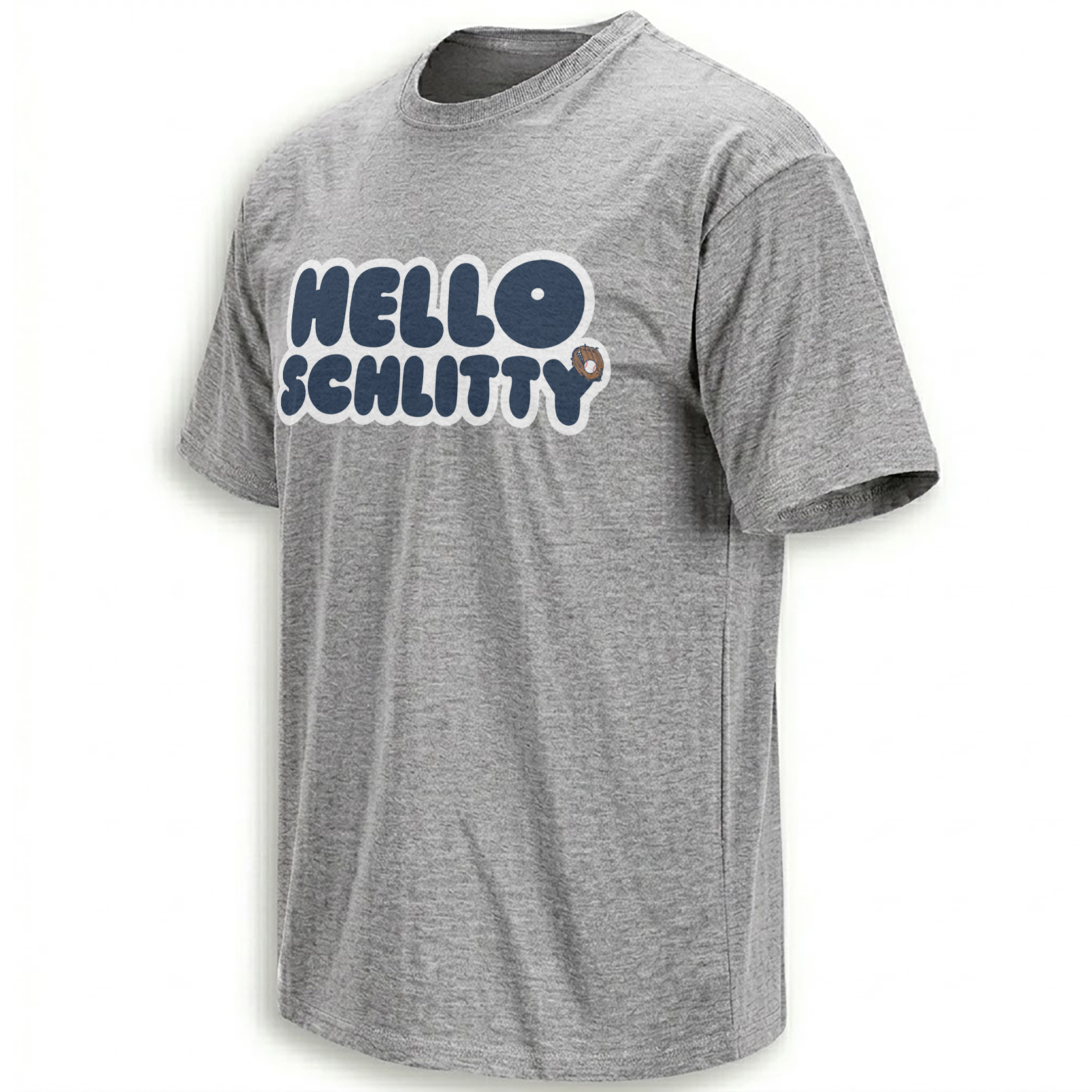
The two graphics are built from the same nickname, but they capture different stages of the fan reaction. One introduces the character. The other delivers the review.
“Hello Schlitty” reads like an entrance line. Its rounded navy lettering is oversized, playful and immediately legible. The cream outline separates the type from the sport-grey background, while the small pitcher and glove imagery keep the phrase connected to baseball without making the design feel like a formal statistical poster.
Visually, it borrows from friendly collegiate lettering, vintage mascot graphics and the kind of nickname-driven fan pieces that develop around players before official branding catches up. The word “Hello” is important because it frames Schlittler’s emergence as an arrival. New York is meeting a pitcher whose reputation is still growing with every start.
“Schlitty Good” shifts from greeting to evaluation. The phrase works like the final line after six scoreless innings: casual, slightly absurd and completely clear. It converts pitching analysis into fan language. Instead of discussing induced vertical break, pitch tunneling or fastball shape, the graphic reduces the conclusion to two words.
A nickname-first introduction that treats Schlittler’s rise like a new character entering the Bronx baseball story.
Open the greeting →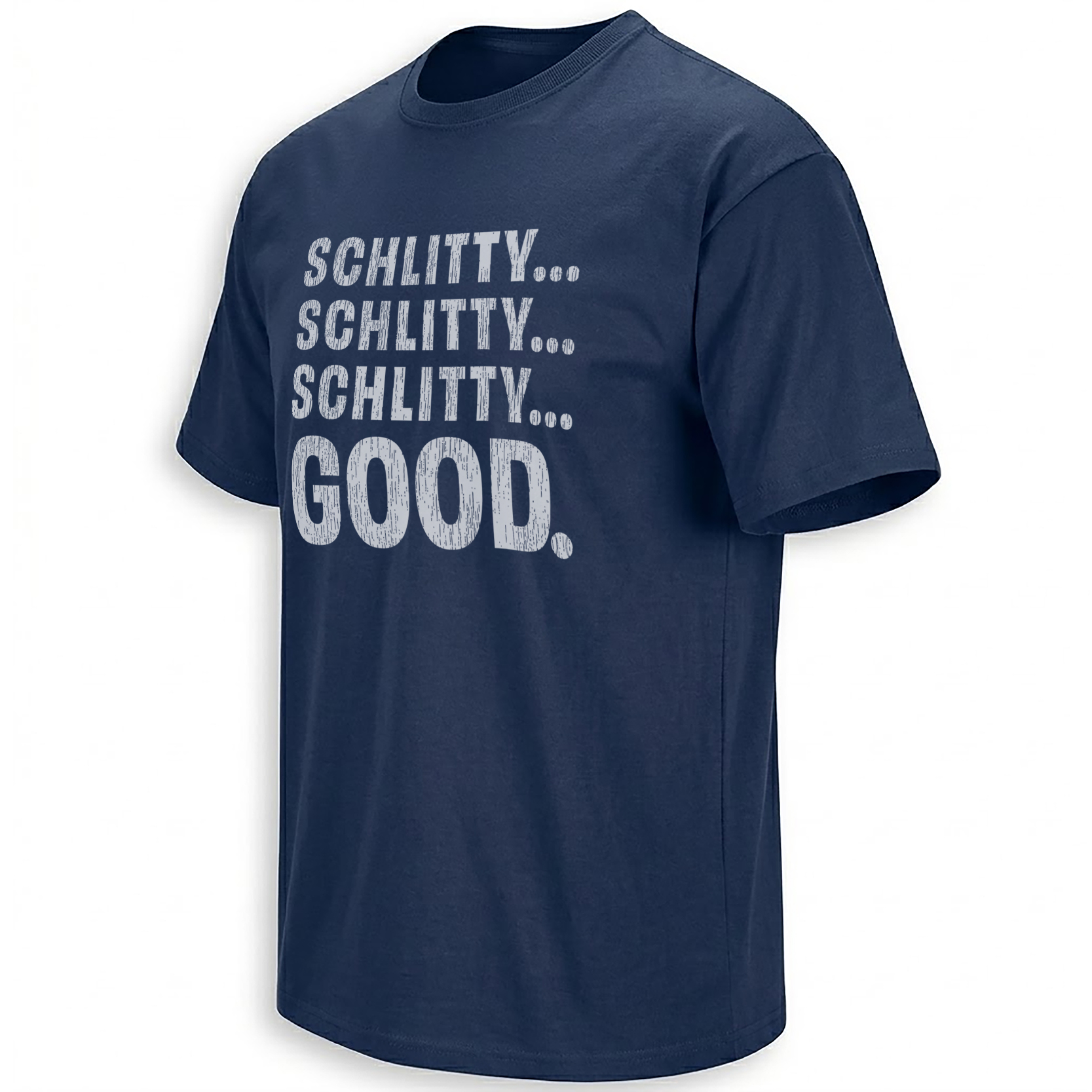
A compact fan verdict for the nights when fastball shapes, late swings and strikeout totals make technical analysis feel unnecessary.
See the fan verdict →The Design Language Is Intentionally Less Serious Than the Pitching
That contrast is the reason both graphics work. Schlittler’s actual performance belongs to one of baseball’s most scrutinized environments. Every start generates velocity readings, pitch-movement charts, rotation debates, All-Star projections and comparisons to Yankees history.
The artwork refuses to carry all of that analytical weight. Instead, it uses chunky lettering, simplified illustration and nickname humor to preserve the lighter part of the experience: the pleasure of recognizing that a young pitcher is becoming appointment viewing.
The navy palette keeps both pieces tied to New York baseball identity without requiring a large official-looking emblem. Cream outlines introduce the worn warmth of an older scorecard or stadium program. The sport-grey base resembles the neutral surface of classic baseball undershirts, practice tops and newspaper photography.
Most importantly, the compositions leave room for the words to dominate. That choice reflects how the moment is circulating. Fans are not only sharing pitching clips. They are repeating the nickname, remixing it into captions and using it as shorthand whenever Schlittler produces another sequence of uncomfortable swings.
“Hello Schlitty” announces arrival. It fits the feeling of a young pitcher entering a larger level of New York recognition.
“Schlitty Good” compresses a full pitching recap into the kind of deliberately simple language fans repeat after a dominant start.
Repetition turns the nickname into a character: calm on the mound, overpowering at the top of the zone and increasingly central to the Yankees’ season.
New York Sports Culture Helped the Nickname Travel Faster
Player nicknames spread differently in New York because the city’s sports conversations constantly overlap. A baseball phrase can move from a Yankees broadcast to social media, into a Knicks discussion and back into the Stadium before the next pitching appearance.
Josh Hart’s Cy Young endorsement was a perfect example. The comment did not come from a traditional baseball analyst. It came from a newly crowned New York basketball champion speaking the same language as fans watching Schlittler overpower Cincinnati.
That crossover matters because it positions “Schlitty” inside a larger citywide mood. The nickname is no longer contained within prospect circles or pitching analysis. It has become accessible enough for athletes from another sport, casual viewers and rivalry accounts to use without explanation.
This is how modern fan identities become durable. Performance creates credibility. A nickname creates portability. Memes, graphics and cross-sport reactions then carry the player beyond the box score.
Boston Gives the Story Its Necessary Edge
Every memorable Yankees identity benefits from conflict, and Schlittler’s relationship with Boston supplies more than enough of it. He is a Massachusetts native who grew up close to Red Sox territory, then delivered his most important early career performance while wearing pinstripes against Boston.
That reversal would already be enough to intensify the rivalry. The online reaction made it sharper. Schlittler has discussed receiving hostile messages directed at him and his family, and he later publicly highlighted persistent trolling from a Red Sox supporter after another dominant Yankees start.
The episode showed both the energy and the uglier limits of rivalry culture. Traditional boos, jokes and competitive resentment are part of the Yankees–Red Sox ecosystem. Personal abuse is something else. Schlittler’s sarcastic “rent free” framing worked because his pitching had already supplied the response that mattered most.
For Yankees fans, the Boston connection makes the nickname feel even more Bronx-coded. “Schlitty” is playful when New York says it and deeply irritating when Boston has to hear it after another collection of strikeouts.
A Running Visual Archive of the Yankees’ 2026 Season
The wider New York Yankees collection functions as a record of how the season is being experienced rather than as a static list of player names. Aaron Judge milestones, rivalry moments, emerging pitchers and sudden fan phrases each become separate chapters in the same Bronx conversation.
Schlittler’s two designs occupy a particularly interesting place inside that archive because they document the moment before a career has fully settled into history. These are not retrospective pieces about a completed legacy. They belong to the unstable, exciting stage when fans are still deciding how large the story might become.
The broader MLB Shirts and Apparel collection extends that idea across baseball, following the way a single start, home run, rivalry exchange or unexpected nickname can become visual language before the season has even finished explaining itself.
Why This Moment Feels Larger Than One Great Start
A 13-strikeout game is memorable on its own. What gives this one additional weight is the path surrounding it. Schlittler had already proven himself in an elimination game. He had already handled Fenway hostility. He had already matched up with established aces and begun turning his starts into events.
The Cincinnati outing therefore felt less like a surprise and more like confirmation. The fastball was still explosive. The control was sharper. The crowd reaction arrived earlier. Teammates no longer sounded amazed that he could dominate; they sounded as though dominance had become the expectation.
That transition is the real story of “Schlitty” in 2026. The nickname began as a convenient play on a surname. It now carries an entire set of associations: high velocity, multiple fastball shapes, no fear of rivalry pressure, understated postgame answers and the possibility of a homegrown Yankees ace.
Years from now, the significance of the season will depend on what follows. Awards are not decided in June, and promising starts do not guarantee permanent greatness. But cultural memory does not wait for a career retrospective. Fans create language while events are still happening because they need a way to name the feeling immediately.
Right now, the name is Schlitty.
Frequently Asked Questions
Why are Yankees fans calling Cam Schlittler “Schlitty”?
“Schlitty” is a natural shortening and remix of Schlittler’s surname. It has grown from a simple nickname into fan shorthand for his fastball-heavy pitching style, calm personality and rapid rise in the Yankees rotation.
What happened in Cam Schlittler’s 13-strikeout game?
On June 19, 2026, Schlittler struck out a career-high 13 batters over six scoreless innings, allowed four hits and issued no walks as the Yankees defeated the Cincinnati Reds 5–0 at Yankee Stadium.
What Yankees record did Schlittler set against Cincinnati?
At 25 years and 134 days, he became the youngest pitcher in Yankees history to record at least 13 strikeouts without allowing a walk in one game.
Why was Schlittler’s 2025 performance against Boston important?
He struck out 12, walked none and pitched eight scoreless innings in the deciding game of the 2025 American League Wild Card Series, helping the Yankees eliminate the Red Sox and establishing his reputation for handling rivalry pressure.
What is the difference between the Hello Schlitty and Schlitty Good designs?
“Hello Schlitty” treats the nickname as an introduction to a rising Yankees pitching personality, while “Schlitty Good” works as a playful fan verdict after another dominant performance.
Why do the designs use playful lettering instead of a serious statistical layout?
The rounded typography and nickname humor preserve the social side of Schlittler’s rise. They reflect how fans communicate after his starts rather than attempting to reproduce a formal box score.
The Hello Schlitty and Schlitty Good graphics preserve the playful language forming around Cam Schlittler, while the wider Yankees visual archive follows the player moments and Bronx phrases defining the 2026 season.
Hello Schlitty Shirt and Schlitty Good Shirt capture Cam Schlittler’s emergence as a Yankees pitching phenomenon through playful Bronx nickname language, navy baseball typography and the energy surrounding his career-high 13-strikeout performance.