Oklahoma Put Its Mark at the Center: The Diamond Emblem of a 2026 National Champion
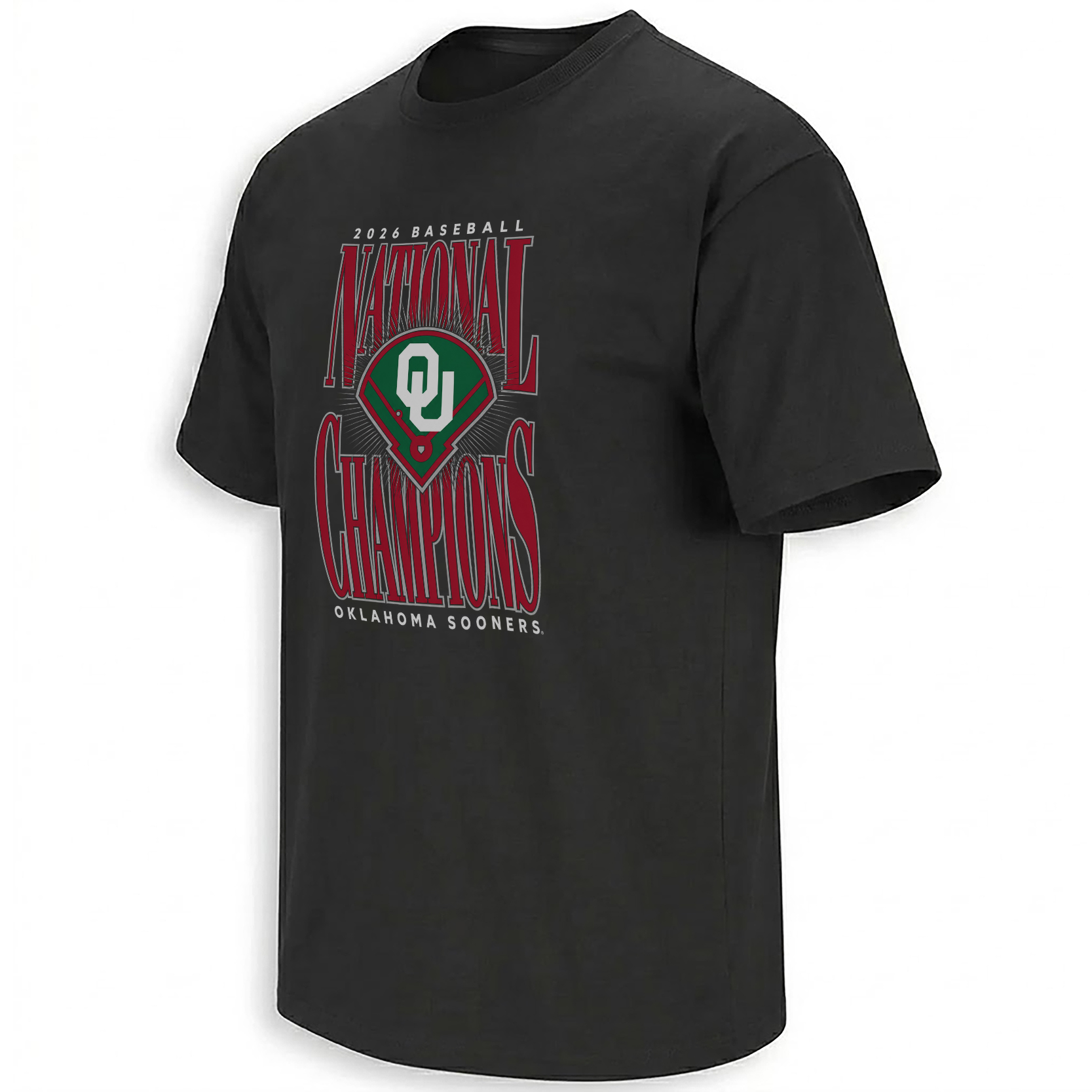
The Sooners’ third baseball national championship is compressed into one sharp graphic system: towering red title typography, a green field-shaped emblem, the interlocking OU mark and a black background that makes the entire championship seal feel cut from the Omaha night.
Oklahoma ended the 2026 Men’s College World Series with a 13–2 victory over North Carolina in the deciding third game. The result completed a 43–23 season, delivered the program’s third baseball national championship and placed 2026 beside the title years of 1951 and 1994.
The final margin made the ending look simple, but the emotional reaction carried the weight of thirty-two seasons without a championship. The dogpile, trophy lift and crimson celebration images immediately became part of Oklahoma’s athletic archive.
This diamond-emblem graphic approaches that moment without attempting to recreate the final out or illustrate the entire Omaha run. It reduces the title to its most recognizable elements: the name of the achievement, the Oklahoma mark and the geometry of the field where the championship was won.
The field is reduced to a diamond, the program to two letters and the entire season to one word: champions.
Oklahoma baseball • Omaha • June 2026The Graphic Reads Like a Championship Seal
The 2026 Baseball National Champions design is built around a central emblem rather than a sprawling scene. That choice gives it the authority of a seal, badge or institutional mark.
“2026 Baseball” appears in small, widely spaced lettering at the top. Beneath it, the word “National” stretches vertically in narrow crimson type, while “Champions” repeats the same visual force below the central symbol.
Between those two words sits a stylized baseball diamond. The green interior references the field, the crimson outline reconnects it to Oklahoma, and the white OU mark provides the cleanest point of recognition.
Why the Baseball Diamond Is Bigger Than a Field Diagram
The baseball diamond is one of the few sports diagrams recognizable even when stripped of players, scoreboards and equipment. Four points and several connecting lines are enough to identify the game.
That simplicity gives the shape symbolic power. The diamond contains every run, defensive alignment, mound visit and final out. It is not simply where baseball happens; it is the structure through which every baseball result becomes possible.
In the Oklahoma artwork, the diamond also functions like a shield. The point faces downward, the upper edges widen around the program mark and the red border gives the green field a more formal championship character.
By placing the OU mark inside the diamond, the design transforms field geometry into program identity. Oklahoma is not shown beside the championship space; it occupies the center of it.
Green Is the Unexpected Color That Makes the Emblem Work
Oklahoma championship graphics naturally rely on crimson, white and black. The green center of this design introduces a contrasting color without weakening the program identity.
Green immediately suggests grass and playing surface. It gives the viewer a visual route into baseball before the smaller “2026 Baseball” line is read. Because the green is contained inside a crimson border, it remains subordinate to Oklahoma rather than competing with it.
On the black shirt, the green and crimson combination becomes especially sharp. The dark base removes visual noise and allows the white OU mark to feel illuminated at the center of the composition.
Narrow letterforms create vertical scale, giving “National” and “Champions” the character of a banner or arena headline.
The white OU letters provide immediate recognition and remain the brightest element inside the darker championship palette.
The field shape organizes the composition, separating the upper and lower title words while creating a strong visual center.
The Typography Feels Tall Enough for a Championship Banner
The words “National” and “Champions” do not use broad collegiate block lettering. Their narrow, elongated proportions create a different emotional tone.
The letters rise and fall around the emblem like vertical banners. Thin outlines and shadow details add depth, while the irregular internal linework gives the type a slightly distressed, screen-printed quality.
That combination keeps the design from feeling like a standard official wordmark. It carries some of the personality of independent sports graphics, vintage concert posters and old championship newspaper advertisements.
The narrow letterforms create drama without requiring oversized width. They frame the OU diamond vertically, allowing the symbol to remain central while the championship language stretches across the full height of the artwork.
Why the Black Garment Base Changes the Mood
A white or grey base would make the graphic feel closer to a traditional collegiate souvenir. Black pushes it toward a sharper streetwear and poster aesthetic.
Crimson becomes deeper against black. The green field feels richer, while the white OU mark gains stronger contrast. The result is less like a daytime stadium program and more like a championship graphic seen under night lighting.
That darker mood fits the final stage of Oklahoma’s run. College World Series memories are often preserved through bright daytime games, but the championship itself becomes associated with the later hours: stadium lights, postgame ceremonies and the images circulating long after the final broadcast ends.
A Minimal Graphic Can Still Hold an Entire Postseason
The artwork does not list opponents, reproduce the bracket or show the final score. Its minimalism depends on the emotional familiarity of the moment.
Oklahoma supporters already know what stands behind the word “Champions”: the difficult regional path, the trip through the Super Regional, the victories in Omaha and the response after North Carolina forced a deciding game.
The design therefore works as a conclusion rather than a recap. It assumes the history and preserves the outcome.
From 1951 and 1994 to a New Oklahoma Championship Mark
Oklahoma’s earlier titles now form a three-year championship line with 2026. Each season belongs to a different visual era.
The 1951 championship survives through archival documentation and the early history of the College World Series. The 1994 title became the long-standing modern reference for Oklahoma baseball supporters. The 2026 championship entered fan culture instantly through live highlights, social posts and graphic releases.
This emblem belongs unmistakably to the contemporary moment, yet its shield-like geometry and distressed typography give it enough archival character to sit beside older championship imagery.
The Diamond as a Timestamp of Omaha
The strongest championship graphics do not need to illustrate every decisive play. They need to return supporters to the emotional logic of the event.
Here, the green diamond recalls the field. The black base recalls the night. Crimson carries Oklahoma. The central OU mark identifies whose celebration occupied the space after the final out.
Inside the wider College Baseball Shirts archive, the piece offers a different interpretation of Oklahoma’s title from schedule, bracket, stadium and equipment graphics. It preserves the championship through pure emblem design.
The broader NCAA Shirts collection places that symbol inside college athletics’ larger visual culture, where school marks, colors and postseason achievements become shorthand for memories shared across campuses and generations.
Frequently Asked Questions
Who won the 2026 Men’s College World Series?
The Oklahoma Sooners won the 2026 Men’s College World Series by defeating North Carolina 13–2 in the deciding third game of the championship series.
How many baseball national championships has Oklahoma won?
Oklahoma has won three NCAA Division I baseball national championships, with title seasons in 1951, 1994 and 2026.
What appears in the center of the Oklahoma championship design?
The center features a green baseball-diamond emblem outlined in crimson with the white interlocking OU mark placed inside it.
Why does the design use green with Oklahoma crimson?
Green represents the baseball field and creates contrast inside the emblem, while the crimson outline keeps the symbol connected to Oklahoma’s primary visual identity.
What does the tall typography communicate?
The narrow, elongated National and Champions lettering creates the scale of a vertical championship banner while framing the central OU diamond.
Why does the black background matter?
The black base intensifies the crimson, green and white palette, giving the artwork a sharper night-game and streetwear character.
The 2026 Baseball National Champions Diamond Emblem design places the OU mark at the center of the field, while the broader college baseball archive follows the brackets, scores, equipment and Omaha imagery surrounding the Sooners’ championship run.
2026 Baseball National Champions Shirt captures Oklahoma’s third national title through towering crimson lettering, a green baseball-diamond emblem, the central white OU mark and a sharp black-ground composition tied to the Sooners’ Omaha championship.