
The O-Zone: How Owen Hull Became the Center of North Carolina’s Omaha Run
A walk-off double sent Carolina to Omaha. An opposite-field home run changed the College World Series opener. Four hits and four runs helped send the Tar Heels into the championship series. By the middle of June, nearly every important UNC rally seemed to pass through Owen Hull’s zone.
Owen Hull’s first season at North Carolina reached its defining image before the Tar Heels even arrived in Omaha. With the Chapel Hill Super Regional tied in the bottom of the ninth, the left-handed hitter drove an RBI double that defeated USC 4–3 and sent UNC back to the Men’s College World Series.
That swing could have stood alone as the signature moment of his year. Instead, it became the beginning of a larger June. Hull homered in the College World Series opener against Ole Miss, extended his hitting streak and then produced four hits, four runs and two RBIs as Carolina defeated West Virginia 12–7 to reach the championship series.
“The O-Zone” works because it turns those performances into a place. The phrase sounds like the part of a ballpark where every important pitch eventually finds Owen, or the area of a postseason game in which North Carolina’s No. 8 becomes most dangerous.
The O-Zone is not one position on the field. It is the space a game enters when Owen Hull comes to the plate with Carolina’s season moving beside him.
The Nickname Turns a Player Into a Postseason Environment
Most baseball nicknames describe a physical trait, shorten a surname or emphasize one skill. “The O-Zone” does something more visual. It transforms the first letter of Owen into an atmosphere surrounding the player.
The phrase carries several meanings at once. It sounds like “ozone,” a layer covering the field from above. It sounds like an offensive zone where opposing pitchers lose control of an inning. It also creates a clean identity around a player whose name begins with the same open circular shape used throughout the design.
That flexibility makes the phrase useful beyond one statistic. Hull can enter the O-Zone through a home run, a line drive, an aggressive turn around the bases or a celebration after another Carolina breakthrough.
Fans do not need to select only one moment. The nickname provides a container for the entire run.
The first initial becomes the primary visual symbol, allowing the player’s name and the atmosphere around his performance to occupy the same phrase.
Hull’s jersey number gives the phrase a specific Carolina figure and separates the design from a general baseball slogan.
“The O-Zone” sounds like a shared section of the ballpark, turning an individual player reference into a community rally point.
The Artwork Captures the Celebration, Not Only the Swing
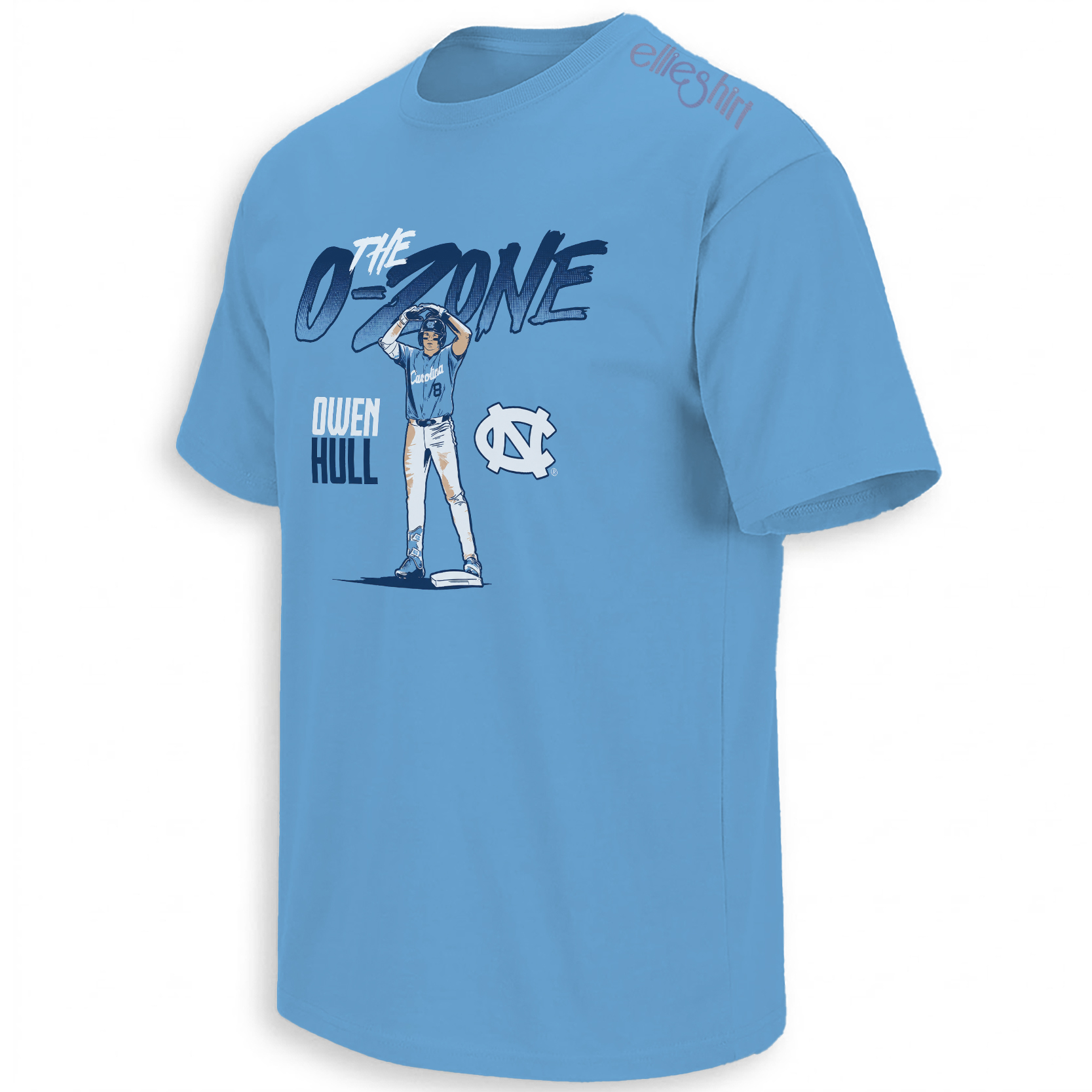
The The O-Zone design presents Hull in the emotional moment after the action. His raised arms, open expression and Carolina uniform communicate release rather than preparation.
That choice fits the postseason story. Hull’s most important hits were not isolated achievements hidden inside ordinary games. They created visible changes in North Carolina’s season.
The walk-off double produced a dogpile and an Omaha berth. His home run against Ole Miss tied a College World Series opener. His four-hit performance against West Virginia helped send UNC into the championship series.
A batting pose would show how the ball was struck. The celebration shows what the hit meant after it landed.
The Walk-Off Double Changed His Carolina Story in One Swing
Hull transferred to North Carolina after two seasons at George Mason, where he had already established himself as a productive hitter and one of the country’s most aggressive baserunners.
The move placed him inside a program with national expectations and a lineup built to return to Omaha. Yet transfer success is never guaranteed merely because past numbers are strong. A new conference, new teammates and a larger postseason spotlight require a player to establish his place again.
Hull did that throughout the season, but the decisive Super Regional swing turned his production into Carolina history.
UNC had lost the first game of the series to USC and responded by forcing a winner-take-all finale. With the score tied in the ninth inning, Hull drove the ball for the walk-off double that delivered the program’s thirteenth College World Series appearance.
The hit carried two victories inside it. Carolina won the game, and Hull completed the emotional transition from high-impact transfer to permanent part of Tar Heel postseason memory.
- USC won the Super Regional opener. Carolina entered the remainder of the series without room for another loss.
- UNC forced a deciding third game. The Tar Heels recovered with a shutout and restored the series to even terms.
- The finale reached the bottom of the ninth tied. One swing could determine whether the season ended in Chapel Hill or continued in Omaha.
- Hull delivered the walk-off RBI double. His hit gave UNC a 4–3 victory and transformed No. 8 into one of the faces of the postseason.
An Opposite-Field Home Run Announced Him in Omaha
Charles Schwab Field is not a ballpark that gives every hitter easy home-run distance. Its dimensions and Omaha weather can turn deep drives into routine outs, particularly when hitters attempt to force pull-side power.
Hull’s home run against Ole Miss traveled in the opposite direction. With Carolina trailing 1–0 in the sixth inning, he drove the ball over the left-field wall to tie the game.
The swing mattered because it demonstrated a complete offensive approach. Hull did not need to abandon his timing and reach for maximum pull power. He allowed the pitch to travel, used the opposite field and still created enough impact to leave one of college baseball’s most demanding parks.
UNC later took control and won 6–2, but Hull’s home run changed the emotional shape of the opener. The Tar Heels were no longer trying to solve the deficit. They were level, and the game had entered Carolina’s preferred late-inning territory.
Four Hits Against West Virginia Made the O-Zone Feel Unavoidable
A single dramatic swing can create a postseason reputation. Repeated production turns that reputation into an expectation.
In the bracket-clinching victory over West Virginia, Hull went 4-for-5 with two doubles, a triple, two RBIs and four runs scored. He reached repeatedly, moved through the bases and remained connected to nearly every important offensive sequence.
The performance was significant because it showed more than home-run power. Hull controlled the entire geometry of the game. Doubles created immediate scoring position. The triple forced the defense to chase the ball while he continued running. Four runs demonstrated how frequently the hitters behind him completed the work.
Carolina produced twelve runs, its highest total in a Men’s College World Series game. Hull did not need to supply all of them himself. His value came from placing the offense in motion again and again.
Two doubles and a triple showed that Hull could create extra-base damage even when the ball remained inside the stadium.
Four runs scored demonstrated how his speed, reads and aggressive movement continued affecting the game after contact.
A Twelve-Game Hitting Streak Gave the Breakout Continuity
Postseason baseball creates the illusion that every player is being reinvented in real time. A hot week becomes a national storyline, while the months of work leading toward it can disappear from view.
Hull’s Omaha production belonged to a longer stretch. His hitting streak reached twelve games during Carolina’s run, connecting the Super Regional heroics to his performances at the College World Series.
That continuity matters because opponents had already received updated scouting reports. Pitchers understood he was driving the ball, controlling the opposite field and entering games with unusual confidence.
The production continued anyway. That is the difference between an overlooked hitter surprising one opponent and a central lineup figure succeeding after the surprise has disappeared.
A hot hitter surprises the first scouting report. A postseason star keeps producing after every opponent knows exactly where the danger lives.
Hull Brought Speed to a Lineup Already Full of Power
At George Mason, Hull stole 42 bases during the 2025 season and set a school record that had stood since 1992. The total showed that his game had never been limited to standing in the batter’s box and waiting for extra-base contact.
North Carolina gained a player capable of changing an inning in several ways. He could drive the ball, take an extra base, challenge an outfielder’s route or force a pitcher to divide attention between the plate and the running game.
That versatility becomes especially valuable in tournament baseball. Opponents may neutralize one source of offense for several innings, but a player who can reach and immediately apply pressure creates another route toward scoring.
Hull’s 6-foot-4 frame gives his player image the appearance of a conventional power hitter. His movement after contact adds the less obvious part of the O-Zone identity: the zone does not end when the ball leaves the bat.
Hull combines the visual presence of a middle-order hitter with the baserunning history of a disruptive leadoff threat, allowing UNC to use his power and speed inside the same postseason lineup.
The No. 8 Design Looks Like a Modern Carolina Player Poster
Number 8 provides the artwork with a clean numerical anchor. Its two circular forms echo the O in Owen and the atmospheric shape suggested by “The O-Zone.”
Carolina blue keeps the image connected to the university before any smaller text is read. Dark navy supplies depth, while warm red and gold accents prevent the composition from becoming visually flat or dependent on one school color.
Hull’s raised-arm celebration gives the design upward movement. The pose suggests that the decisive play has already occurred and the viewer is entering the emotional aftermath.
The result is not a statistical infographic. It is a character poster for the player occupying the center of UNC’s current baseball moment.
The primary color identifies the university instantly and connects Hull’s individual performance to the larger Tar Heel program.
Raised arms preserve the release after an important play rather than presenting another conventional stance at the plate.
Rounded forms and a bold player-poster hierarchy transform the nickname into a visual environment surrounding No. 8.
His Transfer Story Fits the Modern College Baseball Era
College baseball rosters now develop through several paths at once. Programs recruit high school players, retain experienced contributors and use the transfer portal to add athletes whose skills have already been tested at the college level.
Hull represents the most successful version of that movement. He arrived with real production rather than only projection, then adapted quickly enough to become central to a national championship run.
His George Mason record remains important because it explains the foundation. The .367 average, 83 runs and 42 stolen bases from 2025 showed the player Carolina was adding.
The UNC season shows what happened when those tools entered a deeper lineup, a major-conference schedule and one of the sport’s largest postseason stages.
The transfer did not erase the earlier development. It gave that development a new setting and a larger audience.
The O-Zone Became a Team Story, Not Only a Player Story
Hull’s production matters because Carolina repeatedly converted it into victories. Gavin Gallaher, Colin Hynek, Jake Schaffner and the rest of the lineup ensured that reaching base remained the beginning of an inning rather than its final achievement.
The pitching staff created similar support. Jason DeCaro’s work against Ole Miss gave Hull’s tying home run room to matter, while the bullpen repeatedly protected the advantages built by the offense.
This relationship keeps The O-Zone from becoming an isolated star narrative. Hull occupies the center of the artwork, but the cultural meaning comes from the team moving with him.
A four-hit game becomes historic when it helps secure a championship-series berth. A walk-off double becomes permanent when it sends an entire program to Omaha.
Why Fans Respond to a Player-Specific Zone
Sports fandom often turns exceptional players into places. A stadium section receives a nickname. A defensive area becomes associated with one fielder. A stretch of the court or field begins to feel controlled by one athlete.
“The O-Zone” follows that instinct. It suggests that fans are not merely watching Owen Hull. They are entering the space created by his performance.
That language becomes especially effective during a hot streak. Each plate appearance feels connected to the previous one, and every new hit strengthens the idea that the zone remains active.
The phrase is also easy to carry beyond the stadium. It works as a caption, chant, sign and wearable fan identity without requiring a complete explanation of one game.
From Chapel Hill Walk-Off to Omaha Championship Stage
The sequence of Hull’s postseason tells a complete visual story.
In Chapel Hill, he ended the Super Regional with the hit that sent UNC west. In Omaha, he tied the opener with a home run and later helped power the largest College World Series scoring performance in program history.
The geography changed, but the role remained recognizable. Hull arrived in important situations and produced the kind of contact that altered Carolina’s direction.
That continuity is what allows the Owen Hull O-Zone piece to represent more than one celebration. The design records the player who connected UNC’s final home game to its championship opportunity in Omaha.
The Wider Tar Heel Baseball Archive
Hull’s player story belongs beside the wider language surrounding North Carolina’s 2026 run. GDTBATH captures the shared Carolina identity, while The O-Zone identifies one of the hitters driving the team through the bracket.
The broader NCAA collection preserves these tournament phrases, campus identities and player moments from across college sports.
One design records what it feels like to be a Tar Heel during the run. The other records the No. 8 figure at the center of several of its defining plays.
Together they show how college baseball memory develops: a team creates the achievement, one player supplies an unforgettable image and fans create language capable of carrying both.
Frequently Asked Questions
Who is Owen Hull?
Owen Hull is a left-handed-hitting outfielder for the North Carolina Tar Heels who transferred to UNC after two productive seasons at George Mason.
What number does Owen Hull wear for UNC baseball?
Hull wears jersey number 8 for the North Carolina Tar Heels.
What does “The O-Zone” mean?
The O-Zone is a player-specific nickname built around Owen Hull’s first initial, his hot bat and the idea that important UNC offensive moments repeatedly enter his area of influence.
How did Owen Hull help send North Carolina to Omaha?
Hull hit a walk-off RBI double in the bottom of the ninth inning to defeat USC 4–3 in the deciding game of the Chapel Hill Super Regional.
What did Owen Hull do against Ole Miss in the College World Series?
Hull hit an opposite-field solo home run in the sixth inning to tie the game before North Carolina pulled away for a 6–2 victory.
How did Hull perform against West Virginia in the bracket final?
He went 4-for-5 with two doubles, a triple, two RBIs and four runs scored as UNC won 12–7 and advanced to the championship series.
Why does the design use a celebration pose?
The raised-arm pose focuses on the emotional result of Hull’s postseason production and connects the artwork to the victories created by his biggest hits.
The Owen Hull No. 8 celebration piece preserves the player connecting Carolina’s Super Regional breakthrough, unbeaten Omaha bracket and return to the national championship series.
The O-Zone Shirt celebrates UNC baseball standout Owen Hull in a bold No. 8 Carolina-blue celebration design. The artwork connects his walk-off Super Regional double, opposite-field Omaha home run, four-hit semifinal performance and breakout role in North Carolina’s 2026 championship run.