
New York Forever: How the Knicks Parade Bus Became a Moving Monument to 53 Years of Belief
The open-top bus carried the NBA champions through Lower Manhattan, but the image was larger than one roster and one morning. It carried five boroughs, three generations of basketball memory and a city finally able to see its long wait moving through the Canyon of Heroes.
By sunrise on June 18, Lower Manhattan had already stopped behaving like an ordinary workday. Fans had filled the available viewing areas, orange-and-blue clothing covered the sidewalks, and the route between Battery Park and City Hall had become a temporary corridor for fifty-three years of Knicks memory.
The championship itself had been secured five days earlier, when New York defeated San Antonio in Game 5 and completed a 4–1 NBA Finals victory. The parade changed the scale of that result. What had belonged to the players inside one arena now moved slowly through the city in full public view.
At the center of that movement was the open-top parade bus: champions standing above the street, confetti falling between buildings and spectators searching for any elevated surface from which they could see. The bus became the defining machine of the celebration because it turned a static accomplishment into a journey.
The bus did not simply carry the champions. It gave New York a moving image large enough to hold the years that came before them.
The Parade Began Before the Bus Appeared
A championship parade is officially scheduled, but its emotional beginning cannot be controlled by a timetable. It begins when the first supporters arrive in darkness, when subway cars fill with jerseys and when office workers abandon the idea of a normal morning.
The Knicks’ celebration drew that energy hours before the announced start. Viewing areas filled early as supporters gathered along Broadway and near City Hall. Some had watched the franchise’s 1973 championship. Others had inherited the story through parents, grandparents and grainy footage of an era that had become almost mythological.
Younger fans arrived with a different archive. Their Knicks history included rebuilding seasons, draft debates, Linsanity, playoff returns and the slow transformation from a team people mocked into one capable of finishing June as champion.
The parade connected those histories without asking anyone to choose the most authentic version of fandom. A person who remembered Walt Frazier and a teenager wearing a Jalen Brunson jersey were standing beside the same route, waiting for the same bus.
Fans who remembered the franchise’s earlier titles finally witnessed the kind of citywide celebration those teams never received along the Canyon of Heroes.
Supporters shaped by Patrick Ewing, defensive battles and unfinished Finals runs saw decades of near-history converted into an actual championship ending.
Younger fans watched the current roster create its own mythology rather than borrowing every important image from the franchise’s past.
Why the Parade Bus Became the Day’s Central Symbol
Trophies are designed to remain still. They are lifted, photographed and placed in display cases. A parade bus does the opposite. It moves the championship through space and allows the city to encounter it block by block.
The elevated deck creates a temporary stage above ordinary traffic. Players can see the scale of the crowd, while supporters can identify the people whose games had structured their spring and early summer.
That height also changes the players’ relationship to the city. Inside an arena, the audience rises around the court. On a parade bus, the champions rise above the street while office windows, rooftops, scaffolding and sidewalks become the stands.
The visual is inherently cinematic: tall buildings framing a narrow path, paper falling from above and a bus moving through the center like a float in a civic ritual. Even viewers who were not present can understand the emotional geography from one photograph.
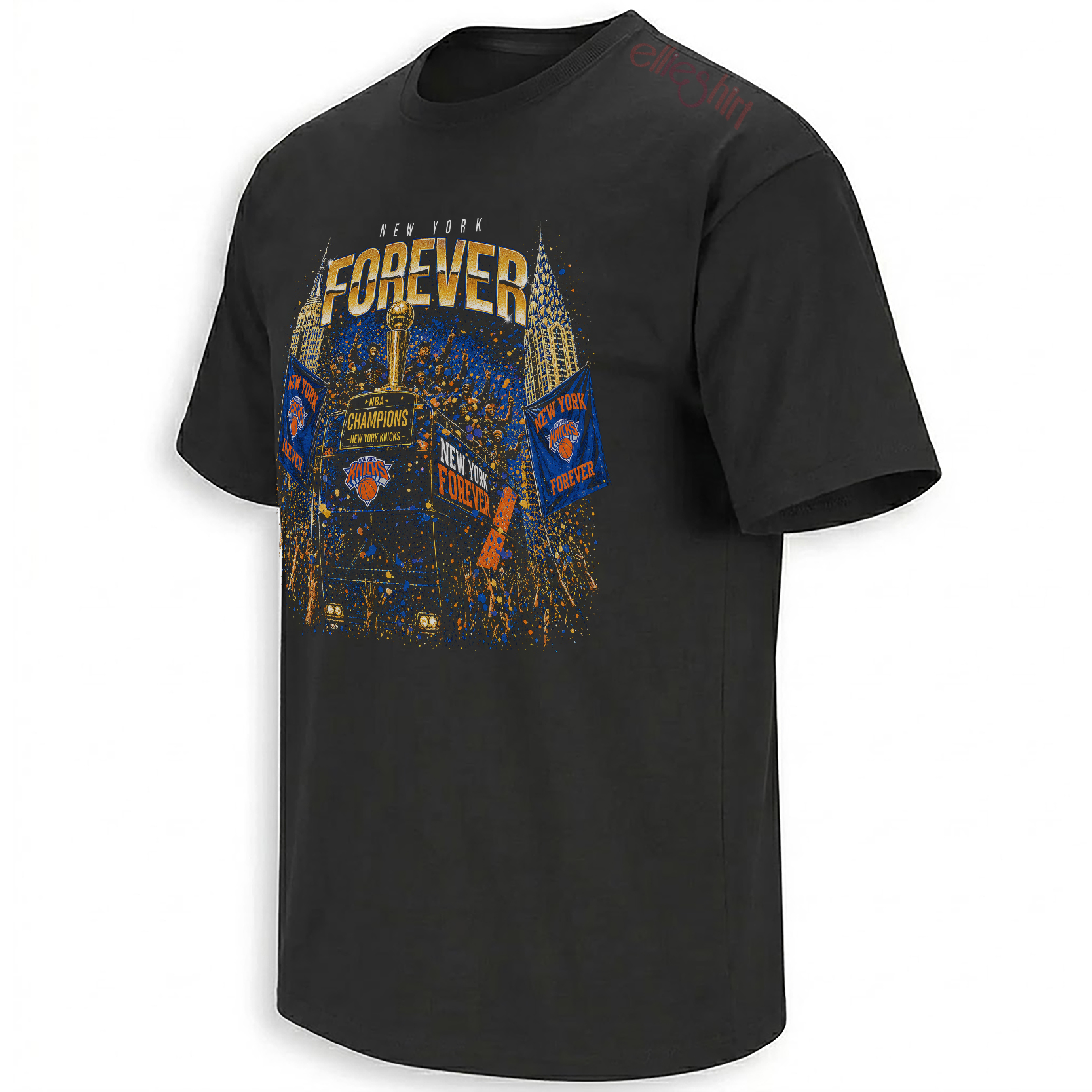
“New York Forever” Says More Than “Champions”
“Champions” names the result. “New York Forever” describes the relationship surrounding it.
The phrase does not limit the emotion to one Finals series, one roster or one summer. It suggests continuity between every version of the city that carried the team: old Madison Square Garden memories, 1990s playoff nights, neighborhood courts, subway arguments and the current generation that finally reached the parade.
“Forever” also acknowledges the unusual permanence of New York sports identity. Players change, arenas are renovated and entire eras become documentary footage, but the city continues to attach family stories and neighborhood loyalties to the same uniform.
On the parade graphic, the words operate like the headline above a historical photograph. They do not explain every face or every building. They tell the viewer how the scene should be remembered.
- “New York” establishes the real subject. The design celebrates the Knicks, but the emotional frame is the city that surrounded and sustained the team.
- “Forever” connects separate eras. The championship belongs to 2026 while the phrase reaches backward toward 1970, 1973, the 1990s and every season between.
- The bus creates movement. The image is not a studio portrait or trophy still life. It shows the title traveling into public memory.
- The skyline makes the celebration civic. Buildings, streets and falling confetti turn the achievement into an event involving the entire city rather than only the arena.
The Canyon of Heroes Gave the Knicks a New Historical Frame
Lower Broadway carries the accumulated memory of New York’s largest public celebrations. Championship teams, returning soldiers, explorers and civic figures have moved through the corridor beneath falling paper and crowds pressed against the buildings.
The 2026 parade placed the Knicks inside that tradition for the first time. The franchise had won titles before, but it had never received an official ticker-tape parade through the Canyon of Heroes.
That distinction changed the historical meaning of the morning. The event was not a recreation of what happened in 1970 or 1973. It was a new chapter the earlier championship generations had never experienced.
Walt Frazier, Patrick Ewing and other franchise figures appearing around the celebration made the missing continuity visible. Past and present were not represented through a graphic montage. They occupied the same streets.
The Design Captures the Parade as a City Poster
The artwork does not approach the bus as a piece of transportation. It enlarges it into a moving stage and places the players within a broader composition of buildings, signage, confetti and championship typography.
The result resembles a street poster discovered after the celebration rather than a clean official team photograph. Layered faces, rough edges and compressed urban imagery reproduce the sensation of trying to absorb many parade details at once.
Orange and blue provide immediate Knicks recognition, but the neutral shadows and distressed texture prevent the piece from becoming a flat two-color logo treatment. The city remains visible as architecture, atmosphere and physical scale.
The bus sits at the point where those elements meet. It holds the roster, travels through the skyline and provides the lower visual foundation for the larger “New York Forever” statement.
The dark background deepens the shadows and makes the orange-and-blue highlights feel illuminated, giving the collage the mood of a late-night championship poster or subway-wall print.
The warm neutral background softens the contrast and makes the composition resemble an aged commemorative page preserved from the morning after the parade.
Two Garment Colors Create Two Different Memories
The artwork remains the same, but black and sand change the emotional period in which the parade appears to exist.
On black, the design feels immediate and loud. Blue becomes electric, orange resembles arena light and the bus appears to move through a dense field of nighttime city energy. This version emphasizes celebration as spectacle.
On sand, the same image becomes archival. Warm fabric interacts with the distressed printing like old paper, giving the parade the quality of a newspaper front page, vintage sports program or commemorative poster recovered years later.
Neither interpretation is secondary. One preserves how the celebration felt while it was happening. The other imagines how the moment may look after time has converted it into family history.
A high-contrast treatment that frames the parade bus, roster and championship colors with the density of a New York night poster.
View the black edition →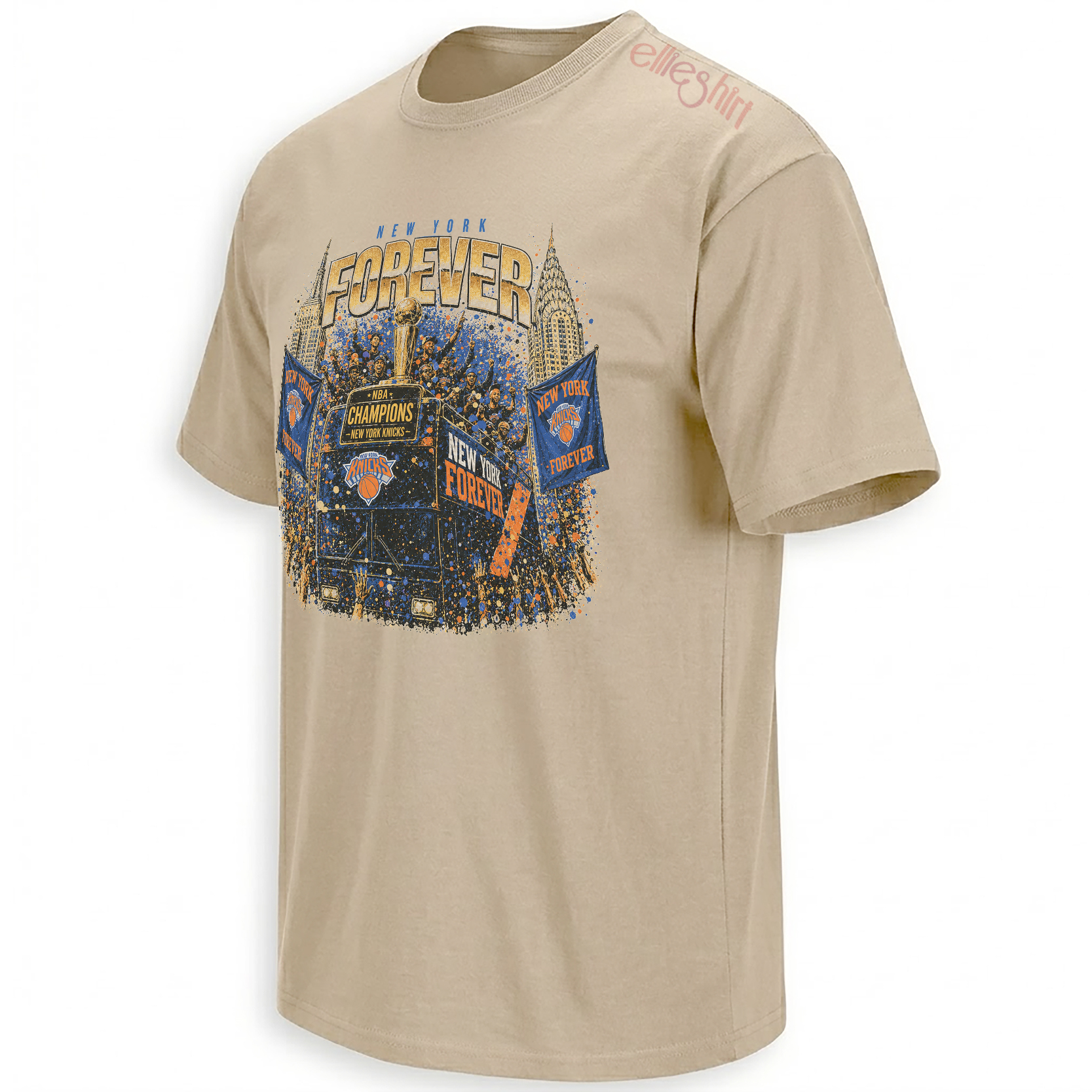
A warmer archival version that makes the championship collage feel like a vintage commemorative page from the city’s basketball history.
View the sand edition →Confetti Turned the Financial District Into an Arena
Confetti is decorative only until enough of it falls to alter an entire street. During the parade, orange, blue and white paper moved through the spaces between buildings, collected on shoulders and remained behind after the buses had passed.
Inside Madison Square Garden, the celebration had been contained by an arena roof. Lower Manhattan gave the same emotion vertical distance. Paper could fall from office windows, drift through sunlight and make the towers themselves appear involved.
This visual transformation mattered because the Financial District is normally associated with speed, work and controlled movement. The parade replaced that rhythm with chanting, waiting and collective attention.
For several hours, Broadway was no longer a route people used to reach somewhere else. It became the destination.
The confetti did not hide the city. It made the buildings look as though they had finally joined the celebration.
The Crowd Became Part of the Championship Roster
Parade images naturally focus on the players because they occupy the elevated bus and carry the trophy. Yet the scale of the scene depends on the people surrounding them.
Supporters filled the street-level viewing areas and appeared in windows, on rooftops and across temporary structures. The crowd transformed the route from a procession into a visible exchange between the team and the city.
That exchange was especially significant for a franchise whose fan base remained culturally loud through long periods without championship reward. Knicks supporters had spent decades turning ordinary regular-season games into major events, debating every roster decision and treating Madison Square Garden as a stage even when the team was not a contender.
The parade allowed that loyalty to appear in one concentrated image. The players received the championship bus. The fans supplied the walls around it.
The bus becomes meaningful because it is surrounded. Without the crowd, it is transportation. With five boroughs pressing toward the route, it becomes proof that the championship belonged to a larger New York community.
Why the Parade Felt Different From the Trophy Ceremony
The trophy ceremony answered the competitive question: who won the NBA championship? The parade answered the cultural question: what did the title mean once it returned to New York?
On the Finals court, players were still inside the structure of competition. Cameras followed league protocol, speeches arrived quickly and the result remained connected to the opponent standing nearby.
The parade removed the opposing team from the visual field. There was no scoreboard and no need to manage the next game. Every image could focus on the champions, the city and the release created by the end of a 53-year wait.
This is why parade imagery often survives differently from game footage. A game records performance. A parade records possession—the moment a city publicly claims the championship as part of its identity.
Jalen Brunson Became the Face at the Front of a Larger Story
Jalen Brunson entered the celebration as Finals MVP and the central figure of the championship run. His speeches, trophy images and presence on the parade route gave the current roster a clear emotional leader.
Yet the “New York Forever” framing keeps the story from collapsing into one player biography. Brunson occupies the present, while the phrase places him inside a larger continuum of captains, point guards, playoff teams and fans.
That balance reflects how New York sports heroes are often remembered. Their individual achievements matter, but the city quickly absorbs them into a wider mythology. A player becomes associated with a borough, an arena entrance, a radio call or a particular version of the skyline.
Brunson’s 2026 image is the championship bus: trophy nearby, confetti in the air and a city finally celebrating behind him.
The Bus Carried Franchise History Alongside the Current Team
The presence of former Knicks figures gave the parade another layer of visual continuity. Walt Frazier represented the championship teams of the early 1970s. Patrick Ewing represented a 1990s era that came close enough to make the absence of a title feel permanent.
Their appearance prevented the celebration from becoming a clean break between past disappointment and present success. Earlier teams were not erased by the 2026 victory. They became part of the emotional path toward it.
That structure also explains the power of the word “forever.” The current roster earned the trophy, but the franchise’s emotional history does not begin with the Finals opener or end with the City Hall ceremony.
The parade bus moved forward while carrying people and memories from different decades. Few images could summarize the franchise more precisely.
From a Live Celebration to a Memory Object
Championship graphics appear quickly because fans want a physical connection to an event before its emotional details begin to blur.
The New York Forever parade bus design preserves details that a basic champions logo cannot: the vehicle, the crowded composition, the city architecture and the feeling of movement through confetti.
Those elements allow the piece to function like a memory object. It points not only to the season’s final result but to one specific morning when the championship became publicly visible across Lower Manhattan.
Years later, the bus may become the fastest way to identify the entire week. Fans will not need the full schedule or every Finals statistic. The image of the roster moving beneath the buildings will reopen the larger story.
The Wider Knicks Championship Archive
The parade bus represents one chapter of a postseason that generated many distinct images: the trophy lift, Jalen Brunson’s Finals MVP moment, OG Anunoby’s late-game heroics, neighborhood celebrations and the confetti-covered route toward City Hall.
The wider New York Knicks Shirts collection gathers those visual languages into a running record of the franchise’s championship era.
The 2026 NBA Finals Champions collection focuses specifically on the slogans, players, trophy imagery and cultural moments that emerged as New York completed the title run.
Inside the broader NBA Shirts collection , the parade design demonstrates how championship culture extends beyond the court. The final score creates the event; the city, fans and imagery determine how the event will be remembered.
Frequently Asked Questions
When was the New York Knicks’ 2026 championship parade?
The Knicks’ championship ticker-tape parade took place on June 18, 2026, through the Canyon of Heroes in Lower Manhattan, followed by a City Hall ceremony.
Why was the 2026 Knicks parade historically significant?
It celebrated the franchise’s first NBA championship since 1973 and was the first official Knicks ticker-tape parade through the Canyon of Heroes.
What does “New York Forever” mean in the design?
The phrase connects the 2026 championship to generations of Knicks fans, earlier franchise eras and the continuing relationship between the team and all five boroughs.
Why is the parade bus central to the artwork?
The open-top bus carried the players and trophy through the city, turning the championship into a moving public image surrounded by crowds, buildings and confetti.
What route did the Knicks parade follow?
The procession traveled through Lower Manhattan along the Canyon of Heroes, beginning near Battery Park and moving toward City Hall.
Why does the design come in black and sand versions?
Black emphasizes electric championship color and nighttime city energy, while sand gives the distressed collage the appearance of an aged newspaper page or vintage sports poster.
How is a parade graphic different from a standard champions design?
A standard title graphic records the result. A parade graphic preserves how the city received the champions through the bus, route, crowd and confetti-filled urban setting.
The New York Forever parade bus piece preserves the moving image of the 2026 champions traveling through Lower Manhattan while five boroughs converted a 53-year wait into public memory.
New York Forever Shirt captures the Knicks’ historic 2026 championship parade bus moving through Lower Manhattan beneath orange-and-blue confetti. Available in black and sand presentations, the distressed collage connects Jalen Brunson’s championship roster, the Canyon of Heroes and generations of New York basketball memory.