When Lady Liberty Got Her Ring: Brunson’s Championship Became New York Mythology
The Knicks’ first NBA championship since 1973 gave New York a new visual language: Jalen Brunson with two postseason MVP trophies, a championship ring large enough for a monument and the Statue of Liberty transformed into an orange-and-blue witness to history.
New York did not celebrate the Knicks’ 2026 championship only through the scoreboard. It projected the victory across the city itself. Streets filled, subway platforms turned into chants, boroughs traded images of the final horn and familiar landmarks were pulled into the visual language of the title.
The Statue of Liberty was an inevitable participant. She already functions as the city’s most portable symbol: recognizable before the skyline is fully visible, powerful enough to represent New York beyond basketball and flexible enough to absorb whatever emotion the city needs her to carry.
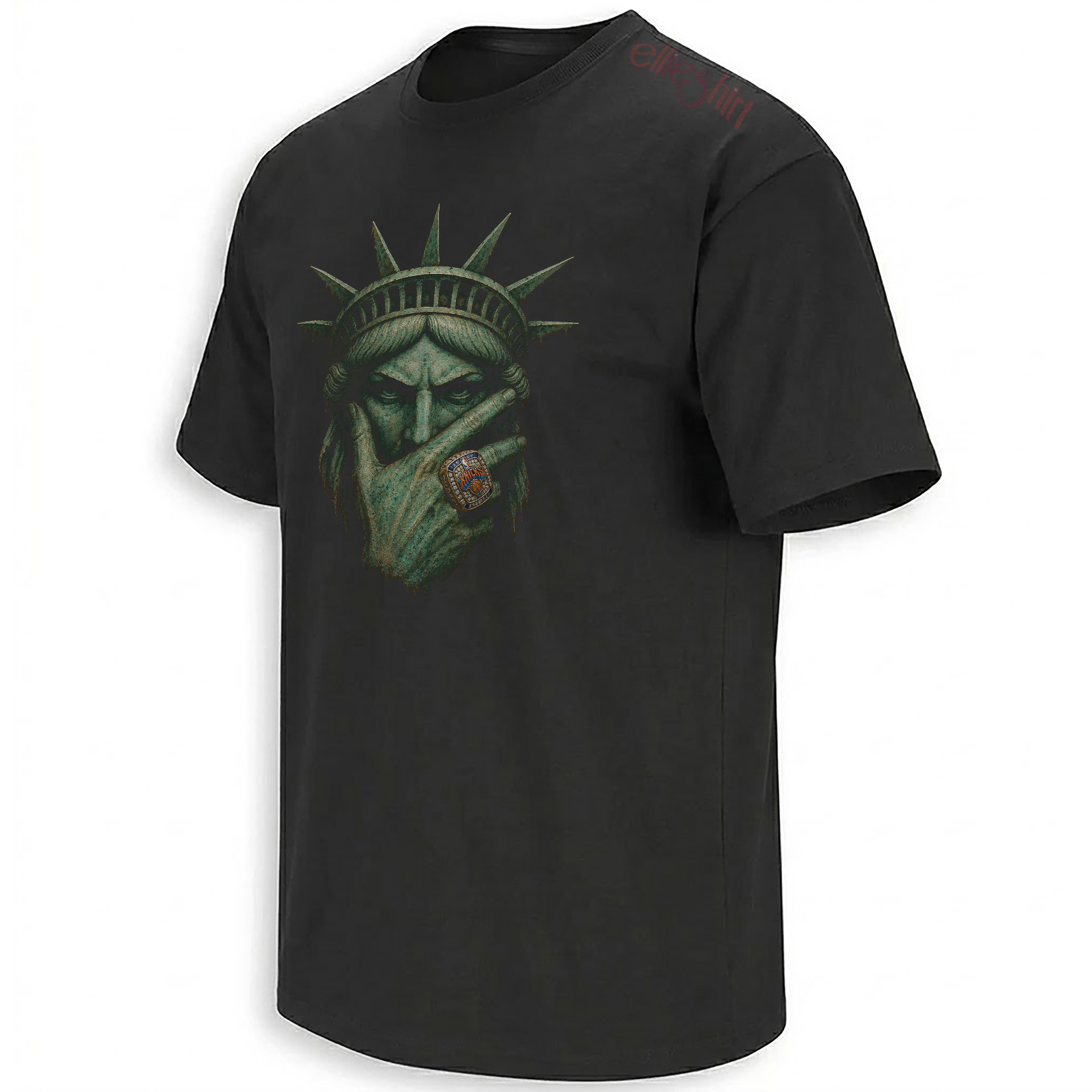
In this championship image, the torch gives way to a new gesture. Liberty raises a hand marked by the Knicks’ title, while Jalen Brunson’s celebration and postseason trophies supply the human story behind the ring. The monument and the player meet inside one idea: New York finally has something new to place beside its history.
The championship ring belongs to the players, but the image places it on Liberty because the emotional ownership belongs to the entire city.
The Moment New York Needed a Monument
Championships create an immediate problem for visual culture: how do artists represent an emotion much larger than one play?
A photograph of the final score proves what happened. A trophy-lift image captures the official ceremony. A player portrait identifies the central figure. None of those images alone explains what fifty-three years of waiting feels like across five boroughs.
A monument solves that problem. The Statue of Liberty does not belong to one neighborhood, one generation or one price tier of Madison Square Garden ticket. Her silhouette represents the city at a scale larger than the arena.
Placing a Knicks championship ring on her hand expands the title from a team achievement into civic mythology. The ring is no longer simply jewelry commissioned for a roster. It becomes evidence that New York itself has passed through the season and emerged as champion.
Brunson provides the face of the championship, but the monument enlarges its ownership. The graphic imagines the title as something worn by New York—not only by the players who received the rings.
Why Brunson Belongs Beside the Statue of Liberty
Brunson’s placement is not accidental. He became the figure through whom New York understood the championship run: the guard trusted with late possessions, the leader associated with the team’s emotional stability and the scorer who delivered 45 points in the title-clinching Game 5.
His route to that image matters. Brunson did not arrive in New York as a universally accepted franchise savior. His 2022 signing was debated as an aggressive investment in a good guard rather than the beginning of a championship era.
Each postseason changed the scale of the conversation. Brunson became an All-Star, a playoff closer, the captain of a contender and eventually the winner of both the Larry Bird Eastern Conference Finals MVP Trophy and the Bill Russell NBA Finals MVP Trophy.
By the night the Knicks finished San Antonio, he no longer appeared beside New York symbols as a temporary celebrity. He had become part of the city’s current iconography.
The Ring Replaces the Torch as the Main Event
The Statue of Liberty is normally understood through three objects: the crown, the tablet and the torch. Each gives the monument a formal symbolic role. The torch carries illumination; the tablet anchors the figure in history; the crown makes the silhouette instantly recognizable.
The championship graphic introduces a fourth object: the ring.
That addition changes the posture from ceremonial welcome to celebratory display. Liberty is no longer only holding an ideal above the harbor. She is showing the city what it has won.
The exaggerated scale of the ring is essential. A realistic piece of jewelry would disappear inside the composition. The oversized version operates like championship typography: it announces itself before the viewer studies the details.
Gold also creates a productive contrast against the oxidized copper green associated with the statue. The colors tell two different time stories. Liberty green suggests age, permanence and the accumulated surface of history. Ring gold represents something new, reflective and freshly earned.
Two MVP Trophies Tell the Full Brunson Story
The presence of two MVP trophies separates the artwork from a generic championship graphic. They create a map of the entire postseason.
Brunson first received the Larry Bird Trophy after leading the Knicks through the Eastern Conference and back to the NBA Finals for the first time since 1999. That award represented arrival: New York had crossed the conference and restored itself to basketball’s final stage.
The Bill Russell Trophy carried a different meaning. It represented completion. Brunson did not only bring the Knicks to the Finals; he closed the series with the highest-scoring Finals game in franchise history and left San Antonio as the most valuable player of the championship round.
Displayed together, the trophies create a simple visual sentence. Brunson led New York through the East, then led it through the Finals.
The championship ring completes that sentence. The awards belong to Brunson’s individual performance. The ring confirms that those performances ended with the team objective fully achieved.
Forty-Five Points Turned Celebration Into Coronation
Brunson’s Game 5 performance gave the eventual celebration a clear central image. The Knicks did not drift into the championship behind an ambiguous Finals MVP debate. Their leader scored 45 of the team’s 94 points and controlled the decisive fourth-quarter stretch.
The performance mattered partly because of the game’s resistance. San Antonio built another double-digit lead, the Knicks struggled early and the possibility of returning to New York for Game 6 remained alive.
Brunson responded with the style that had defined his rise: controlled footwork, strength through contact, changing speeds and an unusual comfort inside possessions that appeared to have run out of space.
He scored 13 consecutive Knicks points during the fourth quarter. By the final horn, the Finals MVP presentation did not feel like a separate ceremony attached to the championship. It felt like the formal naming of what the game had already shown.
That is why the design can place Brunson beside an enlarged civic monument without the pairing feeling inflated. His Game 5 performance was already being processed by fans at monumental scale.
From 1973 to 2026: The Ring Carries the Missing Years
A championship ring records one season, but Knicks fans inevitably read the 2026 ring through every year that came before it.
New York’s previous title belonged to 1973—a different arena culture, a different city and a roster that had long since passed into basketball mythology. Generations of supporters grew up knowing the championship through archival footage rather than personal memory.
The gap included serious contenders, painful playoff exits, unstable rebuilds, famous rivalries and long stretches when championship language felt almost unusable around the franchise.
That history changes the emotional weight of the new ring. It is not merely the third ring in a franchise count. For many living Knicks supporters, it is the first one they experienced in real time.
The Statue of Liberty is particularly effective in that context because she visually spans eras. The monument existed before all three Knicks championships. Giving her the 2026 ring suggests that the city has been standing in place through the entire wait.
The City Celebration Was Larger Than Madison Square Garden
New York’s response after Game 5 confirmed why a city-scale symbol belonged in the artwork. Celebrations spread beyond the arena district into streets, bars, neighborhoods and spontaneous public gatherings across the boroughs.
Fans who had inherited the team from parents and grandparents treated the title as family history finally becoming present tense. Others experienced the Knicks as a rare shared identity capable of moving across neighborhood, cultural and generational boundaries.
The timing also gave the celebration an unusual summer visibility. The win arrived during a period when New Yorkers were already gathering outdoors, filling sidewalks and creating images capable of traveling immediately through social media.
In that environment, the Statue of Liberty became useful visual shorthand. A single altered image could communicate what thousands of street photographs were showing: the championship had escaped the building and entered the identity of the city.
Why the Artwork Uses Myth Instead of Realism
The graphic does not attempt to depict a literal event. The Statue of Liberty did not play in the Finals, accept a ring at center court or stand beside Brunson during the trophy ceremony.
Its purpose is symbolic compression.
One side of the design gives viewers the human achievement: Brunson, his celebration and the trophies earned through performance. The other side gives viewers the civic meaning: Liberty wearing the championship as though New York itself had been included on the roster.
That combination resembles the visual language of old sports posters, newspaper illustrations and street-vendor graphics. Literal accuracy matters less than emotional accuracy. The image asks what the championship felt like, then answers at the scale of a monument.
Oxidized copper tones create the atmosphere of an established New York landmark, while gold, orange and royal blue introduce the brightness of a newly won championship. Brunson supplies the narrative center; Liberty enlarges the emotion from player history into city history.
A Championship Object Becomes a Memory Object
Rings are designed to summarize seasons. Names, records, logos and stones are compressed into an object small enough to wear but elaborate enough to reward years of work.
Fan graphics perform a similar function. They cannot reproduce every playoff game, every comeback or every possession Brunson controlled. Instead, they select the visual elements most likely to reactivate the memory later.
In this design, those elements are immediate: Liberty, Brunson, two MVP trophies and one championship ring.
Years from now, a viewer will not need the complete Game 5 box score to understand the image. The monument establishes New York. The ring establishes the title. Brunson establishes the central player. The trophies establish the journey.
That efficiency is what turns the graphic from celebration into archive.
Brunson’s No. 11 Became Part of the City’s New Uniform
The championship accelerated a transformation already visible throughout the postseason. Brunson’s No. 11 had moved beyond arena apparel and become a common piece of New York visual identity.
Jerseys appeared in offices, schools, delis, subway cars and neighborhoods far from Madison Square Garden. The number represented the player, but it also functioned as shorthand for a style of leadership Knicks fans had decided to trust.
That trust was built through repetition. Brunson continued asking for the ball in difficult moments. He continued playing through physical defense. He continued appearing composed while the city around him treated each postseason possession as an emergency.
The championship ring gave the number a final layer. No. 11 was no longer only the jersey of the Knicks’ best player. It was the number worn by the Finals MVP who ended the drought.
Where the Liberty Ring Fits Inside the Knicks Championship Archive
Every championship produces several kinds of visual memory. Team photographs preserve the complete roster. Player graphics isolate individual achievement. Score designs record the result. Parade imagery captures public release.
The Liberty ring belongs to the category of civic fantasy. It imagines how the city might physically wear the victory if New York were one enormous person.
That gives the design a different role from a standard roster shirt or Finals scoreboard graphic. It is less concerned with recording every factual detail and more concerned with preserving the emotional ownership of the title.
The wider New York Knicks Shirts collection follows the championship through several perspectives: Brunson’s MVP run, the historic comebacks, team portraits, New York slogans and images that place the title inside the identity of the city.
The broader NBA Shirts collection places the Liberty graphic inside a larger basketball tradition in which championships become posters, monuments become fans and one season’s images become the visual memory of an era.
Frequently Asked Questions
When did the New York Knicks win the 2026 NBA championship?
The Knicks clinched the championship on June 13, 2026, by defeating the San Antonio Spurs 94–90 in Game 5 and winning the NBA Finals series 4–1.
How long had it been since the Knicks’ previous championship?
New York’s previous NBA title came in 1973, so the 2026 championship ended a 53-year drought.
Why is Jalen Brunson shown with two MVP trophies?
Brunson won the Larry Bird Trophy as Eastern Conference Finals MVP and the Bill Russell Trophy as NBA Finals MVP during the Knicks’ 2026 championship run.
How many points did Brunson score in the championship-clinching game?
Brunson scored 45 points in Game 5, setting a Knicks franchise record for points in an NBA Finals game.
Why does the Statue of Liberty wear a Knicks championship ring?
The image is symbolic rather than literal. Liberty represents New York City, so placing the ring on her hand turns the team’s championship into a visual celebration shared by the entire city.
What do the green and gold colors represent?
Liberty green evokes the aged copper surface and permanence of the monument, while championship gold represents the newly earned ring and the brightness of the 2026 title.
Is the Statue of Liberty Ring design an official Knicks or NBA product?
No. It is an independently created fan-culture artwork and is not an official product of the New York Knicks, the NBA or the National Park Service.
The Statue of Liberty championship ring graphic connects Brunson’s two-MVP postseason to the city’s most recognizable monument, while the wider Knicks championship archive follows the players, comebacks and public images that defined New York’s 2026 title.
Statue of Liberty Ring Shirt transforms New York’s most recognizable monument into a Knicks champion, pairing Lady Liberty’s championship ring with Jalen Brunson’s celebration and two-MVP postseason.