
Bunch of Champs: How Carolina’s Complete Team Won the Stanley Cup
Carolina’s 2026 Stanley Cup had an MVP, an unexpected goaltending hero and a captain who scored throughout the Final. Its deepest truth, however, was collective: this was a bunch of champions whose different roles kept producing the next answer.
When the final horn sounded in Las Vegas on June 14, the first images naturally searched for individuals. Jordan Staal received the Conn Smythe Trophy. Brandon Bussi completed a shutout. Taylor Hall, Jackson Blake and Nikolaj Ehlers had scored the goals that secured Carolina’s second Stanley Cup.
Yet the Hurricanes had not finished the postseason 16–3 because one player had carried every round. They won because the identity survived every change in circumstance. A different line could create the goal. A different defenseman could end the rush. A different goaltender could enter the Final and become part of championship history.
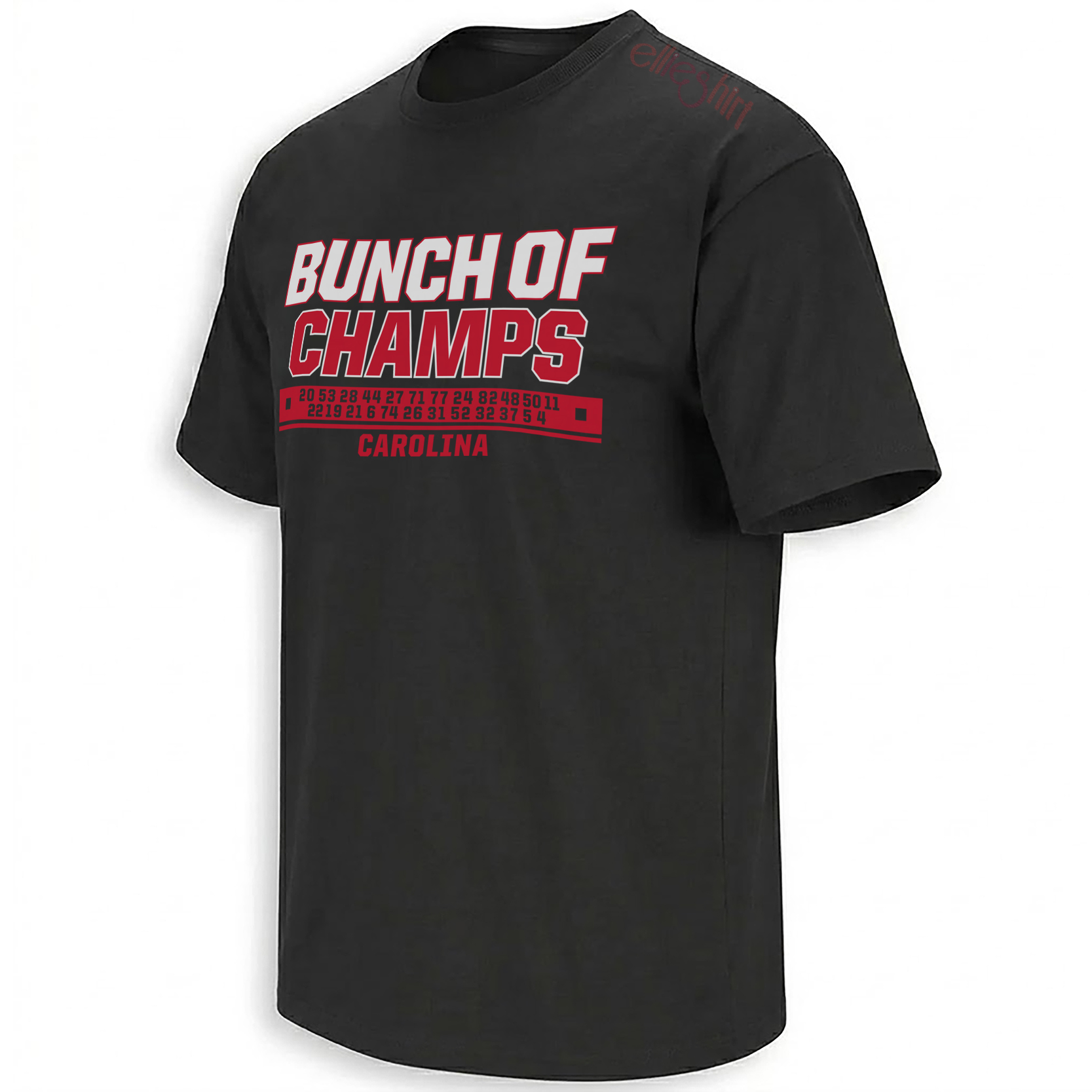
That is the cultural logic behind “Bunch of Champs.” The phrase is playful, almost casual, but the image beneath it is serious. It presents Carolina’s stars and personalities as a connected group rather than isolating one face above the rest.
The result is less like a traditional team photograph and more like a celebratory hockey collage—the type of graphic that appears after a roster has stopped being a collection of players and become one permanent championship unit.
Carolina had one Conn Smythe winner, but the Cup belonged to a group that kept producing a different champion whenever the moment required one.
The Final Had Heroes, but the Season Had a Team
Championship storytelling naturally narrows. A long postseason becomes a handful of moments because those are the images fans can carry most easily.
Staal scoring in five straight Final games became one story. Bussi taking over the crease and winning three consecutive starts became another. Hall opening the scoring in Game 6, Blake adding the second goal and Ehlers placing the final puck into an empty net became the clean sequence that completed the run.
The complete season was wider. Sebastian Aho remained central to Carolina’s attack. Andrei Svechnikov supplied force and scoring pressure. Seth Jarvis brought pace, personality and the energy of the franchise’s younger core.
Jaccob Slavin gave the defense its calm center. Shayne Gostisbehere moved the puck. Jordan Martinook carried veteran urgency. Logan Stankoven and Jackson Blake gave the lineup youthful directness. Every layer created another problem for an opponent trying to solve the Hurricanes.
The graphic treats those faces as parts of the same visual field because the championship had already done the same thing to their careers. Whatever came before, they were now members of one Cup-winning team.
Why “Bunch of Champs” Fits This Roster
The phrase succeeds because it avoids the polished tone of an official championship slogan. “Bunch of Champs” sounds like something said inside a group chat, beneath a celebration photo or among fans still processing how many players created important moments.
“Bunch” suggests informality. It describes people gathered together rather than arranged by status. “Champs” removes the need for explanation. Once the Cup has been won, every face inside the group shares the same title.
That combination fits Carolina’s culture. The Hurricanes’ identity was built around connected pressure rather than hierarchy. Even when one player became the headline, the team rarely stopped looking like a complete system.
The wording also captures the emotional transformation that occurs after a championship. During the season, fans debate individual performance. After the final horn, those separate arguments temporarily collapse. The roster becomes one victorious group.
“Bunch of Champs” is intentionally less formal than “Stanley Cup Champions.” It turns an official achievement into fan language—the affectionate way supporters describe a collection of personalities who have just become permanently linked.
The Collage Feels Like the Celebration After the Photograph
Official team photographs are built around order. Players are arranged in rows. The trophy occupies the center. Everyone faces the same direction so the image can function as a permanent historical record.
The Bunch of Champs design uses a different visual logic. The faces overlap. Expressions and poses carry different energies. The composition feels crowded because championship emotion is crowded.
Players do not experience the first minutes after winning in neat rows. They collide along the boards, search for teammates, raise their arms, disappear inside group embraces and move through a ceremony that keeps producing new combinations of people.
The collage translates that atmosphere into a printable frame. It resembles the wall of screenshots, close-ups and celebration images that begins forming online before the Cup has finished moving through the roster.
Rather than documenting one exact second, the artwork combines multiple forms of championship presence into one collective memory.
Jordan Staal Gave the Bunch Its Captain
A collective championship can still have an emotional center. Staal became that figure through the timing of his production and the length of his relationship with Carolina.
His goals in the first five games of the Final turned the captain into the series’ recurring answer. He was not producing empty scoring after the outcome had been settled. His goals arrived while the Cup was still being contested.
The Conn Smythe Trophy gave the postseason a recognized MVP, but Staal’s importance extended beyond the award. He had lived through the seasons when Carolina was rebuilding, the years when playoff qualification became normal again and the repeated runs that stopped before the Final.
When he received the Cup in 2026, the image carried all of those earlier endings inside it.
In the collage, Staal does not need to be separated from the group to remain central. The captain’s meaning comes from his place inside it.
Aho, Svechnikov and Jarvis Carried the Core
Carolina’s offensive identity was not built overnight. Aho and Svechnikov had already become foundational pieces of the franchise before 2026, while Jarvis increasingly represented its current energy and future.
Aho supplied intelligence, movement and the ability to influence the game beyond raw scoring. Svechnikov brought a more physical form of danger, capable of changing the emotional temperature of a shift through contact or individual attack.
Jarvis added speed, timing and a personality that supporters could easily embrace. Together, the three represented different versions of what a Hurricanes forward could be.
Their presence in the collage gives the design continuity. These are not random players assembled only because the team won. They are recognizable faces of the competitive era that had been building toward the championship.
The Cup completed the argument around the core. Years of potential and repeated postseason appearances finally produced the result that would define the group historically.
The captain and Conn Smythe winner gave the Final its recurring scoring story and its deepest veteran emotion.
Carolina’s cerebral offensive center remained one of the players through whom the team’s attacking identity was organized.
Power, scoring threat and physical urgency made Svechnikov one of the most immediate visual personalities in the group.
Jarvis carried the speed, personality and next-generation energy of a championship core built to extend beyond one season.
Hall’s First Cup Added a Career Story to the Group
Taylor Hall entered the championship with a career that had already moved through multiple cities, expectations and reinventions.
His place in Carolina’s run therefore carried a different kind of emotion from the players who had developed primarily inside the organization. The Cup did not complete one uninterrupted franchise journey. It gave a long and winding individual career its championship destination.
Hall’s opening goal in Game 6 made that story part of the clinching night itself. He did not simply participate in the roster celebration after the result. He scored the goal that allowed Carolina to begin controlling the final game.
That contribution is exactly why a collage works. It allows players with different relationships to the franchise to occupy the same championship space.
The homegrown core, veteran captain, recent additions and breakout performers all become equally entitled to the word “champs.”
Jackson Blake Represented the Fearlessness of the New Group
Blake’s goal and assist in Game 6 gave the clinching performance a clear younger voice. The stage did not shrink his game or push him toward caution.
Championship teams need players who understand the stakes, but they also benefit from players young enough to attack the moment without carrying every previous disappointment.
Blake supplied that directness. His contribution reinforced the idea that Carolina’s title was not only the end of a long organizational wait. It was also the beginning of a new set of player memories.
In the collage, younger players stand beside the veterans whose careers had accumulated far more playoff history. The visual equality captures one of the Cup’s most democratic effects: once the team wins, age and résumé no longer determine who can claim the championship.
Brandon Bussi Became the Unexpected Champ in the Frame
No player changed his place in Carolina’s championship story more dramatically during the Final than Bussi.
He entered the series outside the main narrative, then became the starting goaltender for the final three victories. By Game 6, the unlikely adjustment had become one of the central reasons Carolina could close the series in Las Vegas.
His 22-save shutout gave the final game a clean ending. Vegas never found the goal that could have changed the crowd, created uncertainty or forced Carolina to protect a one-score lead through the last minutes.
Bussi’s story demonstrates why “bunch of champs” is more accurate than a design limited only to the most famous names. Playoff identity is fluid. The player outside the spotlight in one round can become essential in the next.
A championship collage creates room for that unpredictability. It acknowledges that history does not always choose its heroes in advance.
Slavin and the Defense Made the Group Hold Together
Offensive players naturally supply the most visible celebration imagery, but Carolina’s dominance was inseparable from the defensive structure behind them.
Slavin remained the calm center of that structure. His positioning allowed the Hurricanes to defend aggressively without turning every mistake into a crisis. The rest of the defense supported the same identity through puck movement, recovery and the ability to prevent opponents from controlling dangerous areas.
That work becomes especially important in understanding Bussi’s shutout. A goaltender makes the saves, but the entire team influences which shots are available, where rebounds travel and whether second chances develop.
The group image therefore carries an unspoken tactical meaning. Carolina’s stars did not simply coexist. Their roles fit together.
Rod Brind’Amour Built a Team That Looked Like a Team
Brind’Amour’s championship story had its own historic symmetry. He captained Carolina to the Cup in 2006 and coached the franchise back to it twenty years later.
His greatest coaching achievement, however, may have been creating a team whose collective identity remained visible even when personnel or circumstances changed.
The Hurricanes could lose a game without looking strategically lost. They could change goaltenders without abandoning the defensive structure. Different forward lines could contribute without forcing the team to reinvent itself around the latest scorer.
That continuity explains the 16–3 record better than any single highlight. Carolina repeatedly forced opponents to solve the same connected pressure, and few found an answer before the series was already moving away from them.
“Bunch of Champs” may sound casual, but the group was anything but accidental. It was the result of years spent building a repeatable hockey identity.
Why the Design Feels Closer to a Bootleg Team Tee
The composition draws from the tradition of crowded sports and music graphics in which multiple faces are layered into one central block.
This visual style often appears in vintage championship apparel, unofficial arena merch and bootleg-inspired streetwear because it can hold more personality than a single clean logo.
The faces give the shirt a human density. The title supplies the immediate fan language. Red, black and white keep the artwork connected to Carolina while allowing skin tones, uniforms and expressions to create variation inside the group.
The design does not attempt the perfect spacing of an official roster photograph. Its energy comes from accumulation. Every additional face makes the championship feel larger and more crowded.
That is appropriate for a moment remembered through overlapping celebrations, camera angles and player stories.
One Image Cannot Include Every Contributor
A collage necessarily selects. It cannot function as a complete official roster, nor should it be read as a ranking of whose contribution mattered most.
Its purpose is symbolic. The featured faces represent the wider Carolina group—the forwards, defensemen, goaltenders, coaches and support system attached to the Cup run.
That distinction matters because championship culture can easily narrow too far around visible stars. The official roster remains the complete historical record. The graphic creates a fan-facing emotional summary.
“Bunch of Champs” is therefore best understood as a team portrait in cultural shorthand: several recognizable personalities standing in for the collective that won.
Raleigh Received a New Generation of Championship Faces
For twenty years, Carolina’s championship memory was anchored to the players from 2006. Those faces became part of the visual architecture of the franchise.
The 2026 team now creates a second gallery. Younger fans have a championship group they watched themselves. Longtime supporters can place new images beside the old ones without asking either era to replace the other.
That is one reason team-collage designs can become emotionally durable. They recover more than a logo or date. They recover how the roster looked together before trades, retirements and time began separating its members.
The wider Carolina Hurricanes collection follows that championship generation through captain stories, roster graphics, Raleigh rituals and the fan phrases created throughout the 2026 run.
The broader NHL Shirts collection places Carolina’s team collage inside hockey’s larger visual tradition of Cup heroes, championship lineups and the graphics through which supporters preserve a postseason.
Why “Bunch of Champs” Will Change With Time
Immediately after the championship, every face in the collage feels current. Fans have recently watched the players, debated the lines and followed every shift of the Final.
Years later, the graphic will work differently. One face may recall a Conn Smythe run. Another may retrieve an unexpected shutout, a Game 6 goal or a player whose Carolina tenure was shorter than fans expected.
The design will remain crowded even as memory begins assigning each person a different level of prominence.
That tension gives the piece its archival value. It preserves the roster before history reduces the championship to only its largest names.
For one season and one final celebration, they were all simply a bunch of champs.
Frequently Asked Questions
What does “Bunch of Champs” mean in the Carolina Hurricanes design?
The phrase presents Carolina’s recognizable players as one informal championship group, emphasizing the complete team identity behind the 2026 Stanley Cup.
When did the Carolina Hurricanes win the 2026 Stanley Cup?
Carolina clinched the championship on June 14, 2026, with a 3–0 victory over the Vegas Golden Knights in Game 6, completing a 4–2 series win.
What was Carolina’s record in the 2026 Stanley Cup Playoffs?
The Hurricanes completed the postseason with a 16–3 record, losing only three games across all four rounds.
Who won the Conn Smythe Trophy for Carolina?
Hurricanes captain Jordan Staal received the Conn Smythe Trophy after scoring in the first five games of the Stanley Cup Final and leading the team’s championship run.
Who scored in the championship-clinching Game 6?
Taylor Hall, Jackson Blake and Nikolaj Ehlers scored in Carolina’s 3–0 victory over Vegas.
Who recorded the Game 6 shutout?
Brandon Bussi stopped all 22 shots he faced, completing Carolina’s championship with his first career playoff shutout.
Is the graphic intended as a complete official roster?
No. It is a fan-facing team collage featuring recognizable Carolina personalities and should be read as a symbolic group portrait rather than a complete official roster.
Why does the collage style fit a championship team?
The overlapping faces recreate the crowded energy of locker-room celebrations, online photo collections and the many individual stories that merge after a team wins the Cup.
The Bunch of Champs design gathers the recognizable faces of Carolina’s 2026 run into one celebration frame, while the wider Hurricanes championship archive follows the captain, roster, Raleigh rituals and fan language behind the franchise’s second Stanley Cup.
Bunch of Champs Shirt captures the Carolina Hurricanes’ 2026 Stanley Cup through a crowded team collage celebrating Jordan Staal, Sebastian Aho, Andrei Svechnikov, Seth Jarvis and the complete group behind a dominant 16–3 postseason.