From Captain to Coach: Rod Brind’Amour’s Two Carolina Stanley Cups
In 2006, Rod Brind’Amour raised the Stanley Cup wearing Carolina’s captain’s “C.” Twenty years later, he watched a new Hurricanes captain receive the trophy before lifting it again as the coach who had carried the franchise back to the summit.
The final seconds in Las Vegas did more than confirm Carolina’s second championship. They completed one of the most unusual full-circle stories in modern hockey: the captain who defined the Hurricanes’ first Stanley Cup had become the coach responsible for shaping the team that won the next one.
Carolina defeated the Vegas Golden Knights 3–0 in Game 6 on June 14, completing a 4–2 Stanley Cup Final victory and ending a twenty-year wait. The result belonged to Jordan Staal, Brandon Bussi and the entire 2026 roster, but the historical bridge between the two Cups belonged unmistakably to Brind’Amour.
He did not merely return to an old celebration in a different suit. He had spent the years between the championships embedded inside the organization—as a former player, assistant coach, head coach and cultural standard for what Hurricanes hockey was supposed to feel like.
That is why “2X Champion” carries more meaning here than a simple title count. The two championships came through two different forms of leadership. One was earned inside the game as captain. The other was built around the game as coach.
In 2006, Brind’Amour showed Carolina how a captain raises the Cup. In 2026, he built the team that could raise it again.
The First Cup Became Carolina’s Founding Hockey Memory
The Hurricanes’ 2006 championship established the central image of the franchise’s early history. Brind’Amour, already known for conditioning, defensive responsibility and relentless preparation, received the Stanley Cup and lifted it with a rawness that became instantly recognizable.
It was not a polished ceremonial gesture. He grabbed the trophy, raised it quickly and turned the moment into a release of everything the playoff run had demanded.
That image became inseparable from Carolina hockey. For twenty years, it appeared in anniversary packages, arena montages and the family stories through which older supporters explained the franchise’s greatest night to younger fans.
Brind’Amour’s captaincy mattered because it represented the identity Carolina wanted to claim: hard to play against, physically prepared, defensively committed and unwilling to separate skill from labor.
The 2006 Cup therefore belonged to an entire roster, but the captain’s lift gave the championship its enduring human symbol.
Twenty Years Later, the Same Franchise Needed a Different Kind of Leadership
A captain can influence a game through shifts, faceoffs, matchups and physical example. A coach has to create the environment in which hundreds of those decisions begin to resemble one coherent identity.
Brind’Amour’s transition from player to coach therefore required more than carrying old standards into a new role. He had to translate the habits that defined him into systems, expectations and daily accountability for players with different personalities.
When he became Carolina’s head coach in 2018, the Hurricanes had missed the playoffs for nine consecutive seasons. His first team immediately returned to the postseason and reached the Eastern Conference Final.
What followed was not one short burst of success. Carolina became a consistent playoff presence. The forecheck, conditioning, defensive structure and collective work rate became recognizable even when individual players changed.
The years without another Cup still created pressure. Strong regular seasons and deep playoff runs eventually stop being viewed as progress if the final breakthrough never arrives. By 2026, the Hurricanes were not being asked whether they were competitive. They were being asked whether Brind’Amour’s model could finish the journey.
The captain could embody Carolina’s identity through his own performance. The coach had to make that identity repeatable across an entire roster, season after season, until it finally produced another championship.
Why “From Captain to Coach” Is the Real Story
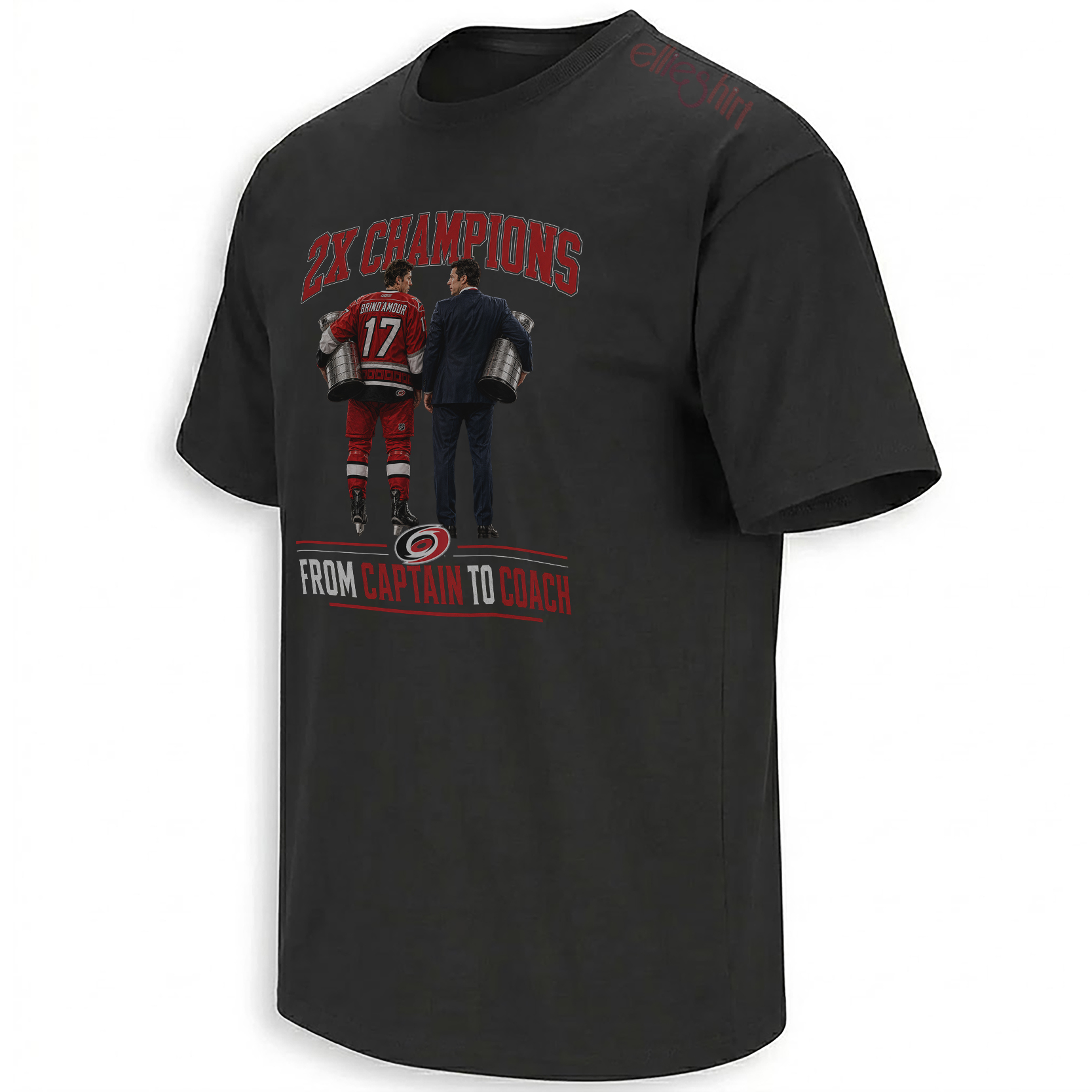
The strongest element of the first design is not simply the number two. It is the visual transition between roles.
One side presents Brind’Amour inside the physical mythology of the player: uniform, equipment, competition and the Cup held close to the body. The other places him in the visual language of coaching, where leadership is expressed from behind the bench rather than through possession of the puck.
The Stanley Cup connects the two figures, but their relationship to it has changed. In 2006, Brind’Amour helped win it through direct action on the ice. In 2026, he built the structure that allowed other players to create the decisive actions.
The design therefore works like a before-and-after image without implying that one version replaced the other. The captain remains present inside the coach. The values associated with the player became the standards associated with the team.
“From Captain to Coach” is not merely a career timeline. It explains why the second Cup felt connected to the first while still belonging completely to the 2026 roster.
The Second Design Turns the Story Into an Icon
The second 2X Champion design approaches the same legacy with less narrative detail and greater visual concentration.
Brind’Amour appears as the central figure with the Stanley Cup held near his body, allowing the image to recall the physical intimacy of a player’s trophy lift even while the championship context recognizes his role as coach.
The “2X Champion” typography acts as a simple historical marker. Rather than explaining the twenty-year journey, it invites the viewer to supply the memory: 2006 as captain, 2026 as coach.
That compression gives the artwork the feeling of an icon or championship portrait. The first piece tells the complete transformation. The second captures the emotional result of that transformation in one concentrated frame.
Two versions of Brind’Amour frame the complete twenty-year arc from Carolina’s first Stanley Cup to its second.
Explore the dual-era graphic →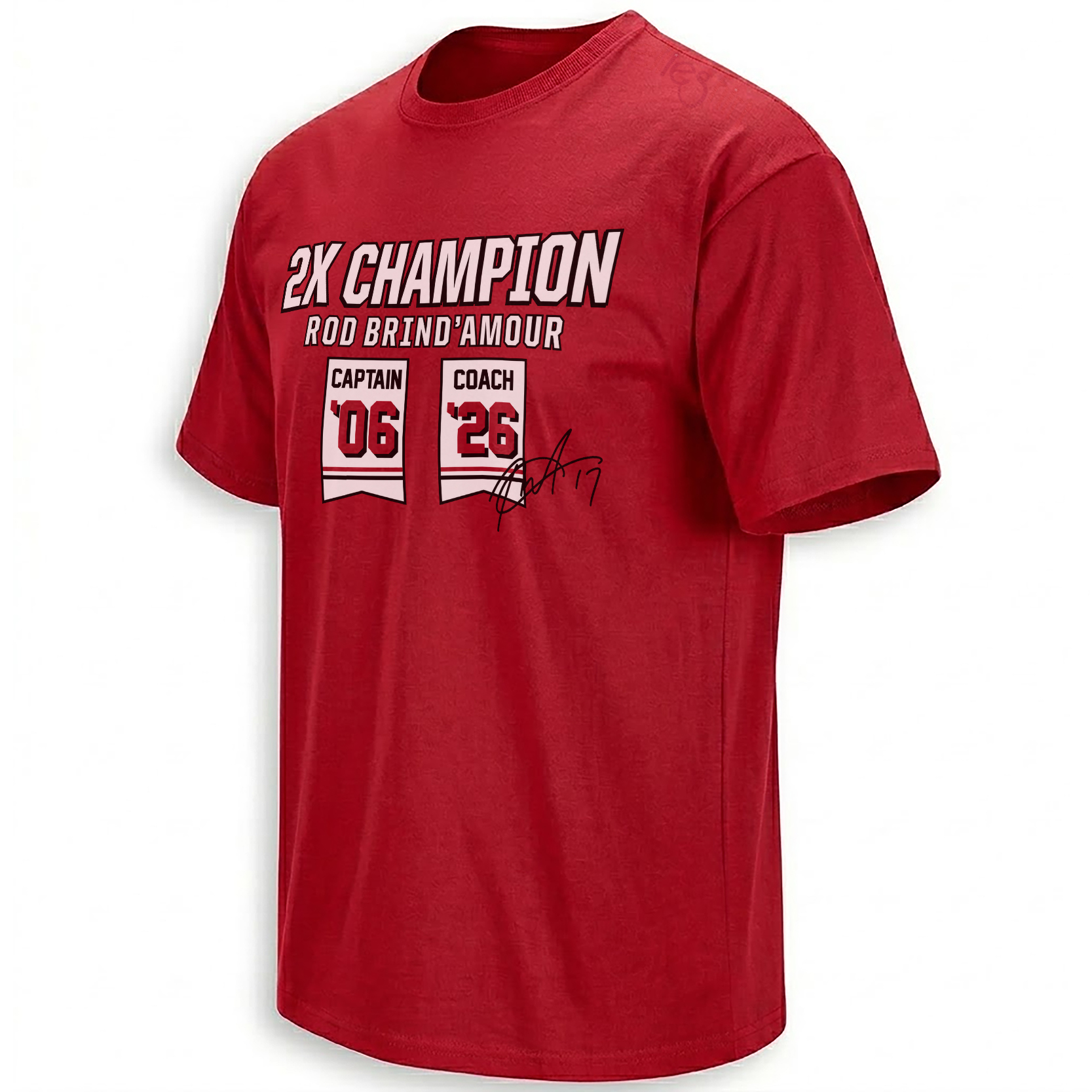
A concentrated trophy image turns Brind’Amour’s captain-to-coach achievement into one championship icon.
View the championship portrait →The 2026 Cup Did Not Simply Repeat 2006
Full-circle sports stories can become too neat when the second event is treated as a replica of the first. Carolina’s 2026 title was powerful precisely because it did not reproduce the old championship.
Jordan Staal was the captain and Conn Smythe winner. Brandon Bussi emerged as the unexpected goaltending figure. Sebastian Aho, Andrei Svechnikov, Seth Jarvis, Taylor Hall, Jackson Blake and the rest of the roster created their own sequence of defining moments.
Brind’Amour’s importance was not that he remained the central player. It was that he had created space for a new captain and a new team to become the center of the story.
That is one of the clearest differences between leadership on the ice and leadership behind the bench. The captain often has to become visible at the decisive moment. The coach succeeds when the players are prepared to own that moment themselves.
When Staal lifted the Cup first, the gesture confirmed that the championship belonged to the current team. When Brind’Amour eventually held it again, the history of the franchise entered the frame.
The Trophy Lift Connected the Two Eras Instantly
After Carolina secured the 2026 championship, Brind’Amour recreated the forceful Cup lift associated with 2006. The gesture gave the internet and broadcast coverage an immediate split-screen comparison.
The visual worked because the body remembers what the official record cannot express. The face was older. The role had changed. The suit replaced the uniform. But the emotional release remained recognizable.
Fans did not need a long explanation to understand the symmetry. One image showed the captain who had completed Carolina’s first championship. The other showed the coach who had spent years attempting to give the franchise another one.
Those paired images are likely to become one of the most durable visual records of the 2026 title. They transform twenty years into a single comparison and make the distance between the championships visible through one person.
Both shirt designs draw from that instant recognition. The Cup is not simply a trophy beside Brind’Amour. It is the object through which two versions of his Carolina identity can communicate.
Brind’Amour Became One of Hockey’s Rarest Same-Franchise Champions
Winning the Stanley Cup as both player and coach is already rare. Doing it with the same franchise creates an even narrower historical category.
Brind’Amour became the fourth person in NHL history to win as a player and head coach with the same organization. His achievement is even more specific because his playing title came as captain, giving him a leadership role at the center of both championship teams.
The distinction matters because it confirms how deeply his career has become attached to Carolina. He is not simply a former star who returned for a ceremonial role or a coach hired because of nostalgia.
He participated in the franchise’s identity from multiple levels. He helped establish the standard as a player, supported the organization as an assistant and then accepted responsibility for the entire competitive direction as head coach.
The two Cups are separated by twenty years, but the organizational relationship between them never fully broke.
Brind’Amour led from inside the game, carrying difficult matchups, physical responsibility and the emotional authority of the captaincy.
He led through systems, preparation and culture, creating the conditions for Staal and the current roster to finish the journey.
Conditioning, accountability and collective work remained central to Carolina’s identity across both eras.
The second championship honored the past without removing the agency of the players who created the new Cup run.
Jordan Staal Made the Leadership Line Feel Complete
The captain-to-coach narrative gains additional depth through Jordan Staal. He was not merely the player who accepted the Cup before Brind’Amour. He had spent years carrying the current version of Carolina’s leadership culture.
Staal’s six goals in the Stanley Cup Final and his Conn Smythe Trophy gave the championship a current captain worthy of standing beside the franchise’s most famous former one.
The relationship also prevented the 2026 celebration from becoming overly focused on Brind’Amour’s past. The coach’s history gave the moment context; Staal’s performance gave it a present.
One captain had become the coach. Another captain had become the playoff MVP. The Stanley Cup passed between the two roles, connecting leadership across generations without confusing who had earned the current title on the ice.
For Hurricanes supporters, that handoff may become as meaningful as either individual lift.
Why Raleigh Reads Brind’Amour Differently From a Typical Coach
Most coaches are judged primarily through results, tactical decisions and the immediate direction of the roster. Brind’Amour occupies a more layered place in Raleigh because supporters had already watched him establish his credibility before he ever stood behind the bench.
His number was retired. His 2006 Cup lift remained part of the arena’s emotional architecture. Fans knew the physical standards he represented as a player and could recognize those standards when they began appearing in the teams he coached.
That familiarity creates unusual trust, but it also creates unusual pressure. A franchise legend can be protected by nostalgia only for so long. Eventually, the coach has to be evaluated through what the current team accomplishes.
The 2026 championship settled the central question. Brind’Amour had not simply preserved the memory of Hurricanes hockey. He had built a modern version capable of creating new history.
The Design Language Treats Twenty Years Like One Continuous Frame
Both graphics use red, black and white to keep the story inside Carolina’s visual identity, but the emotional power comes from the relationship between body, trophy and time.
In the captain-to-coach composition, the paired figures create a visual timeline without requiring a traditional list of dates. The viewer understands that the younger figure belongs to the first championship and the older figure belongs to the second.
The Cup creates continuity between them. It appears as the goal of both roles and the physical object that confirms the transformation.
The portrait version removes the timeline and concentrates on legacy. Its image is less explanatory and more emblematic, presenting Brind’Amour as a two-time Carolina champion whose relationship with the trophy now spans most of the franchise’s modern history.
One design works like an editorial spread. The other works like a championship poster.
Why “Champion” and “Champions” Can Both Work Here
The singular phrase “2X Champion” focuses on Brind’Amour as one person who has won two Stanley Cups with Carolina in different roles.
The plural phrase “2X Champions” can work as a headline-style celebration of the two championship versions shown in the graphic—the captain-era Brind’Amour and the coach-era Brind’Amour—or as shorthand for the Hurricanes’ status as two-time champions.
Grammatically, “2X Champion” is the cleaner description when the subject is Brind’Amour alone. “2X Champions” has a broader poster quality when the design visually presents two eras or points toward the franchise’s two championship teams.
The two product concepts therefore use similar language for different visual purposes. The singular version reads as an individual achievement. The plural version reads as a dual-era celebration.
The Internet Saw the Full Circle Before the Celebration Ended
Championship nights naturally generate comparisons, but Brind’Amour’s story supplied one that required almost no invention. The 2006 footage was already iconic, and the 2026 Cup lift created a matching image immediately.
Across hockey coverage and fan spaces, the reaction centered on the symmetry: same franchise, same trophy, different role and exactly twenty years between the titles.
The comparison also carried emotional credibility because Brind’Amour had remained connected to the organization throughout much of the distance between the Cups. This was not a star returning briefly to participate in a reunion.
The journey had been visible through playoff breakthroughs, repeated disappointments and the growing expectation that Carolina’s consistency eventually needed to become a championship.
When the Cup finally returned, the old image and the new image did not compete. They completed each other.
Carolina’s Two Championships Now Form a Living Timeline
Before 2026, the Hurricanes’ Stanley Cup history could be represented through one completed journey. The new title changes the shape of the archive.
The franchise now has two championship generations: the 2006 group that established Raleigh’s place in hockey and the 2026 group that proved the first title was not an isolated memory.
Brind’Amour belongs to both, but differently. That distinction allows him to serve as the connecting figure without reducing either roster to a supporting role in his personal story.
The wider Carolina Hurricanes collection now reads like a growing visual archive of those two eras, connecting the captain’s legacy with the current roster, Raleigh rituals and the championship language created during the 2026 run.
The broader NHL Shirts collection places Brind’Amour’s story inside hockey’s larger culture of Cup captains, championship coaches and the rare figures whose identities become inseparable from one franchise.
Why This Story Will Outlast the Immediate Celebration
Most championship details eventually narrow in public memory. Individual shifts disappear. Tactical decisions become less visible. Even complete series can be compressed into one score and one photograph.
Brind’Amour’s captain-to-coach story is likely to remain because its structure is so clear. A supporter does not need to remember every game to understand the achievement.
He led Carolina to its first Stanley Cup from the ice. Twenty years later, he led the franchise to its second from the bench.
The two designs preserve that story at different levels. One shows the transformation. The other preserves the icon.
Together, they turn “2X Champion” from a numerical claim into a map of how leadership can change form while remaining attached to the same city, franchise and trophy.
Frequently Asked Questions
When did Rod Brind’Amour win his first Stanley Cup with Carolina?
Brind’Amour captained the Carolina Hurricanes to their first Stanley Cup championship in 2006.
What was Rod Brind’Amour’s role in Carolina’s 2026 championship?
He was the Hurricanes’ head coach, guiding the team to a 4–2 Stanley Cup Final victory over the Vegas Golden Knights.
Why is Brind’Amour described as a 2X champion?
He won the Stanley Cup twice with Carolina in different leadership roles: as team captain in 2006 and as head coach in 2026.
How rare is it to win the Stanley Cup as a player and coach for the same franchise?
Brind’Amour became the fourth person in NHL history to win the Stanley Cup as both a player and head coach with the same franchise.
Why does the 2026 Cup lift connect so strongly to 2006?
Brind’Amour recreated the forceful lifting gesture associated with his first championship, giving fans an immediate visual comparison between his captain and coaching eras.
Should the phrase be “2X Champion” or “2X Champions”?
“2X Champion” is grammatically cleaner when referring to Brind’Amour as one person. “2X Champions” can work as poster language for the paired captain-and-coach imagery or Carolina’s two championship eras.
What do the two Rod Brind’Amour designs represent?
The captain-to-coach design shows the full twenty-year transformation, while the 2X Champion portrait compresses both Stanley Cup achievements into one iconic image.
The From Captain to Coach design and 2X Champion portrait preserve two sides of Rod Brind’Amour’s Hurricanes legacy, while the wider Carolina championship archive follows the players, rituals and memories connecting 2006 to 2026.
Rod Brind’Amour 2X Champion designs connect Carolina’s 2006 and 2026 Stanley Cups, preserving his rare transformation from Hurricanes championship captain to championship coach.