
The Knicks’ 2026 Domination Tour: Every Stop on the Road to a Championship
Atlanta tested them. Philadelphia and Cleveland were swept aside. San Antonio forced five Finals games into late pressure. By the end, every date, city and score looked less like a bracket and more like the set list from New York’s longest-awaited victory tour.
The New York Knicks finished the 2026 postseason with a 16–3 record, but the clean total hides how many different versions of the team were required to reach it. They were tested in Atlanta, overwhelming against Philadelphia, ruthless against Cleveland and repeatedly forced into late-game survival against San Antonio.
The final destination arrived on June 13. New York defeated the Spurs 94–90 in Game 5, closed the NBA Finals 4–1 and ended a 53-year championship wait. Jalen Brunson scored 45 points in the clincher, but the larger postseason record had already been written across four cities and nineteen games.
That geography is what makes “Domination Tour” such a natural frame. A tour shirt does not preserve only the final show. It records where the journey traveled, when each stop happened and what the audience witnessed there. New York’s playoff opponents become destinations. Dates become performances. Scores become receipts.
“Domination” Did Not Mean Every Night Was Easy
The word suggests blowouts, but New York’s run was more interesting than a sequence of comfortable victories. Atlanta took a 2–1 lead in the opening round. The Finals produced five games that remained within one possession during the final two minutes. The Spurs built double-digit advantages in every game New York eventually won.
The domination came from accumulation. The Knicks kept finding the next answer. They adjusted after early trouble, won eleven consecutive playoff games through the middle of the bracket and repeatedly recovered when the Finals appeared to be moving away from them.
In that sense, the tour name describes control over the complete route rather than every individual quarter. Different opponents interrupted the rhythm, but none changed the destination.
One Ending
Atlanta created the first conflict. Philadelphia accelerated the run. Cleveland transformed momentum into inevitability. San Antonio supplied the final resistance.
Read together, the rounds resemble four movements in the same tour: survival, acceleration, authority and completion.
Stop One: Atlanta Turned the Opening Round Into a Test
New York did not begin the postseason by moving smoothly through the bracket. Atlanta forced six games and held a 2–1 series advantage after three. For a team carrying championship expectations, the first week of the playoffs immediately demanded a response.
The Knicks answered with three consecutive victories. The sequence changed the emotional direction of the postseason. Instead of allowing one difficult road series to expose uncertainty, New York used the pressure to establish the resilience that would later define the Finals.
The 140–89 closeout in Atlanta gave the first round an ending far more decisive than its beginning. It was the moment the tour shifted from a difficult opening act into something capable of gathering speed.
Stop Two: Philadelphia Became the Acceleration Point
The second round changed the tone. New York swept Philadelphia in four games, scoring 137 points in the opener and 144 in the closeout. The series reduced the uncertainty created by Atlanta and replaced it with the visual language of momentum.
Sweeps carry a special cultural force because they compress an entire matchup into one clean statement. There is no return trip, no prolonged argument and no need for a deciding night. Philadelphia became the stage where the Knicks’ postseason stopped looking merely durable and started looking expansive.
On a tour schedule, those four dates appear close together. That density reflects how quickly New York moved through the round and toward a conference final that had once seemed much farther away.
Stop Three: Cleveland Turned Momentum Into Authority
Cleveland presented the final Eastern Conference obstacle, but the result followed the same four-game pattern. New York swept the series, extended its winning streak to eleven and returned to the NBA Finals for the first time since 1999.
By that point, the run had developed its own rhythm. The Knicks were no longer simply responding to the bracket. They were imposing continuity across matchups. The opponents changed, yet the defensive pressure, late-game confidence and layered scoring kept traveling.
Cleveland therefore functions as the tour’s arena-sized breakthrough: the point where the audience realizes the show is no longer building toward relevance. It has already become the central event.
Final Stop: San Antonio Made New York Earn Every Line
The Finals did not resemble the previous two sweeps. San Antonio’s youth, length and speed forced New York into five closely contested games. Victor Wembanyama altered the geometry of the floor, while the Spurs repeatedly created early advantages.
Yet the Knicks continued to recover. Their four Finals victories included comebacks from double-digit deficits, most dramatically the 29-point reversal in Game 4. Game 5 then required another second-half response before Brunson’s 45-point performance closed the season.
San Antonio was not a ceremonial final date. It was the opponent that made the entire route feel earned. The last line on the back of the shirt carries the smallest final score of the run—94–90—but the largest consequence.
New York recovered from a 2–1 deficit, won three straight and closed the series with a 140–89 road victory.
Series won 4–2Four consecutive wins transformed early postseason tension into a full-speed championship push.
Series won 4–0Another sweep extended the Knicks’ winning streak to eleven and secured their first Finals appearance since 1999.
Series won 4–0Five pressure-filled games ended with Brunson’s 45 points, a 94–90 clincher and New York’s first championship since 1973.
Series won 4–1The Domination Tour Graphic Turns the Bracket Into Music Culture
The Domination Tour Shirt borrows its structure from concert merchandise rather than traditional championship apparel. The front delivers the performer and tour identity. The back lists the dates, cities and outcomes like a schedule collected after the final show.
That crossover is culturally precise. Basketball postseason runs already operate like touring productions. Teams move between cities, perform under different crowds and build a story through repeated appearances. Fans track dates and locations with the same intensity that music audiences remember which stop they attended.
The graphic simply makes that relationship visible. New York is the headline act. The playoff bracket is the route. The championship is the sold-out final destination.
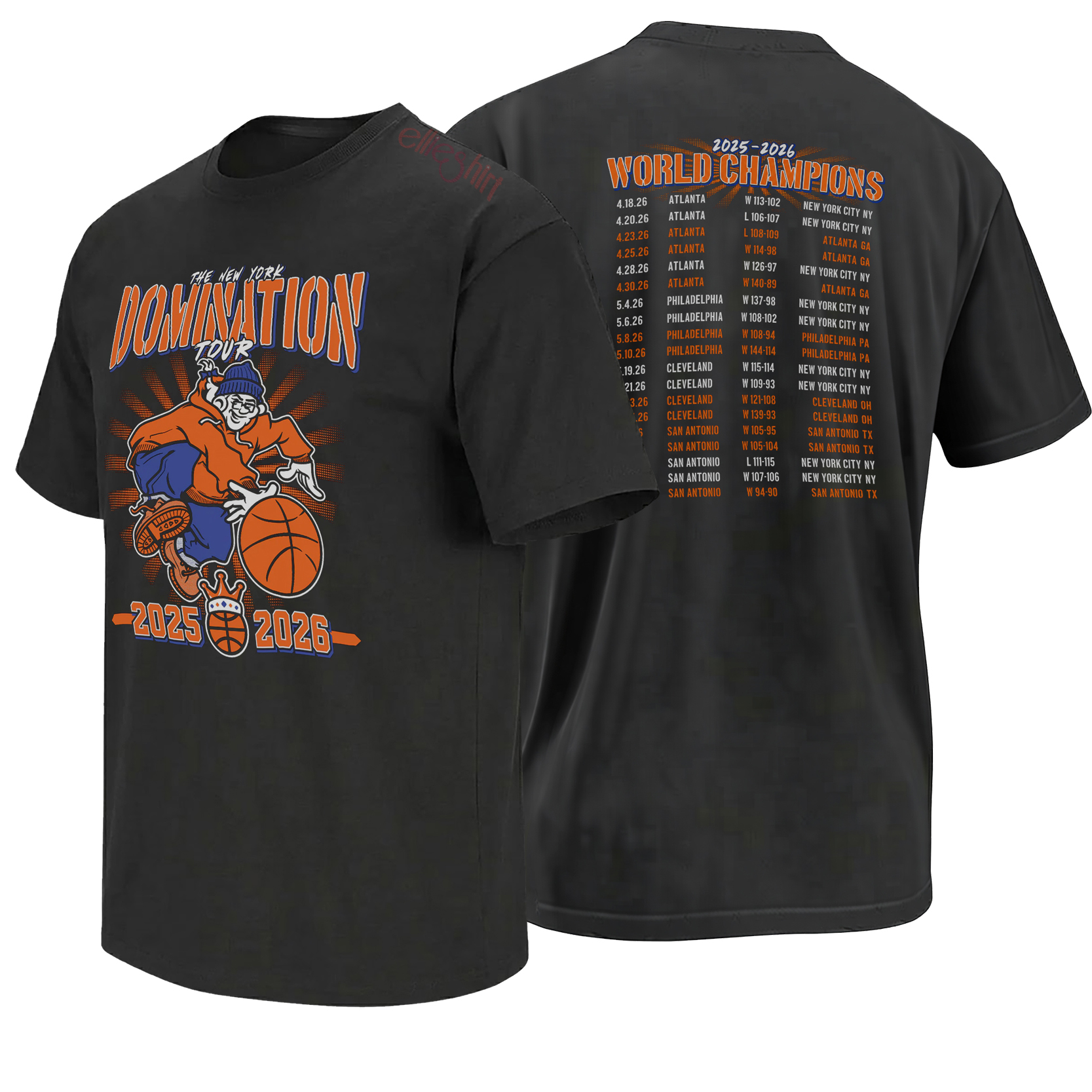
The Front Works Like a Headline Poster
The oversized “Domination” lettering arrives first. Orange fill, blue shadow and stretched athletic typography create the visual volume of a concert title printed above the central performer.
Beneath it, the New York basketball character dribbles toward the viewer with exaggerated movement. The beanie, oversized clothing and illustrated city attitude keep the artwork closer to streetwear and underground tour merch than official league branding.
The 2025–2026 season line anchors the design in time, while the crowned basketball introduces the championship destination without overwhelming the playful front composition.
The Back Is Where the Shirt Proves Its Claim
“World Champions” provides the headline, but the schedule beneath it is the real argument. Each date, opponent, result and location documents how the title was assembled one game at a time.
Wins and losses are allowed to coexist. That choice matters. A weaker championship graphic might erase the three defeats and present the run as effortless. The tour list preserves the full postseason, including the nights that required correction.
The orange-highlighted road victories stand out against the lighter home listings, producing a rhythm similar to a tour schedule where certain cities become visually important. San Antonio appears at the bottom because every route needs a final stop.

Bold tour lettering and the dribbling city character present the Knicks as the central performers of the 2026 postseason.
Open the front graphic →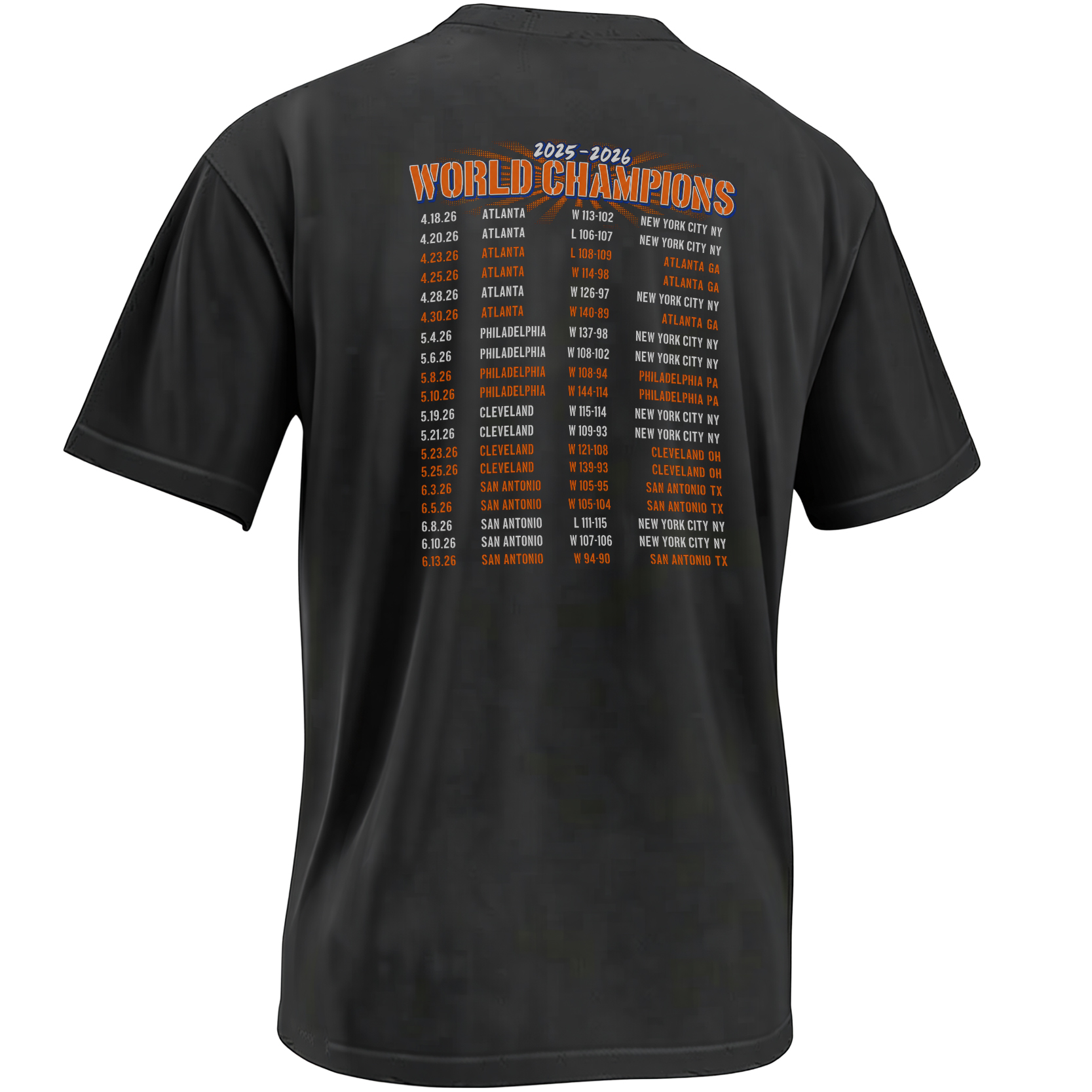
Nineteen game lines preserve the entire route rather than reducing the postseason to one final score.
Open the tour schedule →Why the Cartoon Character Fits New York’s Championship Mood
The figure on the front does not attempt to portray one specific player. That ambiguity allows it to represent the city’s basketball personality rather than a single Finals hero.
Its posture is loose, aggressive and playful. The ball is oversized. The clothing carries street-level energy. The face reads closer to an old mascot, bootleg sports character or record-store graphic than a polished corporate identity.
That visual distance from realism gives the design longevity. Brunson, Anunoby, Towns, Bridges and Hart remain central to the actual title, but the illustrated character can function as the spirit of the entire run: New York moving forward with the ball, leaning into the next city.
The Distressed Printing Makes a New Tour Feel Already Legendary
Tour merchandise becomes culturally interesting after it has aged. The print cracks, the shirt softens and the dates begin to represent memories rather than upcoming events. This design imitates that future state immediately.
The distressed orange and blue lettering makes the graphic feel recovered from an earlier era of arena merchandise. That treatment is especially effective for a Knicks championship because the new title arrives carrying fifty-three years of old imagery, old stories and inherited expectation.
The result is a graphic that records June 2026 while visually suggesting an object fans might still be discussing decades later.
Stretched lettering and layered shadows borrow the volume of vintage concert posters and arena merchandise.
The dribbling figure represents New York’s basketball attitude without reducing the championship to one individual player.
Dates, scores and cities transform the back into a factual road map of the entire postseason.
The Back Includes Losses Because Real Tours Have Difficult Nights
Three defeats appear in the postseason listing: two against Atlanta and one against San Antonio. Their presence strengthens the design rather than weakening the word “Domination.”
A championship route is not meaningful because nothing goes wrong. It becomes meaningful because the team survives when something does. Atlanta’s early advantage forced the Knicks to establish their response. San Antonio’s Game 3 victory and repeated Finals leads required New York to prove that momentum could be recovered.
Keeping those losses on the shirt protects the emotional truth of the run. The back is not a fantasy schedule. It is the record of how domination was achieved through recovery.
Six wins over Atlanta and Philadelphia established the route. Eight consecutive victories across Philadelphia and Cleveland created separation. Four Finals wins against San Antonio completed the title. Every line adds evidence to the same claim.
From 1999 Return to 2026 Completion
Cleveland marked the Knicks’ return to the NBA Finals for the first time since 1999. That historical gap gave the final stages of the run an additional emotional weight. New York was not simply moving into the championship round; it was returning to a stage that had remained part of the city’s basketball mythology for twenty-seven years.
The 1999 team reached the Finals as an improbable eighth seed but did not complete the title. The 2026 team transformed return into resolution. Its tour did not stop at conference celebration or nostalgia. It continued through San Antonio and ended with the trophy.
That is why the final city on the back matters as much as the “World Champions” headline above it. The title did not happen in abstraction. It happened after a specific road was completed.
The Finals Made the Word “Domination” More Complicated
San Antonio led for long stretches. Every Finals game remained close late. New York had to erase double-digit deficits in each of its four wins. On the surface, that does not resemble conventional domination.
But late-game control is its own form of power. The Knicks repeatedly reached the final minutes with the necessary answer, even after the earlier portions of the game belonged to the Spurs. Their identity was not based on preventing every crisis. It was based on refusing to let a crisis determine the result.
The tour therefore ends not with an image of uninterrupted superiority, but with a more New York version of dominance: absorb the pressure, stay in the building and take control when the night becomes most important.
A Running Archive of the Knicks’ Championship Season
The wider New York Knicks Shirts collection records the title through different forms of memory. Some designs isolate Brunson’s performance, Anunoby’s Game 4 finish or a specific fan phrase. The tour concept takes the opposite approach and places the complete postseason on one route.
The broader NBA Shirts archive shows how playoff history becomes visual culture throughout the league. Scores turn into captions, rivalries into symbols and championship brackets into objects fans can revisit after the urgency has passed.
Nineteen Games Preserved Like Nineteen Tour Dates
The Knicks Domination Tour design refuses to skip directly to the trophy. Its cultural value comes from preserving the route: home dates, road dates, difficult losses, runaway wins and the final 94–90 line in San Antonio.
The front captures the posture of the run. The back records the evidence. Together they turn a playoff bracket into something closer to a tour souvenir from the season New York basketball finally reached its last stop.
Knicks Domination Tour FAQ
What does “Domination Tour” mean in the Knicks design?
It reframes New York’s 2026 playoff run as a tour through Atlanta, Philadelphia, Cleveland and San Antonio. Each game becomes a dated stop on the route to the championship.
What was the Knicks’ record in the 2026 NBA playoffs?
New York finished the postseason 16–3, defeating Atlanta in six games, sweeping Philadelphia and Cleveland, and beating San Antonio 4–1 in the NBA Finals.
Why does the back list every game instead of only the series results?
The complete schedule makes the artwork resemble a concert tour shirt and preserves the full championship route, including dates, opponents, scores, locations and the three losses New York overcame.
Why is there a cartoon basketball character on the front?
The illustrated figure represents New York basketball attitude rather than one specific player. Its movement, clothing and exaggerated style give the front the energy of vintage streetwear and music merchandise.
Why does the design call the Knicks world champions?
“World Champions” is traditional championship language used in American professional sports apparel. In this design, it marks the final status of the Knicks after winning the 2026 NBA Finals.
Atlanta, Philadelphia, Cleveland and San Antonio no longer read as separate opponents. Together they form the geography of the Knicks’ 2026 title—the sequence of cities, dates and scores that turned a long-awaited possibility into a completed championship tour.
Domination Tour Shirt transforms the New York Knicks’ 16–3 championship postseason into a two-sided tour graphic, pairing a bold city basketball character with every playoff date, opponent, score and location from Atlanta to the 2026 NBA Finals victory in San Antonio.