Walt Frazier, Jalen Brunson and the Meaning of “New York Forever”
One guard helped define the Knicks’ championship identity in 1970 and 1973. Another ended a 53-year wait in 2026. Standing together with the trophies, they turn separate generations into one continuous New York basketball inheritance.
New York’s 2026 championship immediately produced a new set of defining images: Jalen Brunson holding the Finals MVP trophy, teammates gathering around the Larry O’Brien Trophy and blue-and-orange celebrations spreading from San Antonio back toward the city.
One of the most powerful images did not require another action photograph. It required two guards standing together — Walt Frazier from the championship teams of 1970 and 1973, Brunson from the team that finally placed 2026 beside them.
The contrast contains almost the entire modern history of the franchise. Frazier represents a period when Knicks basketball was not trying to recover its greatness; it was defining greatness. Brunson represents the player who inherited more than half a century of expectation and gave the city a championship memory of its own.
Walt Frazier established what a great Knicks leader looked like
Frazier’s place in Knicks history is sometimes compressed into style: the suits, the Rolls-Royce, the rhyming broadcast language and the name “Clyde.” Those details are real, but they sit on top of one of the most complete guard careers in franchise history.
He controlled games through pace, midrange scoring, physical defense and a kind of calm that made difficult moments appear manageable. The Basketball Hall of Fame credits him with helping lead New York to both its 1970 and 1973 championships while earning seven consecutive All-Defensive First Team selections.
In Game 7 of the 1970 Finals, Willis Reed’s tunnel entrance became the image that defined the night. Frazier supplied the basketball performance that completed it: 36 points, 19 assists and command of the game from the backcourt.
That balance between collective mythology and individual control would become a recurring Knicks ideal. The franchise’s most admired guards were expected to score, defend, organize and remain emotionally composed under the full weight of Madison Square Garden.
Brunson did not imitate Frazier, but he inherited the same responsibility
Brunson’s path into Knicks history followed another visual and basketball language. He arrived in New York without the physical profile traditionally associated with a franchise-transforming superstar.
What followed was built through repetition: footwork, pace changes, post moves, controlled dribbling and an unusual ability to keep playing at his preferred rhythm while larger defenders attempted to dislodge him from it.
In Game 5 of the 2026 Finals, that control became championship history. Brunson scored 45 points and repeatedly stabilized New York while the Spurs threatened to extend the series.
After the title, Frazier described Brunson as one of the greatest Knicks ever. The statement mattered because it came from someone whose own career had provided the standard against which generations of New York guards were measured.
Brunson did not become important by reproducing Frazier’s game or personality. He became important by accepting the same essential burden: make the Knicks feel secure when the pressure is greatest.
Two champions, two trophies and one phrase large enough to hold both eras
The New York Forever Shirt turns the relationship between Frazier and Brunson into a direct visual statement. The two guards stand side by side with their arms around one another, each holding a championship trophy from his era.
That physical gesture is the emotional center of the composition. The figures are not separated into “past” and “present” panels. They occupy the same space, suggesting that 1970, 1973 and 2026 belong to one continuous franchise identity.
“New York Forever” sits beneath them as both a slogan and an interpretation. It does not reduce the design to three championship years. It argues that the more important continuity is the city itself — the same expectations, crowd intensity, street mythology and demand for players capable of carrying New York without being consumed by it.
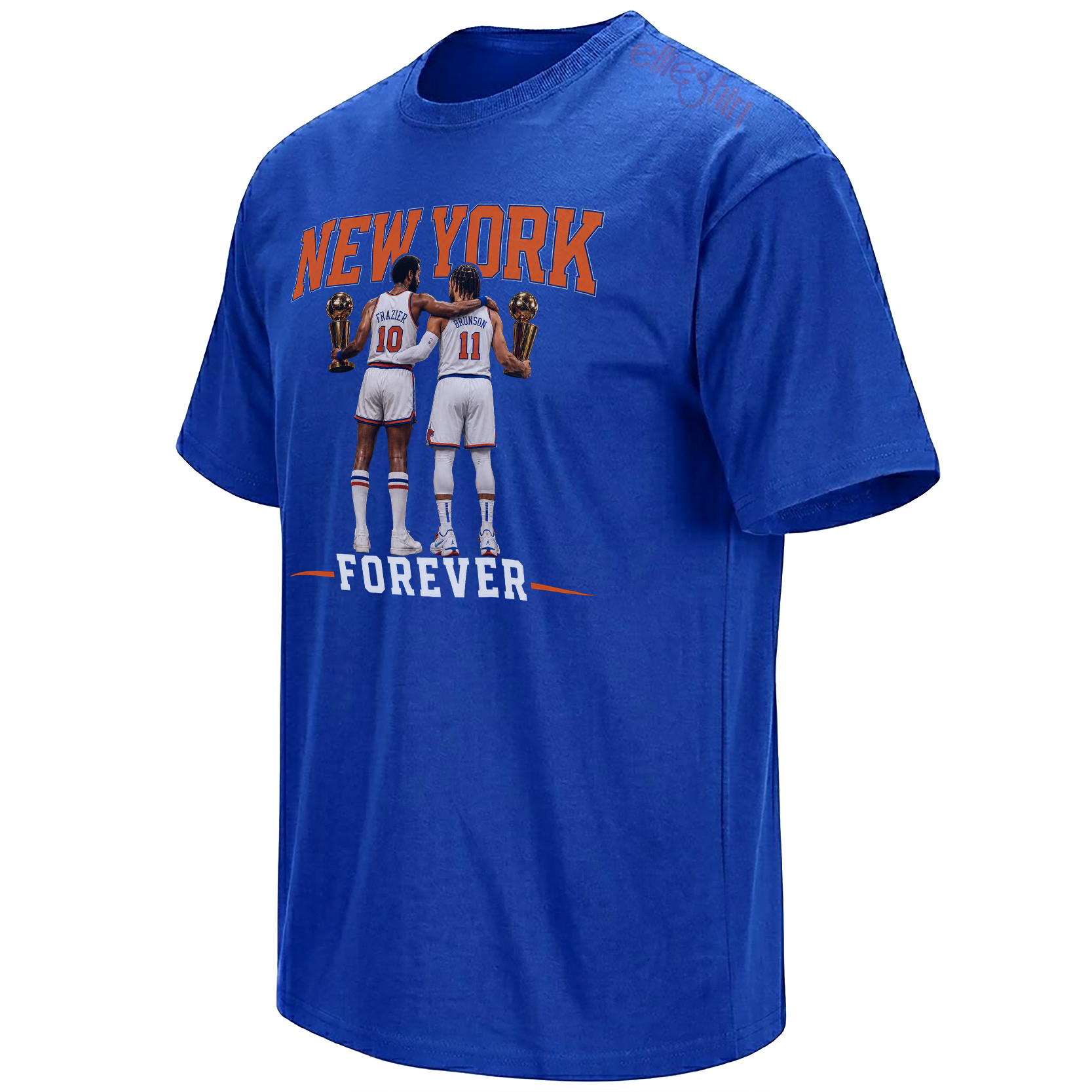
Royal blue places the two champions directly inside the team’s visual language, making the generational handoff feel immediate and unmistakably Knicks.
View the royal-blue piece →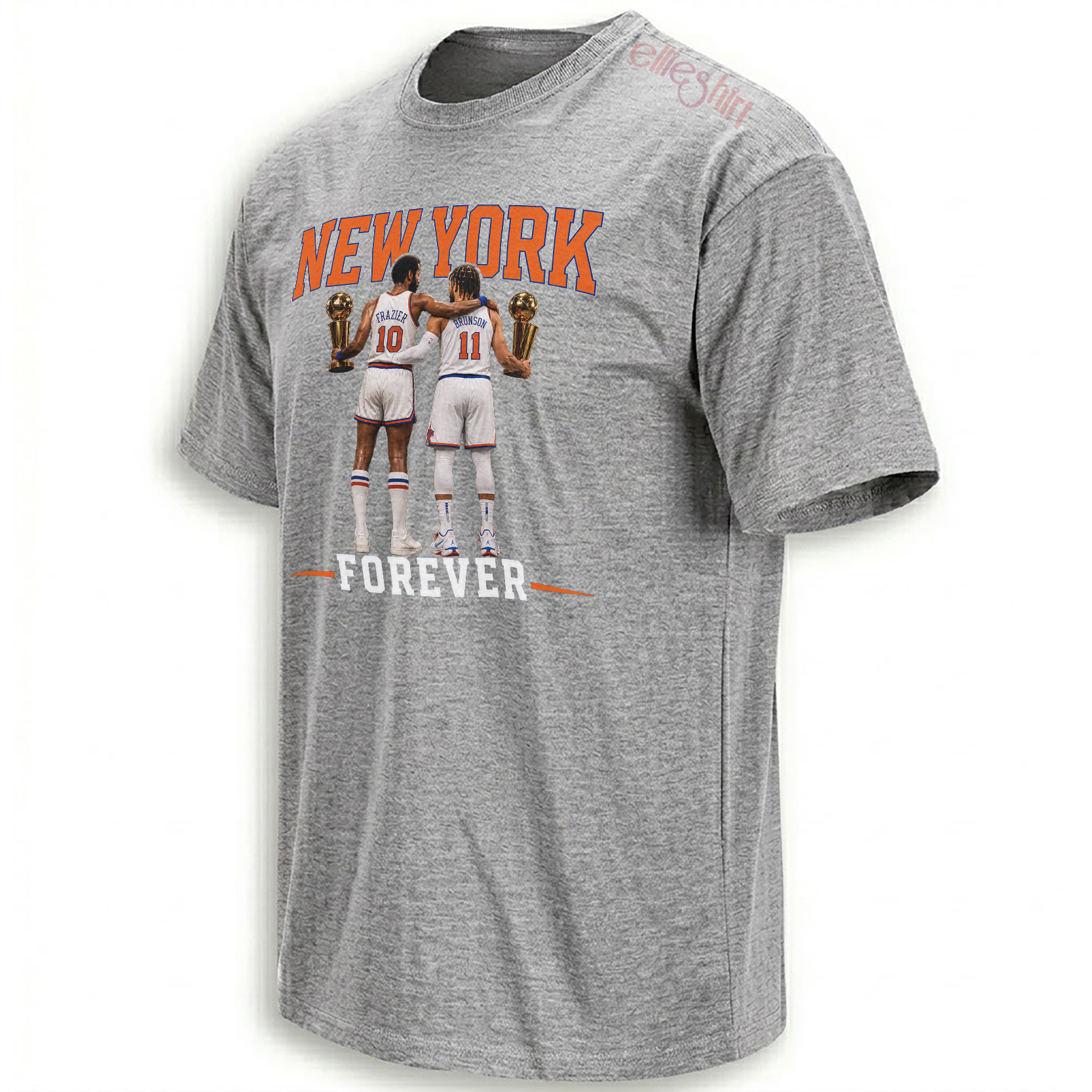
The grey base softens the blue-and-orange artwork and gives the meeting of champions the feeling of a vintage newspaper photograph or old arena souvenir.
Explore the sport-grey version →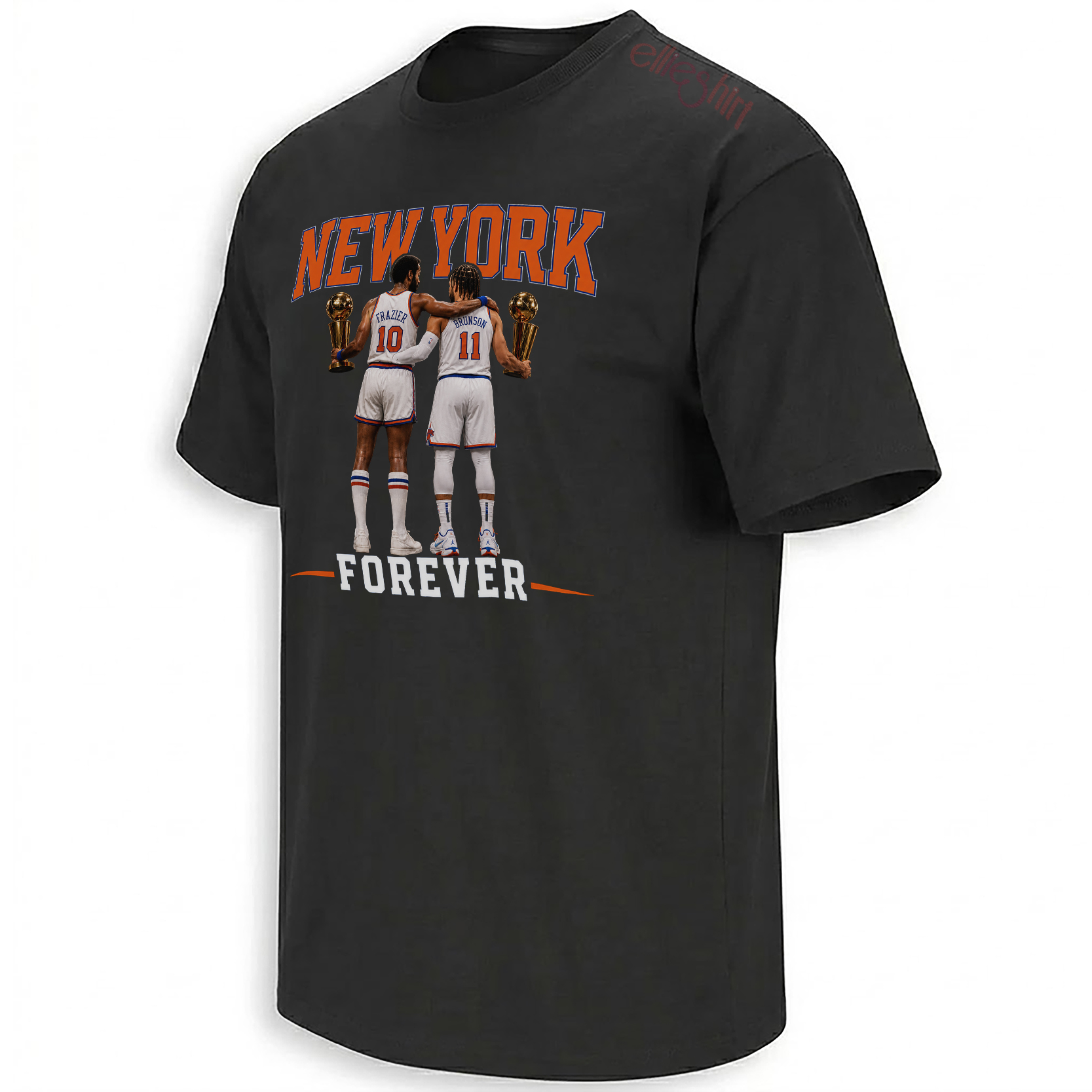
Black gives the trophies, player portraits and orange lettering maximum contrast, creating the mood of a late-night championship poster.
Open the black edition →The embrace matters as much as the trophies
A design showing Frazier on one side and Brunson on the other could easily become a comparison poster. This composition avoids that competitive structure by placing their arms across one another’s shoulders.
The gesture transforms the image from “which guard was greater?” into “how does one era welcome another?” Frazier does not appear as a distant historical monument. Brunson does not appear as someone replacing him.
They are shown as co-owners of the same basketball inheritance.
The pose removes distance between the eras and presents the relationship as recognition rather than rivalry.
Each championship object belongs to a separate era, but both are held inside the same New York frame.
The phrase expands beyond one roster or year and turns the city itself into the lasting subject of the design.
Frazier and Brunson express New York confidence in separate dialects
Frazier’s public identity has always been inseparable from style. His fashion, language and composure helped build the image of the New York athlete as someone expected to perform both on the court and inside the city’s cultural spotlight.
Brunson’s version of charisma is more restrained. His identity is built through preparation, footwork, competitive stubbornness and a dry public manner that rarely appears overwhelmed by the attention around him.
Smooth movement, elite defense, tailored fashion and broadcast language turned Frazier into one of the franchise’s most recognizable cultural figures.
Repetition, balance and emotional discipline allowed Brunson to become the stable center of a team playing under enormous expectation.
The difference makes the pairing stronger. “New York Forever” does not argue that every Knicks icon must look or act the same. It suggests that the city repeatedly recognizes a deeper quality: self-possession under scrutiny.
1970, 1973 and 2026 become three parts of the same sentence
Before Game 5, Knicks championship history was divided into two distinct emotional zones. The early 1970s represented achievement. Everything after 1973 represented pursuit.
The 2026 title changed the grammar of that history. The old championships were no longer isolated monuments from another era. They became the opening chapters of a three-title story.
Frazier’s presence gives the image historical credibility. He does not symbolize an abstract past; he played on both championship teams and remained one of the franchise’s public voices throughout the decades that followed.
Brunson gives the image renewal. He is the player through whom younger fans can finally experience the kind of championship attachment previous generations associated with Frazier, Reed and the teams of Red Holzman.
Together, they make the 53-year gap visible without allowing the gap to become the final meaning of the franchise.
The phrase is larger than a championship slogan
“New York Forever” could be read as a simple declaration of loyalty, but the two-player composition gives it a more specific cultural meaning.
“Forever” refers to continuity across eras that did not resemble one another. The Knicks of Frazier played in a league with another pace, another visual culture and another relationship between players and the public. Brunson’s team competed inside a world of social media, global fandom and instant reaction.
The city remained the linking structure.
Madison Square Garden still demanded confidence. Knicks supporters still carried memory into every postseason possession. Former players remained active participants in the emotional life of the team. The blue and orange still turned a basketball result into a citywide cultural event.
“Forever” therefore does not suggest that New York remains unchanged. It suggests that change itself becomes part of the tradition.
Two championship objects allow the viewer to read the years without a timeline
The trophies do more than confirm that both figures are champions. They divide the image into historical time.
Frazier’s trophy belongs to the era of New York’s first two titles, an age preserved through film grain, old newspaper photography and stories repeated by generations of fans.
Brunson’s trophy belongs to high-definition immediacy: live clips, locker-room video, social media celebration and a city reacting in real time.
By placing both objects in the same composition, the design allows two forms of memory to coexist. One has been aged by decades of retelling. The other is still fresh enough to feel unbelievable.
The visual argument is that both now carry equal permanence.
Royal, grey and black change the mood without changing the story
The royal-blue version is the most directly connected to team identity. The garment becomes part of the artwork, surrounding both champions with the color associated with Knicks uniforms, arena graphics and street celebrations.
The sport-grey version has an archival quality. Its softer base makes the design resemble an older sports photograph transferred onto a classic souvenir shirt, fitting a composition built around historical continuity.
The black version produces the strongest nighttime contrast. Blue, orange, white and trophy tones emerge against darkness, recalling the first hours after the title when championship graphics illuminated phones, bar screens and city streets.
None of the three changes the design’s fundamental idea. They simply determine whether the story feels most like team identity, recovered history or late-night celebration.
Where Frazier and Brunson sit inside the complete Knicks title story
New York’s 2026 championship can be remembered through several visual perspectives. Team collages preserve the roster. Locker-room graphics capture champagne and disbelief. Ring designs connect all three title years. Player-specific pieces keep Brunson’s closeout and OG Anunoby’s Game 4 moment alive.
“New York Forever” performs a distinct role. It places a living representative from the original championship era beside the player who ended the drought, allowing franchise history to appear as a relationship rather than a list of dates.
The wider New York Knicks Shirts collection follows those different layers through player moments, city identity, playoff drama and completed-title graphics.
The 2026 NBA Finals Champions collection brings the title-era archive together, while the broader NBA Shirts collection places the Frazier–Brunson bridge inside the larger visual culture of basketball history, generational fandom and championship memory.
Frequently asked questions
Why are Walt Frazier and Jalen Brunson shown together?
Frazier helped lead the Knicks to championships in 1970 and 1973, while Brunson led New York to its next title in 2026. Placing them together connects the franchise’s original championship era with the team that ended the 53-year wait.
What does “New York Forever” mean in the design?
The phrase represents continuity across generations. Players, basketball styles and media cultures change, but New York’s expectations, fan identity and emotional relationship with the Knicks continue.
Why do both players hold championship trophies?
The trophies establish each player as a representative of a separate championship era. Together, they transform the image into a visual timeline without separating the figures into different panels.
Did Walt Frazier praise Jalen Brunson after the 2026 championship?
Yes. After Brunson’s title-clinching performance, Frazier described him as one of the greatest Knicks ever, recognizing his place among the franchise’s most important players.
Why is Walt Frazier so important to Knicks history?
Frazier was a central guard on both Knicks championship teams, an elite defender, a Hall of Famer and later a longtime broadcaster whose voice remained connected to the franchise across several generations.
How do the royal blue, sport grey and black versions change the design?
Royal blue emphasizes direct Knicks identity, sport grey creates a softer archival sportswear mood and black produces stronger late-night contrast around the trophies, portraits and championship lettering.
The New York Forever Shirt places Walt Frazier and Jalen Brunson shoulder to shoulder with their championship trophies, turning 1970, 1973 and 2026 into one continuous story of Knicks leadership, city identity and generational memory.
New York Forever Shirt unites Walt Frazier and Jalen Brunson as champions from two Knicks eras, pairing the titles of 1970 and 1973 with New York’s historic 2026 victory in a shoulder-to-shoulder tribute to the city’s enduring basketball identity.