When the Knicks Championship Entered Psychedelic Sports Culture
A lightning-struck basketball, curved concert-poster lettering and a 53-year title wait converge in a graphic that treats New York’s 2026 championship like an event already destined for folklore.
The official image of the New York Knicks’ 2026 championship is easy to identify: the final score in San Antonio, the Larry O’Brien Trophy, Jalen Brunson holding the Finals MVP award and a roster gathered inside the first minutes after a 53-year wait had finally ended.
Fan culture rarely stops at the official image. Once the Knicks defeated the Spurs 94–90 in Game 5 and completed a 4–1 Finals victory, the title began moving through every visual language New York supporters could give it — locker-room graphics, caricatures, vintage sportswear, wrestling jokes, city references and designs built from music culture.
The Grateful Dead-inspired championship graphic belongs to that last category. It does not retell the final possession or reproduce a trophy photograph. Instead, it translates the title into psychedelic poster language: curved typography, repeated interior lines, circular composition and a lightning bolt cutting through the basketball at the center.
Why a Knicks championship naturally became a visual culture event
Some titles feel complete the moment the trophy is raised. This one carried too much accumulated history to remain inside a single image. The last Knicks championship had arrived in 1973, meaning the 2026 victory connected supporters who remembered different arenas, different uniforms, different eras of New York and entirely different ways of consuming sports.
Older fans carried memories of championship basketball and the punishing playoff identity of the 1990s. Younger supporters inherited those stories through relatives, archived broadcasts, documentaries, old newspapers and clothing that often outlived the seasons it commemorated.
That generational quality explains why retro and music-inspired graphics feel so natural around the title. They visually collapse time. A new result can look as though it has already survived decades of wear, gathering emotional meaning before the celebration has even finished.
The Grateful Dead-inspired aesthetic is especially effective because it already belongs to a culture of continuity. Concert posters, bootleg shirts, trading communities and long-circulating symbols allowed the band’s visual identity to live far beyond any one album or performance.
A lightning basketball replaces the conventional championship trophy
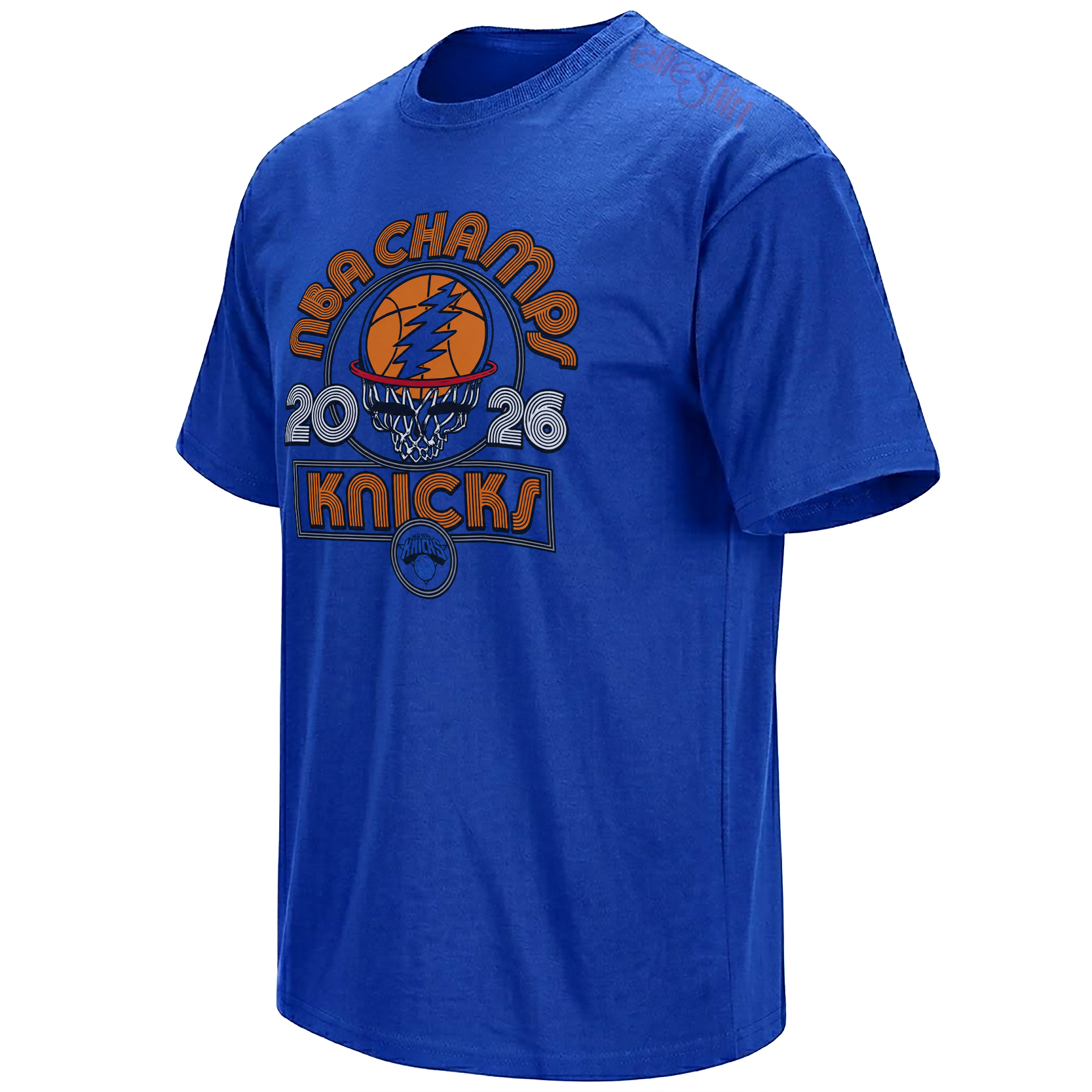
The NBA Champs Shirt — Knicks Grateful Dead-Inspired 2026 makes a decisive visual choice: the central object is not the Larry O’Brien Trophy. It is a basketball suspended above the net and divided by a sharp blue lightning bolt.
That shift changes the emotional meaning of the piece. A trophy describes what was earned. The ball describes how it was earned — through Brunson’s control, difficult possessions, fourth-quarter shot-making and the repeated act of keeping a game alive long enough for New York to reclaim it.
The lightning bolt adds a second layer. It introduces speed, electricity and psychedelic recognition while also suggesting the sudden reversal that defined so much of the Knicks’ postseason. Games appeared to be moving one way and then changed shape in a few violent minutes.
Why the artwork feels closer to a concert poster than standard Finals apparel
Conventional championship graphics usually prioritize legibility and hierarchy. The year, team name, trophy and word “Champions” are arranged so the result can be understood instantly.
This design keeps the result clear but refuses to present it in a conventional athletic voice. “NBA Champs” curves across the top in orange letters built from repeated interior lines. The typography appears to vibrate, recalling the optical movement of late-1960s and 1970s concert posters.
The “Knicks” wordmark below uses the same layered treatment, creating a visual echo between championship status and team identity. The letters are not merely filled with color. They are drawn as systems of lines, giving the print the appearance of movement even when the composition remains still.
A familiar psychedelic symbol is redirected through the actual object of the game, turning basketball energy into championship mythology.
Repeated lines and arched lettering create the optical rhythm of concert art rather than a flat modern sports logo.
Knicks colors keep the crossover grounded in team identity and prevent the psychedelic language from becoming generic nostalgia.
Grateful Dead imagery became a portable language of belonging
The importance of Grateful Dead-inspired visual culture extends beyond the music itself. The symbols became methods of recognition. A skull, lightning bolt, dancing figure or particular red-and-blue arrangement could signal membership in a community without requiring a long explanation.
That portability is one reason the imagery repeatedly crosses into sports, fashion and regional culture. It can absorb another city, team or event while retaining its association with touring, collecting, memory and subcultural identity.
The famous lightning-skull image originated in part from a practical need to identify the band’s equipment. Over time, that functional mark developed into a cultural symbol recognized far beyond the original road cases.
The Knicks design follows a similar symbolic logic without reproducing a literal band logo. The bolt travels into a basketball, the team colors replace the traditional palette and the championship year gives the image a new local purpose.
That distinction matters. The artwork is best understood as a visual homage or inspiration rather than an official collaboration. Its meaning comes from recognizing the design language and watching it mutate inside New York basketball culture.
Deadhead culture and sports fandom preserve memory in similar ways
Music fandom and sports fandom often appear to operate in separate worlds, but both depend on repeated attendance, shared language, collectible objects and stories told by people who insist that one particular night felt different from every other night.
Concert fans remember venues and set lists. Sports fans remember games, scores and the possession that changed an entire postseason.
A worn shirt can function like a ticket stub, proving emotional proximity to a moment even years after the crowd has disappeared.
Familiar visual marks allow strangers to recognize a shared attachment before any conversation begins.
Individual experiences are repeated until they become part of a larger story carried by the entire fan base.
The Knicks’ 2026 championship entered that process immediately. The official record states that New York won the series in five games. Fan memory will also preserve where people watched, who they called, what they wore and which graphic eventually became the image they associated with the night.
Color turns psychedelic nostalgia into unmistakable Knicks identity
The royal-blue garment is not a neutral background. It is the visual environment that makes the crossover belong to New York.
Orange letters rise from the blue with the same immediate contrast seen across Knicks uniforms, arena graphics and city celebrations. White outlines around “2026” provide a bright pause between the warmer typography and darker center illustration.
The blue lightning bolt running through the orange basketball creates a reversal of the surrounding palette. Orange normally acts as the accent against Knicks blue; at the center, the basketball becomes the orange field and the bolt carries the blue through it.
That internal exchange of color makes the symbol feel fully absorbed into the team rather than placed on top of it. The psychedelic reference remains visible, but the design’s primary emotional ownership belongs to Knicks culture.
Why fans often want new history to look old immediately
There is a paradox inside championship apparel. The event is brand new, but supporters often respond most strongly to designs that appear aged, distressed or borrowed from an earlier era.
This is not simply nostalgia for a style. It is a desire to place the new achievement inside a longer timeline. Making the 2026 title resemble a concert graphic from decades ago visually suggests that the moment is substantial enough to have always existed.
For the Knicks, that impulse is particularly powerful. The championship did not replace the memories of 1970, 1973, 1994 or 1999. It entered into conversation with them. A psychedelic retro treatment allows all those eras to coexist without requiring a literal historical timeline.
The graphic therefore works as a kind of imagined vintage artifact: a 2026 result designed as though someone might discover it in a record-store bin years later and immediately understand that the night mattered.
From trophy graphics to music-culture crossovers
The Knicks’ championship has generated several different visual memories. Traditional trophy designs emphasize finality. Caricature art preserves the roster. Locker-room graphics capture the first private celebration. Meme and wrestling crossovers preserve the internet’s side narratives.
This Grateful Dead-inspired piece records another layer: the moment when a basketball championship began behaving like music culture, collecting symbols and aesthetic references that allowed fans to carry the result into different parts of their identity.
The wider New York Knicks Shirts collection follows those changing moods across player moments, comeback graphics, city references and championship designs.
The 2026 NBA Finals Champions collection focuses on the completed title, while the broader NBA Shirts archive places New York’s victory inside the wider visual culture of basketball, music, memes and fan-created language.
Frequently asked questions
Why does the Knicks championship design feel Grateful Dead-inspired?
The graphic uses a lightning bolt, circular central symbol, curved typography and repeated interior linework associated with psychedelic concert-poster and Grateful Dead-adjacent visual culture.
Is this an official New York Knicks and Grateful Dead collaboration?
The design is presented as a Grateful Dead-inspired cultural crossover, not as an official collaboration. It adapts psychedelic visual language to the Knicks’ 2026 championship story.
Why is the lightning bolt placed inside a basketball?
The basketball keeps the symbol rooted in the game itself, while the bolt adds movement, electricity and a recognizable psychedelic reference. Together they transform the ball into the graphic’s championship emblem.
Why does retro music imagery fit the Knicks’ 2026 title?
The championship ended a 53-year wait and connected several generations of supporters. Retro music and poster aesthetics visually compress those decades, making a new victory feel connected to a longer cultural memory.
What role do Knicks blue and orange play in the design?
The blue garment and orange typography establish unmistakable Knicks identity. They allow the psychedelic reference to enter New York basketball culture without overpowering the team’s visual language.
The Knicks Grateful Dead-Inspired NBA Champs Shirt captures New York’s 2026 title through a lightning basketball, layered orange typography and the kind of psychedelic visual rhythm that turns one historic night into a piece of fan folklore.
NBA Champs Shirt — Knicks Grateful Dead-Inspired 2026 transforms New York’s historic championship into psychedelic sports art through a lightning-struck basketball, curved poster typography and bold royal-blue-and-orange team identity.