Champhausen: How Danhausen Became Part of the Knicks Championship Myth
What began as a wrestler’s absurd curse-and-uncurse routine followed New York all the way through the NBA Finals, turning “Knickshausen” into one of the strangest and most internet-native side stories of the 2026 championship.
The official story is already large enough. The New York Knicks defeated the San Antonio Spurs 94–90 in Game 5, completed a 4–1 NBA Finals victory and ended a championship wait extending back to 1973. Jalen Brunson scored 45 points, controlled the closing stages and received the Finals MVP trophy.
The internet, however, rarely permits a championship to remain only an official story. Around the box scores, tactical adjustments and historical weight, another narrative had been growing: perhaps the Knicks were no longer losing because Danhausen had removed a curse.
It was knowingly ridiculous. That was the appeal. By the time the Finals ended, Danhausen’s language had become welded to New York’s run through phrases such as “Knickshausen,” “Forever Uncursed” and finally “Champhausen.” The wrestler’s supernatural comedy did not explain the basketball, but it gave fans another way to participate in it.
Why an imaginary curse fit the emotional logic of this postseason
Sports fandom has never been entirely rational. Supporters repeat routines, preserve lucky objects, avoid forbidden phrases and search for patterns in events that are supposedly decided by preparation, talent and probability.
The longer a title drought lasts, the easier it becomes to describe the failure in supernatural language. A franchise is not merely rebuilding; it is haunted. A team does not simply lose close games; it is cursed. Every collapsed lead and improbable bounce becomes evidence in a mythology built over decades.
That language was especially compatible with the Knicks. Fifty-three years without a championship had produced too much emotional history to fit neatly inside conventional analysis. New York had experienced great teams, dramatic postseasons, famous injuries, painful near-misses and long stretches when the championship conversation felt detached from reality.
Danhausen’s character offered a comic solution to an impossibly serious problem. He did not need to make the curse believable. He only needed to speak as though everyone already understood that it existed.
From cursed Knicks to NBA Champhausen
The Danhausen–Knicks connection developed like a wrestling angle designed for social media: clear language, repeated visual cues and enough flexibility to react to every new result.
Danhausen initially placed his fictional curse into the Knicks conversation during the early playoff run, bringing his familiar supernatural gimmick into New York basketball discourse.
Once the spell was theatrically lifted, New York kept winning. The results allowed fans, television segments and wrestling coverage to treat the coincidence as an expanding joke.
WWE incorporated the crossover into its programming as Danhausen celebrated New York reaching the NBA Finals, giving the internet bit an official wrestling stage.
After New York closed the Finals, the wordplay reached its natural final form: champion plus Danhausen, a title celebration translated into his own peculiar dialect.
The strength of the narrative came from repetition. Each victory made the fictional explanation funnier. Each improbable comeback gave the “uncurse” another piece of evidence. Danhausen did not need to claim literal responsibility in a serious way; his character could behave as though the city owed him everything while occasionally admitting that the players performed the actual work.
A championship graphic wearing Danhausen’s face
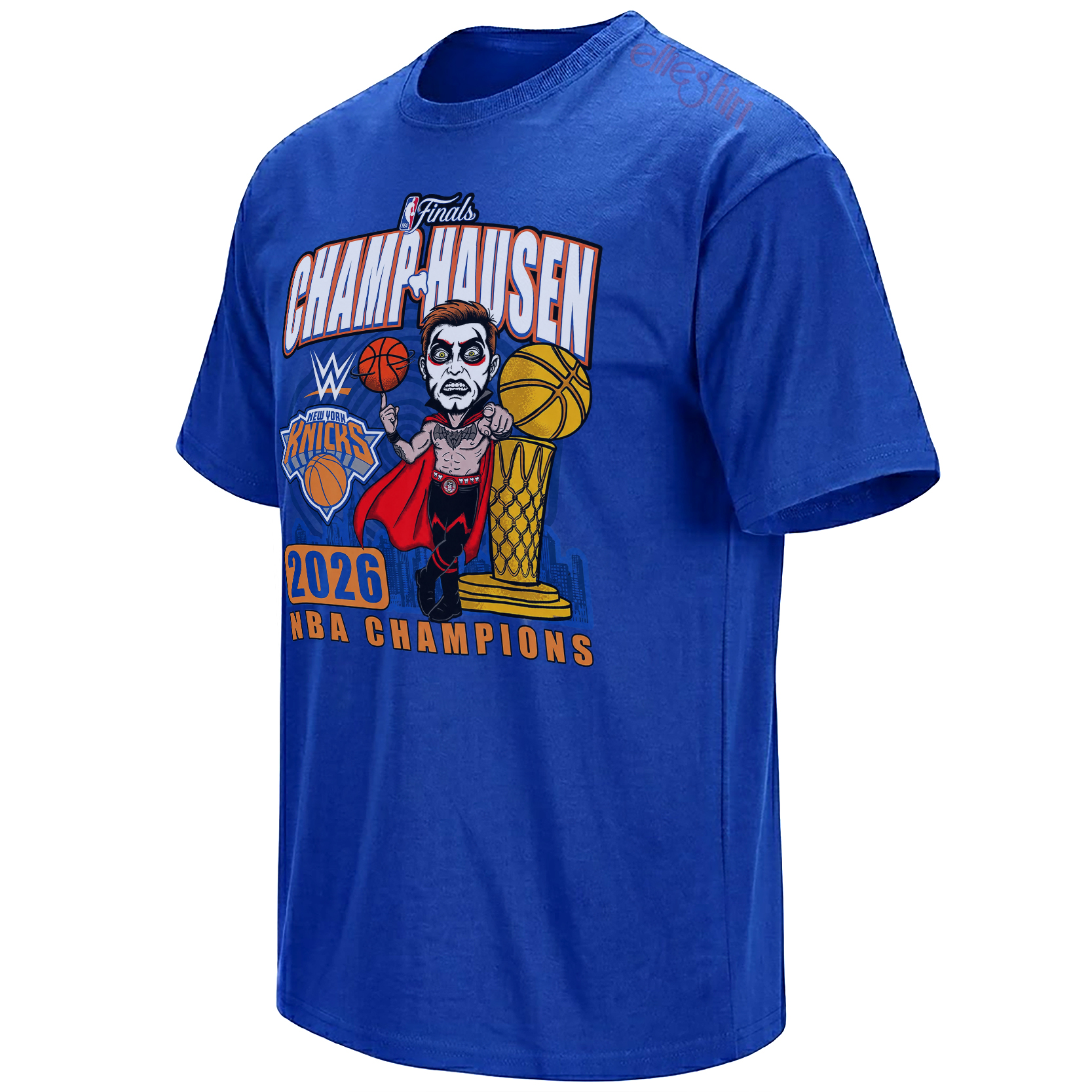
The Champhausen Shirt does not simply place a wrestling figure beside a basketball reference. It compresses the entire crossover narrative into one image: Danhausen in Knicks championship colors, his black-and-white face paint interrupting the polished language of official victory apparel.
That interruption is essential. Conventional champions graphics are designed to communicate certainty. They use trophies, dates, official-looking typography and direct declarations of victory. Danhausen introduces uncertainty, comedy and theatrical menace into that structure.
The result feels like unauthorized folklore from the championship run. It is less concerned with documenting the final score than preserving the joke fans carried alongside it: the Knicks were no longer cursed, and the strange painted man insisted on taking credit.
Why “Champhausen” works better than a normal slogan
Danhausen’s character speaks through a personal vocabulary. Names are altered. Concepts receive unnecessary suffixes. Money becomes “human monies.” Success, failure and social interaction are processed through the voice of someone who behaves like an old horror host trapped inside modern wrestling media.
“Champhausen” works because it follows that linguistic system. It is instantly understandable without being normal. The word carries “champion,” but refuses to leave the achievement untouched. It converts the Knicks’ title into Danhausen’s universe.
A simple mutation that allows Danhausen to insert himself directly into the name of the team.
The word that gave supporters a comic supernatural explanation for New York’s sudden run of victories.
The title result rewritten as a Danhausen phrase and turned into a visual marker of the completed joke.
This is how internet sports language often develops. A phrase does not need institutional approval. It needs repetition, adaptability and a memorable relationship to what supporters are watching. “Champhausen” survived because it could only belong to this exact combination of character, team and moment.
Knicks color, horror-host energy and championship excess
The design’s visual tension comes from combining two identities that normally follow different rules. Knicks imagery is bright, civic and athletic. Danhausen’s character is monochrome, theatrical and deliberately strange.
Blue and orange immediately place the artwork inside New York basketball culture. Those colors carry Madison Square Garden, city apparel and the celebratory intensity of the title run. Danhausen’s face paint cuts through them as a black-and-white interruption, giving the design a focal point that feels closer to wrestling poster art than standard basketball merchandise.
Danhausen’s makeup is visually recognizable enough to operate like a symbol, bringing wrestling identity into the graphic without requiring a full match scene.
Large celebratory lettering establishes the actual sporting result before the altered “Champhausen” language changes its tone.
Knicks colors prevent the crossover from floating into generic wrestling territory and connect the character directly to New York’s title moment.
The unlikely pairing gives the artwork the spirit of a fan-made event poster preserved from a night when separate entertainment worlds collided.
The design succeeds because it does not attempt to make Danhausen look conventionally heroic. His value inside the composition is his weirdness. He remains an outsider who has somehow wandered into the center of a championship celebration and immediately begun negotiating for credit.
That is closer to the emotional reality of the meme than a clean co-branded logo could be. The crossover was never elegant. It was funny because it felt barely controllable.
Wrestling and basketball already share the same emotional machinery
On the surface, professional wrestling and NBA basketball belong to separate forms of entertainment. One is openly built around characters and scripted conflict; the other is a competitive sport governed by results that cannot be predetermined.
Their fan cultures, however, frequently operate through similar machinery. Both create heroes, villains, rivalries, entrances, signature gestures, betrayals, redemption stories and crowds capable of changing the emotional meaning of a building.
Madison Square Garden intensifies that relationship. It is simultaneously a basketball arena, wrestling landmark, concert venue and stage on which New York converts entertainment into civic theater. A Danhausen–Knicks crossover therefore feels less random inside the Garden ecosystem than it might elsewhere.
Brunson’s known interest in WWE also gave the crossover another line of authenticity. The wrestling reference was not being imposed on a basketball culture with no connection to it. It entered a team environment where wrestling language, entrances and fan overlap already made sense.
Fans needed a joke large enough to carry the improbability
The Knicks’ postseason repeatedly placed supporters inside situations that felt unreasonable. The team survived major deficits, produced late reversals and completed a Finals run in which control frequently appeared to belong to the opponent before New York reclaimed it.
Traditional analysis can explain execution, shot-making, lineup decisions and defensive adjustments. It cannot fully express what it feels like to watch a team escape again and again while carrying more than half a century of historical pressure.
That emotional gap is where superstition becomes useful. “Danhausen uncursed the Knicks” was not offered as an alternative to basketball analysis. It was a comic language for the sensation that something fundamental had shifted.
The joke allowed fans to acknowledge how impossible the run felt without needing to explain every detail. It also gave them a recurring character who could appear after each result, claim victory and threaten everyone with further supernatural consequences.
Why crossover graphics preserve details official history leaves out
Official championship history will preserve the score, the series result, Brunson’s 45 points and the trophy presentation. Those details deserve their permanence.
Fan memory keeps additional records. It remembers strange television segments, accidental phrases, celebrity reactions, signs in the crowd and jokes that became funnier with every win. These details explain what it felt like to live through the event rather than only what happened.
Champhausen belongs to that secondary archive. It preserves the bizarre wrestling subplot running beside New York’s championship. Years later, the graphic can recall not only that the Knicks won, but that fans spent part of the postseason debating whether a face-painted wrestler had altered the team’s supernatural condition.
The wider New York Knicks Shirts collection records other parts of the same title run through player moments, comeback language, city identity and championship imagery.
The 2026 NBA Finals Champions collection brings those completed-title graphics together, while the broader NBA Shirts archive places Champhausen inside the larger ecosystem of playoff memes, rivalry language and basketball moments that escaped the broadcast.
Frequently asked questions
What does “Champhausen” mean?
“Champhausen” combines “champion” with Danhausen’s name. It translates the Knicks’ 2026 championship into the wrestler’s familiar style of altering words and names with a “hausen” ending.
Why was Danhausen connected to the New York Knicks?
Danhausen became part of the Knicks’ playoff conversation through a wrestling storyline in which he cursed and later “uncursed” the team. As New York continued winning, the supernatural joke spread across wrestling coverage, sports media and fan spaces.
Did Danhausen actually claim responsibility for the Knicks championship?
Danhausen played the claim as part of his fictional wrestling character, joking that his uncursing powers helped the team while also acknowledging that the Knicks completed the work on the court.
What does “Knickshausen” mean?
“Knickshausen” is another Danhausen-style word mutation that merges the New York Knicks name with his character identity. It became recurring shorthand for the crossover during the playoff run.
Why does the Champhausen design fit the 2026 championship moment?
The design preserves one of the title run’s strangest internet side stories by combining Danhausen’s black-and-white face-painted identity with Knicks blue, orange and championship typography.
The Champhausen Shirt captures the Knicks’ 2026 title through the supernatural comedy that followed the team across the postseason — part wrestling character, part basketball celebration and part internet folklore from a championship New York waited 53 years to see.
Champhausen Shirt turns the New York Knicks’ 2026 NBA championship into Danhausen-style wrestling folklore, combining the “uncursed” playoff meme, blue-and-orange title energy and the face-painted character behind the Knickshausen crossover.