
Laocoön Tip-In Poster Turns OG Anunoby’s Game 4 Moment Into Knicks Sculpture
OG Anunoby’s putback already had the tension of bodies, contact, and survival under the rim. The Laocoön Tip-In Poster pushes that tension into classical art language, turning a Knicks Finals comeback into a sculptural myth.
The Knicks’ Game 4 ending did not look calm. It looked tangled. New York had erased a 29-point deficit against San Antonio, the game had been pulled into its final seconds, and every body near the rim seemed to carry the weight of the night. Then OG Anunoby reached the ball first, tipped it in, and gave the Knicks a 107-106 win with 1.2 seconds left.
That is the kind of basketball moment that naturally escapes ordinary recap language. It was not just a shot. It was struggle turned into form: arms reaching, defenders collapsing, players fighting gravity, the ball hanging above the rim like the entire series had been reduced to one object.
The Laocoön Tip-In Poster works because it understands that visual pressure. Instead of treating the play like a simple highlight, it reads the scene through the language of classical sculpture — bodies under stress, motion locked in place, and a moment of agony transformed into art.
The tip-in became sculpture because the play already had the shape of struggle: bodies twisting, pressure tightening, and one final reach changing everything.
Why Laocoön Is the Right Reference for This Knicks Moment
The Laocoön reference matters because the original sculpture is not about peace. It is about bodies caught in conflict. The famous Hellenistic group is remembered for its twisting forms, strained musculature, and the sense that physical struggle has been frozen at its most intense point.
That language fits the Game 4 tip-in better than a clean heroic portrait would. Anunoby’s basket did not happen in open space. It happened in a crowd. It came out of a missed shot, a rebound fight, and the compressed violence of a Finals possession where every shoulder, hand, and angle mattered.
In that sense, the poster is not just using classical art as decoration. It is using classical art to explain the feeling under the rim. The play was a Knicks rescue scene, but it was also a knot of pressure.
The Poster as a Classical Fan Artifact
The Laocoön Tip-In Poster treats Game 4 like something that belongs in a gallery of New York basketball memory. It slows down the instant that most fans first saw as a blur. Instead of replay speed, the design gives the moment marble weight.
That shift matters. A normal Game 4 graphic might focus on the score, the comeback number, or the reaction phrase. This poster focuses on the physical scene itself. It asks fans to remember the basket not only as the ending, but as a composition of tension: the bodies, the reach, the rim, the ball, and the city waiting for release.
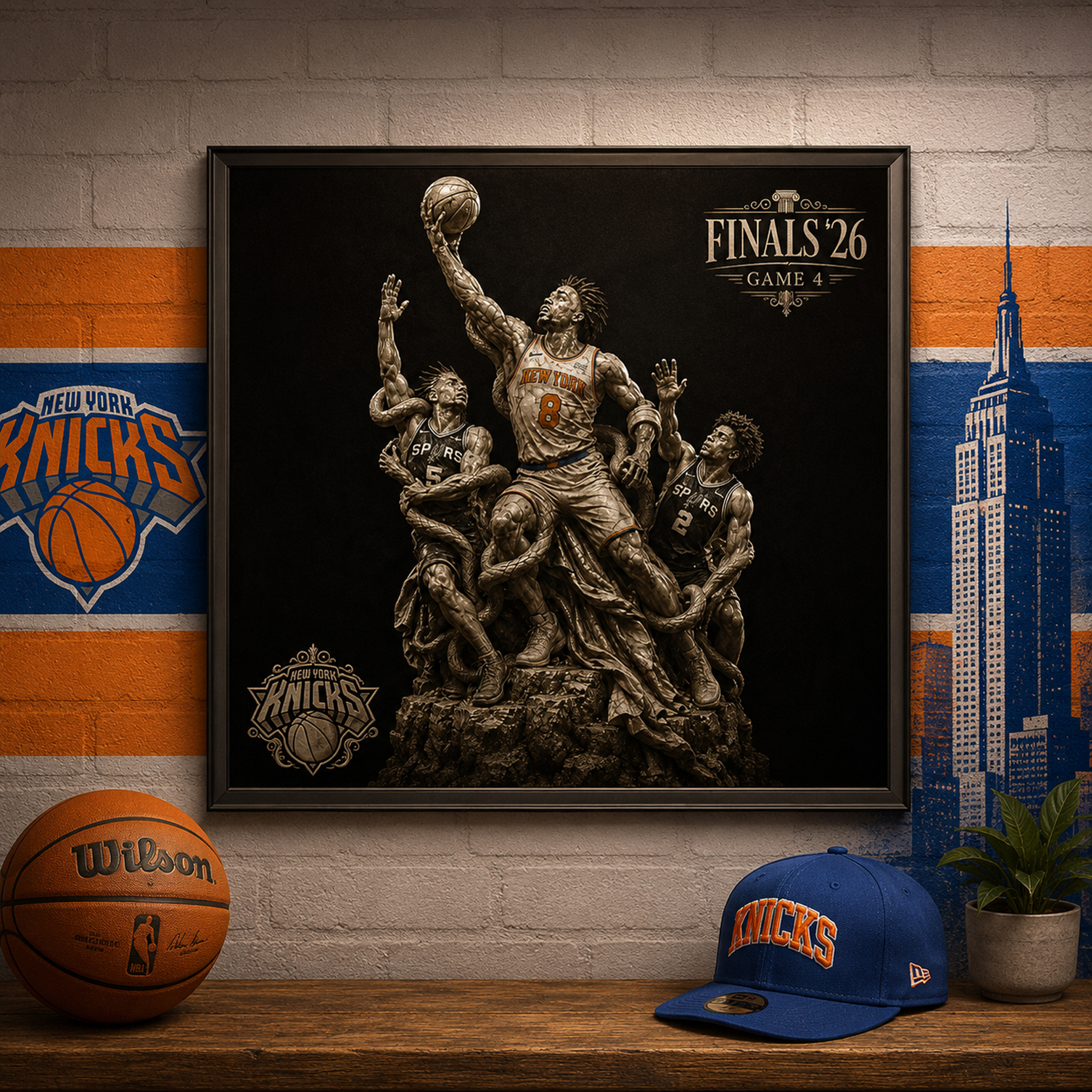
A classical sculpture-inspired reading of Anunoby’s putback, turning Game 4’s body traffic into Knicks mythology.
View the piece →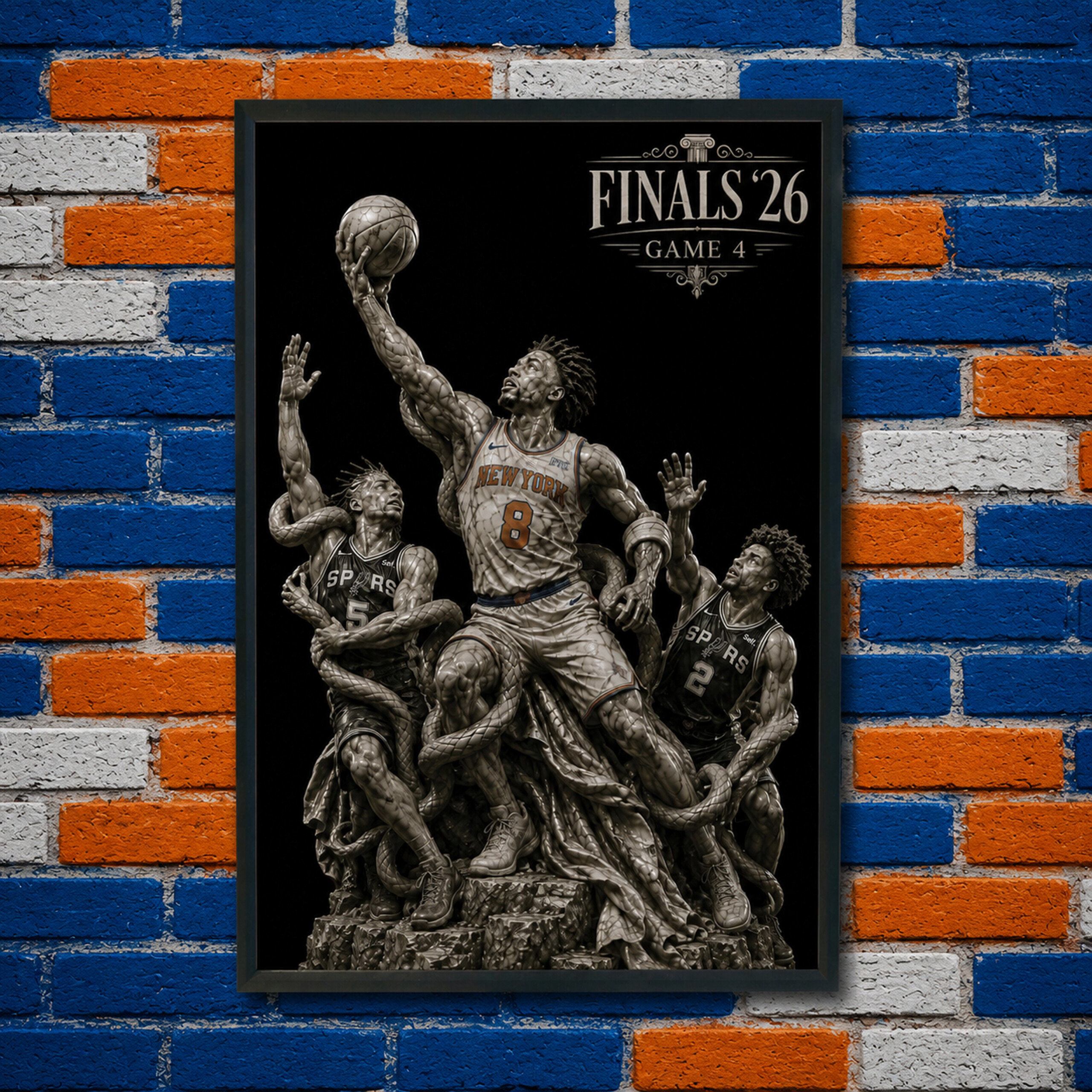
A second gallery-style angle on the same Finals struggle, built around contact, tension, and the last reach.
Open the design →Design Language: Marble Tension, Garden Noise
The strongest part of this poster is the collision between classical stillness and basketball noise. The subject is loud: Knicks-Spurs Finals, a record comeback, the Garden on the edge of eruption, and a final-second putback that moved the series. But the visual treatment gives it the gravity of a sculpture.
That contrast makes the design feel different from a standard sports poster. The palette and Knicks references keep the moment tied to New York, but the Laocoön language makes the scene feel older, heavier, and more dramatic. The bodies do not simply surround the play. They become the play.
The result is a piece that reads like fan mythology. It does not shout “Game 4” in the most obvious way. It shows why Game 4 felt like a battle under the rim.
How Fans Turn Scrambles Into Sacred Images
Big sports moments often become sacred because they can be frozen. A clean jumper has its pose. A dunk has its apex. A tip-in has something stranger: uncertainty. The ball is not fully controlled. The bodies are not cleanly arranged. Everyone is reaching for the same ending.
That is exactly why Anunoby’s play works as art. It was not smooth, and it did not need to be. The mess is the memory. The final basket arrived from a struggle, which made it feel more honest to the comeback that preceded it.
Knicks fans were not only celebrating a made basket. They were celebrating the way the team fought through the ugliness of the night and still found the ball first.
Why This Is Different From a Renaissance Tip-In Poster
A Renaissance treatment often frames a play as a painted myth. The Laocoön angle is sharper and more physical. It is less about grace and more about strain. It focuses on the bodies under pressure, the pain of almost losing, and the violent compression of a Finals possession.
That gives this poster its own lane inside the Knicks Game 4 archive. The tip-in can be many things at once: a meme, a logo, a comeback statistic, a Renaissance scene, and here, a sculpture of struggle. This version is for the fan who saw the play not as clean beauty, but as a physical knot that somehow ended in salvation.
The artwork makes the under-the-rim chaos feel intentional, not accidental. It turns the scramble into form.
Where It Fits in the Knicks Finals Visual Archive
The 2026 Knicks Finals run has produced a wide visual language: Brunson belief pieces, Anunoby tip-in graphics, comeback shirts, Game 4 heist posters, 1999 nostalgia, Renaissance-style art, and now a Laocoön-inspired sculpture reference. The Laocoön Tip-In Poster fits into that archive by giving the night its most physical classical interpretation.
It also belongs naturally beside the wider New York Knicks Shirts collection, where each design can read like a different page from the city’s postseason memory. On the broader basketball side, the NBA Shirts archive tracks how a single play can become a phrase, a poster, a myth, or a piece of fan-made art history.
The strongest thing about this poster is that it does not clean up the play. It honors the tangle. It understands that the Knicks’ comeback was not elegant because it was easy — it became beautiful because it was fought through.
Why the Laocoön Treatment Has Life Beyond Game 4
The best art references survive because they name a feeling fans already had. Here, the feeling is strain. Game 4 was not only about joy; it was about panic, compression, refusal, and release. The Laocoön approach gives that emotional structure a visual body.
That is why the poster can keep working after the series moves forward. It is not only about the Knicks beating the Spurs by one point. It is about how one final reach turned a near-collapse into a sculpture of survival.
FAQ
Why is the Laocoön Tip-In Poster connected to OG Anunoby?
The poster is connected to Anunoby because it interprets his Game 4 tip-in for the Knicks as a classical struggle scene, turning the final-second putback into a sculptural fan-memory image.
What does the Laocoön reference mean in this Knicks design?
The Laocoön reference points to classical sculpture known for tense bodies, strain, and struggle. In this design, that language is used to frame the crowded fight under the rim before Anunoby’s tip-in.
How is this different from a Renaissance-style Knicks poster?
A Renaissance-style poster often emphasizes painted myth and grace. The Laocoön version emphasizes physical tension, body traffic, contact, and the almost painful struggle of the final possession.
Why did OG Anunoby’s tip-in become such a strong art subject?
It became a strong art subject because the play completed a 29-point Finals comeback in the final seconds, while also giving fans a visually dramatic scene of bodies, pressure, and one decisive touch at the rim.
For readers following the visual language of this Finals run, the poster sits naturally beside the latest New York Knicks Shirts and the broader NBA Shirts archive — a classical record of the night Anunoby’s reach became Knicks folklore.
Laocoön Tip-In Poster turns OG Anunoby’s Knicks Game 4 Finals putback into classical sculpture-inspired fan art, capturing New York’s 29-point comeback through bodies, strain, contact, and one final orange-and-blue reach at the rim.