Knicks 2026 NBA Champions: How New York Turned 53 Years Into a Parade
The title was clinched in San Antonio, but its emotional geography runs through Madison Square Garden, subway platforms, neighborhood bars and every New Yorker who learned to carry 1973 as both history and unfinished business.
New York woke up on June 14 with a sentence that had not been available for more than half a century: the Knicks are NBA champions. Their 94–90 victory over the San Antonio Spurs in Game 5 completed a 4–1 Finals win and ended a championship drought stretching back to 1973.
Jalen Brunson authored the final performance. He scored 45 points in the deciding game, the highest total by a Knicks player in an NBA Finals contest, and finished the night holding the Bill Russell Finals MVP trophy. A postseason built on resilience, late-game control and increasingly improbable recoveries had finally produced the image New York had spent decades rehearsing in its imagination.
The title was officially secured on the road, but the championship does not belong to one building or one final buzzer. Its emotional center is still Madison Square Garden. Its routes extend through the subway system. Its colors belong to storefronts, train cars, apartment windows, sports bars and blocks where Knicks basketball has always operated as a form of civic conversation.
The Longest-Running Story in New York Basketball Finally Changed
For years, 1973 functioned as more than a date. It was the reference point beneath every promising season, every Garden revival and every attempt to explain why the Knicks mattered so intensely even when the standings offered little reassurance.
Older fans could connect the franchise to Willis Reed, Walt Frazier, Earl Monroe and a championship era that still lived through documentary footage, anniversary ceremonies and stories passed between generations. Younger fans inherited those images without owning a title memory of their own. The past was vivid, but it was never theirs.
The 2026 team changed that relationship. Brunson, OG Anunoby, Karl-Anthony Towns, Josh Hart and the wider rotation did not erase the historic Knicks. They gave the franchise another chapter capable of standing beside them. The title moved New York basketball from remembrance into lived experience.
The Knicks’ second title became the final championship reference point for more than five decades.
An underdog playoff run restored the Garden’s national mythology, but the season ended without the trophy.
New York defeated San Antonio in five games and created a championship generation that no longer needed to borrow its defining image.
Madison Square Garden Was More Than a Finals Venue
The Garden hosted its first NBA Finals games since 1999 during this series. That gap mattered because Madison Square Garden has always been larger than the sum of the games played inside it. It is a stage where Knicks hope, anxiety, celebrity culture, neighborhood identity and national basketball attention repeatedly collide.
When the Finals returned, the building became a memory machine. Images of the 1990s resurfaced. Comparisons to older playoff crowds became unavoidable. Every possession seemed to carry both present tension and the pressure of all the seasons that had failed to arrive at the same point.
Even though Game 5 ended in San Antonio, the Garden remained the symbolic home of the title. New York’s championship celebration was never going to be contained by the road arena where the trophy was lifted. The result traveled immediately back toward Manhattan and outward through the city.
A Championship Graphic Built Like a New York Transit Map
The New York Knicks NBA Champions Shirt captures that citywide geography through a two-sided composition. The trophy establishes the result, but the subway imagery explains where the feeling belongs. This is not an abstract basketball championship. It is a New York championship connected to movement, density and the shared routes through which the city experiences major events.
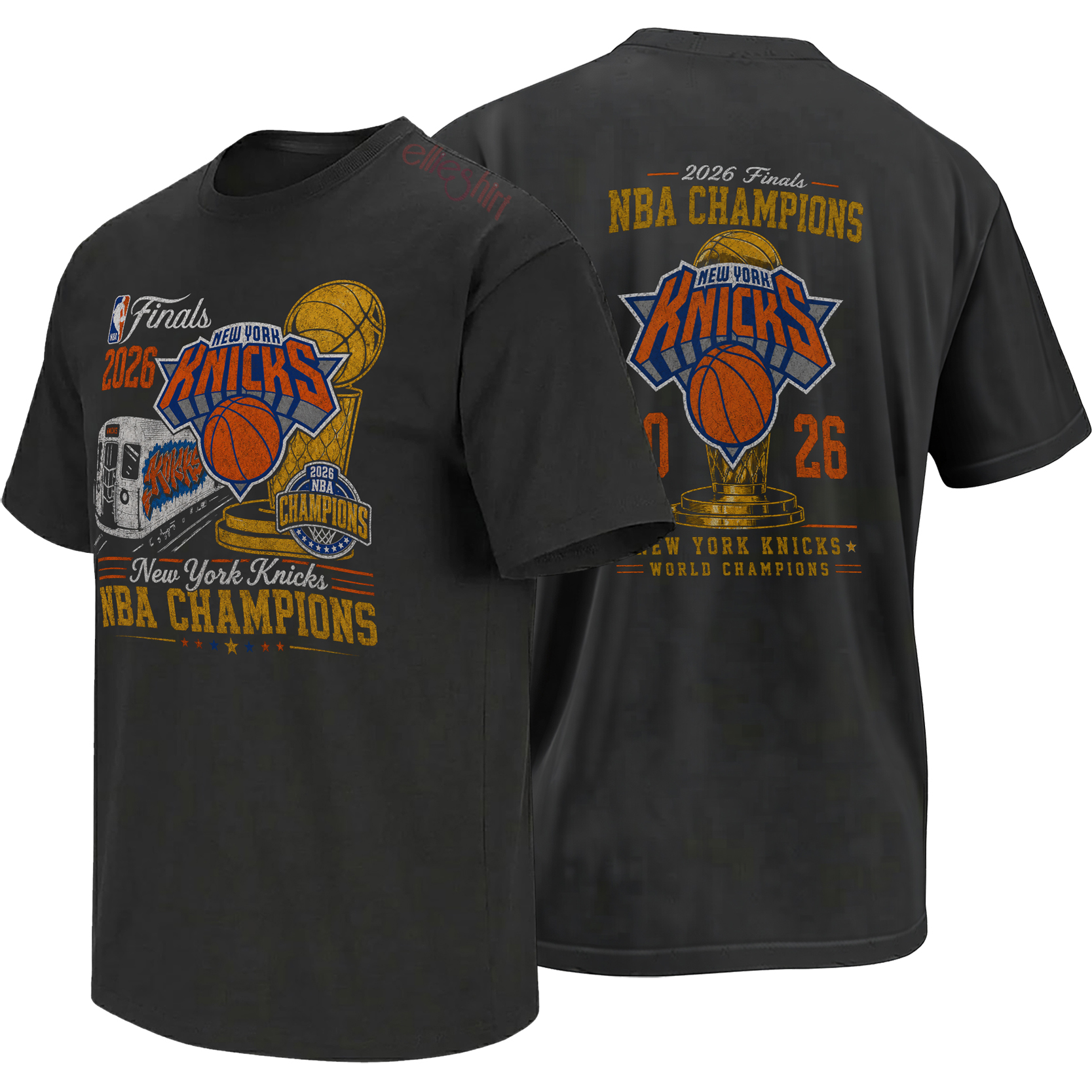
Subway imagery carries a specific New York meaning. It turns the design from a team graphic into a city graphic. The train connects the Garden to boroughs, neighborhoods and the daily movement of supporters who do not experience the Knicks only inside the arena.
In visual terms, the subway car acts like a route marker toward the new championship era: 1973 is no longer the final stop.
Why the Distressed Look Matters After the Title Became Official
Championship graphics often appear immediately after the final buzzer, but this design avoids the sterile appearance of a freshly generated announcement. Its worn typography and weathered color treatment make it feel as though it has already passed through the city.
That texture matters because the Knicks’ title arrived with decades of built-in history. A perfectly polished graphic would capture the result, but not the weight behind it. The distressed finish creates the feeling of an old parade shirt discovered years later, even though the championship has only just happened.
Gold supplies the unmistakable championship center while contrasting against the black garment and orange-and-blue team language.
Transit imagery relocates the title from a neutral Finals stage into the daily visual vocabulary of New York City.
Worn texture gives a brand-new title the emotional appearance of an object already carrying memory.
Front and Back Tell Two Different Parts of the Same Story
The front works like a compressed newspaper cover. It layers “2026 Finals,” the team identity, championship lettering, basketball and trophy imagery, plus the subway reference that grounds everything in New York. The composition is crowded by design because the moment itself contains too many emotions for a minimal logo treatment.
The back is more declarative. “NBA Champions,” the split 20 and 26 numerals, trophy structure and “World Champions” language operate like the reverse side of a parade program. The front explains the city and the journey; the back announces the final status.
Together, the two sides make the piece feel less like an isolated celebration logo and closer to a complete championship poster wrapped around the wearer. It has the information density of old locker-room apparel, but its visual references belong specifically to the Knicks and New York.
From an Early Call to an Official Championship Timestamp
The design initially entered the Finals conversation as an act of belief. It imagined the trophy before New York had formally secured it. That kind of early declaration is part of playoff culture: fans attempt to speak an ending into existence while knowing how quickly confidence can become evidence for rival supporters.
Game 5 changed the status of every “NBA Champions” line in the artwork. The prediction became documentation. The trophy was no longer aspirational. “2026” no longer referred to an imagined parade date. The Knicks had actually completed the series, and the graphic became a timestamp of the moment belief crossed into fact.
That transition gives the piece a particular cultural value. It remembers both sides of the emotional experience: the confidence required to call the title early and the release that followed when the result finally justified it.
Why Knicks Fans React to the City Before the Statistics
The numbers are historic: 4–1, 45 points, first title since 1973. But Knicks fandom has never been constructed through statistics alone. Its identity is spatial. Fans talk about the Garden, the streets around Penn Station, the train ride home, the borough where they watched and the neighborhood where car horns began before the postgame interview had finished.
Across fan spaces, the championship conversation quickly expanded beyond Brunson’s scoring total or San Antonio’s final possession. The deeper reaction centered on time: people remembering who introduced them to the Knicks, which relatives had waited for the title and how many failed eras had accumulated between 1973 and 2026.
That is why a subway car can carry almost as much meaning in the graphic as the trophy. The championship belongs to the team, but the route through which it becomes culture belongs to the city.
A New Knicks Archive Begins With the Word “Champions”
The wider New York Knicks Shirts archive now has a different organizing principle. Graphics built around comebacks, Finals performances, Garden noise and player-specific moments can be read as pieces of one completed championship narrative.
The broader NBA Shirts collection records how postseason events become visual language across the league. Some designs preserve a single play or quote. Others, like this one, attempt to contain the larger emotional architecture of an entire title run.
The Graphic as a New York Championship Document
The New York Knicks NBA Champions graphic belongs to the period immediately after a long-awaited result, when every image still carries the electricity of something fans are learning how to say aloud.
Trophy, subway, Garden-era colors, distressed lettering and the split 20–26 layout turn the design into a compact record of the title. It does not tell every story from the playoff run. It establishes the final line beneath all of them: New York finished the season as champion.
Knicks 2026 Championship FAQ
When did the Knicks win the 2026 NBA championship?
The Knicks secured the championship on June 13, 2026, by defeating the San Antonio Spurs 94–90 in Game 5 and winning the NBA Finals series 4–1.
Why is the 2026 title so important to Knicks fans?
It is the franchise’s first NBA championship since 1973, ending a 53-year wait and giving several generations of Knicks supporters their first title memory.
Why does the design include a New York subway train?
The subway connects the championship to New York City beyond Madison Square Garden. It represents the neighborhoods, boroughs and shared routes through which Knicks culture moves.
What does the distressed artwork communicate?
The worn texture gives the newly won championship the feeling of an established memory, echoing vintage parade shirts and older sports graphics preserved by fans.
Why does the shirt use both front and back championship artwork?
The front provides the detailed New York story through Finals, trophy, team and subway imagery, while the back delivers the direct 2026 NBA Champions and World Champions declaration.
The New York Knicks NBA Champions design freezes the exact point at which 1973 stopped being the franchise’s final title reference. It carries the trophy, the subway, the city colors and the 2026 date as evidence that a new championship story now belongs to this generation.
New York Knicks NBA Champions Shirt captures the 2026 title through distressed trophy artwork, subway imagery, Knicks orange-and-blue details and a two-sided World Champions layout rooted in Madison Square Garden and New York basketball culture.