
How Come It’s Always “You’re Autistic” and Never “Thank You for Explaining Patriots Football”?
The New England version of a viral special-interest meme turns deep football knowledge into the real punchline: perhaps the person explaining every formation, roster move and fourth-down decision deserves appreciation instead of a label.
Every football group has one person who remembers the third-string safety, recognizes a protection adjustment before the snap and can explain why a six-yard completion mattered more than the highlight that followed.
In New England, that person may also carry twenty years of institutional memory. They can move from Tom Brady and Bill Belichick to Drake Maye, Mike Vrabel and the latest training-camp depth battle without losing the thread. Ask one small question and receive a complete oral history of Patriots football.
The meme asks why that enthusiasm so often receives a dismissive response—“you’re autistic”—instead of a sincere thank-you for the information. It is self-aware, slightly confrontational and built around a familiar online experience: someone shares deep knowledge because the subject matters to them, only to have the passion treated as socially excessive.
The joke does not ask the fan to know less. It asks the listener to recognize detailed knowledge as enthusiasm rather than a social failure.
This Is a Meme Template, Not a Patriots Quote
No Patriots player or coach is known to have delivered the complete line during a press conference, game or mic’d-up segment. The wording comes from a broader internet template that has circulated across hobbies such as baseball, Formula 1, gaming, music and ancient history.
Each version preserves the opening—“How come it’s always ‘you’re autistic’”—and changes the final subject. The format allows people to identify the topic they can discuss far beyond the patience of an ordinary conversation.
The Patriots adaptation works especially well because football rewards obsessive recall. Understanding one play can involve personnel groups, field position, coverage shells, protection calls, clock management and knowledge of previous tendencies. A devoted fan can always find another layer.

Why Focused Interests Are Central to the Joke
Many autistic people describe having focused or dedicated interests that receive unusual amounts of time, energy and attention. A person may build expert-level knowledge, collect information over many years or find the subject calming and deeply satisfying.
Football can fit that pattern because it offers structure and virtually unlimited detail. Rosters change, but positions remain recognizable. Each season produces statistics, schedules, formations and repeatable rituals. The sport creates an organized world that can be studied without ever becoming fully complete.
That does not mean loving the Patriots intensely proves someone is autistic. Autism is a neurodevelopmental condition with varied communication, sensory and behavioral characteristics. A shirt cannot diagnose it, and a hobby alone cannot establish it.
The graphic works best as self-directed or community-aware humor about focused interests. Using “autistic” as an insult toward an unwilling person changes the joke from reclamation into ridicule.
Why Patriots Knowledge Is Built for an Information Dump
New England carries multiple eras that fans can connect through personnel, coaching and strategy. The dynasty years generated an enormous archive of playoff games, roster decisions and situational football. The seasons after Brady added debates about succession, identity and rebuilding.
The current era offers another dense chapter. Drake Maye entered 2026 as the center of the offense, while Mike Vrabel’s program added new personalities and training-camp competition. Official Patriots coverage described Maye building connections and preparing with the roster for the season ahead.
A fan can therefore begin with one simple question—how does the offense look?—and move through quarterback development, receiver roles, offensive-line communication, coaching philosophy and schedule difficulty. The information dump is not random. It reflects how football knowledge is interconnected.
How the Artwork Turns Conversation Into Football Parody
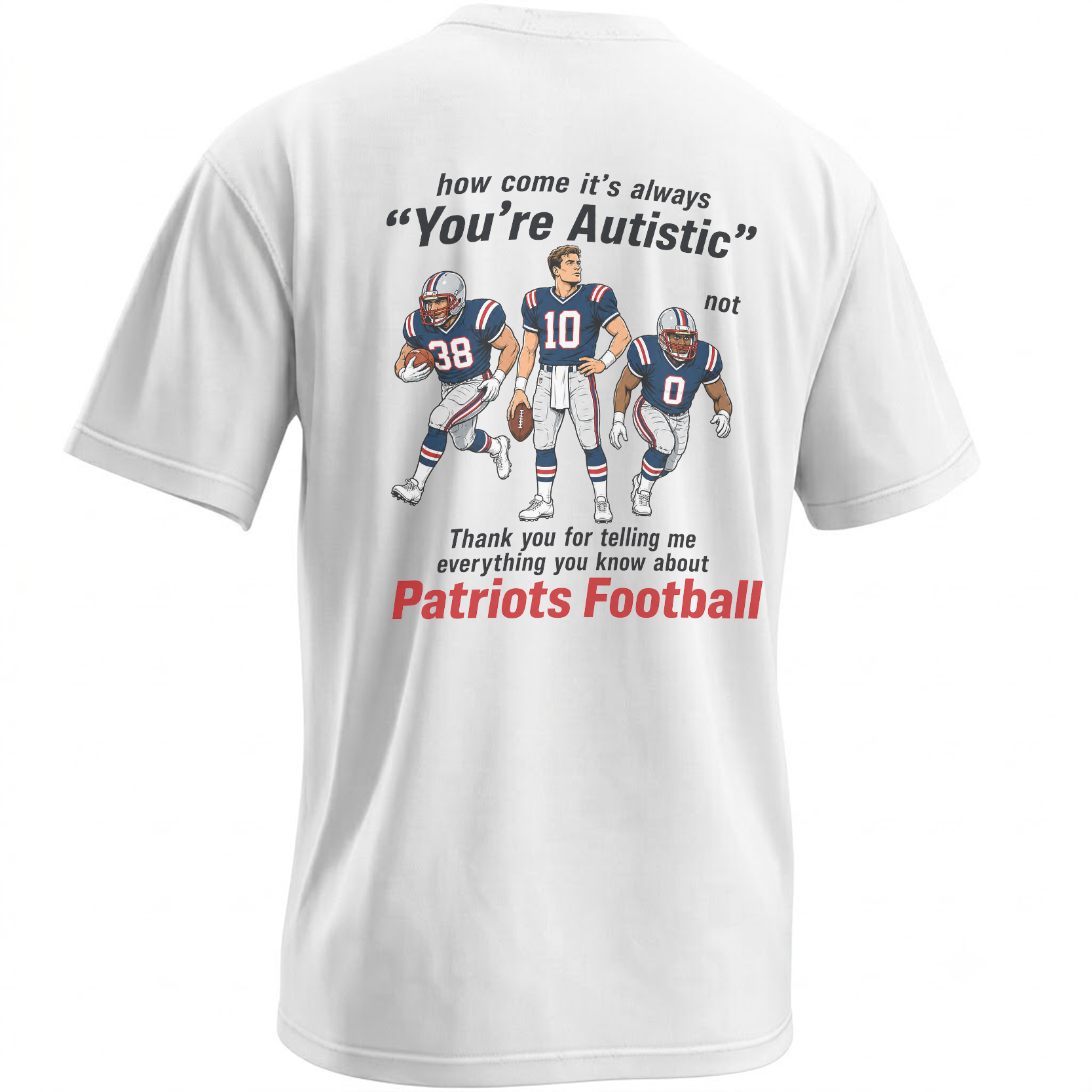
The design places the long sentence around Patriots-style football imagery, making the shirt resemble a fan’s internal monologue printed at full volume. The contrast between the formal team colors and the socially awkward sentence creates the humor.
Navy and red establish the New England association immediately. Player imagery supplies the subject before the full wording is read, while the large text recreates the experience of receiving far more football explanation than expected.
From Online Reclamation to Stadium Humor
The strongest versions of this meme are not built around shame. They allow autistic and neurodivergent people to joke about the difference between how passion feels internally and how it may be received socially.
In that reading, the imagined thank-you matters. It recognizes that sharing a dedicated interest can be an attempt at connection. The fan is not trying to dominate the room; they may be offering the most valuable thing they currently know how to give.
The wider New England Patriots collection records the team-specific jokes, player moments and fan language surrounding Foxborough. The broader NFL collection places the design inside football’s larger culture of detailed argument, ritual and identity.
Frequently Asked Questions
Where did the “How come it’s always you’re autistic” meme come from?
It developed as a reusable online template contrasting a dismissive autism label with gratitude for hearing detailed information about a person’s favorite subject.
Did a Patriots player say this quote?
No verified Patriots player or coach is known to have originated the full sentence. The team version adapts an existing internet meme.
Why does the meme mention autism?
It references the focused and dedicated interests experienced by many autistic people and the social tendency to label those interests instead of engaging with them.
Does knowing everything about football mean someone is autistic?
No. Deep football knowledge alone does not diagnose autism, and autistic people have widely different interests, experiences and communication styles.
Why does the Patriots version work?
New England football has decades of strategy, roster history and fan debate, making it a natural subject for a joke about sharing an enormous amount of specialized knowledge.
The You’re Autistic Patriots design preserves the meme’s central reversal, while the Patriots archive follows the players, arguments and details that give New England fans so much to explain.
You’re Autistic Patriots Football Shirt adapts the viral special-interest meme to New England fandom, turning detailed knowledge about players, strategy and team history into a humorous request for appreciation.