
The Subway Series Still Belongs to All of New York
The Yankees and Mets met again in September 2026, but the phrase “Subway Series” carries far more than one weekend. It holds a century of New York baseball geography, neighborhood loyalty and the idea that the biggest rivalry in town is only a train ride away.
October has already moved the Yankees into a different postseason fight, with New York trying to answer Tampa Bay in the American League Division Series. Yet one of the season’s most distinctly New York chapters happened three weeks earlier, when the Mets crossed town for the latest Subway Series at Yankee Stadium.
The Yankees won two of the three games from September 11 through 13. They opened with a 6–4 victory, absorbed a 12–2 Mets response on Saturday and then took the rubber game 2–0 behind Cam Schlittler’s dominant six innings, Ben Rice’s leadoff homer and Austin Wells’ solo shot.
Those results matter, but the name has always carried more weight than a three-game line score. Few rivalry labels explain a city as efficiently as “Subway Series.” The stadiums change. Players change. The trains, neighborhoods and argument over which New York team owns the city remain.
A Subway Series is never only Yankees versus Mets. It is Bronx versus Queens, family against family and New York arguing with itself.
Why the Name “Subway Series” Is Older Than the Mets
The phrase did not begin with the modern Yankees-Mets rivalry. Long before the Mets existed, New York had three major-league clubs: the Yankees, Brooklyn Dodgers and New York Giants. When two New York teams reached the World Series, supporters could move between ballparks through the city’s transit system, creating the natural description “Subway Series.”
The Yankees repeatedly met the Dodgers and Giants in those all-New York Fall Classics. After both National League clubs left for California, the city lost that exact geography until the Mets arrived in 1962.
The modern crosstown rivalry finally became a regular-season reality when Interleague Play began. On June 16, 1997, the Mets and Yankees played a game that counted at old Yankee Stadium. Three years later, the idea reached its modern peak when both clubs met in the 2000 World Series, the first all-New York Fall Classic since 1956. The Yankees won in five games, but the rivalry acquired a permanent modern reference point.
No year appears on the artwork. That is deliberate. The graphic can belong to the 2000 World Series, the annual Interleague rivalry, the 2026 series or the next Yankees–Mets argument. It behaves like city baseball iconography rather than one-season postseason merchandise.
2026 Made the Rivalry Feel Like a New York Civic Event Again
The September 11 opener carried an emotional layer far beyond standings. It was played on the 25th anniversary of the 9/11 attacks, and Yankee Stadium hosted a pregame remembrance that included former Yankees connected to the city’s 2001 baseball memory.
Derek Jeter, Mariano Rivera, Joe Torre and other members of that era returned as the city marked the anniversary. Brielle Saracini, whose father Victor was the pilot of United Airlines Flight 175, threw a ceremonial first pitch alongside her husband Sean McGuire, who also lost his father on 9/11.
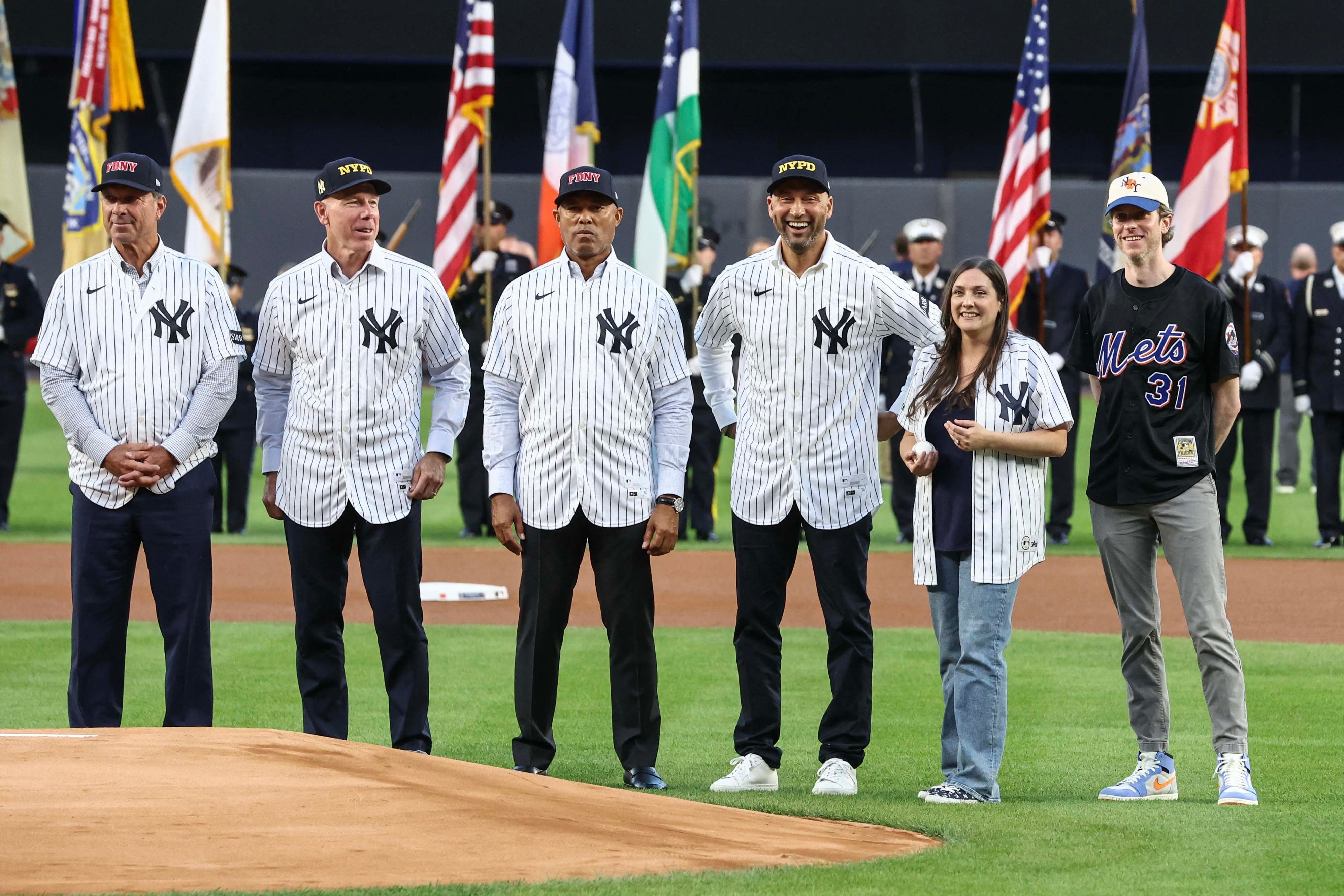
The latest Subway Series opened on a night when Yankees–Mets baseball became part of a larger New York remembrance, reinforcing why the rivalry is inseparable from city identity.
Read the source →The Shirt Turns a Baseball Rivalry Into an NYC Souvenir
That city-first reading explains the Subway Series Shirt better than any individual player statistic.
A huge distressed interlocking NY dominates the composition, clearly establishing the Yankees side of the rivalry. Above it, “Subway Series” appears in worn red athletic lettering. A vintage American League-style eagle crest sits to one side while the Statue of Liberty appears on the other, torch raised inside a circular frame.
Those side symbols are what move the design beyond a basic Yankees logo. The eagle reaches backward into old baseball visual language. Liberty reaches outward toward the city. Beneath everything, flowing New York Yankees script gives the artwork the feel of an old souvenir tee found decades later in a drawer.
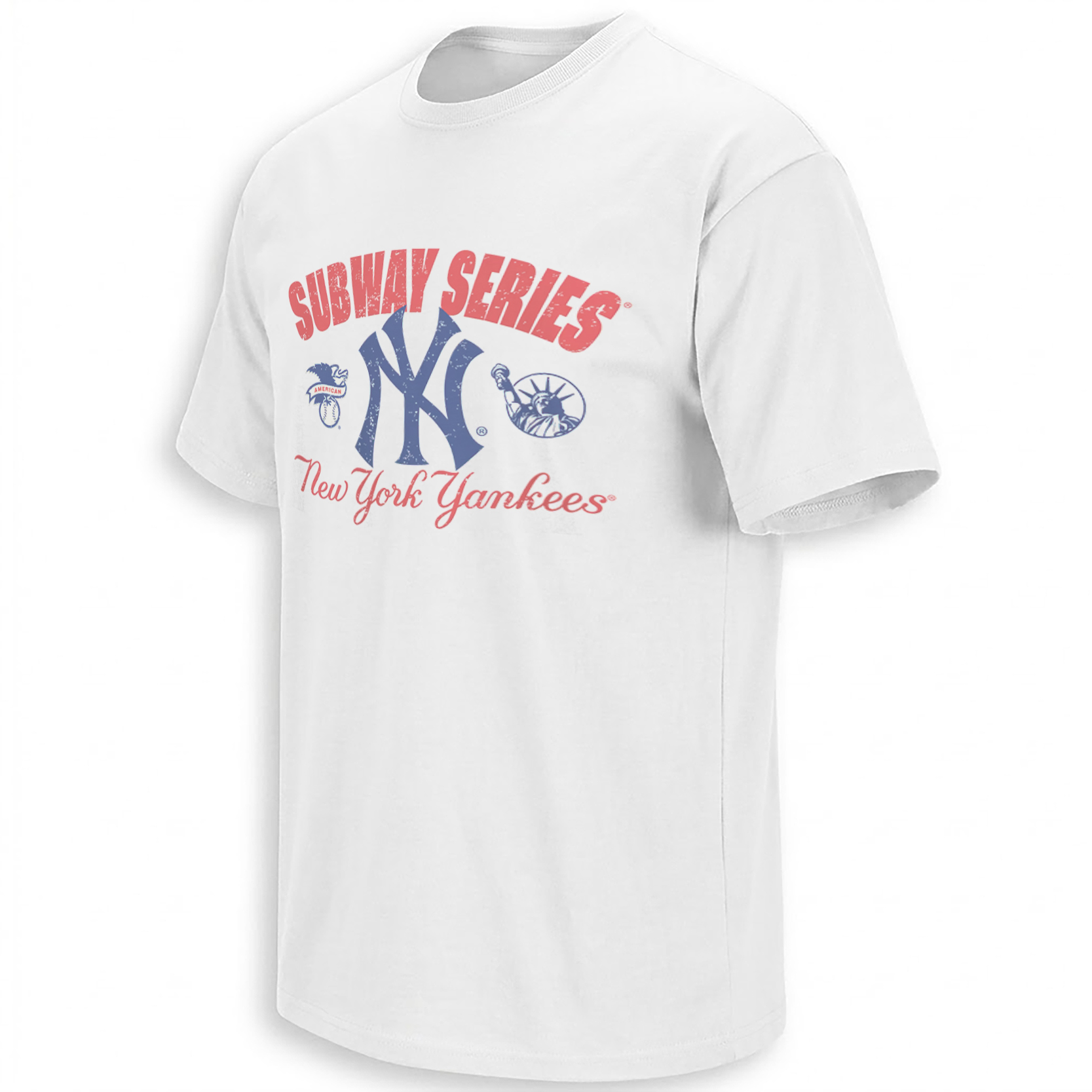
Distressed navy, faded red, Liberty imagery and an oversized Yankees NY turn the crosstown rivalry into a timeless New York baseball artifact.
View the rivalry piece →The Final 2026 Game Gave the Yankees the Last Word
After the Mets hit six home runs in Saturday’s 12–2 blowout, the rubber game offered a sharp reversal. Schlittler gave up only one hit across six shutout innings and struck out eight. Rice homered to lead off the first inning, Wells added another solo shot in the third, and the Yankees bullpen protected a 2–0 finish.
The result gave the Bronx side two victories in three games and pushed the Yankees closer to their eventual postseason berth. It also supplied the kind of rhythm this rivalry repeatedly produces: one club dominates one day, the other responds the next, and New York spends the entire weekend arguing over which result says more.
Why Statue of Liberty Imagery Fits the Subway Series
The Statue of Liberty does something the interlocking NY alone cannot. It makes the graphic legible as New York even to someone who does not know which pitcher started which game.
That matters because the Subway Series is one of the rare sports rivalries defined as much by geography as competition. Both fan bases share the same television market, streets, workplaces and extended families. A Yankees supporter and a Mets supporter can spend the afternoon arguing in Manhattan, board different lines and still reach two major-league ballparks without leaving the city.
The shirt therefore works less like a scorecard and more like a city map reduced to baseball symbols: Yankees NY, Liberty, old league imagery, red and navy, and the name generations of New Yorkers already understand.
The Rivalry Lives Inside a Larger New York Baseball Archive
For the Bronx side of the story, the verified New York Yankees collection holds both current postseason graphics and historical team imagery. The opposing side belongs naturally in Ellie Shirt’s New York Mets collection, while the broader MLB collection connects the Subway Series to the wider culture of rivalry, October baseball and vintage team graphics.
Frequently Asked Questions
What is the Subway Series?
The Subway Series is the traditional name for baseball games between New York City teams, most commonly the Yankees and Mets today, because supporters can travel between their ballparks using the city subway system.
Who won the 2026 Yankees-Mets Subway Series?
The Yankees won two of three games at Yankee Stadium from September 11 through September 13, 2026.
Did the Yankees and Mets ever meet in the World Series?
Yes. They met in the 2000 World Series, with the Yankees winning the championship in five games.
Why is the Statue of Liberty on the Subway Series design?
Liberty expands the graphic from team branding into New York City identity, reinforcing that the rivalry is as much about the city as the two clubs.
Is this specifically a 2026 Subway Series shirt?
No year is printed on the artwork. The design can reference the latest Yankees-Mets series while also connecting to the longer history of New York’s Subway Series tradition.
The Subway Series graphic turns Yankees history, Liberty and crosstown baseball into one undated New York artifact, while the Yankees archive follows the Bronx side from rivalry weekends into October.
Subway Series Shirt celebrates the Yankees side of New York’s crosstown baseball rivalry with a distressed interlocking NY, Statue of Liberty, vintage league imagery and red-and-navy styling connected to both classic history and the 2026 Yankees–Mets series.