
Would Jimothy Be Proud?
A short-bodied raccoon from Ballard became a hometown icon in days. Then the internet gave him a second job: judging our choices with the gentlest possible question.
By July 26, 2026, hundreds of people were gathered in Seattle’s Ballard neighborhood for an official proclamation of “Jimothy Summer.” That is an extraordinary civic ascent for a wild raccoon who had become widely known less than two weeks earlier.
The acceleration was real. Kiana Hall’s July 14 Instagram video—filmed after she encountered the unusually proportioned raccoon during an anniversary walk—approached eight million views. Jimothy then won the Mariners’ Salmon Run at T-Mobile Park, received a Google search animation, inspired artwork and tattoos, and became the subject of a neighborhood celebration.
Yet the most revealing Jimothy meme does not ask where he is going or why he looks that way. It asks, “Would Jimothy be proud?” The phrase turns an unpredictable urban animal into a tiny moral authority, and it explains why this particular internet celebrity has felt unusually comforting.
From one Ballard sighting to Jimothy Summer
Jimothy’s distinctive silhouette appears to result from a congenital spinal condition resembling short-spine syndrome. Washington State University veterinarian Marcie Logsdon explained that the condition can involve shortened or misshapen vertebrae, producing a compressed body shape. Without examining the animal, however, experts cannot responsibly present that explanation as a confirmed diagnosis.
What viewers could see was that Jimothy moved with surprising agility. Older neighborhood footage also appeared to show him as a kit with his mother and siblings. The combination—an unfamiliar body, confident movement and evidence of a cared-for early life—shifted much of the reaction from curiosity toward protective affection.
The hometown response made Jimothy larger than a single viral clip. A neighborhood mural placed him behind a trash bin. Fan art circulated as stickers, prints and handmade tributes. NASA referenced the “iconic raccoon” while sharing a view of Seattle from the International Space Station. The city’s baseball culture folded him into an existing mascot ritual rather than merely posting another meme.
That is how internet fame becomes folklore: the same character appears in search results, sports, local art and ordinary conversation until everybody can understand the reference without seeing the original video.
“Would Jimothy be proud?” works because it replaces online judgment with something softer: pause, picture the raccoon, and try not to make the timeline worse. Ellie Shirt internet culture desk
Why the internet made Jimothy a moral compass
The phrase belongs to a familiar family of jokes: before making a questionable decision, imagine the disappointed face of a person—or creature—you respect. Jimothy is an ideal candidate precisely because he has no known doctrine, platform or expectation. His imagined approval can stand for basic decency without becoming a lecture.
The humor also reverses the normal relationship between people and wildlife. Humans usually decide whether a raccoon is cute, strange, troublesome or worthy of protection. Here, the raccoon evaluates us. A creature once watched from porches becomes the observer; the audience becomes accountable.
In a feed crowded with rage, synthetic perfection and competitive self-presentation, Jimothy’s appeal came from being unpolished and unknowable. He was not performing for the camera. His body did not fit a familiar template. The public’s affection therefore felt like a small vote for eccentric reality over optimized content.
The design turns a meme into a ritual
The graphic treats Jimothy like the illustration in an old field guide or a benevolent woodland emblem. The phrase is not simply a caption beneath a viral animal. Its stacked hierarchy creates a sequence: instruction first, pause second, judgment last. Reading the shirt reenacts the mental ritual it describes.
That is why the question format matters. “Jimothy is proud” would close the joke. “Would Jimothy be proud?” leaves a tiny gap for self-examination. The design can accompany an impulsive purchase, a reckless text message or the decision to leave wildlife alone. Its usefulness is imaginary, but its moral rhythm is real.
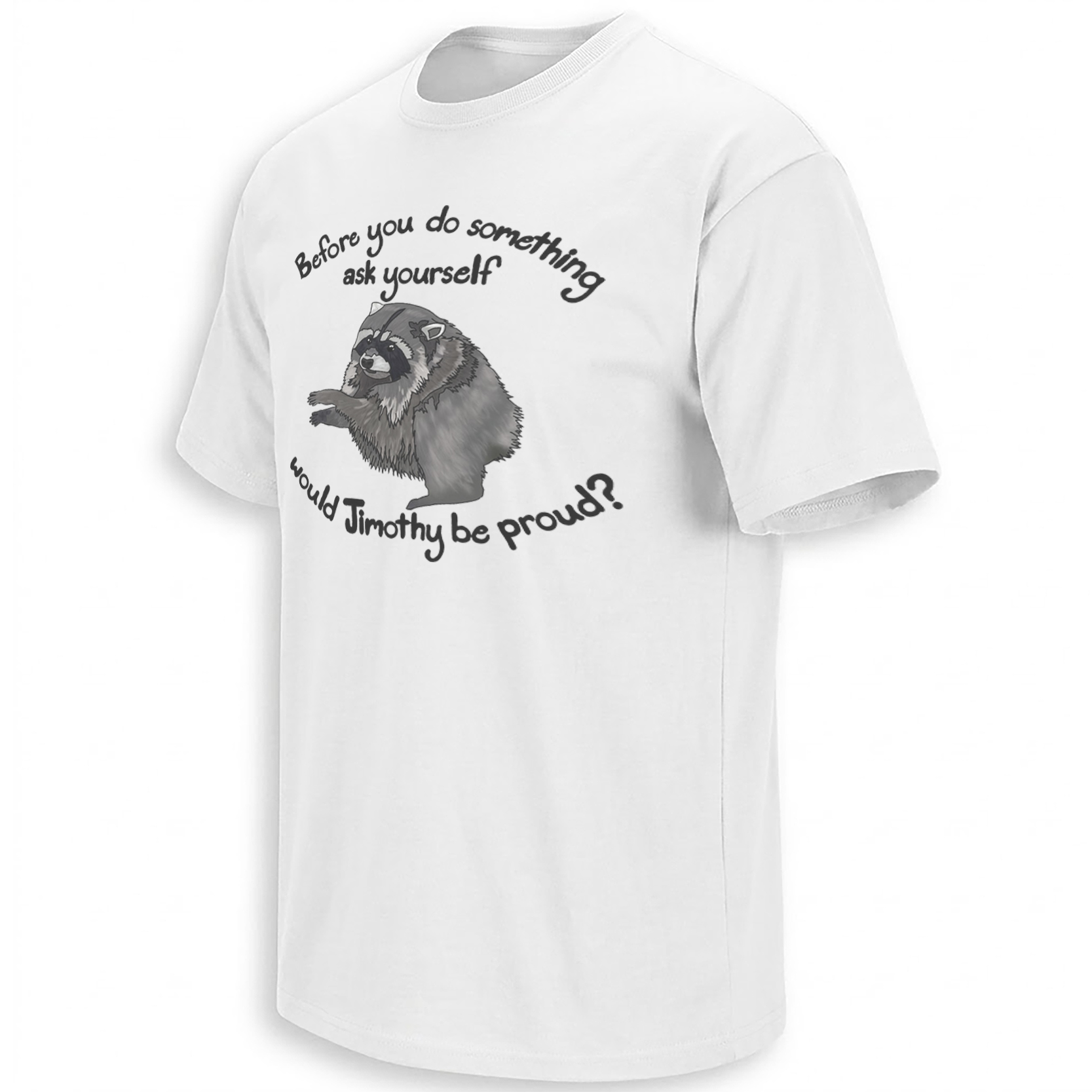
Would Jimothy Be Proud Shirt
The design records the moment Jimothy stopped being only a viral sighting and became a question people could carry into everyday decisions.
View the piece →A hopeful meme, with one important limit
Viral-animal fame is always complicated. Audiences can transform a living creature into a character faster than they learn what that creature needs. Jimothy’s image has already crossed into commerce, politics, games and institutional accounts. None of those versions can speak for the animal itself.
The best Jimothy culture recognizes that tension. It celebrates his survival and singular appearance without treating access to him as a public entitlement. The imagined Jimothy may function as Seattle’s mascot, Google animation or gentle conscience. The real raccoon still deserves space to move through Ballard without being chased by his own celebrity.
That distinction gives the wider Jimothy collection and the broader raccoon archive their clearest editorial purpose: preserving the visual language of “Jimothy Summer” while the actual animal remains free and wild. The newest collection places the meme beside other fast-moving cultural timestamps.
Why this little question may outlast the trend
Google animations disappear. Meme cycles move on. Civic proclamations become artifacts of a specific summer. But a phrase can survive when it performs a useful social function.
“Would Jimothy be proud?” is reusable because it converts affection into behavior. It asks people to carry the tenderness they feel toward an unusual raccoon into the next decision they make. That may be absurd, but internet language often becomes memorable by hiding a sincere idea inside a joke.
Jimothy did not choose to become a symbol of optimism, Seattle strangeness or resistance to doomscrolling. The culture built those meanings around him. The least it can do in return is make its moral compass point toward kindness—and keep a respectful distance.
Reporting and source notes
- ABC News: Jimothy’s viral rise, veterinary context and wildlife guidance
- FOX 13 Seattle: Ballard’s official “Jimothy Summer” celebration
- MLB.com: Jimothy wins the Mariners’ Salmon Run
- Axios Seattle: Google’s Jimothy Easter egg and activation count
- The Guardian: Jimothy fan culture, art and Seattle folklore
Frequently asked questions
What does “Would Jimothy be proud?” mean?
It is a playful moral-check meme: before making a questionable decision, imagine whether Seattle’s beloved viral raccoon would approve. The humor turns Jimothy into a gentle, fictional conscience.
Who is Jimothy the raccoon?
Jimothy is a wild raccoon seen around Seattle’s Ballard neighborhood whose unusually short, rounded body made him a viral sensation in July 2026. His appearance is believed to resemble short-spine syndrome, although no diagnosis has been confirmed through an examination.
What was “Jimothy Summer”?
“Jimothy Summer” was the name fans and Seattle officials gave the raccoon’s rapid rise into local folklore. On July 26, 2026, a Ballard gathering marked an official city proclamation celebrating the phenomenon.
Should people approach or feed Jimothy?
No. Public-health and veterinary experts advise people to enjoy Jimothy from a distance, avoid feeding or cornering him, and remember that he is a wild animal rather than a pet or public attraction.
Would Jimothy Be Proud Shirt turns Seattle’s beloved viral raccoon into the internet’s gentlest moral compass. The design preserves the humor, kindness and local folklore of Jimothy Summer 2026.