
Woodward Pistons: Where Detroit Basketball Meets the City’s Most Famous Street
From championship parades to Little Caesars Arena and independent basketball commentary, Woodward Avenue carries a story that makes the name Woodward Pistons uniquely Detroit.
Some streets are simply addresses. Woodward Avenue is something closer to a public record of Detroit’s history, and professional basketball is part of that record.
On October 20, 2026, the Detroit Pistons opened another NBA season with heightened expectations after a remarkable transformation that produced 60 regular-season victories in 2025–26. The city’s basketball conversation is no longer dominated by rebuilding projections. Supporters are discussing what comes after a breakthrough.
That renewed energy makes Woodward a timely symbol. The avenue connects the modern Pistons’ downtown home to memories of their championship generations, while the Woodward Pistons name also evokes Detroit’s independent sports-media community.
Two EllieShirt graphics capture these connections differently: one resembles an intersection of street signs; the other strips the concept back to a horizontal wordmark. Both draw from a real relationship between basketball and the city.
Why Woodward Avenue Matters to Detroit Basketball
Woodward Avenue is one of Detroit’s defining thoroughfares. Its M-1 designation, automotive associations and central position in the city’s geography have helped make the name recognizable well beyond Michigan.
For basketball supporters, the connection is unusually concrete. Little Caesars Arena, home of the Detroit Pistons since 2017, stands at 2645 Woodward Avenue. The street is therefore not an abstract reference added to a shirt for local flavor. It is part of the team’s actual modern address.
When the franchise moved from The Palace of Auburn Hills to downtown Detroit, the transition helped restore the Pistons’ daily geographical connection with the city’s central entertainment district. Supporters traveling to games could once again associate the franchise with downtown streets, restaurants, public transportation and surrounding neighborhoods.

The scene explains the design’s appeal better than a generic basketball court could. Woodward is the physical setting through which supporters approach the arena, and its name already carries a century of urban associations.
The Championship Parades That Made Woodward Basketball History
Woodward’s connection to the Pistons predates their downtown arena by decades. After the Bad Boys won NBA championships in 1989 and 1990, Detroit held public celebrations that turned its central streets into gathering places for thousands of basketball supporters.
The Detroit Historical Society preserves footage from the June 18, 1990 championship parade along Woodward Avenue. Its archive documents supporters lining barricades, marching bands, championship imagery near the Fox Theatre and Pistons personalities moving through the route.
This is particularly valuable historical evidence because it connects the street directly to the franchise’s second consecutive championship, rather than simply relying on vague memories of old downtown celebrations.
Those titles were built around players including Isiah Thomas, Joe Dumars, Dennis Rodman and Bill Laimbeer. Their physical defense and distinctive personalities made the Bad Boys one of the most recognizable teams in league history.
Woodward offered the city a place to celebrate that identity collectively. The parade route linked famous athletes with residents who had followed the team through earlier seasons, creating civic memories that extended far beyond the games themselves.
Historical archive: Detroit Historical Society — Pistons Championship Parade, June 18, 1990. The original archive contains historic parade footage and a detailed description of celebrations along Woodward Avenue.
Woodward Pistons Is Also a Modern Sports-Media Identity
There is a second layer to the Woodward Pistons name that a purely historical explanation would miss.
Woodward Sports Network launched in 2020 as a Detroit-centered digital sports-media organization, building programming around the city’s teams through live discussions, interviews, podcasts and online video.
Its Woodward Pistons coverage brought local basketball conversation into a digital environment. Contributors associated with the platform have included Brandon “DetroitKoolAid” Dent, Jeff Iafrate and Detroit basketball journalist Rod Beard.
This distinction is important. Woodward Pistons is not simply an invented combination of a road name and an NBA team. The name also belongs to a recognizable part of Detroit’s contemporary sports-media ecosystem.
The broader shift reflects how basketball fandom works today. Supporters do not depend entirely on television broadcasts or newspapers to discuss a game. They follow independent analysts, debate roster decisions, watch postgame reactions and build communities around local personalities.
That digital conversation gives the Woodward name a new function: a place where Detroit basketball is discussed, not only a location where games are played.
Readers can explore the network’s published basketball coverage through Woodward Sports Network. The EllieShirt graphics are independent fan-inspired designs; they are not presented here as official network or Pistons merchandise.
Two Graphics, Two Interpretations of the Same Detroit Identity
The two Woodward Pistons designs approach the same cultural reference from different directions.
The first uses an intersection of blue-and-white street signs, one labeled WOODWARD and the other PISTONS, with small red flame accents. The result resembles a piece of municipal wayfinding reimagined through basketball.
The second takes a more restrained approach. A horizontal wordmark places the two names together with a small street-sign emblem, making the composition closer to independent sports-media branding than traditional souvenir artwork.
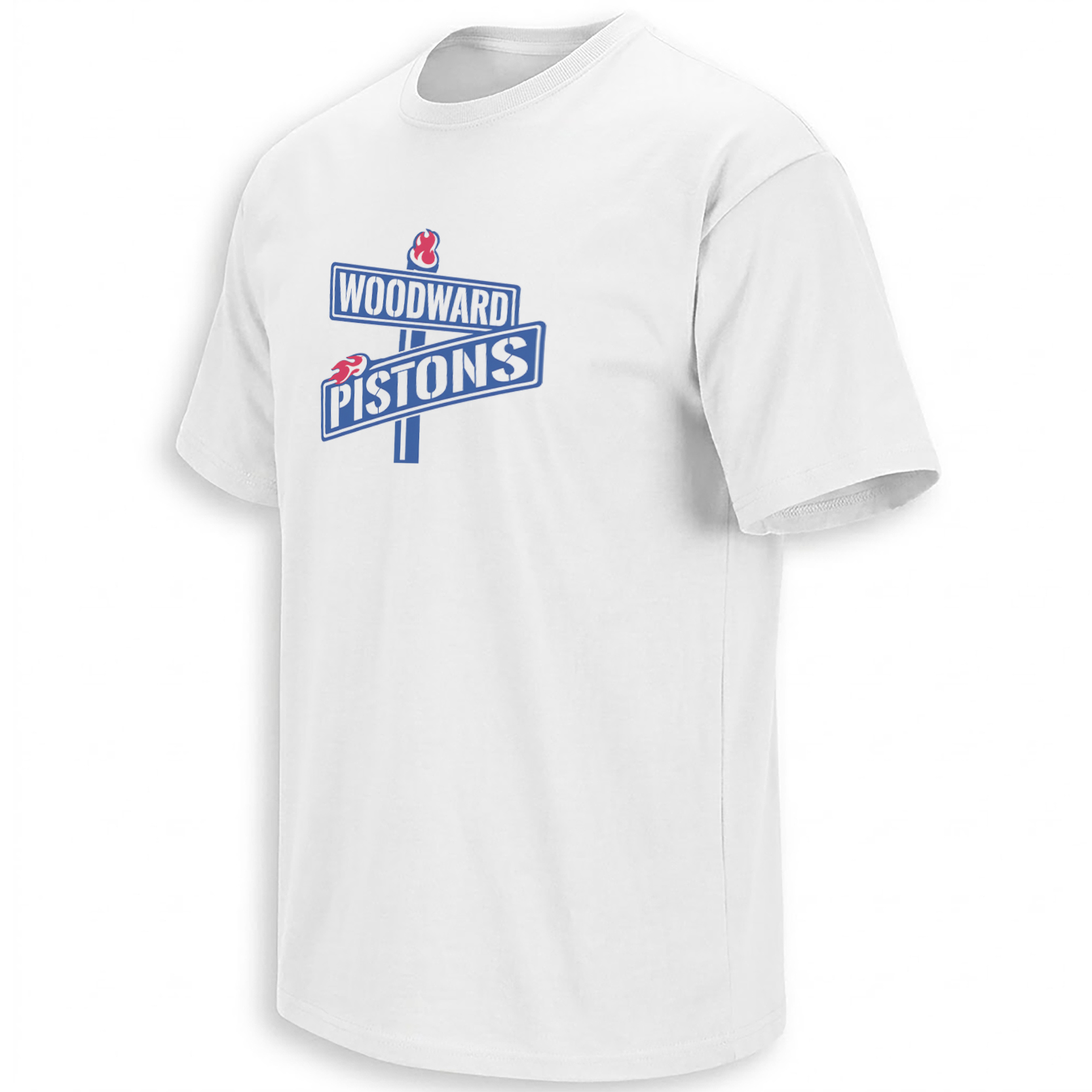
An intersection-inspired graphic linking the city’s famous avenue with its basketball identity.
View the street-sign design →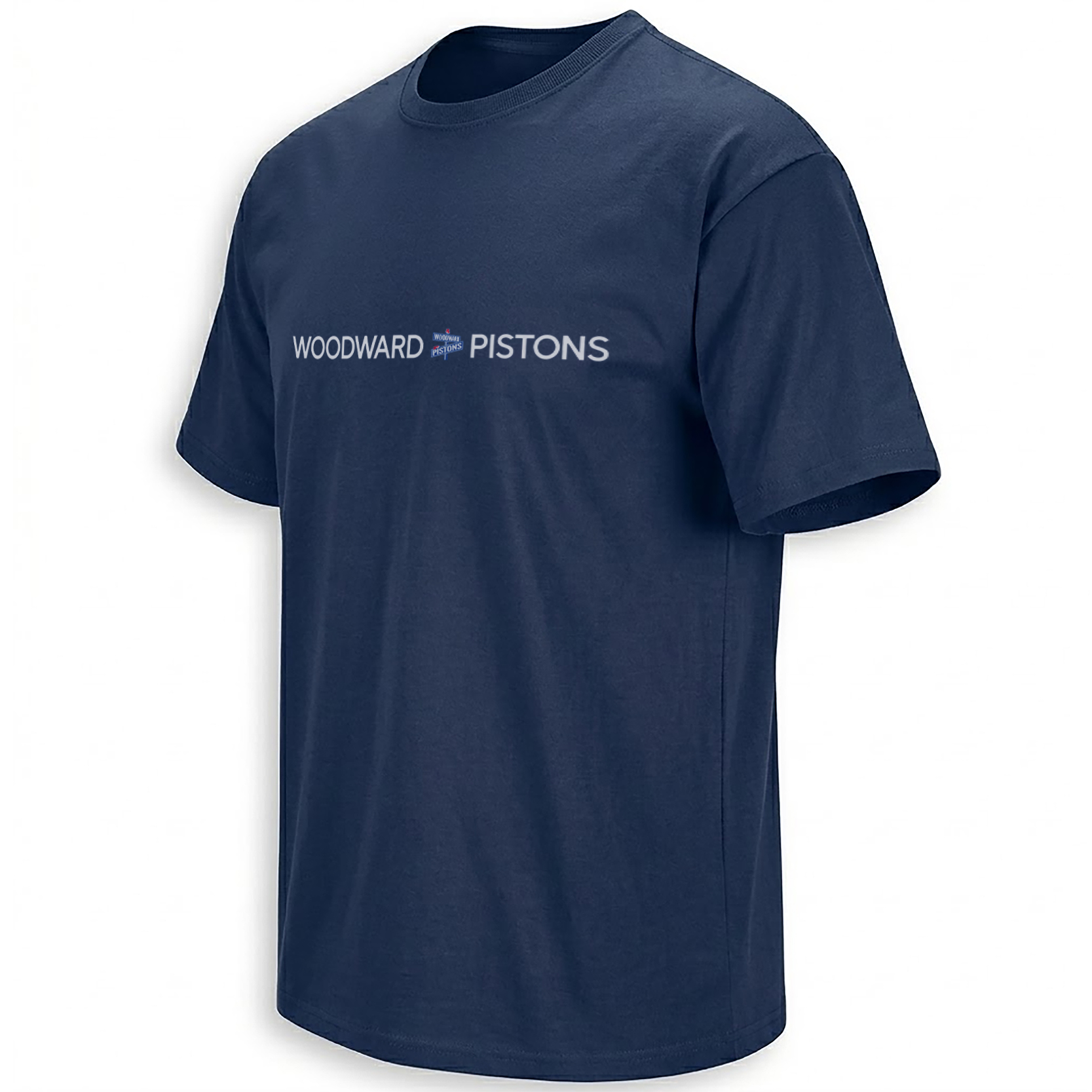
A quieter interpretation of Detroit basketball and its independent sports-media culture.
Explore the wordmark →Why Street Signs Work as Sports Graphics
Street signs have a visual advantage: people recognize their function instantly. They identify location, direction and the boundaries of familiar places without needing long explanations.
In sports culture, those qualities translate naturally into symbols of belonging. A street name can evoke a neighborhood, an arena, a hometown or a route supporters have traveled for years.
The Woodward Pistons street-sign design uses that shared visual language. Blue-and-white rectangular forms create the appearance of everyday civic infrastructure, while their unexpected pairing converts the familiar sign into a basketball statement.
The minimalist version works differently. Its emphasis on typography and a small emblem makes the design feel closer to a media identity, where recognition comes from the name itself rather than a large illustration.
Both approaches rely on the same underlying principle: Detroit basketball is a geographical identity as much as a team affiliation.
Why Woodward Feels Relevant Again in 2026
The Pistons enter the 2026–27 season in a dramatically different position from their rebuilding years. Following a 60-win campaign in 2025–26, expectations have shifted from simply becoming competitive to proving that their improvement can last.
Cade Cunningham, Jalen Duren and Ausar Thompson remain central to the team’s developing identity. The wider basketball conversation now concerns consistency, postseason progress and the challenges of facing opponents who no longer underestimate Detroit.
That increased attention also creates new opportunities for local sports-media voices. A successful team generates more detailed analysis, more disagreement and more emotionally invested discussion.
Woodward Sports and other Detroit-focused outlets operate within that environment. Their value to supporters comes from maintaining a continuous local conversation rather than appearing only for the biggest nationally televised games.
The geographic and media meanings of Woodward therefore reinforce each other. One is the route to the arena; the other is part of the conversation surrounding the franchise.
EllieShirt’s Detroit Pistons collection preserves different expressions of that fan culture through historical references, current team language and graphic interpretations. The broader NBA collection places Detroit’s identity alongside the traditions and visual histories of other basketball cities.
Fans particularly interested in the team’s current leading figure can also explore related Cade Cunningham designs.
Frequently Asked Questions
What is Woodward Pistons?
Woodward Pistons refers to a Detroit basketball-media identity associated with Woodward Sports Network. The name also connects naturally to Woodward Avenue, the historic street where Little Caesars Arena is located.
Why is Woodward Avenue important to the Detroit Pistons?
Woodward Avenue hosted celebrations associated with the franchise’s championship era, including the documented 1990 Pistons parade. The team’s current arena is also located at 2645 Woodward Avenue.
When did the Pistons move to Little Caesars Arena?
The Detroit Pistons began playing at Little Caesars Arena in 2017 after leaving The Palace of Auburn Hills.
What is the difference between the two Woodward Pistons designs?
The street-sign version uses intersecting blue-and-white road signs with red accents, while the minimalist version uses a horizontal Woodward Pistons wordmark and a small street-sign emblem.
Is Woodward Pistons an official Detroit Pistons team name?
No. The NBA franchise is the Detroit Pistons. Woodward Pistons is a basketball-media and fan-culture reference rather than an official alternate team name.
The Woodward Street Sign and Woodward Minimalist Wordmark designs connect Detroit’s physical landscape, basketball memories and contemporary sports conversation through two distinct visual approaches.
Woodward Pistons connects Detroit’s historic Woodward Avenue, the Pistons’ championship parade history, Little Caesars Arena and Woodward Sports culture through two street-inspired basketball graphics: an intersecting road-sign design and a minimalist wordmark.