
“If You’re Scared, Go to Church” Will Stein’s Kentucky Revolution
A defiant March radio quote became the soundtrack to a remarkable October: two overtime gambles, two conversions and a road victory that pushed Kentucky to 6–1.
Will Stein had not coached a regular-season game at Kentucky when he delivered the line that would come to define his early identity in Lexington. On March 9, 2026, Kentucky Sports Radio host Matt Jones questioned the difficulty of the Wildcats’ upcoming SEC schedule. Stein did not offer a cautious assessment. He challenged the fear itself.
“If you’re scared, go to church, bro.” The remark was funny, confrontational and perfectly suited to college football’s highlight-driven internet. It supplied Big Blue Nation with a coach who sounded eager to confront opponents that had often made Kentucky’s schedule intimidating.
By October 19, those words carried different weight. Kentucky had won consecutive overtime games against South Carolina and No. 10 LSU by choosing to attempt game-ending two-point conversions. Then Stein’s Wildcats went to Norman and defeated Oklahoma 21–13, improving to 6–1. A March soundbite now had an October story behind it.
What Did Will Stein Mean by “If You’re Scared, Go to Church”?
Stein was responding to Matt Jones’s concerns about Kentucky’s difficult 2026 schedule. The March 9 conversation, covered by Kentucky Sports Radio on On3, centered on the demands of playing in the SEC, including games against Alabama, LSU, Texas A&M and other major programs.
His answer suggested an approach rather than a prediction. Tough competition was not something Kentucky could negotiate away. The coach wanted his players and supporters to embrace it.
The phrase did not originate as a religious appeal. In context, it was colloquial locker-room humor: if the schedule frightens you, football might not be the place to hide. That confrontational tone made the sentence easy to repeat, paraphrase and adapt into Kentucky fan graphics.
Original interview: Will Stein Talks with Matt Jones & KSR →
Why Did Stein’s Two-Point Decisions Change the Meaning of the Quote?
On October 3, Kentucky found itself 17 points behind South Carolina before mounting a comeback. The game eventually reached overtime, where quarterback Kenny Minchey connected with Henry Boyer for a touchdown. An extra point could have extended the game. Stein instead sent the offense out to win it.
Minchey delivered a conversion pass to Willie Rodriguez, completing a 35–34 victory. Kentucky Athletics described it as the program’s largest comeback from a road deficit.
One week later, the circumstances were remarkably similar. Against tenth-ranked LSU on October 10, Kentucky scored in overtime and faced another one-point deficit. Once again, Stein rejected the conventional extra point. This time Minchey scored on a quarterback draw, sealing a second 35–34 victory.
In March, Stein said he wasn’t afraid. In October, he kept choosing the play that left no room for a second chance.
Ellie Shirt Editorial AnalysisThose moments made the preseason expression feel unusually relevant. A coach’s attitude had become visible through identifiable game decisions. The official LSU recap confirms the crucial details of that second conversion.
What Happened in Kentucky’s October 17 Win at Oklahoma?
The narrative continued in Norman. Kentucky entered the game ranked No. 15 and came away with a 21–13 victory over Oklahoma, becoming bowl eligible in Stein’s debut season. The Wildcats were 6–1 overall and 4–1 in SEC play afterward.
That game was not another two-point showcase. Kentucky needed a strong defensive finish, with Jordan Castell returning a late interception for a touchdown and Ty Bryant helping seal the result with another pick. It demonstrated that Kentucky’s early success was not dependent on repeating exactly the same dramatic play.
The Kentucky Athletics Oklahoma recap placed the win within a broader season of rapidly changing expectations. Stein’s confidence now had a record that demanded attention, although future SEC opponents would continue testing its limits.
Who Is Will Stein? The Coach Behind Kentucky’s New Attitude
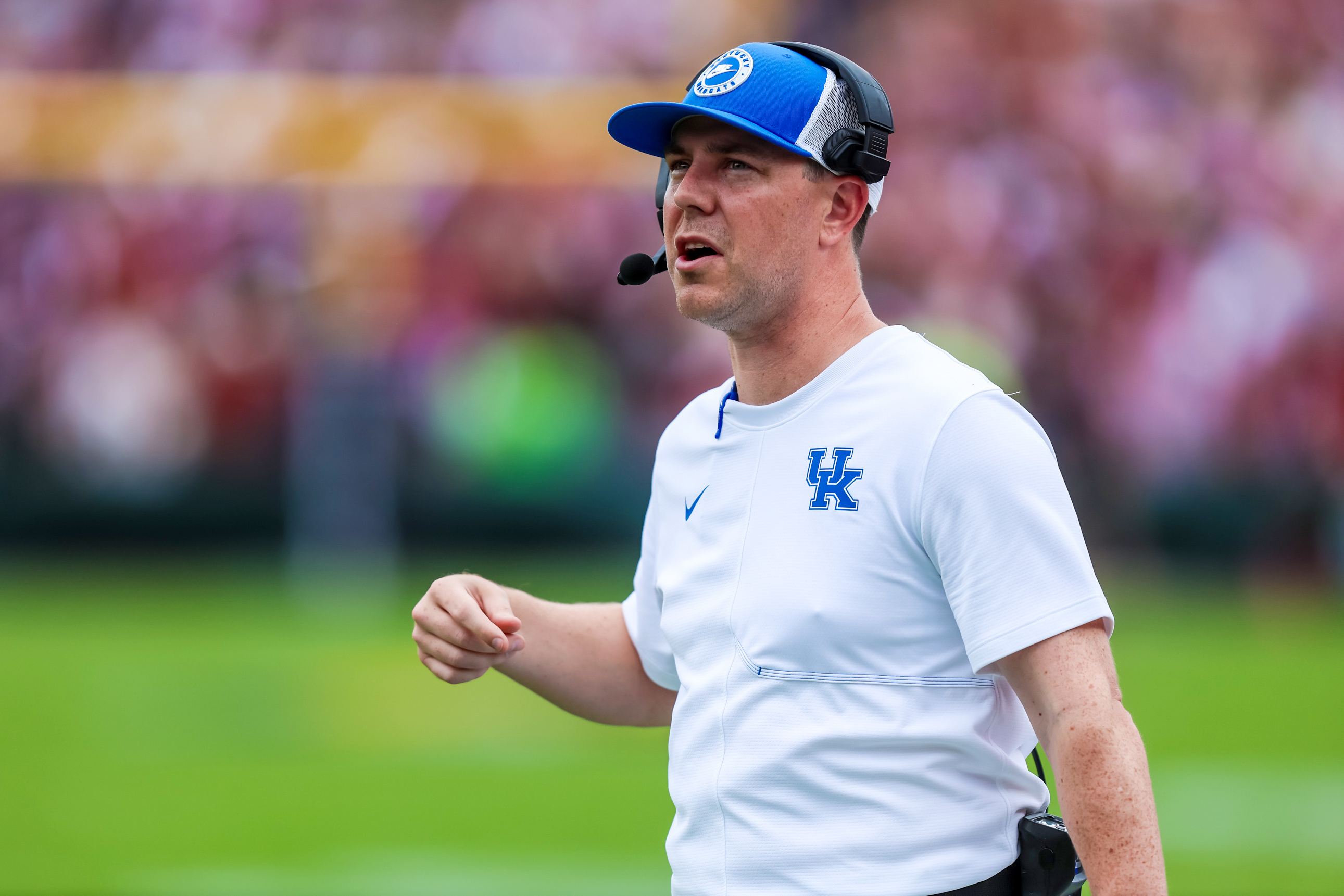
Stein arrived at Kentucky after building his reputation as an offensive coordinator, including his work with Oregon. His return to the Commonwealth added a personal dimension: he grew up connected to Kentucky sports culture, and his first head-coaching opportunity put him in charge of a program trying to establish a new identity.
His public manner is direct, energetic and comfortable with the language of competition. The church quote became a memorable example because it compressed that personality into one short exchange.
Why Does the Two-Finger Gesture Matter in the Will Stein Design?
The EllieShirt graphic turns Stein into an immediately recognizable sideline character. He wears a headset, cap and hooded top, raising two fingers while the slogan appears beneath the illustration.
The image is deliberately simplified. Light-gray portrait lines contrast with a royal-blue background, while dark outlines define the expression and microphone. The overall result resembles an old sports-newspaper drawing adapted for modern fan culture.

An illustrated Kentucky coaching portrait that pairs Stein’s March remark with the fearless decision-making associated with his October victories.
View the graphic →The raised two fingers offer an especially useful visual connection. They can be read as a reference to Kentucky’s consecutive game-winning two-point attempts. That is an interpretation of the illustration, not a claim that it reproduces a verified gesture from either victory.
The restrained palette keeps the focus on character rather than statistics. The headset identifies Stein as a decision-maker; the fingers echo Kentucky’s bold October calls; the small slogan supplies the soundbite that gives the image its cultural context.
Why Has Big Blue Nation Embraced This Quote?
Kentucky football supporters know how quickly optimism can become pressure during an SEC season. The new coach’s words did not promise an unbeaten year. They gave fans a memorable response to anxiety about the teams ahead.
After wins over South Carolina, LSU and Oklahoma, the phrase feels less like simple bravado and more like a marker of Kentucky’s early 2026 identity. The fan reaction is understandable: two decisive conversion calls are precisely the kind of moments supporters will remember long after routine possessions have been forgotten.
Those moments sit naturally within EllieShirt’s Kentucky Wildcats Football collection. Related team imagery also appears in the Kentucky Wildcats collection, while the broader NCAA archive connects the story with the culture of other college programs. Readers following the coach specifically can explore the Will Stein design search.
Frequently Asked Questions
When did Will Stein say “If you’re scared, go to church”?
He used the expression during a March 9, 2026, Kentucky Sports Radio interview while discussing the Wildcats’ challenging SEC schedule.
Why did Kentucky go for two against South Carolina and LSU?
Stein chose to attempt decisive two-point conversions in overtime rather than extend each game. Both attempts succeeded and Kentucky won 35–34.
What does the two-finger gesture on the design mean?
The illustration can be interpreted as a visual reference to Stein’s two successful overtime conversion decisions, although it does not identify a specific play.
What was Kentucky’s record after beating Oklahoma?
Kentucky improved to 6–1 overall after defeating Oklahoma 21–13 on October 17, 2026.
Stein’s early Kentucky story connects a memorable radio exchange with a series of ambitious football decisions. The If You’re Scared, Go to Church design preserves that combination of personality, two-point courage and Big Blue Nation’s 2026 optimism.
Will Stein’s “If You’re Scared, Go to Church” graphic captures Kentucky’s 2026 football identity through his viral March quote, illustrated two-finger gesture and consecutive overtime conversion victories. A visual reminder of Big Blue Nation’s fearless new coaching era.